YOUR COFFEE KEEPS GOING COLD — AND THE EMBER MUG 2 ISN’T A FIX FOR EVERYONE WHO HAS THAT PROBLEM
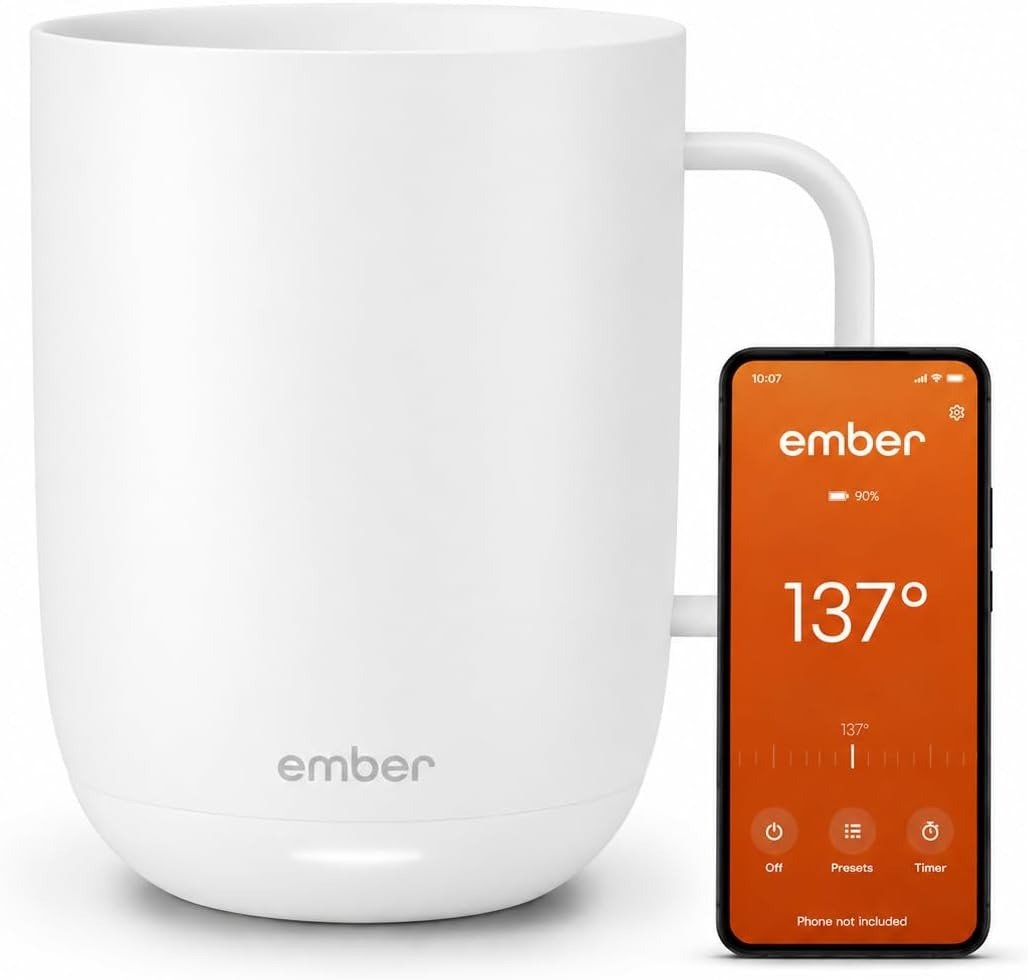
EMBRER MUG 2
The Result Looks Fine. The Frustration Isn’t
You pour a full mug. It’s perfect. You get pulled into something — a call, a paragraph, a problem that needed three minutes and took twenty. You come back. The coffee is somewhere between disappointment and room temperature.
You’ve done this hundreds of times. Reheated it in the microwave. Tasted the flatness. Told yourself you’d drink it faster next time.
You didn’t.
That’s not a discipline problem. That’s a structure problem — and it’s the exact gap the Ember Mug 2 was designed to close. But it only closes it under specific conditions. Understanding those conditions is the difference between “life-changing” and “expensive regret.”
The product has nearly 20,000 reviews on Amazon averaging 4.1 stars. The 5-star reviews and the 1-star reviews describe entirely different experiences — and they’re often using the exact same mug.
That split doesn’t happen because some units are defective. It happens because two different types of drinkers bought the same object expecting the same outcome.
What You’re Actually Feeling but Not Naming
The irritation isn’t really about cold coffee.
It’s the specific texture of a morning that keeps fragmenting before you finish anything in it. You sit down to drink, you get interrupted, you return to something that no longer rewards the return. There’s a small cost each time — not dramatic, but cumulative. The pleasure of the thing you were looking forward to simply isn’t there when you get back to it.
Most people manage this in one of three ways: they chug the first half before it cools, they microwave it twice a morning and accept the flavor loss, or they quietly adjust their standards downward and stop expecting the last sip to be anything.
None of those are solutions. They’re surrenders to a friction that has an actual mechanical fix — under the right conditions.
The Ember Mug 2 doesn’t make your coffee hotter. It holds a precise temperature — between 120°F and 145°F — and maintains it actively, using a built-in heating element that responds to real-time thermal data from four internal sensors. The outside of the mug stays cool. The liquid inside holds the exact degree you set, indefinitely when on its charging coaster.
That’s not a warmer. That’s a different category of object.
The Hidden Mechanism Behind the Miss
Here’s what most buyers don’t understand before they purchase, and what explains both the ecstatic reviews and the bitter ones.
The Ember Mug 2 is not a reheating device. It is a temperature-maintenance device. If your coffee arrives at 170°F from a drip machine and you pour it in, the mug will cool it down to 145°F — its ceiling — within a few minutes. The mug’s job begins at that point. Everything above 145°F, it actively works against you.
This is by design. The temperature ceiling isn’t a flaw — it reflects where the research on coffee actually lands. A 2008 study published in Fire and Materials identified the optimal drinking temperature as approximately 136°F, with a preferred range of 130°F–140°F for the overwhelming majority of drinkers. A peer-reviewed study in the Journal of Food Science (2019) confirmed this, finding the optimum consumption range at roughly 130°F–140°F. UC Davis research found 65% of participants rated 140°F–144°F as “just about right.”
The Ember’s range maps precisely onto the science of where flavor and comfort converge. What it doesn’t map onto is the psychological expectation that “hot coffee” means scalding coffee.
If you are the type of drinker who wants black coffee at 165°F, who pours it directly and drinks it in under fifteen minutes, the Ember Mug 2 is genuinely not your product. It will feel like an expensive mechanism for cooling down your coffee to a temperature you consider lukewarm. That’s not a malfunction — it’s a mismatch.
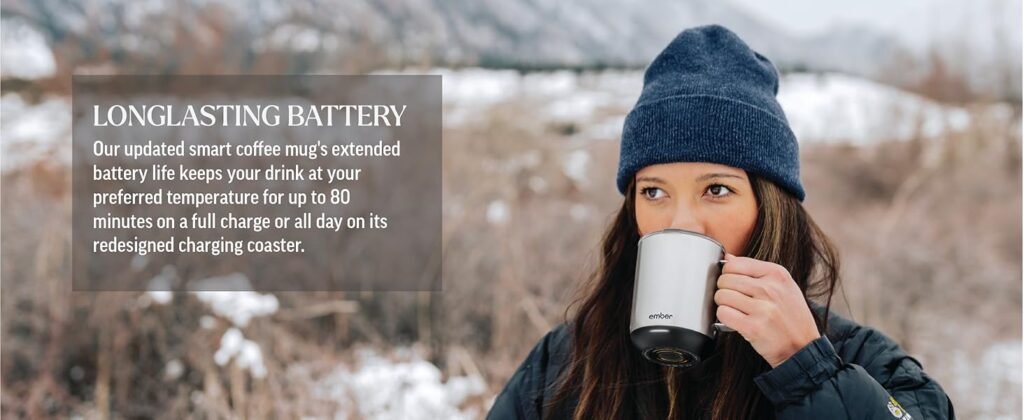
The second hidden mechanism is the charging coaster. Off the coaster, the 10 oz version holds temperature for up to 90 minutes on battery. The 14 oz version, 80 minutes. These numbers are real for drinks poured in hot. In a room-temperature environment, they hold. In a cold environment, they fade faster. The coaster converts the mug from a portable device into an indefinite desk system — which is how the majority of devoted users actually use it.
The mug isn’t wireless freedom. It’s a desk companion with the option of 80–90 minutes of autonomy.
| Feature | Ember Mug 2 — 10 oz | Ember Mug 2 — 14 oz |
|---|---|---|
| Battery life (off coaster) | Up to 90 min | Up to 80 min |
| Temperature range | 120°F – 145°F | 120°F – 145°F |
| With charging coaster | All-day | All-day |
| Best for | Pour-over, espresso drinks, smaller pours | Standard drip coffee, lattes, larger fills |
| Default temp (without app) | 135°F | 135°F |
| Hand-wash only | Yes | Yes |
| Can reheat cold liquid | No (only maintains hot liquid) | No (only maintains hot liquid) |
The Threshold Where the Outcome Quietly Breaks
There’s a specific point at which the Ember Mug 2 stops performing its core function — and it’s not a hardware failure. It’s a behavioral one.
The mug wakes when it detects liquid. It enters sleep mode after two hours of inactivity or when empty. If you pour cold milk in first and then add coffee, the mug may misread the temperature baseline. If you pour a drink that starts below 100°F, it will not heat it up to your target — it lacks the power to warm a cold liquid efficiently, and attempting to do so consumes the entire battery.
These aren’t edge cases. They’re common behaviors for people who assume a smart mug can also be a reheating device.
The other threshold is the app. Without the Ember app connected, the mug defaults to 135°F and remembers its last manual setting. The app is iOS and Android compatible and allows precision temperature control, presets for different drinks, an LED color for the indicator light, and a steep timer for tea. For most users who set it once and forget it, the app dependency vanishes after week one. For users who have experienced the Bluetooth disconnection bug — which appears in multiple user reports across platforms — re-pairing every few days is a real and recurring friction point.
| Use Case | Ember Performs | Ember Fails |
|---|---|---|
| Desk worker with charging coaster | ✅ All-day precision temp | — |
| Slow sipper, 90+ min sessions | ✅ Holds across long sessions | — |
| Coffee brewed hot (170°F+), cooled to range | ✅ Maintains from that point | — |
| Off-coaster portability, 1-2 hours | ✅ Battery holds | — |
| Black coffee drinker, prefers 160°F+ | — | ❌ Ceiling is 145°F |
| Fast drinker, finishes in 15 min | — | ❌ Overkill at any price |
| Reheating cold or room-temp coffee | — | ❌ Not designed for this |
| Outdoor, car, commute use | — | ❌ Wrong product category |
| Dishwasher use | — | ❌ Hand-wash only |
Why Most Buyers Misread This Too Early
The comparison that kills the most purchase decisions is the insulated mug comparison.
“A Zojirushi keeps my coffee hot for six hours. Why would I spend $130 on something that lasts 80 minutes and needs to be charged?”
It’s a reasonable comparison if hot coffee is the only goal. But insulated mugs don’t maintain a temperature — they slow the drop. By the time your Zojirushi is at a drinkable 140°F, it passed through 165°F, 158°F, 150°F on its way down. The window where the flavor is exactly where you want it is narrow and random. You catch it if you’re paying attention.
The Ember holds you at 135°F — or wherever you set it — and keeps you there. That is a mechanically different experience. Not objectively better for every person. But structurally different in what it does.
The second comparison that misleads buyers is the cheap mug warmer. Desk warmers operate at fixed, unregulated temperatures — typically too hot for drinking comfort — and they don’t hold precision. They’re a hotplate, not a thermostat. The Ember is a closed-loop temperature control system with 1°F accuracy.
The third misread: buying it primarily as a gift for someone who drinks fast, drinks scalding coffee, or is rarely at a desk. Nearly all regret reports trace back to this mismatch. The mug is not a universal coffee improvement. It is a specific solution to a specific problem.
Who Is Actually Inside This Problem
The person the Ember Mug 2 was built for drinks deliberately but slowly. They sit at a desk — at home or in an office — and they get interrupted. They make one cup, and they want that one cup to stay drinkable across the full length of a morning, not just the first twelve minutes.
They probably drink lattes, cappuccinos, flat whites, or coffee with cream — drinks that land between 140°F and 150°F out of the machine, and settle comfortably into the Ember’s range almost immediately.
They likely have a defined spot where the charging coaster can live permanently. The coaster becomes a non-event — it’s just where the mug sits when not in hand.
They care about the flavor of what they’re drinking. Not obsessively, but enough that lukewarm, reheated, microwave-flattened coffee represents a real and daily disappointment.
| Profile | Fit Score |
|---|---|
| Desk worker, home or office, slow sipper | ⭐⭐⭐⭐⭐ Strong fit |
| Tea drinker who steeps carefully | ⭐⭐⭐⭐⭐ Strong fit |
| Remote worker, minimal movement during mornings | ⭐⭐⭐⭐⭐ Strong fit |
| Latte / cappuccino / creamer drinker | ⭐⭐⭐⭐⭐ Strong fit |
| Medium sipper, 45–60 min sessions, coaster-adjacent | ⭐⭐⭐⭐ Good fit |
| Fast drinker, finishes in under 20 min | ⭐⭐ Poor fit |
| Black coffee drinker, prefers 155°F+ | ⭐ Wrong product |
| On-the-go, car commuter | ⭐ Wrong product category (see Travel Mug 2) |
| Gifting for unknown preferences | ⭐⭐ High regret risk |
Where Wrong-Fit Begins
The wrong-fit buyer usually appears in one of four forms.
The first is the fast drinker who finishes a cup in fifteen minutes and never actually experiences the cold coffee problem. For them, the mug is infrastructure solving a problem they don’t have. It will work perfectly and mean nothing.
The second is the high-temp preference drinker. Multiple users across Amazon Q&A and community forums describe the 145°F ceiling as a dealbreaker. One common complaint: “Black coffee from any machine comes out at 170°F. I pour it into my new Ember and watch it cool down to 145°F in three minutes.” For this drinker, the mug actively works against their preference, not for it. The ceiling is hard and will not change with a firmware update — it’s by design.
The third is the on-the-move drinker who wants a travel companion. The Ember Mug 2 is lidless, requires a charging coaster for all-day use, and is not engineered for commuting. Ember makes a separate Travel Mug 2+ for that use case. Buying the Mug 2 for mobility is buying the wrong product.
The fourth is the person with Bluetooth sensitivity — those who experience the known disconnection issue will find re-pairing a consistent friction point. It’s not universal, but it’s documented across enough user reports to note.
This is also the mug that will frustrate you if you’ve never consistently sat in one place for a full cup. The Ember is a desk tool. Its magic is stationary. If your mornings are physically mobile — kitchen to car, office to meeting room without a coaster — the mug will underperform relative to expectations.
The One Situation Where the Ember Mug 2 Becomes Logical
If this is your morning:
You brew coffee. You sit at a desk — home office, corporate office, it doesn’t matter. You get absorbed in work. You surface twenty minutes later. You surface again an hour in. You want the last sip to reward you with the same temperature as the first.
And if your preferred drinking temperature falls anywhere in the 120°F–145°F band — which, per the peer-reviewed research on consumer preference, describes the majority of drinkers, especially those who drink with cream or milk — then the Ember Mug 2 does exactly what it says it does, with a precision that no insulated mug, hotplate, or microwave routine can replicate.
The 10 oz version is the right choice for espresso drinks, pour-overs, and smaller morning fills — and it has the slightly longer battery life of 90 minutes. The 14 oz is better for standard drip coffee and larger-volume morning drinks, and its 80-minute battery matches most desk sessions.
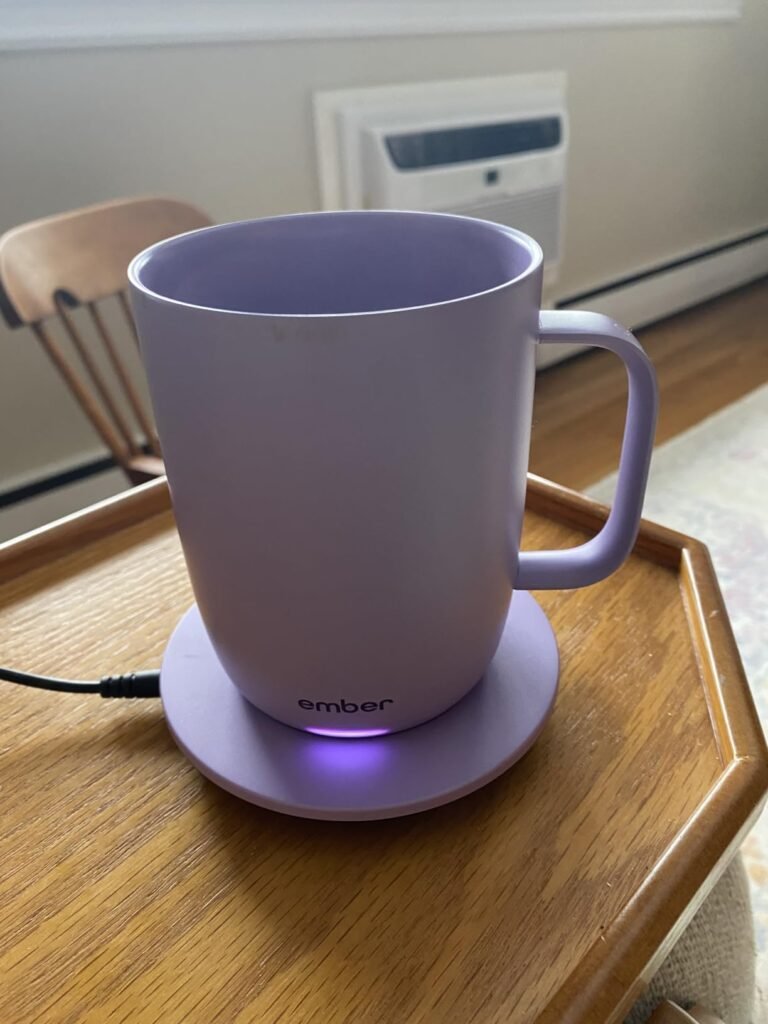
Both come with the charging coaster. For anyone whose coaster lives permanently on a desk, the battery limitation becomes irrelevant — the mug runs all day.
At full retail of $129.95 for the 10 oz, the price is high. The product earns it only for the drinker described above. For everyone else, it does not.
What It Solves, What It Reduces, and What It Still Leaves to You
What the Ember Mug 2 actually solves:
The cold-coffee problem for desk-based slow sippers. Completely, reliably, and without requiring behavioral change. Once the coaster is on your desk, the problem is structurally closed.
What it meaningfully reduces:
The microwave cycle. The disappointment of the second half of a cup. The small daily friction of a morning that keeps fragmenting before you finish it. Multiple long-term owners across years of use — including five-year repeat buyers — report this as the change that made it worth the price.
What it does not solve:
It does not make bad coffee better. It does not make fast coffee slower. It does not replace a travel mug, a thermos, or a quality insulated vessel for mobile use. It will not reheat a forgotten lukewarm cup.
What it still leaves to you:
Hand-washing only — non-negotiable. The app setup on first use, which some users on Android have found inconsistent. The charging coaster requires a power outlet. Battery longevity is a real question over multi-year use — lithium-ion cells degrade, and when they do, the mug becomes coaster-only.
The regret line:
The people who regret this purchase bought it expecting a universal coffee improvement. The people who love it bought it for a specific desk-based, slow-sipping, precision-temperature need — and found it solved exactly that problem, daily, for years.
Final Compression
The Ember Mug 2 doesn’t solve a coffee problem. It solves a time-fragmentation problem — specifically, the one where the session you planned keeps getting interrupted, and the drink you were looking forward to isn’t there when you return.
If your mornings are fragmented and desk-bound, if your preferred temperature is in the 120°F–145°F band, and if you have a spot where a coaster can live permanently — this product removes the cold-coffee problem from your life without requiring any discipline, any behavior change, or any compromise.
If your coffee is consumed in under twenty minutes, if you want it hotter than 145°F, or if you drink on the move — this is not the fix for your situation.
The decision isn’t about whether the Ember Mug 2 is good. It is good, within its specific window of fit. The decision is whether your mornings live inside that window.
If they do, the $130 closes a daily friction that compounds across every morning you drink coffee at a desk. If they don’t, it’s an elegant object solving someone else’s problem.
Frequently Asked Questions
| Question | Answer |
|---|---|
| Does the Ember Mug 2 work without the app? | Yes. Without the app, it defaults to 135°F and remembers the last temperature setting you used. For most drinkers who settle on one preferred temperature, the app becomes optional after initial setup. |
| Can the Ember Mug 2 reheat cold coffee? | No. It can only maintain the temperature of a hot liquid already poured in. Attempting to heat a cold or room-temperature drink will drain the battery in approximately 30–40 minutes with minimal temperature gain. |
| Is 145°F really hot enough? | For most drinkers with cream, milk, or espresso-based drinks: yes, comfortably. For black coffee drinkers who prefer 155°F–170°F: no. Peer-reviewed research consistently identifies the preferred drinking temperature for most consumers at approximately 130°F–140°F, placing the Ember’s ceiling at or above most people’s actual sweet spot. |
| What’s the difference between the 10 oz and 14 oz? | The 10 oz holds up to 90 minutes off the coaster; the 14 oz holds up to 80 minutes. The 10 oz suits pour-overs, espresso drinks, and smaller fills. The 14 oz suits standard drip coffee and larger morning pours. Both use identical temperature technology and include the charging coaster. |
| How long does the charging coaster battery last — meaning the mug’s battery over months of use? | The built-in lithium-ion battery is non-replaceable and will degrade over years of daily charging cycles. Several multi-year users report no meaningful degradation after two to three years. Some report charging issues appearing after two years of heavy use. Buying through Costco is frequently recommended for its generous return policy as a hedge against longevity risk. |
| Is the Ember Mug 2 dishwasher safe? | No. Hand wash only. It is waterproof and submersible up to one meter, so sink washing is safe. The electronics make dishwasher use a permanent risk. |
| Who should not buy the Ember Mug 2? | Fast drinkers (under 20 minutes), black coffee drinkers who prefer temperatures above 145°F, commuters needing a lidded travel solution, and anyone gifting it without certainty that the recipient is a slow desk-based sipper. |
Transparency Note:
This analysis is built on aggregated real-world experience. It extracts what repeatedly holds, what breaks, and what users uncover only after living with the system—then shapes it into a clear model you can use immediately. Think of it as structured experience, refined and presented so you don’t have to learn it the hard way.
“A quick note: Don’t believe the star ratings, but trust personal experience. This article is a compilation of collected experiences”