Keurig K-Express Essentials Review: The Machine Works Fine — Until It Doesn’t, and You Were Never Told When That Would Be
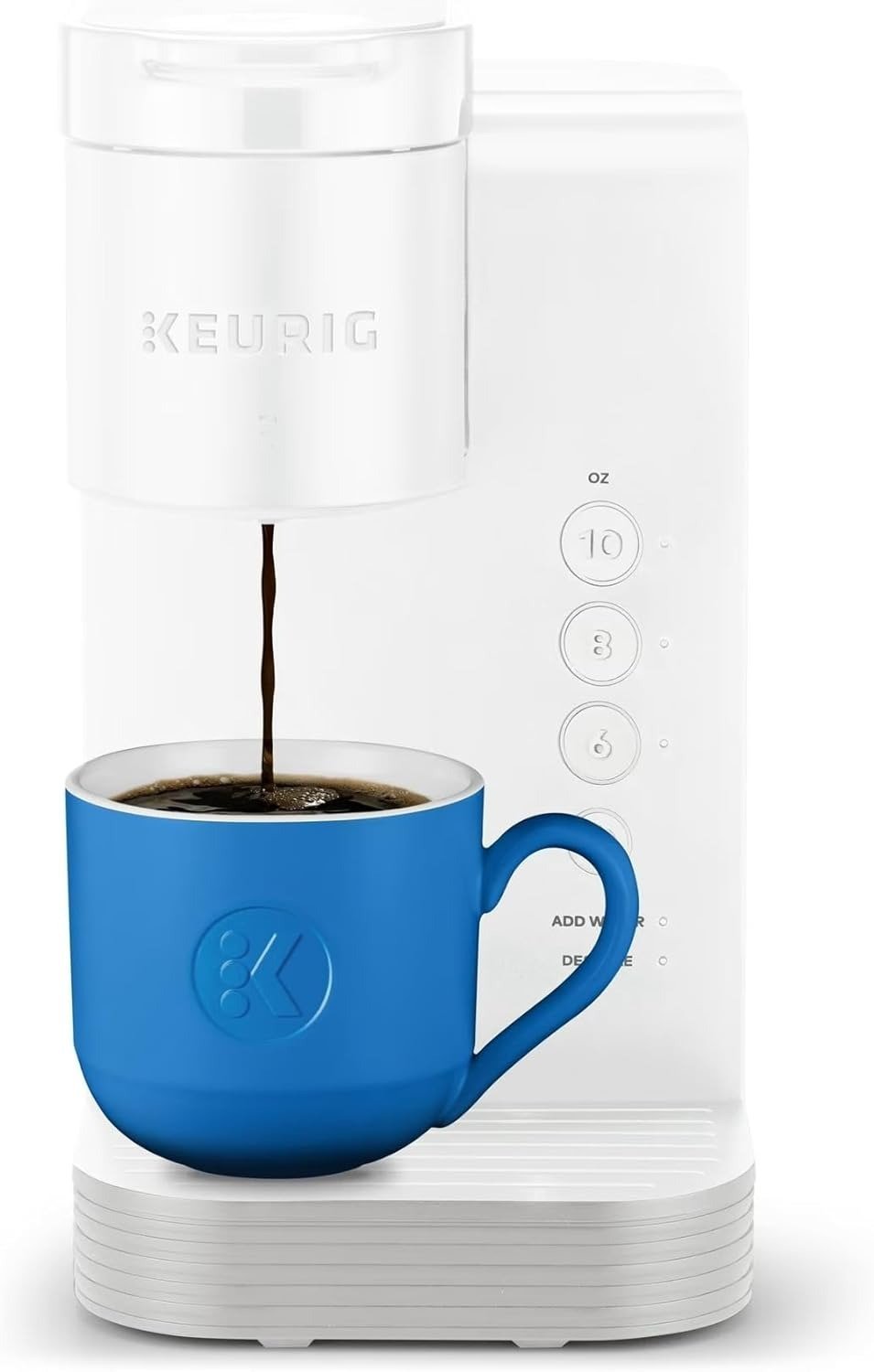
KEURIG K-EXPRESS ESSENTIALS
The Result Looks Fine. The Problem Isn’t.
You plug it in. You fill the reservoir. You press a button. Coffee comes out in under two minutes. Everything works exactly as advertised.
So why does this machine generate such a split — buyers who call it the best small purchase they’ve made, and buyers who feel genuinely deceived three months later?
It’s not about the coffee. It’s not even really about the machine.
It’s about what you were never told the machine was designed for.
What You’re Actually Feeling but Not Naming
You didn’t buy the Keurig K-Express Essentials because you love coffee deeply. You bought it because you hate the friction of coffee in the morning.
You want one cup. You want it now. You want no grounds to clean, no pot to monitor, no leftover coffee growing cold in the kitchen. You want to open a cabinet, grab a pod, and be done.
That’s not a compromise. That’s a completely legitimate use case — and the K-Express Essentials was built almost perfectly for it.
The annoyance that surfaces later isn’t about the coffee’s taste or temperature. It’s subtler. It sounds like this:
“It was fine, then it started making less coffee than I asked for.”
“It started taking longer between pods.”
“The descale light came on and I couldn’t get it to go off.”
“It worked for eight months and just… stopped.”
None of these feel like buyer fraud. They feel like bad luck. But they’re not bad luck. They’re the output of a machine operating exactly as it was engineered — inside a use pattern it wasn’t designed to outlast.
The Hidden Mechanism Behind the Miss
The K-Express Essentials is built around a single fixed threshold: 250 brews.
That’s the internal counter that triggers the descale reminder. Not a sensor reading scale buildup. Not an actual measurement of mineral deposits. A counter. Every brew increments it. At 250, the machine asks you to descale.
This matters more than it sounds.
At one cup per day, you hit 250 brews in roughly eight months. At two cups per day, you hit it in four months. At one cup per business day in an office, you hit it in just over a year.
The descale cycle isn’t the problem. The problem is what happens when it doesn’t complete correctly — and completing it incorrectly is, according to hundreds of real owner reports across Walmart, Slickdeals, and product forums, far more common than the box suggests.
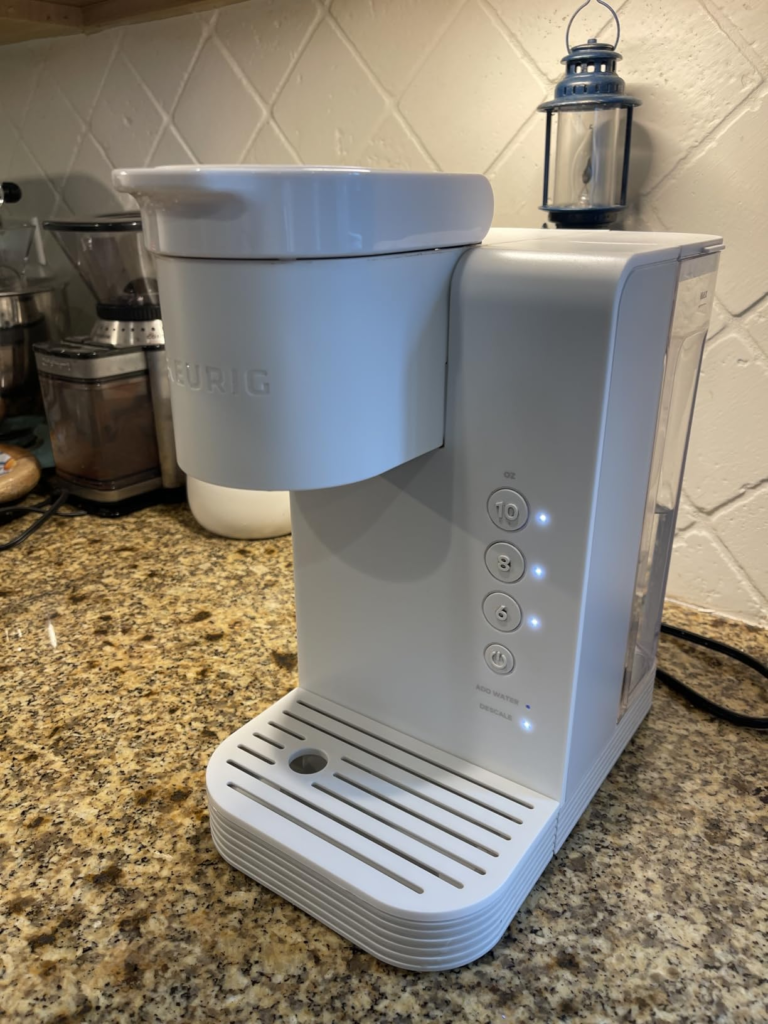
The machine runs descale solution through in 8-oz increments. If the cycle is interrupted — power issue, improper solution ratio, wrong water type — the machine can enter what owners describe as a descale loop: a state where the descale indicator stays lit and the machine refuses to brew. Running more descale solution doesn’t fix it. There is no manual override. The only documented resolution is warranty replacement.
Keurig lost a class-action lawsuit over this same mechanism on a higher-end model. The K-Express Essentials inherited the architecture.
The Threshold Where the Outcome Quietly Breaks
There are two performance phases for this machine:
| Phase | Duration | Experience |
|---|---|---|
| Phase 1: Pre-threshold | Brews 1–249 | Fast, consistent, no issues |
| Phase 2: Descale threshold | Brew 250 | Maintenance cycle triggered |
| Phase 3: Post-threshold (normal) | Brews 251–500+ | Returns to normal if descale completes correctly |
| Phase 3: Post-threshold (failed) | After brew 250 | Machine locks, refuses to brew |
The machine you experience in months one through three is not the same machine you experience at month seven. Not because anything failed — but because you’ve crossed the only maintenance gate it has, and whether you pass through cleanly depends on variables the spec sheet never mentions: your water hardness, whether you use the right descale solution, whether the cycle runs uninterrupted.
Most buyers don’t know the gate exists until they’re standing in front of it.
Why Most Buyers Misread This Too Early
The first mistake happens at the price point.
At $35–$59, the K-Express Essentials looks like a low-risk purchase. If it breaks, it’s not a $200 loss. That logic is sound — but it changes the calculus only if you factor in the replacement cycle, not just the purchase price.
| Scenario | Machine Cost | Annual Pod Cost | Replacement Frequency | Annual True Cost |
|---|---|---|---|---|
| Light user (1 cup/day) | $39 | ~$365 | Every 1–1.5 years | ~$405–440 |
| Moderate user (2 cups/day) | $39 | ~$730 | Every 8–12 months | ~$769–808 |
| Office use (5 days/week) | $39 | ~$1,300 | Every 12–18 months | ~$1,339–1,365 |
The machine’s cost is not the real number. The machine’s lifespan relative to your use intensity is the real number — and the K-Express Essentials was engineered for light-to-moderate residential use, not daily office deployment or heavy household brewing.
The second mistake is comparing it to machines that cost twice as much without asking why those machines cost more. The K-Express Essentials has no water temperature adjustment, no brew-strength control, no pressure regulation. Those aren’t premium gimmicks. They’re the variables that protect flavor at the 10-oz size.
At 6 oz, the machine produces a concentrated, satisfying cup. At 10 oz with most K-Cup pods — which are calibrated for 8 oz — the result is noticeably diluted. Not because the machine is broken. Because 10 oz is outside the pod’s optimal extraction range and the machine has no mechanism to compensate.
Who Is Actually Inside This Problem
You fit this machine if the following conditions are true:
- You drink one cup per morning, nothing more
- You want speed and zero cleanup as your primary criteria
- You have soft-to-moderate water hardness (or use filtered water consistently)
- You will remember — and correctly execute — a descale cycle every 8–10 months
- You are buying this for a single residential user, not a shared space
- You are comfortable with the 1-year warranty as your risk boundary, not multi-year reliability
You fit this machine exceptionally well if you’re placing it in a guest room, a vacation home, a dorm room, or a small apartment where coffee is a weekday utility rather than a daily ritual.
Where Wrong-Fit Begins
| Use Profile | Risk Level | Why |
|---|---|---|
| Office with 3+ daily users | High | Hits descale threshold in 2–3 months; multiple users means inconsistent maintenance execution |
| Heavy user (3+ cups/day) | High | Crosses threshold in under 4 months; machine’s lifespan compresses dramatically |
| Hard water area, no filter | High | Mineral buildup accelerates failure; descale loop more likely |
| Expecting 2–3+ year lifespan | High | Median real-world lifespan is 8–14 months under daily use |
| 10-oz cups as primary size | Moderate | Dilution is structural, not fixable |
| Gifting to non-technical user | Moderate | Descale process requires precise execution; failure = locked machine |
| Shared kitchen/break room | High | No one owns the maintenance cycle; machine degrades without intervention |
The pattern across negative reviews is not random. It clusters almost entirely in the office-use and multi-user segments, and in hard-water geographies where the 250-brew counter arrives before anyone thought to read the maintenance instructions.
The One Situation Where This Product Becomes Logical
One person. One cup in the morning. Filtered or softened water. A small kitchen where counter space matters. A budget that correctly classifies a $39 machine as a 12–18 month appliance rather than a permanent fixture.
In that situation, the Keurig K-Express Essentials is not a compromise. It is the correct answer.
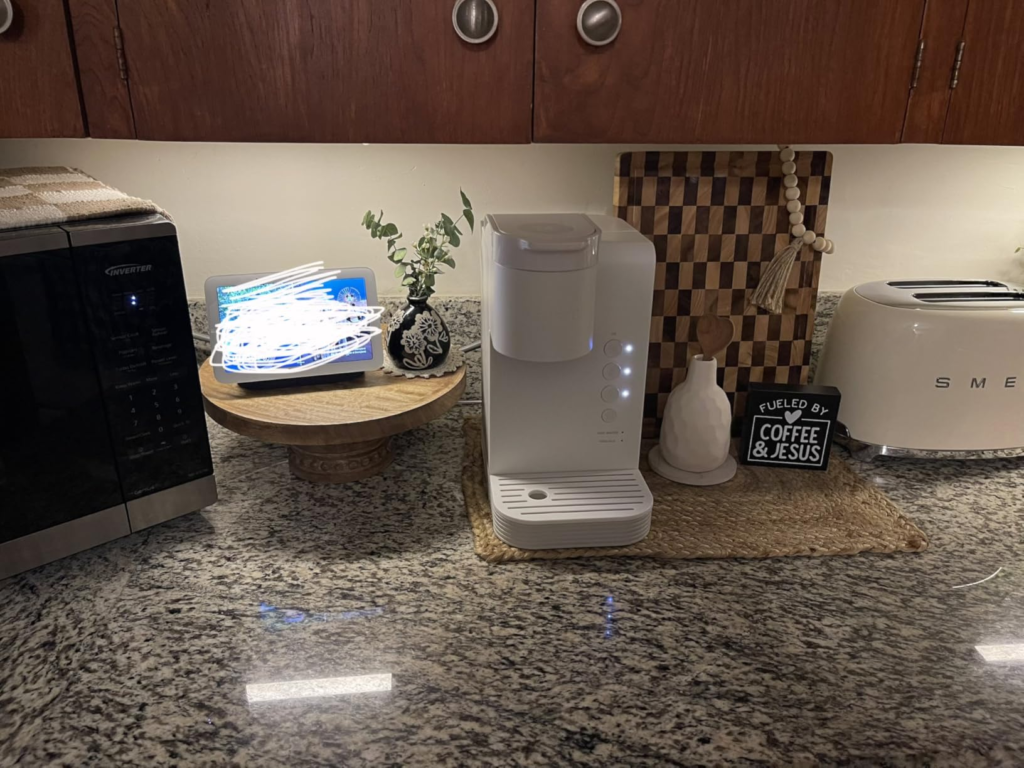
It brews fast. Faster than any pour-over, faster than most drip machines reaching temperature. The 36-oz reservoir means you’re not refilling every morning. The 6.5-inch footprint is genuinely narrow — it fits beside a toaster without claiming the entire counter. The auto-off at five minutes is real and useful. And at 4.5 lbs, it’s light enough that moving it for counter cleaning isn’t an event.
For the buyer who drinks coffee casually — one cup, mornings only, no strong preference for roast intensity or temperature precision — this machine delivers exactly what it promises. The only requirement is that you go in knowing what it is.
What It Solves, What It Reduces, and What It Still Leaves to You
| Category | Reality |
|---|---|
| Morning friction | Fully solved — pod in, button pressed, done in under 2 minutes |
| Counter space | Solved — genuinely compact at 6.5″ wide |
| Cleanup burden | Largely solved — no grounds, no pot, wipe-down only |
| Coffee quality at 6–8 oz | Good — most K-Cup pods perform well in this range |
| Coffee quality at 10 oz | Noticeably diluted — structural, not correctable |
| Long-term reliability | Not solved — median lifespan 8–14 months under normal use |
| Descale maintenance | Partially solved — reminders built in, but execution is on you |
| Hard water performance | Not solved — requires filtered water or more frequent descaling |
| Brew strength control | Not available — what the pod gives you is what you get |
The machine is not pretending to be something it isn’t. The spec sheet says what it does. What it doesn’t say is how those specs interact with real usage patterns over time — and that gap is where most buyer regret lives.
Final Compression
The Keurig K-Express Essentials is one of the most clearly bounded products in the single-serve coffee category. It has a defined performance window, a known maintenance gate, and a predictable lifespan under normal residential use.
Buyers who match it correctly — one cup per day, soft water, light use — often run it for well over a year without issue. Buyers who exceed its design parameters, or who hit the descale cycle without knowing how to complete it, find themselves in warranty conversations within months.
The question is not whether this machine is good or bad. The question is whether your use pattern fits inside the window it was built for.
| Decision Signal | Recommendation |
|---|---|
| 1 cup/day, soft water, small kitchen | Buy with confidence |
| 2 cups/day, residential, filtered water | Buy, budget for replacement at ~12 months |
| Office use or 3+ users | Do not buy — wrong category entirely |
| Hard water, no filter | Do not buy without a water filter plan |
| Want 2+ years of reliability | Spend up to the K-Slim or K-Supreme tier |
If you’re inside the first or second row of that table, the machine is available on Amazon. The decision stops being complicated once you’ve correctly located your use pattern.
Frequently Asked Questions
| Question | Answer |
|---|---|
| How long does the Keurig K-Express Essentials actually last? | Under light residential use — one cup per day, soft water, correct descaling — most users report 12–18 months before any issues. Under heavier use or in hard-water areas, the median drops to 8–11 months. The machine carries a one-year limited warranty. |
| What does the descale light mean and why won’t it turn off? | The machine counts every brew. At 250 brews, the descale reminder activates. If the descale cycle is not completed correctly — wrong solution ratio, interrupted cycle, or incorrect water — the machine can enter a locked state where it won’t brew. This is the most common failure point reported by owners and typically requires a warranty replacement to resolve. |
| Is the coffee from the K-Express Essentials actually good? | At 6 oz and 8 oz, most K-Cup pods perform well in this machine. The heat and pressure are adequate for standard pods. At 10 oz, most pods are over-extracted for volume — the result is noticeably thinner and lighter. If you consistently want 10-oz cups, this is a structural limitation with no workaround. |
| Can I use a reusable pod with the K-Express Essentials? | Yes. The machine is compatible with the My K-Cup Universal Reusable Filter, sold separately. This is one of the more useful features for buyers who prefer a specific ground coffee over pod options. |
| Is this machine worth buying for an office? | No. In a shared office environment, the 250-brew threshold arrives too quickly, the descale process requires attention that no single person owns, and the machine’s lifespan compresses under multi-user daily volumes. A commercial or semi-commercial brewer is the structurally correct choice for that use case. |
| What’s the difference between the K-Express Essentials and the standard K-Express? | The Essentials is a stripped-down version sold primarily through Walmart. It has a 36-oz reservoir versus the standard K-Express’s smaller reservoir, simpler button controls, and a lower price point. The core brewing mechanism is the same. The Essentials trades some flexibility for a lower entry cost. |
| Does water type actually matter? | Yes, significantly. In hard-water areas, mineral deposits accumulate faster than the 250-brew counter suggests. Users with well water or tap water high in calcium and magnesium hit maintenance issues earlier and experience the descale-loop failure at higher rates. Using a Brita-filtered or reverse-osmosis water source substantially extends the machine’s reliable performance window. |
Transparency Note:
This analysis is built on aggregated real-world experience.
It extracts what repeatedly holds, what breaks, and what users uncover only after living with the system—then shapes it into a clear model you can use immediately.
Think of it as structured experience, refined and presented so you don’t have to learn it the hard way.
“A quick note: Don’t believe the star ratings, but trust personal experience. This article is a compilation of collected experiences”
![The Hands-Free Espresso Problem: When Convenience Breaks Consistency ([شاركنينجا][1])](https://focusedinsight.net/wp-content/uploads/2026/02/image-26.png)