THE BREVILLE BARISTA TOUCH DOESN’T FAIL PEOPLE. IT REVEALS WHAT WAS FAILING THEM ALL ALONG.
Every morning, somewhere, someone pours a shot from a machine they paid $800 for and thinks: this doesn’t taste right. The espresso looks correct. The foam exists. The machine made its sounds. But the drink in the cup is not the drink they imagined when they read the reviews.
The machine is working exactly as intended. The problem started before the first bean was ever ground.
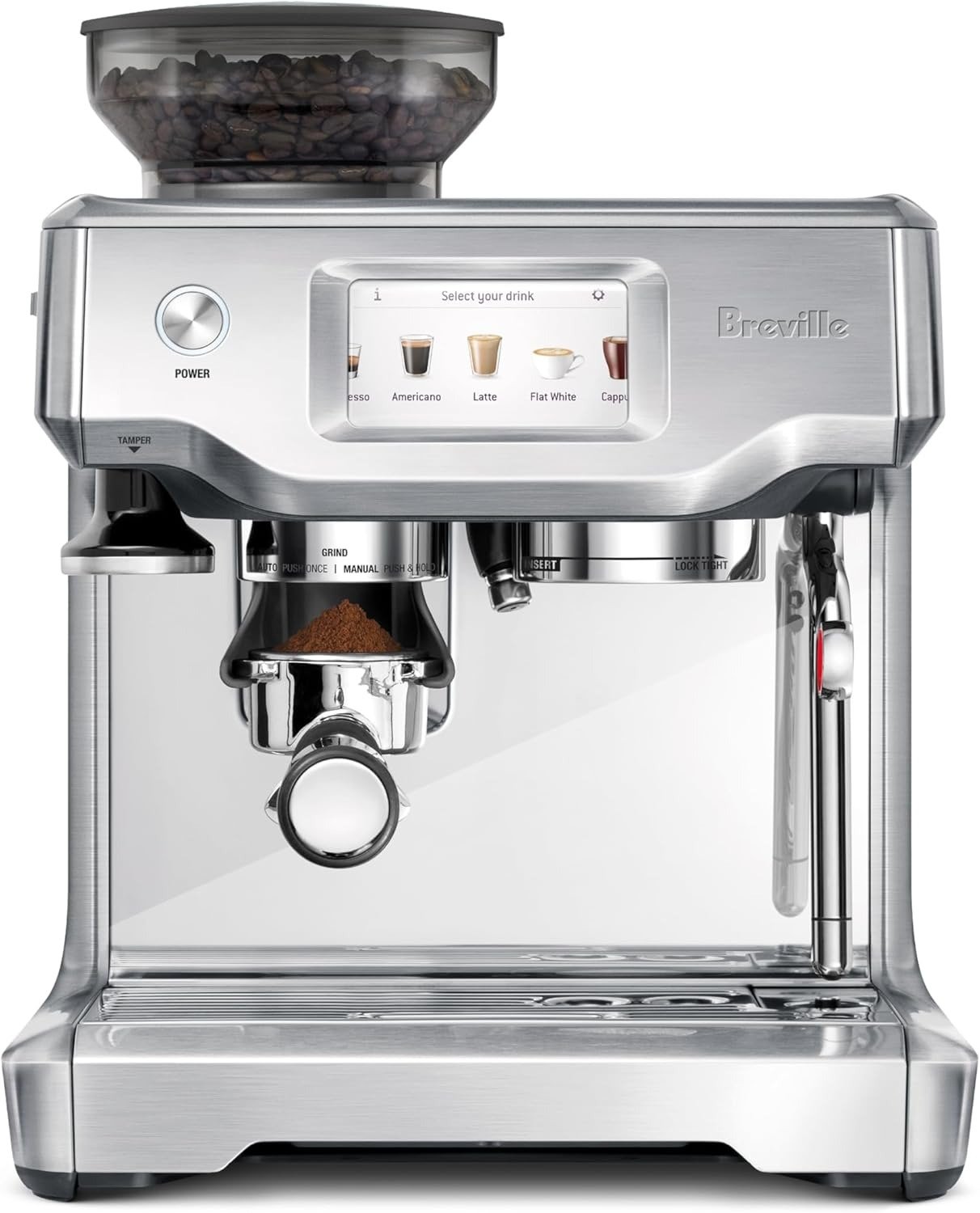
The Breville Barista Touch BES880 is one of the most precisely positioned espresso machines ever designed for the home market. It occupies a specific and narrow slot: past beginner, short of professional, built entirely around one assumption about who you are and what your mornings look like. When that assumption is accurate, this machine works at a level that genuinely embarrasses its price. When that assumption is wrong, no amount of dialing in will close the gap.
This article is about finding out which side of that line you’re on — before you decide, not after.
The Result Looks Fine. The Problem Isn’t.
Most negative experiences with the Barista Touch don’t announce themselves dramatically. There’s no catastrophic failure. No obvious defect. The machine pulls a shot in the right timeframe. The milk froths. The touchscreen responds cleanly. And yet the cup tastes flat, or acidic, or just slightly off — and the person standing in the kitchen doesn’t know exactly why.
This is the signature friction pattern of the mid-range espresso machine segment, and the Barista Touch is one of its clearest examples. The gap isn’t in the hardware. The gap is in the calibration — and calibration is a skill, not a setting.
What the Barista Touch delivers at its best is genuinely close to what a trained barista produces with commercial equipment. The ThermoJet heating system reaches temperature in 3 seconds. The 9-bar Italian pump creates the extraction pressure that produces real espresso crema — not the pressurized-basket simulation that cheaper machines rely on. The conical burr grinder uses the same European Baratza (Etzinger) burrs found in machines that cost significantly more. The automatic steam wand textures milk to a precision that most manual wands cannot match without years of practice.
All of that is real. None of it is marketing fiction.
But here is what the specification sheet doesn’t disclose: the machine is only as accurate as the person operating it is patient. The single-boiler architecture means the grouphead is cold when you start. That cold metal will drop the temperature of your first shot and produce an under-extracted result — unless you run a blank flush first. The ThermoJet’s 3-second claim refers to water temperature only. The brewing components take longer. First-time users who don’t know this will pull a sour shot, assume the machine is misconfigured, adjust the grind, pull another sour shot, and start a cycle of incorrect corrections.
The machine didn’t fail. The expectation was wrong.
What You’re Actually Feeling but Not Naming
There’s a specific category of buyer who ends up frustrated with the Barista Touch, and it’s not who most reviews describe.
It isn’t the total beginner who has never touched an espresso machine. Those users tend to follow the guided interface closely, start at the recommended settings, and improve steadily over a few weeks. The touchscreen tutorial system genuinely works for them. The pre-programmed drink profiles give them a starting point. The automatic steam wand removes one of the most difficult manual skills from their workflow. They learn, they dial in, they stay.
The frustrated buyer is usually someone with just enough experience to feel confident but not quite enough to know what they don’t know. They’ve used a Nespresso. They’ve pulled shots on someone else’s machine. They’ve watched enough YouTube to believe they understand the variables. So they skip the tutorial. They ignore the flush. They jump straight to grind adjustment when the real problem is grouphead temperature. They compare their result to a café shot without accounting for the fact that the café machine has been running for two hours before the first customer arrives.
This is the confidence threshold problem. The Barista Touch is designed for users who are either completely guided or completely intentional. The middle ground — informed enough to improvise, but not precise enough to improvise correctly — is where most of the disappointment lives.
| User Profile | Likely Outcome |
|---|---|
| Complete beginner, follows guidance | Strong results within 2–3 weeks |
| Informed beginner, patient and methodical | Excellent results, grows into the machine |
| Partially experienced, skips steps | Repeated frustration, incorrect adjustments |
| Experienced espresso hobbyist | May find automation limiting vs. full manual control |
| Milk-drink focused daily user | This machine is near-perfect for them |
| Black espresso purist, precision-oriented | Consider the Barista Pro or a separate grinder setup |
The feeling you’re not naming is this: I should be better at this than the machine is assuming I am. That feeling is real, but it’s also the machine working correctly. The Barista Touch is not built to reward instinct. It’s built to reward process.
The Hidden Mechanism Behind the Miss
The Barista Touch runs a ThermoJet system — a thermoblock variant that heats water almost instantly. This is genuinely impressive. But it creates a structural reality that most users discover only after their first few disappointing shots.
Unlike a thermocoil system or a dual boiler, the ThermoJet heats water in isolation. It does not preheat the grouphead. It does not warm the portafilter from the inside out the way a machine that’s been running for 20 minutes will. On a cold start, the first 30–40 milliliters of hot water passing through the brew group will lose meaningful temperature to the cold metal around it.
The practical result: your first shot of the day is structurally different from your second shot. If you pulled a perfect shot yesterday with settings 7 on the grind and 30 seconds extraction, those exact same settings tomorrow morning will produce a sour, under-extracted result — because the machine hasn’t fully thermalized yet.
The fix is simple: run a blank shot (water, no coffee) first. Let it run for 20–30 seconds through the empty portafilter. Then pull your actual shot. This preheats the group and the portafilter and produces consistent temperature from the start.
Experienced home baristas know this immediately. New users discover it on Reddit forums, usually after two weeks of inconsistent results, attributing the problem to the beans.
The hidden mechanism is not a flaw. It is a calibration requirement the manual underemphasizes.
| What Users Often Blame | What’s Actually Happening |
|---|---|
| “Beans must be stale” | Cold grouphead drop on first shot |
| “Grind is wrong” | Extraction temp inconsistency, not grind |
| “Machine is defective” | No warm-up flush performed |
| “Milk foam isn’t right” | Steam wand not purged before use |
| “Shot runs too fast” | Grind set too coarse, or dose too light |
| “Shot runs too slow” | Grind set too fine, or dose too heavy |
The Threshold Where the Outcome Quietly Breaks
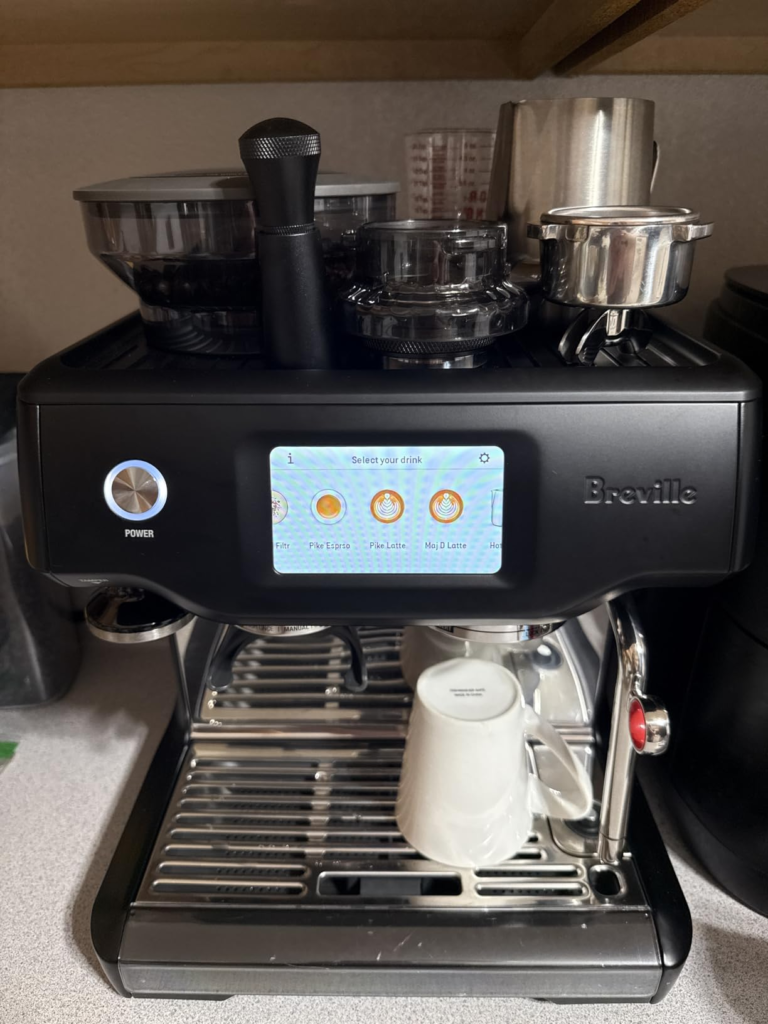
There is a measurable threshold where the Barista Touch either performs at its ceiling or quietly declines — and it is not based on price sensitivity, bean quality, or brand loyalty.
The threshold is: how many milk-based drinks do you make per week?
The Barista Touch was engineered around the latte-and-cappuccino household. Its automatic steam wand — which adjusts temperature between 104°F and 167°F and offers 8 levels of foam texture — is not a convenience feature. It is the machine’s primary performance advantage over everything in its price class. The drip tray’s integrated thermometer is not aesthetic; it allows the steam wand to hit precise temperature targets without guessing or manual monitoring.
For users who drink flat whites, lattes, cortados, cappuccinos, or any milk-integrated espresso drink daily, the Barista Touch produces results that are legitimately difficult to replicate at home with other equipment at this price point. The microfoam it generates — defined by at least one million micro-bubbles per milliliter in Breville’s own specification — creates the texture that makes milk-based espresso drinks taste balanced and rich rather than simply warm and brown.
For users who primarily drink black espresso, the automatic steam wand is irrelevant, and the machine’s value proposition shifts substantially. At $799, you are partially paying for a feature that contributes nothing to your daily drink. The Barista Pro, at a lower price point, offers the same ThermoJet system, the same Etzinger burrs, the same grind settings — and a manual steam wand that produces excellent results for users willing to learn the technique. If your morning is a double shot and nothing else, the Barista Pro is probably the more honest choice.
| Daily Drink | Barista Touch Value | Better Alternative |
|---|---|---|
| Latte, cappuccino, flat white | Maximum — this is the machine’s purpose | None at this price |
| Cortado or macchiato | High — auto wand handles small milk volumes well | None |
| Double espresso, black | Moderate — you’re paying for unused automation | Barista Pro |
| Long black / Americano | Low automation need, machine still works fine | Barista Pro |
| Pour-over or filter coffee | Wrong machine entirely | Dedicated brewer |
Why Most Buyers Misread This Too Early
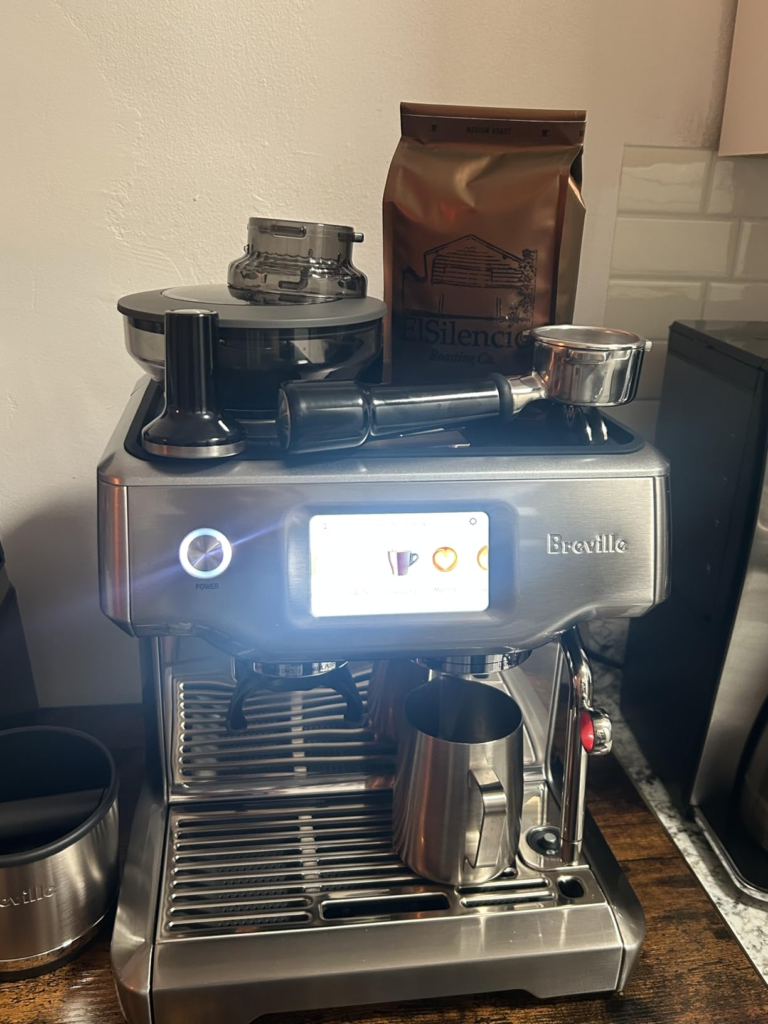
The most common comparison trap at this price point is the Barista Touch versus a fully automatic machine — a bean-to-cup super-automatic that grinds, doses, tamps, extracts, and froths with one button press.
This comparison is almost always wrong in both directions.
Super-automatic machines at similar prices produce coffee, not espresso. They use pre-infusion pressure profiles designed for consistency, not for extraction quality. The result is a stable, repeatable, adequately-caffeinated drink that lacks the flavor complexity that fresh-ground, properly-extracted espresso produces. The comparison feels favorable to the super-automatic because it requires nothing. It is unfavorable to it because it delivers less.
The second common misread is comparing the Barista Touch to the Barista Express — Breville’s own lower-cost entry machine. The Express uses a thermocoil system that actually preheats the grouphead from the start, which gives it a temperature stability advantage on the first shot that the Touch’s ThermoJet doesn’t naturally replicate. Experienced baristas sometimes prefer the Express for this reason, along with its lower price.
The mistake is not choosing the wrong machine. The mistake is choosing the machine based on the wrong variable.
Buyers who compare on: screen vs. no screen, grind settings count, or visual design — will often end up in the wrong place. The correct comparison variables are:
| Decision Variable | What It Actually Determines |
|---|---|
| How many milk drinks per week | Auto steam wand value |
| First shot of the day or multiple? | Preheat tolerance |
| Willing to learn manual milk steaming? | Pro vs. Touch |
| Espresso only vs. full drink range | Touch vs. Pro vs. Express |
| Want guided workflow long-term | Touch wins |
| Want to go deeper into craft over time | Pro or separate grinder setup |
Who Is Actually Inside This Problem
The global home espresso machine market reached $3.55 billion in 2025, with semi-automatic machines growing at 6.5% annually. Bean-to-cup integrated machines like the Barista Touch represent one of the fastest-growing sub-categories, with 6.7 million units sold in this format globally in 2024 alone.
But aggregate market data obscures the real demographic insight.
The Barista Touch is not a machine for coffee beginners who want to learn espresso. It’s not a machine for espresso purists who want maximum control. It is specifically, precisely designed for a third group that receives almost no marketing attention: the committed daily milk-drink household that wants café-quality results without the requirement to become a skilled barista.
This is the person who:
- Makes 2–4 espresso-based drinks daily, mostly milk-based
- Has previously spent $4–$7 per drink at a café, daily or near-daily
- Is willing to learn the basics of grind adjustment and extraction timing
- Does not want to spend months learning manual milk steaming technique
- Values morning speed and routine repeatability over experimentation
- Has a counter that can support a machine with a modest footprint (about 13″ deep, 12.5″ wide, 16″ tall)
For this person, the Barista Touch produces a return on investment that is measurable in months. At $5 per day in café spending, the machine pays for itself in approximately 5 months — before accounting for the savings on premium beans purchased at retail.
The frustration cases are concentrated among buyers who didn’t belong to this category and selected the machine based on brand recognition, visual appeal, or a comparison review that never identified the governing question: what do you actually drink every morning?
Where Wrong-Fit Begins
There are four profiles for whom this machine consistently produces regret. Not because the machine is defective — it isn’t — but because the fit is structurally wrong.
Profile 1: The Espresso Purist
You drink double shots, black, every morning. You care deeply about extraction clarity, origin flavor notes, and pressure profiling. The Barista Touch’s fixed 10-second pre-infusion, single boiler, and lack of pre-infusion time control will feel like a ceiling you hit immediately. You need a dual boiler or a machine with programmable pre-infusion at minimum.
Profile 2: The Craft Seeker
You want to learn espresso as a skill. You want to develop your manual tamp, your milk steaming technique, your intuition for grind adjustment. The Barista Touch’s automatic systems will feel like they’re constantly doing the interesting parts for you. The Barista Pro — or a Gaggia Classic Pro paired with a standalone grinder — will give you more educational feedback per shot.
Profile 3: The Low-Volume Household
You make one espresso every few days. The grind settings drift. The beans age. The machine sits between uses and creates more descaling burden than value. At lower volumes, simpler and cheaper machines make more practical sense.
Profile 4: The Comparison Shopper Who Stops at Screen Quality
If the touchscreen is the primary reason you’re considering this machine, you’re making a surface-level decision on a structural question. The screen is genuinely good — intuitive, responsive, clear. But it is not the reason to choose this machine over its siblings. It’s a navigation convenience, not a performance variable.
| Wrong-Fit Signal | What It Suggests Instead |
|---|---|
| “I mostly drink black espresso” | Barista Pro BES878 |
| “I want to improve my barista skills” | Barista Express or separate grinder setup |
| “I make 1–2 drinks per week” | Bambino Plus at half the price |
| “I want full pressure profiling control” | Dual Boiler or prosumer machine |
| “I compared this to a super-automatic” | Reassess the category difference entirely |
The One Situation Where the Breville Barista Touch Becomes Logical
After everything above has been read and understood, there is one situation where the Barista Touch is not merely a reasonable choice but the most rational purchase available at its price point.
You make milk-based espresso drinks — lattes, flat whites, cappuccinos, cortados — at least once daily, often twice. You want café-level results without café-level training. You are willing to learn the basics of grind adjustment (a one-time calibration per new bag of beans) and the simple preheating routine. You are not interested in spending months developing manual milk steaming skill. You want a machine that your entire household can use without individual training. And your annual café spend, if calculated honestly, exceeds $1,500.
In that specific intersection, the Barista Touch BES880 is not merely defensible. It is the logical endpoint of the decision.
What the machine delivers in this situation:
| Performance Feature | Real-World Impact |
|---|---|
| ThermoJet 3-second heat-up | No waiting. Machine is ready with your morning routine. |
| Auto steam wand, 8 temperature levels | Consistent microfoam without learning the technique |
| 30 grind settings, conical Etzinger burrs | Enough range to dial in virtually any bean type |
| 8 customizable drink profiles | Different users, different drinks, saved and repeatable |
| 9-bar Italian pump with low-pressure pre-infusion | True espresso extraction, not pressurized-basket simulation |
| Integrated water filtration (Claris system) | Reduces scale buildup, extends machine lifespan |
| 54mm stainless steel portafilter | Commercial-grade brewing surface, not plastic |
| Non-dairy milk compatibility | Works cleanly with oat, almond, soy — tested consistently |
The machine also carries a 2-year Breville warranty and has been in production long enough to have a comprehensive repair and support ecosystem — a meaningful consideration for a machine at this price level.
What It Solves, What It Reduces, and What It Still Leaves to You
Clarity on this point prevents the most common category of regret.
What the Barista Touch fully solves:
Manual milk steaming skill. The automatic wand handles this entirely. Morning heat-up time. The ThermoJet eliminates the 15–20 minute warm-up that traditional machines require. Milk temperature precision. The integrated thermometer and programmable temperature settings remove guesswork. Workflow complexity for multiple users. Saved profiles mean each person in the household can select their drink without reconfiguring anything.
What it significantly reduces but does not eliminate:
Grind calibration time. You still need to dial in when you switch beans — typically 2–4 shots to find the right setting. Puck preparation mess. The dosing funnel reduces spill significantly, but tamping is still manual and still creates some ground distribution. Extraction inconsistency. The machine helps, but the first-shot cold grouphead issue requires a flush routine to fully manage.
What it leaves entirely to you:
Bean selection. The machine cannot compensate for stale or low-quality beans — and no machine at any price can. Maintenance discipline. Backflushing, descaling, and filter replacement need to happen on a regular schedule; the machine alerts you, but the work is yours. Grind adjustment patience. When a new bag produces inconsistent shots, the fix is methodical adjustment, not machine recalibration. Expectation calibration. This is still a home machine. The ceiling is genuinely high, but the path to the ceiling requires attention.
| Category | Machine Handles | You Handle |
|---|---|---|
| Milk frothing | Auto — fully managed | Selecting milk type and volume |
| Water temperature | Managed | Initial flush on cold start |
| Grind consistency | Managed within set parameters | Setting grind size per bean |
| Extraction timing | Managed by shot timer | Adjusting if shots run off |
| Cleaning alerts | Machine prompts | Performing the actual maintenance |
| Bean quality | Cannot compensate | Sourcing fresh, quality beans |
Frequently Asked Questions
Q: Does the Breville Barista Touch BES880 work well for beginners?
It depends on the type of beginner. If you follow the guided workflow, start at recommended settings, and are patient during the first two weeks of calibration, yes — it is one of the most beginner-accessible machines at its price. If you assume prior experience transfers directly and skip the fundamentals, results will be inconsistent until you reset your approach.
Q: What is the real difference between the Barista Touch BES880 and the Barista Touch Impress BES881?
The Impress adds assisted tamping via a lever mechanism (22 lbs of pressure, 7° barista twist) and barista guidance feedback after each shot. It also adds alternative milk frothing presets (oat, almond, soy) and, in the latest version, cold extraction. The BES880 (standard Touch) requires manual tamping. For most daily users, the difference in shot-to-shot consistency that the Impress tamping system provides is meaningful — but the BES880’s lower price makes it reasonable for users who are comfortable with manual tamping.
Q: Is the single boiler a serious limitation?
For household use of 1–3 drinks per sitting, no. You will need to wait 10–15 seconds between pulling a shot and beginning to steam milk — the boiler switches between brew temperature and steam temperature. For high-volume households making 5+ drinks in rapid succession, or for users who want to brew and steam simultaneously, a dual boiler machine is the correct category.
Q: How often does the machine require maintenance?
The machine alerts you when cleaning cycles are due. Standard maintenance includes: weekly backflush with cleaning tablet, monthly steam wand purge and wipe-down, and descaling every 2–3 months depending on water hardness and usage volume. Water filter replacement every 2–3 months. The Claris filtration system is one of the better-rated consumer filters in this category.
Q: Can the Barista Touch make good black espresso?
Yes. The extraction quality is genuine — 9-bar pump, low-pressure pre-infusion, PID temperature control. For black espresso drinkers, the performance is strong. The question is not capability but value: if you don’t use the automatic steam wand, you are paying for a significant feature you don’t need. The Barista Pro at a lower price delivers the same extraction quality with a manual steam wand.
Q: Does the touchscreen interface slow down the morning routine?
Initially, yes — there is a brief learning period. After 1–2 weeks, most users report the touchscreen is faster than analog button combinations for adjusting parameters. The ability to store 8 custom drink profiles means a returning user can select their drink in one tap. The main friction point is that some functions (like running a group flush) require navigating into the drink menu rather than having a dedicated button — a design choice that minor but real.
Q: What beans work best with the Barista Touch?
Freshness is the primary variable, not origin. Beans roasted within 2–4 weeks, degassed properly (typically 7–14 days after roast date for espresso), and stored sealed will produce the best results. Medium and medium-dark roasts tend to be most forgiving for dialing in on a semi-automatic machine. Very light roasts require finer grind settings and are less forgiving of temperature inconsistency.
Q: Is the $799 price justified?
For the specific user this machine is designed for — daily milk-based espresso drinks, household-level volume, value placed on automation — yes. The internal components (Etzinger burrs, Italian pump, ThermoJet, precision steam wand) are not found at this integration level for less. The honest answer is: if your daily drink is a latte and your alternative is a $5–$7 café purchase, the math resolves within 5–6 months.
Final Compression
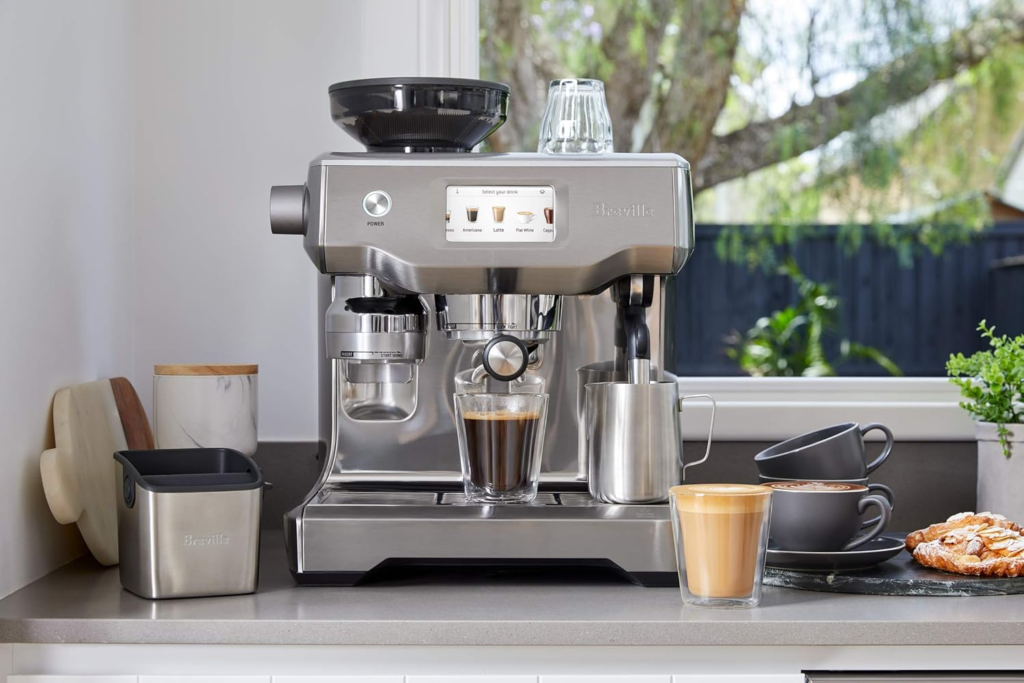
The Breville Barista Touch BES880 doesn’t have an ambiguity problem. It has a placement problem. It exists at exactly the right point in the home espresso market for a very specific user — and that user tends to be underserved by both the entry-level capsule category and the fully manual enthusiast category. Most of the frustration this machine generates comes not from internal failure but from the buyer arriving from the wrong direction.
If your mornings involve milk-based
Transparency Note:
This analysis is built on aggregated real-world experience.
It extracts what repeatedly holds, what breaks, and what users uncover only after living with the system—then shapes it into a clear model you can use immediately.
Think of it as structured experience, refined and presented so you don’t have to learn it the hard way.
“A quick note: Don’t believe the star ratings, but trust personal experience. This article is a compilation of collected experiences”