Denon Home Sound Bar 550 Review: The Moment “Compact” Stops Feeling Premium
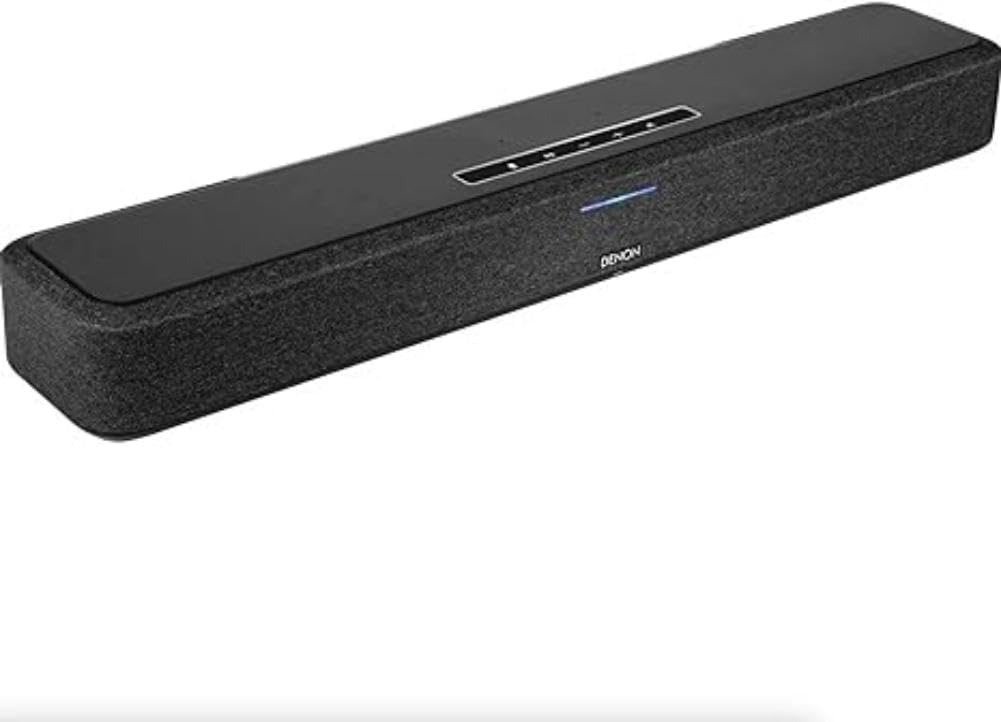
DENON HOME SOUND BAR 550
The mistake happens fast. You slide a small, expensive soundbar under the TV, step back, admire the clean line it draws across the cabinet, hit play—and for ten seconds your brain says, yes, this is it. Then the first action scene arrives. Or the first low synth note. Or the first crowded dialogue mix. And that is where expensive and enough part ways.
That split is the whole story of the Denon Home Sound Bar 550.
I do not think this soundbar wins by brute force. It wins by restraint, fit, and control. It is a 26-inch bar with two 19mm tweeters, four 55mm full-range drivers, three passive radiators, HDMI in plus eARC, HEOS multi-room support, Wi-Fi, Bluetooth, AirPlay 2, Alexa, and Siri support. On paper, that sounds like a compact luxury answer to everything. In practice, it is something narrower and more interesting: a soundbar that feels far more serious than its size, right up until your room, your bass demands, or your Atmos expectations cross the wrong line.
The Result Looks Fine. The Problem Isn’t.
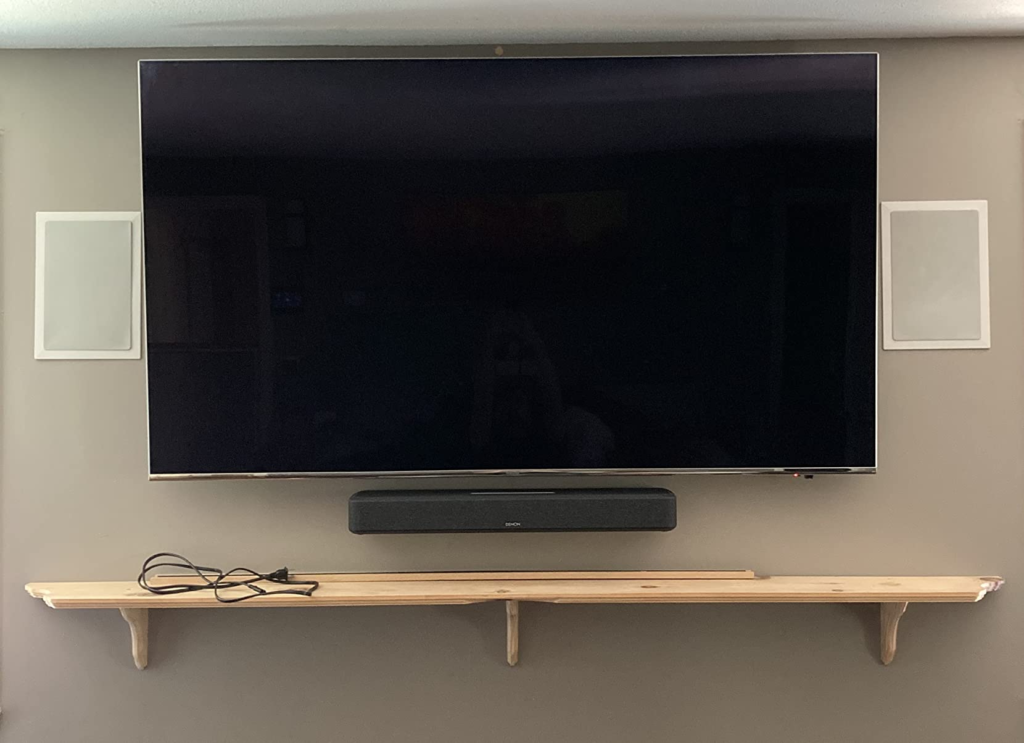
From across the room, the Denon 550 looks like a clever purchase. It is compact, neat, and visually disciplined. At 25.95 inches wide, 2.95 inches high, and 4.72 inches deep, it fits where longer bars look clumsy, especially under smaller living-room TVs, bedroom sets, or media consoles that do not have much breathing room. Denon’s own industrial design helps here: gray mesh wrap, restrained logo, touch controls that light up only when your hand gets close. It does not scream for attention. It cleans the room instead.
That visual calm matters more than most people admit. A bulky bar can make a setup feel technical. This one makes it feel intentional. Set it directly beneath a 40- to 55-inch TV, keep the cabinet top uncluttered, and the room shifts from “electronics corner” to something tighter, quieter, more considered. Sound Advice explicitly says it is best suited to 40- to 55-inch screens, though it can survive with a 65-inch display if expectations stay realistic.
But the first pleasant illusion is also the first trap.
A clean object can make you overestimate performance. A premium badge can make you assume scale. Dolby Atmos on the box can make you imagine height. That is where buyers get themselves into trouble.
What You’re Actually Feeling but Not Naming
Most people do not say, “This soundbar lacks deep low-bass extension and a convincing physical center image.” They say something looser.
Something is missing.
Voices are clear, but the room does not open up.
The movie starts, but it does not quite arrive.
That vague dissatisfaction has a shape.
With the Denon 550, the part that lands first is clarity. RTINGS found a balanced midrange that keeps dialogue clear and detailed, and multiple reviewers praised its dialogue enhancer and overall crispness. AVForums and Sound Advice also describe it as sounding bigger than the cabinet suggests, with a detailed, controlled delivery that works unusually well for music as well as TV.
What you are naming incorrectly is not “bad sound.” It is contained sound.
Contained width.
Contained pressure.
Contained impact.
That difference matters, because contained sound can still be very good. It just stops short of physical immersion.
The Hidden Mechanism Behind the Miss
Here is the hidden variable: the Denon 550 is compact enough to flatter itself in small spaces and compact enough to expose itself in larger ones.
RTINGS classifies it as a 2.0 setup and notes three recurring limits: it struggles to reproduce deep low bass, it does not get very loud, and compression rises at max volume. AVForums says much the same in more graceful language: impressive two-channel performance, decent bass, but no subwoofer depth and only a modest sense of immersion. Sound Advice adds the missing mechanical explanation—the cabinet is relatively small, there are no side-firing drivers, and the Atmos/DTS:X effect relies on processing rather than dedicated upfiring hardware.
That is why the bar can sound refined and still leave you unsatisfied.
The ingredients are serious.
The enclosure is small.
The psychoacoustics can stretch perception, but not physics.
Even Tom’s Guide, which was positive about the overall sonic quality, put it bluntly: this is “technically yes, but not really” when it comes to Atmos, and the bar is expensive for a 2.0 design.
So the miss is not random. It is structural.
The Threshold Where the Outcome Quietly Breaks
This article lives inside one model only: Threshold.
And the Denon 550 has a very clear one.
Below the threshold, it feels elegant, clever, and high-grade.
Beyond it, it starts to feel like a compromise dressed in premium fabric.
Here is the threshold in plain language:
| Variable | Inside the threshold | Beyond the threshold |
|---|---|---|
| TV size | 40″–55″ is the natural fit | 65″+ makes the bar look and often feel undersized unless the room is tight |
| Room demand | Small to medium room, moderate volume, close seating | Larger room or open-plan space exposes limited scale and loudness |
| Bass expectation | You want clean bass support, not chest-hit rumble | You expect subwoofer-like weight in films or bass-heavy music |
| Atmos expectation | You want a fuller, more dimensional presentation than TV speakers | You expect true overhead envelopment from a single bar |
| Ecosystem value | HEOS, AirPlay 2, Alexa, Sirius/AirPlay voice control matter to you | You only care about movie impact per dollar |
That is the break point. Not whether the bar is “good” or “bad.” Whether your use case sits on the right side of that line.
Why Most Buyers Misread This Too Early
Because they compare labels, not load.
Dolby Atmos. DTS:X. HEOS. Alexa. HDMI eARC. High-res streaming. Those are real features. The problem is that buyers often read them as proof of scale instead of proof of capability. The Denon 550 can decode Atmos and DTS:X, group with HEOS products, stream over AirPlay 2 and Bluetooth, pass 4K HDR10 and Dolby Vision, and accept both HDMI input and eARC output. None of that guarantees the kind of room-filling force people imagine when they see “home theater” in the product pitch.
This is where the early comparison trap bites.
A buyer sees: premium codecs, premium price, premium brand.
So the buyer assumes: premium immersion.
But the real decision metric is different: how much physical scale can a compact single bar sustain before the illusion thins out?
RTINGS says it lacks a discrete center channel, which affects how accurately voices anchor. It also says loudness and deep-bass extension are weak points. User feedback mirrors that split almost perfectly. Some owners praise the clarity, tonal balance, and easy expansion with Denon surrounds and subwoofer. Others say it does not fill the room, that a subwoofer becomes necessary, or that HEOS and connectivity can be frustrating.
That is not contradiction. That is threshold behavior.
Who Is Actually Inside This Problem
You are inside this product’s sweet spot if three things are true.
First, your room is not asking for violence. It is asking for refinement. A bedroom media wall. A compact living room. An apartment where subwoofer excess is more liability than thrill. A second TV zone where you still want grown-up sound.
Second, you care about what many bars blur: speech edges, tonal cleanliness, the way music hangs together instead of just swelling sideways. Sound Advice, AVForums, and user feedback repeatedly point to the same pattern—clarity, coherence, precision, and better musical behavior than people expect from a TV-first bar.
Third, you actually value the Denon ecosystem. Not in theory. In use. HEOS multi-room. Direct streaming. The option to add Denon Home speakers and the wireless sub later. If that ecosystem matters, the 550 stops being a standalone luxury toy and starts acting like the disciplined front door to a larger system.
This is not a bar for people chasing the biggest demo in the store.
It is for the listener who notices texture before boom, intelligibility before spectacle, and upgrade path before instant theater cosplay.
Where Wrong-Fit Begins
Wrong fit begins the moment you ask this bar to impersonate a larger one.
If you have a big, open room, sit far from the screen, love heavy action mixes, or want the sofa to feel pressure during explosions, this is where doubt starts creeping in. RTINGS says it does not get very loud, compresses at max volume, and cannot deliver the deep thump and rumble many people want from action content. Best Buy buyers say much the same in ordinary language: good overall, but not room-filling, with upward-firing absence affecting the sense of fullness.
Wrong fit also begins if you are paying mainly for the word “Atmos.” Denon’s processing can widen and lift the presentation, and some reviewers found the effect enjoyable, but this is still virtual immersion from a compact cabinet, not a dramatic overhead event generator.
And there is a second kind of wrong fit that does not get enough attention: patience tolerance.
If you hate app friction, get irritated by setup hiccups, or expect every wireless feature to behave perfectly from minute one, owner feedback raises a yellow flag. Tom’s Guide reported Wi-Fi hiccups during setup. Amazon and Reddit comments include both happy system-builders and frustrated buyers who ran into app or connectivity problems.
So no, this is not for everyone. It never was.
The One Situation Where This Product Becomes Logical
Here is the one situation where the Denon Home Sound Bar 550 stops being a maybe and becomes logical:
You want a compact, visually disciplined, music-capable soundbar for a small to medium room, and you care more about clean dialogue, tonal finesse, and future HEOS expansion than about raw bass drama from day one.
That is the condition.
Inside that condition, the Denon 550 makes sense in a way cheaper bars often do not. It gives you:
- a genuinely compact footprint rather than a long slab that dominates the furniture
- sharper dialogue behavior and a dialogue enhancer for mixed TV content
- better music credibility than many TV-first soundbars in its class, according to AVForums, Sound Advice, and owner reactions
- HEOS, AirPlay 2, Bluetooth, Alexa, Siri compatibility, HDMI input, and eARC in one tidy chassis
- a clean path to add wireless surrounds and a sub later if your threshold shifts over time
That is the quiet authorization.
Not because it crushes every rival.
Not because it is cheap.
Not because it is magic.
Because in that exact scenario, it behaves like a premium answer to a specific problem.
If this is the condition you are actually dealing with, this is the logical next step: Denon Home Sound Bar 550.
What It Solves, What It Reduces, and What It Still Leaves to You
The cleanest way to judge this bar is not by what it promises. It is by what it changes.
| It solves | It reduces | It still leaves to you |
|---|---|---|
| Thin, flat TV audio with weak dialogue intelligibility | The need for a giant bar under a modest TV | Deciding whether you later need a subwoofer or surrounds |
| The ugly visual sprawl of oversized soundbars in smaller rooms | The harsh tradeoff between TV audio and music playback quality | Accepting that “Atmos” here is processing-led, not full physical overhead theater |
| Ecosystem fragmentation if you already live in Denon/HEOS territory | Day-to-day friction through eARC and TV-remote integration once installed properly | Managing app tolerance, setup patience, and realistic loudness expectations |
So what does the room become when this bar is the right fit?
Cleaner.
Quieter.
More expensive in the right way.
Not because the bar turns your wall into a cinema fantasy, but because it removes the cheapness TV speakers leak into a space. Dialogue stops sounding trapped inside the panel. Music no longer feels like a side function. The area under the screen looks composed instead of crowded. And if you place it centered beneath the display with a little breathing room on a cabinet deep enough to handle its 4.72-inch depth, the whole setup starts to read as one controlled object rather than a TV with accessories.
Final Compression
The Denon Home Sound Bar 550 is not the soundbar people imagine when they shop by logos and format badges. It is better than that in some ways, and smaller than that in others.
It is not the bar I would choose for a large room, a bass addict, or someone chasing theater-scale Atmos from a single box. The evidence simply does not support that fantasy. RTINGS, AVForums, Tom’s Guide, Sound Advice, and user feedback all converge on the same verdict: clean, compact, capable, expandable—but limited by size, low-end weight, and ultimate immersion.
But once I stop asking it to be a mini stadium and judge it by its real threshold, the picture sharpens.
For the right room, the right ears, and the right expectations, this bar does something surprisingly rare: it feels refined before it feels theatrical, controlled before it feels inflated, and civilized before it feels showy. That is not a flaw. That is the whole point.
And if your break point starts exactly there, hesitating usually costs more than choosing cleanly.
Transparency Note:
This analysis is built on aggregated real-world experience.
It extracts what repeatedly holds, what breaks, and what users uncover only after living with the system—then shapes it into a clear model you can use immediately.
Think of it as structured experience, refined and presented so you don’t have to learn it the hard way.
“A quick note: Don’t believe the star ratings, but trust personal experience. This article is a compilation of collected experiences”