Your Wi-Fi Does Not Collapse Outside. It Quietly Breaks at the Wall.
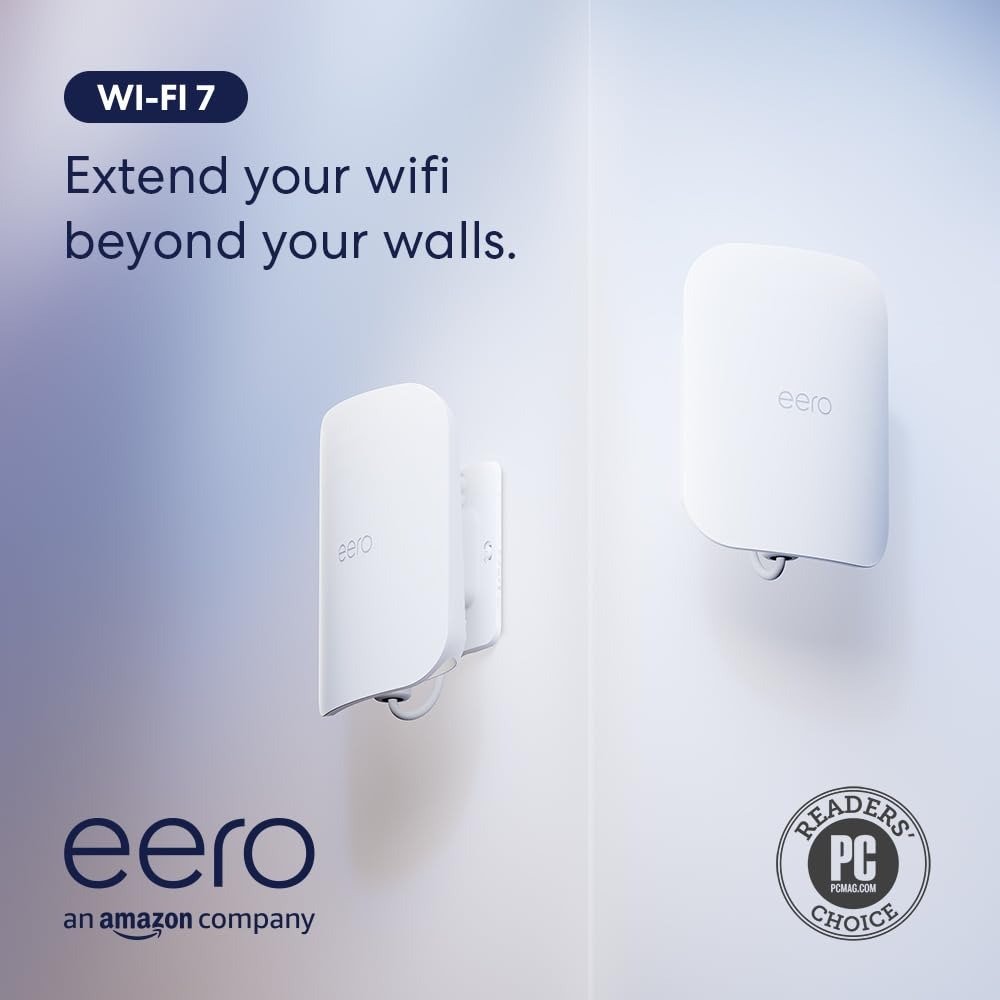
EERO OUTDOOR 7
Two bars lie.
That is usually where this problem starts. Not with a dramatic outage. Not with a dead network. Not even with obvious failure. It starts with a patio camera that hesitates before loading, a garage stream that turns grainy at the wrong moment, a backyard call that stays connected just long enough to make you trust it, then slips. The signal looks alive. The experience does not. That gap is what most people misread, and it is exactly the gap the eero Outdoor 7 was built to address. eero positions it as an outdoor Wi-Fi 7 mesh unit with IP66 weather resistance, up to 15,000 square feet of outdoor coverage, support for 100+ devices, a single 2.5GbE PoE+ port, and wireless speeds up to 2.1 Gbps. Tom’s Guide also found that it is meant to extend an existing eero network outdoors rather than replace a whole network by itself.
What makes this product interesting is not the headline spec sheet. It is the shape of the failure it targets. TechCrunch described the appeal in blunt terms: a long-standing need for outdoor coverage without becoming your own network engineer. Best Buy customer summaries repeatedly land on the same cluster of benefits—range, signal strength, coverage, easy setup, reliable connectivity. That pattern matters because this is not a router people buy for theory. They buy it when the house stops being the whole map.
The Result Looks Fine. The Problem Isn’t.
Indoor Wi-Fi failure is loud. Outdoor Wi-Fi failure is sneaky.
Inside the house, you usually know when your network is weak. Pages stall. Devices disconnect. Speeds crater. Outside, the story is messier. A phone still shows signal. A speaker still appears online. A camera still pings the app. So the brain files the system under “working,” even when the real outcome has already started to fray. That is why people keep trying to solve an outdoor problem with indoor logic: move a node closer to the window, add a cheap extender, hope the garage will somehow count as “basically inside.” It often works just enough to waste months. The Outdoor 7 exists because that half-working zone is real, persistent, and common.
Tom’s Guide tested the Outdoor 7 as a weatherized mesh node and found it straightforward to add in the app, with a full setup that took 13 minutes including physical installation. Best Buy reviewers echoed that ease-of-setup theme, while Reddit users kept describing the same practical win in plain language: better range than an indoor node in a garage, stronger coverage across a backyard, cleaner signal to cameras on outbuildings or farther parts of a property. That consistency across lab review, retailer feedback, and field anecdotes is the first reason this product earns attention.
What You’re Actually Feeling but Not Naming
Most buyers do not say, “I have an exterior propagation threshold problem.”
They say something softer. More human.
“The patio is usable, but not solid.”
“The garage works, except when I actually need it.”
“The camera is online, but the feed feels delayed.”
“The yard has Wi-Fi, but it doesn’t feel trustworthy.”
That feeling has a cost. You start checking devices twice. You avoid putting smart hardware in places you do not trust. You take calls near the door instead of where you actually want to sit. You build your routine around network doubt. That is the psychological toll of false coverage: the network is present enough to invite dependence, but unstable enough to punish it. User reports around the Outdoor 7 repeatedly describe relief in exactly those terms—coverage finally reaching a detached garage, a dock area, a large backyard, or a full acre-plus property without the usual flakiness.
The important point is this: the pain is rarely “I have no Wi-Fi.” The pain is “I cannot trust the Wi-Fi I appear to have.” That is a different problem, and it requires a different buying standard.
The Hidden Mechanism Behind the Miss
What fails first is not always speed. It is the handoff between indoor assumptions and outdoor physics.
The Outdoor 7 is built around a very specific engineering compromise: dual-band Wi-Fi 7 on 2.4 GHz and 5 GHz, no 6 GHz band, one weather-protected Ethernet port, PoE+ support, and an enclosure designed to reduce exposed ingress points for dust and water. eero explicitly says the single-port design exists to reduce pathways for contaminants, and the unit is rated IP66 with an operating range of -40°F to 131°F. In other words, this is not a Max 7 wearing boots. It is a hardened exterior mesh node optimized for range, survivability, and cleaner deployment outside.
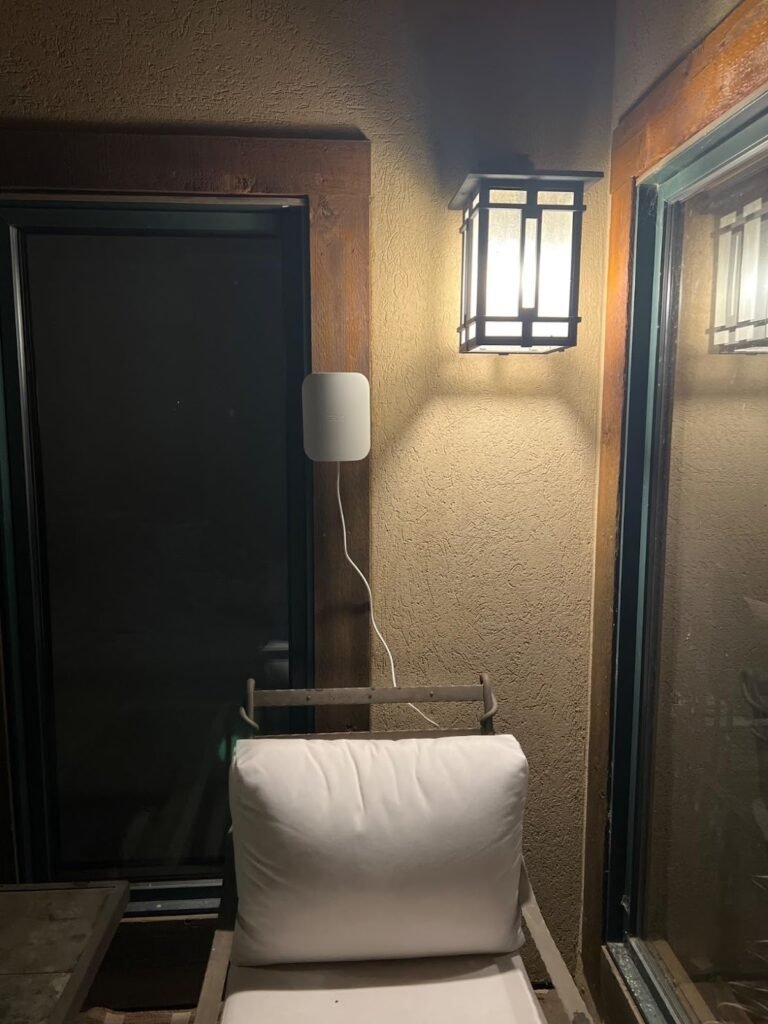
That design choice also reveals the hidden variable buyers miss: outdoor reliability is often more about the transition zone than about raw indoor horsepower. Mounting surface, distance from indoor nodes, overlap, line of sight, metal, stucco, trees, and client-device radio strength all shape the result. eero’s own support documents warn that devices choose their connection point themselves, overlap can occur if the Outdoor 7 is too close to indoor units, and metal surfaces can interfere with signal behavior. Reddit users describe that reality in a less polished way: stucco blocks signal, trees and obstructions matter, and the limiting factor can easily become the phone or camera, not the access point.
This is the miss. Buyers compare router class when they should be comparing failure geometry.
The Threshold Where the Outcome Quietly Breaks
There is a point where “good enough inside” stops meaning “usable outside.”
That is the threshold.
For this category, I would name it the Exterior Trust Threshold: the moment your indoor mesh still reports life, but the outdoor use case has already become unstable enough to alter behavior. You stop placing cameras where they should go. You avoid streaming near the pool. You treat the garage like a fringe zone. You start solving around the weakness instead of fixing it. The product becomes logical only after that threshold, not before.
Here is what that threshold usually looks like in practice:
| What you see | What is actually happening |
|---|---|
| Signal bars still appear | Reliability has already started to decay |
| Patio browsing feels “mostly fine” | Latency spikes and weak backhaul show up under load |
| One camera connects | Multiple outdoor devices begin competing for fragile margin |
| Indoor node near a window seems close enough | Building materials and placement are still stealing the handoff |
That logic matches both the product’s design and the review record. eero claims up to a 70-foot radius and 15,000 square feet outdoors, while Tom’s Guide measured a maximum range of 95 feet in its testing context and emphasized that the Outdoor 7 is about bringing eero mesh outdoors cleanly, not chasing the highest-end Wi-Fi 7 throughput class.
Why Most Buyers Misread This Too Early
Because they shop the label, not the break point.
The first mistake is seeing Wi-Fi 7 and assuming top-tier performance everywhere. The Outdoor 7 is Wi-Fi 7 capable, but it is dual-band only. eero’s own FAQ says Wi-Fi 7 improvements are not exclusive to 6 GHz, which is true, but the missing 6 GHz band still matters for top-end performance. RTINGS, in its review of the indoor eero 7 family, makes this point sharply: the lack of 6 GHz holds back the biggest Wi-Fi 7 speed gains, even if top speeds remain good for many real-world uses. Tom’s Guide says the same thing about the Outdoor 7 in simpler language: you get the outdoors-ready convenience, but not the high-performance 6 GHz band.
The second mistake is treating outdoor networking as a generic extender problem. It is not. The Outdoor 7 works exclusively with eero gear; eero states plainly that it is incompatible with non-eero Wi-Fi routers because of TrueMesh. That alone filters out a large group of buyers. If you want a universal outdoor access point for a mixed-brand network, this is the wrong lane entirely.
The third mistake is reading coverage claims like they are guarantees instead of ceilings. A 15,000-square-foot outdoor claim is useful as a directional signal, not a promise for every wall type, every yard shape, every mounting choice, or every client device. User reports reinforce that spread: some see major gains through garages and across properties, while others remind people that walls, windows, metal, and client radios can dominate the final result.
Who Is Actually Inside This Problem
This product is for a narrow reader. That is a strength, not a weakness.
You are inside the problem if most of the following are true:
| Fit signal | Why it matters |
|---|---|
| You already run an eero network | Outdoor 7 is designed to extend eero, not replace mixed-brand gear |
| Your pain starts beyond the exterior wall | This is an exterior reliability fix, not a generic indoor upgrade |
| You care more about stable outdoor coverage than peak benchmark bragging | The design favors survivability, deployment, and practical range |
| You have cameras, speakers, a patio workspace, a detached garage, a dock, or an outbuilding | These are the real use cases repeatedly mentioned by eero and reviewers |
| You want clean setup, not network hobbyism | Ease of installation is one of the most repeated positives in reviews |
That profile is consistent across eero’s product description, support pages, Amazon’s positioning, Tom’s Guide’s verdict, and the tone of user feedback. This is the outdoor node for people already living in eero land and tired of pretending the backyard is “close enough.”
Where Wrong-Fit Begins
Wrong-fit starts faster than most people expect.
Do not buy this because the words Wi-Fi 7 lit up your brain. Do not buy it because you want the strongest spec sheet in the abstract. Do not buy it if you are outside the eero ecosystem. Do not buy it if your real frustration is indoor whole-home speed and not outdoor reliability. Do not buy it if you specifically want 6 GHz throughput as the center of the purchase. eero itself says the Outdoor 7 works only with eero products, and both Tom’s Guide and RTINGS make the 6 GHz limitation impossible to ignore.
It is also the wrong fit if you think the product will override poor placement physics by sheer branding. eero notes that overlap with indoor nodes can hurt if placed too close, client devices choose where they connect, and mounting near metal can degrade behavior. Reddit users add real-world texture to that warning: orientation matters, obstructions matter, and wireless backhaul can be good, but wired can tighten consistency further.
This is not a magic halo you bolt to a wall. It is a precise fix for a precise break.
The One Situation Where This Product Becomes Logical
The eero Outdoor 7 becomes logical when your network is already eero, your indoor coverage is acceptable, and your trust gap begins exactly where your life leaves the house.
That is the moment.
At that point, the Outdoor 7 stops looking expensive and starts looking specific. It gives you IP66 weather protection, a wide outdoor coverage claim, PoE+ support or optional outdoor AC powering, compatibility with existing eero hardware, and a setup flow designed around outdoor installation. Tom’s Guide called it easy to configure and reliable, and Best Buy reviewers have it at 4.7/5 from 71 reviews, with “range,” “signal strength,” and “coverage” called out as the highest-rated themes. That is not universal praise. It is more useful than praise. It is alignment between intended job and reported outcome.
This is the cleanest way to think about it:
| If your problem is… | Then Outdoor 7 is… |
|---|---|
| Weak, inconsistent outdoor coverage on an existing eero network | A logical fix |
| Desire for maximum Wi-Fi 7 performance tier | The wrong product |
| Need for a universal outdoor AP across brands | The wrong product |
| Detached garage, patio, dock, barn, ADU, or camera zone falling outside your trust boundary | Exactly what it was made for |
That is the split. Clear enough to buy on. Sharp enough to reject on.
What It Solves, What It Reduces, and What It Still Leaves to You
What it solves is straightforward: it extends eero coverage outdoors with a device physically built for weather, longer reach, and exterior mounting. It also reduces the routine friction that comes from fake coverage—camera hesitation, patio inconsistency, garage dead edges, and the constant low-grade suspicion that the network will fail precisely when the setting changes from casual to important. Reviewers and owners repeatedly describe those outcomes in practical language rather than benchmark theater, and that is usually a good sign in this category.
What it does not solve is equally important. It does not give you 6 GHz. It does not integrate with non-eero ecosystems. It does not eliminate placement judgment. It does not guarantee that every client device will connect exactly where you want. It does not remove the value of wired backhaul where wiring is possible. It does not magically turn a poor network design into a great one. eero’s own support pages and Tom’s Guide both make those limits visible, and RTINGS’ broader assessment of the eero 7 platform reinforces why the missing 6 GHz band matters if pure performance is your main buying metric.
There is also an ongoing cost layer worth noticing. Tom’s Guide notes annual electricity cost estimates of about $5.95 in wireless mode and about $35 using the eero PoE+ switch in its test scenario, and it also points out that some network features and security tools live behind the eero Plus subscription. That does not kill the value proposition. It simply narrows it further toward buyers who care more about deployment sanity and outdoor stability than about squeezing every feature free of charge.
Final Compression
If your Wi-Fi problem is still inside the house, keep walking.
If your problem begins the moment life moves outside, stop here.
The eero Outdoor 7 is not the outdoor answer for everyone. It is the answer for a very particular kind of failure: the point where indoor Wi-Fi remains technically present, but outdoor trust has already broken. That is why its missing 6 GHz band matters less to the right buyer than its weather hardening, eero-only integration, easier setup, PoE+ flexibility, and unusually large outdoor coverage target. That is also why the wrong buyer will overpay for it and the right buyer will feel the decision settle almost immediately.
If your break point starts at the exterior wall, your devices already live on eero, and the yard, garage, dock, or outbuilding has become the part of the property you no longer trust, this is the logical next step.
Transparency Note:
This analysis is built on aggregated real-world experience. It extracts what repeatedly holds, what breaks, and what users uncover only after living with the system—then shapes it into a clear model you can use immediately. Think of it as structured experience, refined and presented so you don’t have to learn it the hard way.
“A quick note: Don’t believe the star ratings, but trust personal experience. This article is a compilation of collected experiences”