TempPro TP829 Review: The Grill Looked Ready. The Inside Wasn’t.
TEMP PRO TP829
The chicken had grill marks in the right places. The skin pulled tight and glossy. Everyone was already sitting down, plates out, and I cut into the thickest part of the thigh anyway — habit more than doubt — and found that faint pink stain near the bone that means dinner isn’t actually ready, even though every visual cue said otherwise.
That gap, between what meat looks like and what it actually is, is the real subject of this review. Not probes. Not range. That gap.
Guessing Meat Temperature: The Result Looks Fine. The Problem Isn’t.
Why does meat that looks finished still come out wrong? Because “looks done” was never a temperature. It’s a guess built from color, char, and how long the thing has been over heat — and every one of those signals lies under the right conditions.
A chicken thigh can look fully cooked at 150°F and still sit under the 165°F line that actually matters. A steak pulled at the right color can still be ten degrees short of your target, because carryover heat — the rise that keeps happening after food leaves direct heat — adds a second layer of guesswork on top of the first.
This isn’t really about skill. Even people who cook constantly are reading a proxy, not a measurement. The eye was never built to read internal temperature.
Constantly Checking the Grill: What You’re Actually Feeling but Not Naming
Here’s the part nobody quite says out loud: the annoyance isn’t the cooking. It’s the checking.
It’s walking out to the grill for the fourth time in an hour, lifting the lid, losing heat you’ll have to earn back, and walking away no more certain than before. Call it the walk-back tax — the time, fuel, and patience spent re-verifying something a thermometer should have told you the first time.
On a long smoke, that tax compounds. You’re either tethered to the yard for six or ten hours, or you’re inside, half-listening for a timer nobody set, running the math on whether it’s been long enough yet.
Why Wireless Thermometers Lose Signal: The Hidden Mechanism Behind the Miss
Why do some “wireless” meat thermometers work fine on the counter and fall apart the moment you close the lid? Because not all wireless is the same wireless.
Most phone-paired probes run on Bluetooth — built for earbuds and fitness trackers, not for punching through a closed steel lid, a brick wall, or sixty feet of open yard. Owners in grilling forums describe exactly this pattern: solid signal indoors, dropouts the second the lid comes down.
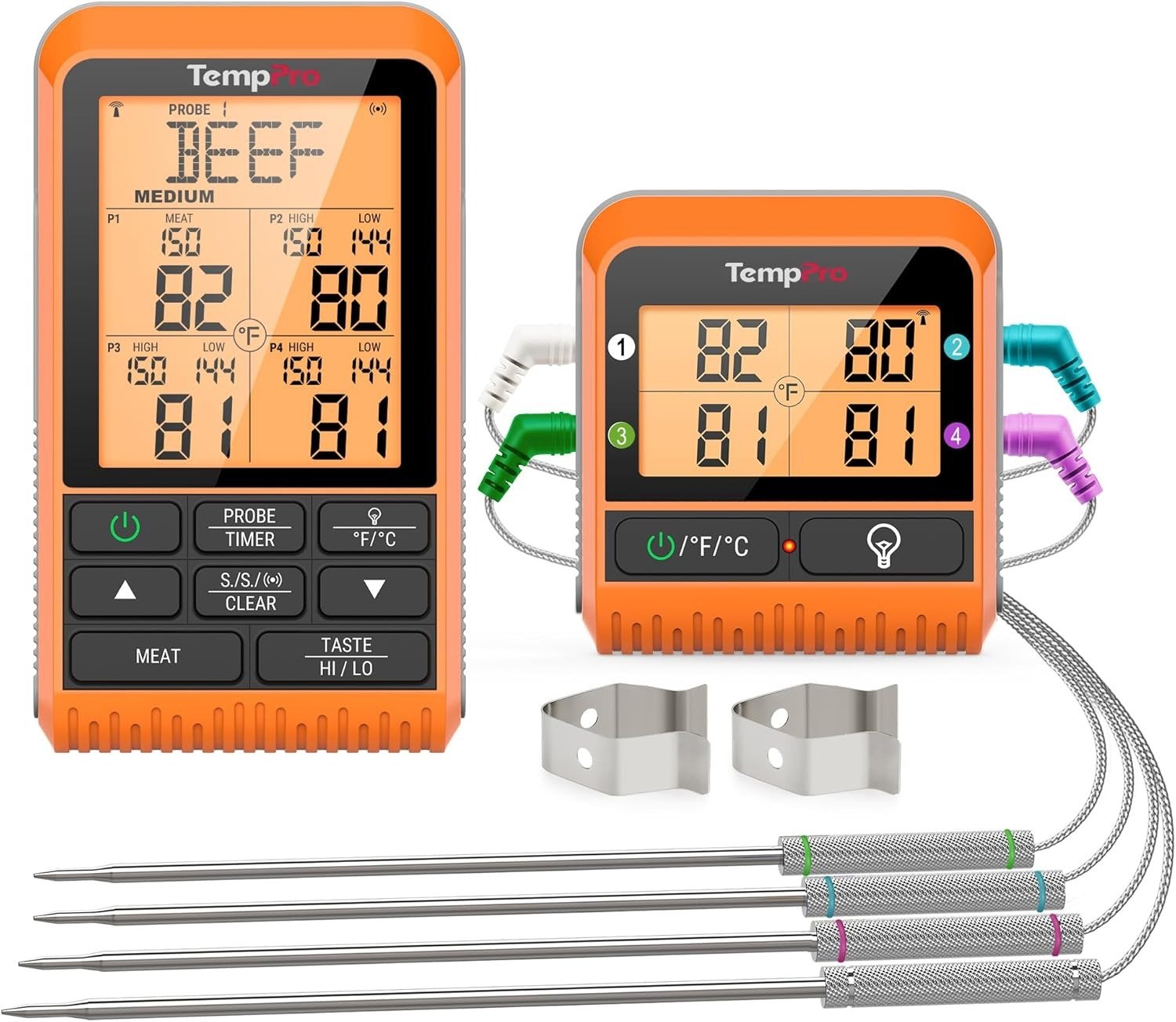
The TP829 sidesteps that specific failure with RF (radio frequency) transmission instead of Bluetooth, at a frequency that tolerates obstacles better. It’s worth being precise here, because this is where buyers get confused: the four probes are wired, by cable, into a transmitter box that sits near the grill. What’s wireless is the link from that transmitter to the handheld receiver, rated up to 1,000 feet. It’s not a fully cable-free system — it’s a longer-range signal between two boxes, with the last few feet to the meat still handled by a wire.
Safe Meat Temperature Chart: Where the Outcome Quietly Breaks
Why do the same five or ten degrees matter so much? Because doneness isn’t a slope — it’s closer to a cliff.
| Food | Safe Internal Temp |
|---|---|
| Poultry (whole, parts, ground) | 165°F |
| Ground beef, pork, lamb | 160°F |
| Beef, pork, lamb (steaks, roasts, chops) | 145°F + 3-min rest |
| Fish | 145°F |
These are USDA minimums, not style preferences — you can always cook further for texture, but going under them isn’t a choice, it’s a risk. The quiet failure point is usually poultry: the visual cues that read as “done” often show up before the number does.
TempPro TP829 vs Cheaper Thermometers: Why Most Buyers Misread This Too Early
Why do so many people compare this against the wrong thing? Usually because they stop at probe count and price.
The first trap is the name itself. This exact listing reads “TempPro TP829 (Previously ThermoPro)” — not a typo, not a knockoff. The company is mid-rebrand from ThermoPro to TempPro, and the listing confirms delivery is random: you might unbox either branding, with identical hardware inside. Strange detail to see on a product page, but an honest one.
The second trap is treating every “wireless meat thermometer” as interchangeable:
| Model | Probes | Wireless Range | Probe Type | Best Fit |
|---|---|---|---|---|
| TP826 / TP828 | 2 | 500 ft (RF) | Wired to transmitter | Casual, single-zone cooks |
| TP829 (this one) | 4 | 1,000 ft (RF) | Wired to transmitter | Multi-item, long-distance monitoring |
| TP862B | 2 | RF, shorter range | Cable-free, rechargeable | Rotisserie, no dangling wires |
| MEATER Plus | 1 | Bluetooth + booster | Fully cable-free | App users wanting zero wires |
| Inkbird IBT-4XS | 4 | Bluetooth | Wired to transmitter | Cook-history graphing via app |
Buy on probe count alone and you’ll either overpay for range you don’t need, or underbuy on range you’ll regret the first time you smoke something at the far end of the yard.
Who Needs a 4-Probe Wireless Thermometer: Who Is Actually Inside This Problem
Who is this actually for? Anyone cooking more than one thing, or one zone, at a time.
That’s the holiday cook running a turkey and a ham on the same day. The person smoking a brisket on one rack and ribs on another, needing both readings without opening the lid twice. The household where a spouse, a teenager, or a guest needs to glance at a screen and read a number without downloading anything. And, realistically, it’s a common Father’s Day or birthday pickup for a cook who already grills often enough that another thermometer is a genuine upgrade, not clutter.
If you’re cooking one steak on one grate, most of this is more machine than you need.
TempPro TP829 Pros and Cons: Where Wrong-Fit Begins
Why do a small number of buyers end up disappointed with a product most people rate well? Because they bought it for a job it was never built to do.
| You should buy this if… | Look elsewhere if… |
|---|---|
| You cook multiple items or zones at once | You want phone-based cook-history graphs |
| You want range that survives walls and lids | You need fully cable-free probes (rotisserie) |
| You don’t want apps, pairing, or accounts | You’re chasing lab-grade precision above all else |
| More than one person needs to read it | You only ever cook one item at a time |
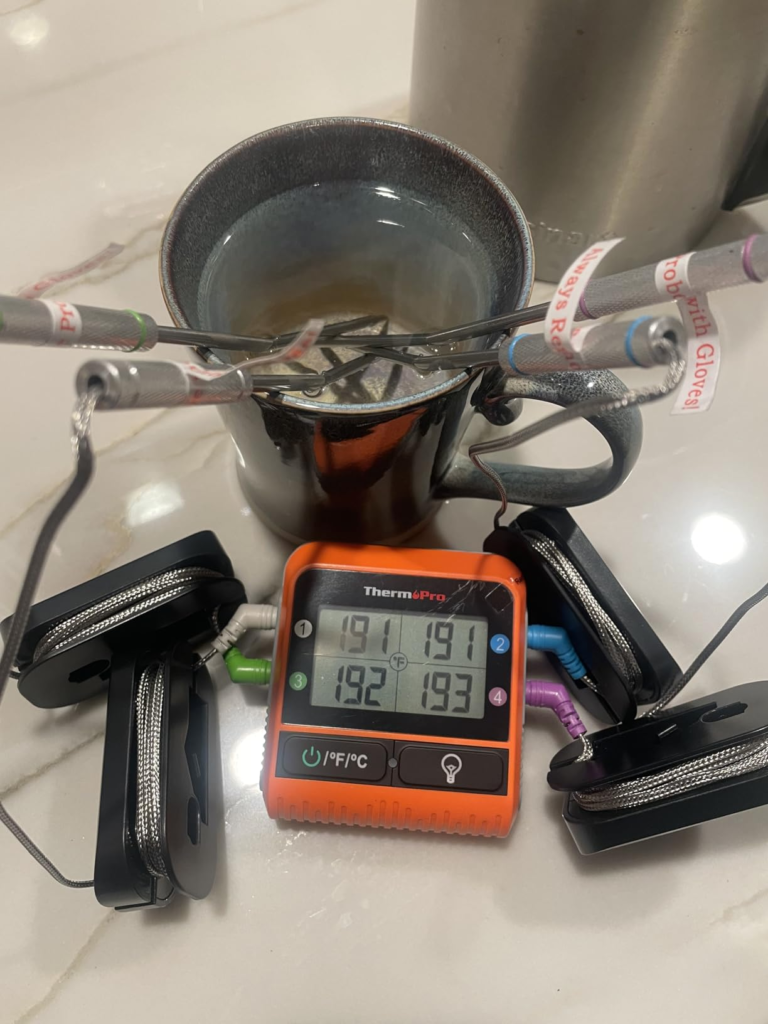
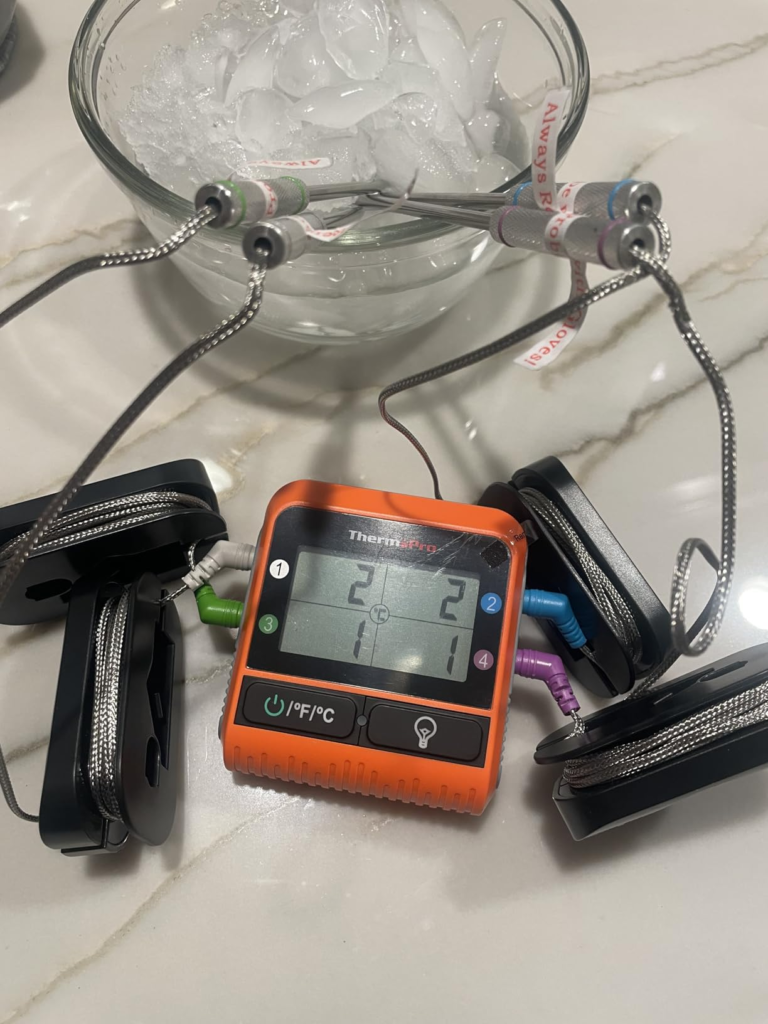
The recurring complaint, once you get past the star rating, isn’t accuracy — most owners find it tracks closely against a trusted reference thermometer when checked in ice water or boiling water. It’s probe longevity. Some owners get years of regular use. Others are emailing for a warranty replacement within the first several months, usually on one probe out of four rather than the whole unit. The registration-based 3-year warranty exists largely because of this pattern, and it’s worth doing at purchase, not after something fails.
TempPro TP829 Review: The One Situation Where This Product Becomes Logical
If you’ve recognized your own kitchen in the last few sections, here’s what you’re actually buying.
| Spec | Detail |
|---|---|
| Probes | 4 color-coded stainless steel, wired to transmitter |
| Wireless range | Up to 1,000 ft (RF, not Bluetooth) |
| Temperature range | 14°F to 572°F (-10°C to 300°C) |
| Rated accuracy | ±1.8°F (±1.0°C) |
| Display | Backlit LCD receiver, all 4 probes at once |
| Power | 4 AAA batteries in transmitter + 4 AAA in receiver |
| Water resistance | IPX4 (splash resistant, not submersible) |
| App or Wi-Fi required | No |
| Certification | NSF certified |
| Warranty | 1 year, extendable to 3 with registration |
| Brand note | Currently transitioning from ThermoPro to TempPro branding |
Setup is genuinely simple: batteries in, probes in, power on, and the two units find each other automatically. No account, no app store, no pairing code. That simplicity is the actual product — the range and probe count just make it useful for more occasions.
TempPro TP829 Features Explained: What It Solves, What It Reduces, and What It Still Leaves to You
Why mention what this doesn’t do? Because the fastest way to regret a purchase is to expect it to solve a problem it was never built for.
| It solves | It reduces | It still leaves to you |
|---|---|---|
| Guessing doneness by sight or timing | Trips back and forth to the grill | Fire and temperature management |
| Missed timing that leads to overcooking | Anxiety during long, unattended smokes | Seasoning, technique, and rest time |
| Confusion over which probe tracks what | Dependence on a phone while cooking | Verifying a new probe before you trust it |
It won’t manage your fire, hold a low-and-slow temperature for you, or replace judgment built from cooking the same cut a few times. Test any new probe in ice water (32°F) and boiling water (212°F at sea level) before your first real cook — two minutes that can catch a rare faulty unit before it costs you a dinner.
TempPro TP829 FAQ: Your Questions Answered
| Question | Answer |
|---|---|
| Is the TempPro TP829 the same as the ThermoPro TP829? | Yes. The manufacturer is mid-rebrand from ThermoPro to TempPro, and the listing itself confirms delivery is random — you may receive either branded box, with identical hardware inside. |
| How accurate is the TempPro TP829? | Rated accuracy is ±1.8°F (±1.0°C). Test any new probe in ice water and boiling water before your first real cook — it takes two minutes and catches the rare faulty unit early. |
| Does the TP829 need Wi-Fi, Bluetooth, or an app? | No. It uses RF between the transmitter and receiver, with no app, account, or pairing required. |
| How many batteries does it need? | Eight AAA total — four in the transmitter, four in the receiver. Keep spares on hand; the receiver tends to run through them faster than expected. |
| Can I use it in the oven or on a rotisserie? | The oven, yes, within its rated temperature range. Rotisserie is workable but not ideal, since the probes are wired rather than cable-free — a fully wireless probe system suits a spinning rotisserie better. |
| What’s the real difference between the TP829 and the 2-probe TP826/TP828? | Probe count and range: four probes and 1,000 feet here, versus two probes and 500 feet on the smaller models. If you only ever cook one item at a time, the smaller version is the more logical buy. |
TempPro TP829 Final Verdict: The Decision, Simplified
Strip away the specs and it comes down to one question: are you tired of guessing, or tired of checking, or both?
If the answer is yes, and the situations above sound like your kitchen rather than someone else’s, this is the logical next step — not a bigger decision than it needs to be. If you specifically need phone-based cook-history graphs or fully cable-free probes, this isn’t that product, and it won’t pretend otherwise.
Transparency Note:
This analysis is built on aggregated real-world experience.
It extracts what repeatedly holds, what breaks, and what users uncover only after living with the system—then shapes it into a clear model you can use immediately.
Think of it as structured experience, refined and presented so you don’t have to learn it the hard way.
“A quick note: Don’t believe the star ratings, but trust personal experience. This article is a compilation of collected experiences.”