GOVEE HYGROMETER THERMOMETER REVIEW: YOUR ROOM LOOKS FINE. THAT’S EXACTLY THE PROBLEM.
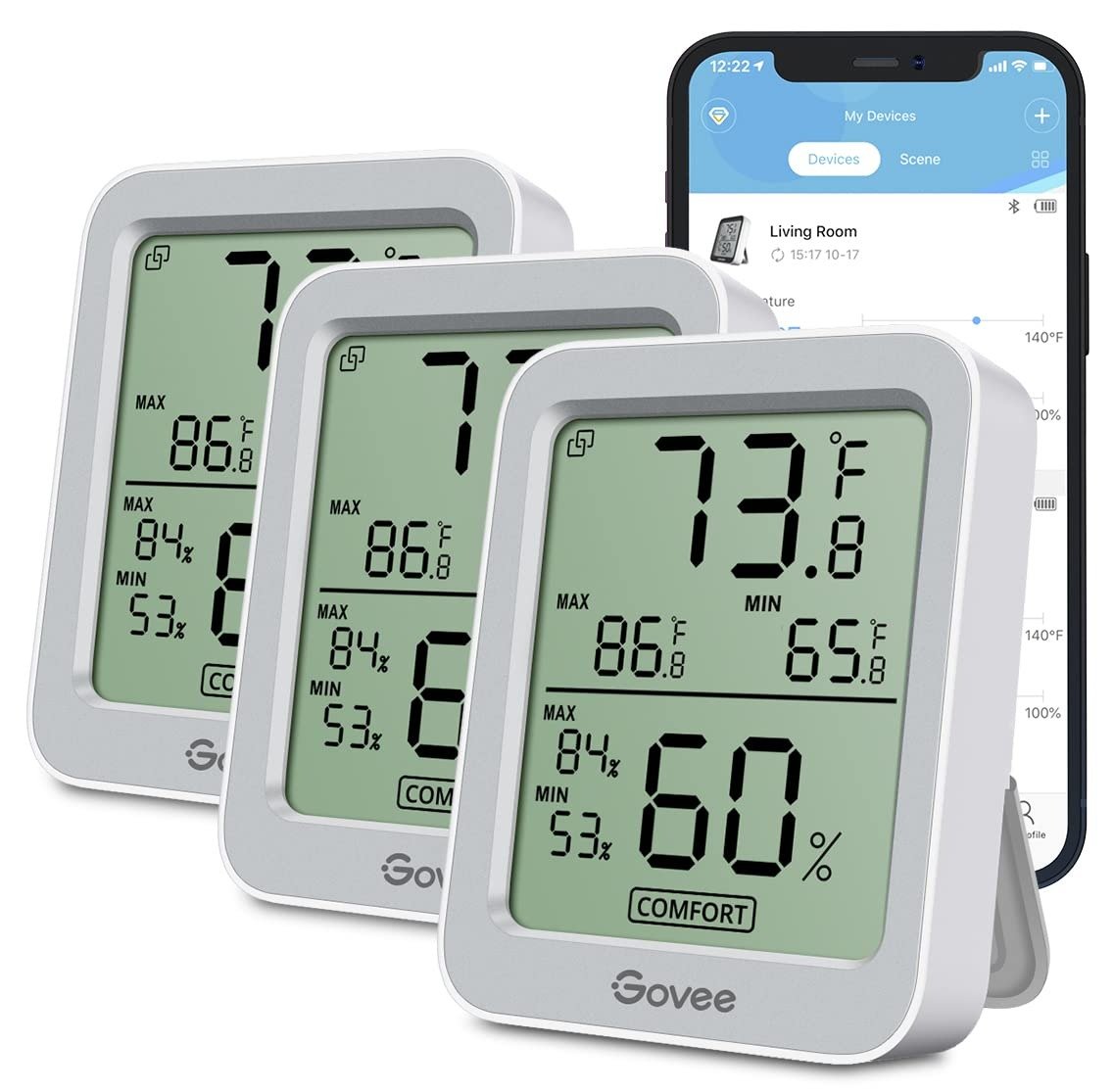
GOVEE HYGROMETER THERMOMETER
Indoor Air Quality Warning Signs: The Result Looks Fine. The Problem Isn’t.
The rooms and collections that end up ruined almost never look like disaster movies first. No burst pipe, no wall of visible mold — just a bedroom that smells fine, a humidor that looks sealed, a guitar that seems perfectly in tune, right up until the exact week it isn’t.
That’s the part nobody warns you about. Air doesn’t announce itself. A space can look, smell, and feel completely normal while the one number that predicts almost everything that eventually goes wrong — relative humidity — has already drifted somewhere it shouldn’t be.
We spent time with the spec sheet, the manuals, and a long list of real owner reviews for the Govee Bluetooth Hygrometer Thermometer — the compact, app-only, 262-foot version — to find out how much that one number actually tells you, and exactly where the device’s own limits quietly start.
Musty Smell in the House: What You’re Actually Feeling but Not Naming
Here’s the feeling first, before the numbers. Slightly heavy morning air. Windows that fog a little faster than they used to. A basement that smells “fine” until you’ve been down there ten minutes and your nose adjusts. Cigars burning a touch faster than last month. A guitar that won’t hold tune the way it did in spring.
None of that reads as an emergency. That’s exactly why it isn’t caught early. Most people only start searching “why does my house smell musty” or “why is my humidor humidity off” after the visible damage has already shown up — a soft patch on drywall, a cracked wrapper, a cloudy wine label. By then the actual air condition has usually been wrong for weeks.
Relative Humidity vs Surface Moisture: The Hidden Mechanism Behind the Miss
The mechanism is simpler than most people expect, and it’s the reason a room can “test fine” and still cause damage. Relative humidity is a room-wide average. It’s not what’s happening on any single surface.
A bedroom can read a perfectly reasonable 48% RH in the middle of the room while a cold exterior wall, an uninsulated pipe, or a window frame sits close to saturation right at the surface. Warm indoor air hits that cold spot, releases its moisture as condensation, and that’s where mold actually starts — not in the open air a hygrometer samples, but in the six inches of surface it doesn’t.
This is also why two people can own the identical sensor and get completely different outcomes. One places it in the open middle of a room; the other places it near the corner, the closet, or inside the actual humidor or wine rack. Only one of them is measuring the risk that matters.
Mold Humidity Threshold: The Point Where the Outcome Quietly Breaks
There’s an actual number here, and it’s worth knowing regardless of which device you use. The EPA recommends keeping indoor relative humidity below 60%, ideally between 30–50%. Above roughly 60% RH, with the right surface temperature, mold can begin germinating within 24 to 48 hours. It isn’t an alarm that goes off — it’s a slow, quiet crossing.
Other environments carry their own thresholds, and they’re tighter than most people assume:
| Environment | Ideal RH range | What breaks outside it |
|---|---|---|
| Home / bedroom (general) | 30–50% | Below 30%: dry skin, static, irritated sinuses. Above 60%: mold can germinate in 24–48 hrs |
| Cigar humidor | 65–72% | Below 65%: cracked wrappers, harsh fast burn. Above 72–75%: mold risk, tobacco beetles above ~70°F |
| Wine storage | 50–70% | Below 50%: drying corks, oxidation risk. Above 70%: label mold, mildew |
| Guitars, pianos, hardwood floors | 35–55% | Outside range: cupping, gapping, cracked finishes, tuning instability |
| Baby’s room | 40–60% | Too low: congestion, dry cough. Too high: dust mites, mold |
None of these thresholds care whether you noticed. That’s the entire argument for a sensor in the first place — not comfort, prevention.
Hygrometer Accuracy: Why Most Buyers Misread This Too Early
This is where most people make their first real mistake, and it happens before the device even arrives — during the comparison itself.
Buyers line up the “connecting range” numbers across listings — 164 ft, 196 ft, 230 ft, 262 ft — and assume the bigger number means better remote monitoring. It doesn’t. Every one of those figures describes Bluetooth range in open air, phone-to-sensor, inside the same building. None of them mean you’ll get an alert on vacation, at work, or two floors away through concrete. That capability belongs to Wi-Fi models or a separate Wi-Fi gateway add-on — a different product, not a bigger number on the same one.
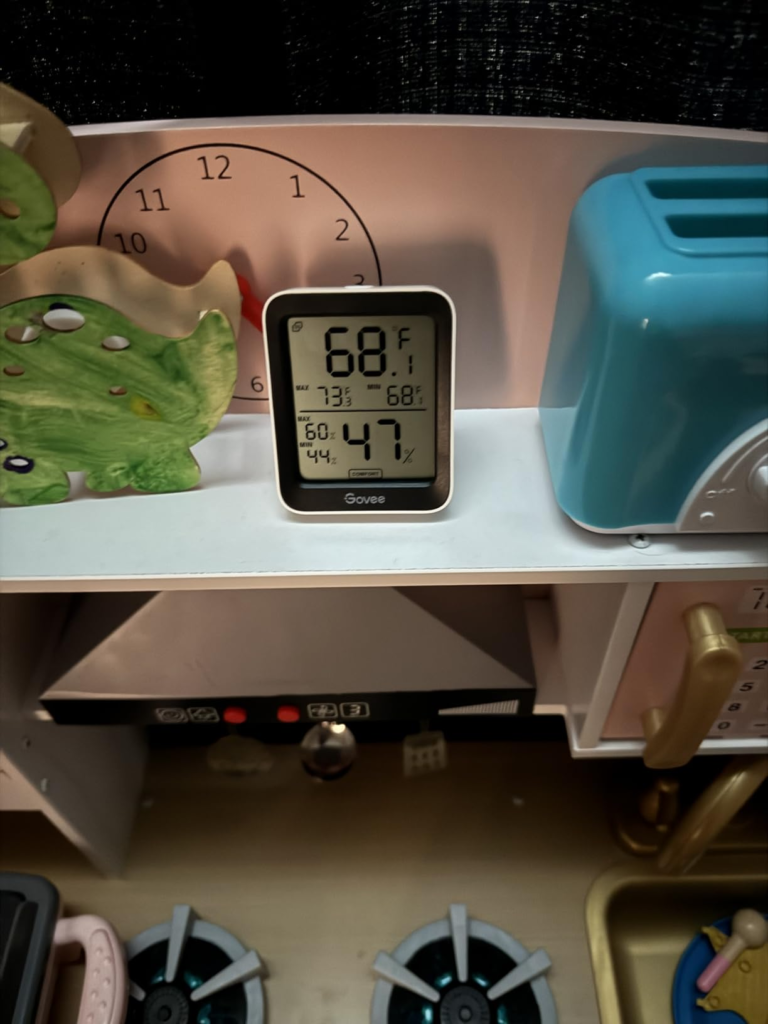
The second mistake is treating “±3% RH” as a rounding error. At the edges of a tight range — a humidor sitting at 68%, a nursery at 42% — a 3-point margin is the difference between comfortably inside your target and quietly outside it. Every consumer hygrometer, not just this one, drifts with age and benefits from an occasional calibration check. Owners who’ve used this exact sensor inside humidors report the same pattern: accurate out of the box, then a slow creep over months that a five-minute calibration corrects.
Home Humidity Monitor Uses: Who Is Actually Inside This Problem
Strip away the marketing categories and the real audience for a sensor like this is anyone who has something that degrades quietly and doesn’t get checked often enough.
| You are… | What you’re actually protecting |
|---|---|
| A homeowner or renter in an older building, a basement, or a humid climate | Structural wood, drywall, air quality, and your own lungs |
| A cigar collector without a built-in climate system | Wrapper integrity, burn quality, and years of aging potential |
| A wine owner without a dedicated cellar | Cork seal, oxidation, and label condition |
| A guitar, piano, or instrument owner | Tuning stability, finish, and joinery |
| A new parent | A nursery that isn’t quietly too dry or too damp |
| A grower with a greenhouse, propagation tent, or terrarium | Germination rates and the specific range your plants or reptile actually need |
If you recognize yourself in more than one row, that’s normal. Most buyers do.
Govee Hygrometer Limitations: Where Wrong-Fit Begins
This exact version — compact, Bluetooth-only, no on-device screen — isn’t the right pick for everyone, and it’s worth saying plainly rather than discovering it after checkout.
Skip this one if you want alerts while you’re away from the property. A vacation home, a rental you don’t live in, a cabin you check on remotely — none of that works over Bluetooth. That needs the range of the phone itself, which means Wi-Fi or a paired gateway, not this model.
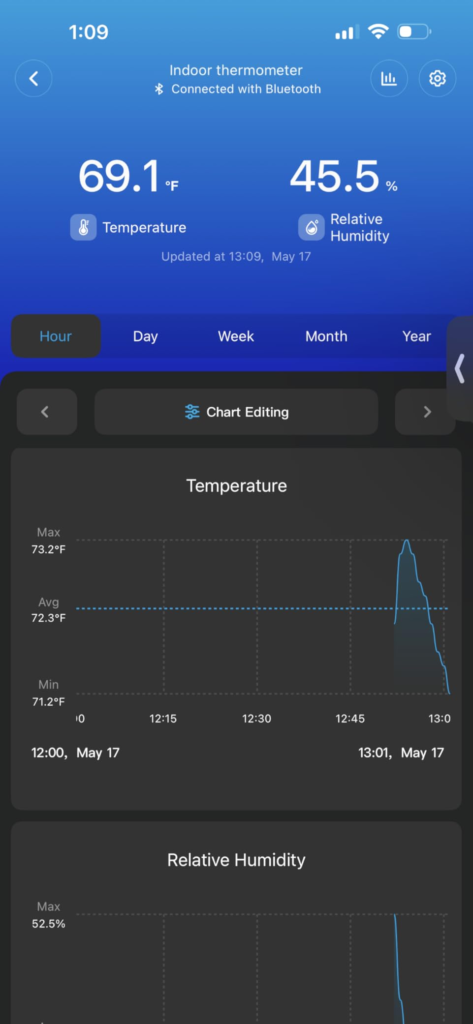
Skip it if you want a wall-mounted number you can glance at without opening an app. This version has no display. Everything lives in the phone app. Govee’s own larger siblings carry an LCD screen if that’s what you actually pictured when you thought “thermometer.”
Skip it if you’re monitoring a fridge, freezer, or anything behind metal. Cold drains the battery faster, and metal blocks the signal — something Govee notes in its own documentation for this sensor line.
And skip it if your home is large or heavily walled. The 262 feet on the box is a best-case, no-obstacles number. Two floors, brick, or a few interior walls will cut that down well before you hit the marketed distance.
Govee Hygrometer Thermometer: The One Situation Where It Becomes Logical
Here’s who it’s actually built for: someone monitoring one or two spaces they’re regularly near — a bedroom, a home office, a humidor, a wine rack, a nursery — who wants an accurate baseline, a history that catches slow drift, and a phone alert the moment they cross a line they’ve set, without paying for whole-home Wi-Fi coverage they don’t need yet.
| Spec | What it actually is |
|---|---|
| Connectivity | Bluetooth only — not the Wi-Fi version |
| Range | Up to 262 ft, open air, no obstacles |
| Accuracy | ±0.54°F temperature, ±3% RH humidity |
| Refresh rate | Every 2 seconds |
| Data | 20 days stored on-device, up to 2 years exportable as CSV |
| Display | None — app only, via Govee Home |
| Power | Single replaceable battery, no charging cable |
At this price point — solidly in budget-sensor territory, not smart-home-investment territory — that’s a fair trade. You’re not paying for a screen you won’t check or range you won’t use.
Govee Hygrometer Thermometer Review: What It Solves, What It Reduces, and What Still Depends on You
| It solves | It reduces | It still leaves to you |
|---|---|---|
| Not knowing your actual RH and temperature at all | The chance of catching drift too late, thanks to logged history | Actually ventilating, dehumidifying, or humidifying in response |
| Guessing instead of measuring | The odds of an unnoticed slow creep past your threshold | Calibrating it every few months against a known reference |
| Blind spots in rooms you don’t check daily | Surprise, if you place it near the real risk surface, not the open middle of the room | Remembering it’s local — not a substitute for Wi-Fi if you travel |
It doesn’t fix your air. It tells you, accurately and early, when your air needs fixing. That’s the whole job, and it does that job well within its actual range.
Govee Hygrometer Thermometer FAQ: Quick Answers Before You Buy
| Question | Answer |
|---|---|
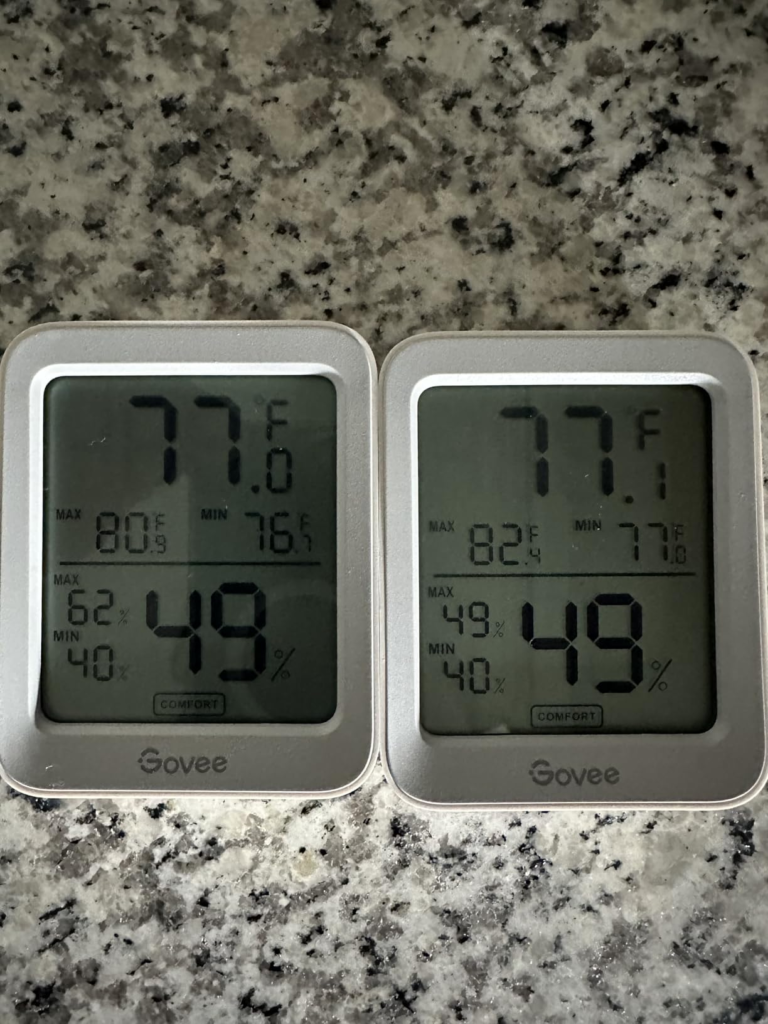
| Is the Govee Hygrometer Thermometer accurate? | Yes, within its stated ±0.54°F and ±3% RH margins, using a Swiss-made sensor. Like any consumer hygrometer, accuracy drifts slightly over time and benefits from an occasional calibration check. |
| Does it work without Wi-Fi? | Yes — this version runs entirely on Bluetooth and never needs a Wi-Fi network. That’s also its main limitation: no Wi-Fi means no remote connection. |
| Will I get a notification if I’m not home? | No, not with this Bluetooth-only version. Alerts only reach your phone within Bluetooth range of the sensor. For away-from-home alerts, you’d need Govee’s Wi-Fi model or a Wi-Fi gateway. |
| Does it have a screen? | No. This compact version has no on-device display — all readings live in the Govee Home app. |
| How long does the battery last? | Govee’s own estimates for similar models sit around six months, though real-world owners in normal room conditions frequently report well over a year before a swap. |
| Is it good for a cigar humidor, wine rack, or reptile tank? | Yes, with one caveat: place it as close as possible to what you’re actually protecting, not just in the general room, and expect to calibrate it periodically for precision-sensitive uses like cigars. |
Govee Hygrometer Thermometer Review: Final Verdict and the Next Step
If the blind spot in this article sounds familiar — a space that looks fine while the actual number quietly drifts past where it should be — the fix isn’t complicated. It’s a sensor placed near the real risk surface, checked occasionally, and left alone to do its one job.
This version handles that job accurately and cheaply, for anyone working within normal Bluetooth range of their own home. It won’t follow you on vacation, and it won’t put a number on your wall. For everything closer than 262 feet, it will quietly tell you the truth before your nose, your wallet, or your cigars do.
Transparency Note:
This analysis is built on aggregated real-world experience.
It extracts what repeatedly holds, what breaks, and what users uncover only after living with the system—then shapes it into a clear model you can use immediately.
Think of it as structured experience, refined and presented so you don’t have to learn it the hard way.
“A quick note: Don’t believe the star ratings, but trust personal experience. This article is a compilation of collected experiences.”