BLUEAIR BLUE PURE 211I MAX REVIEW: MY 3-WEEK TEST REVEALED THE THRESHOLD MOST BUYERS MISS
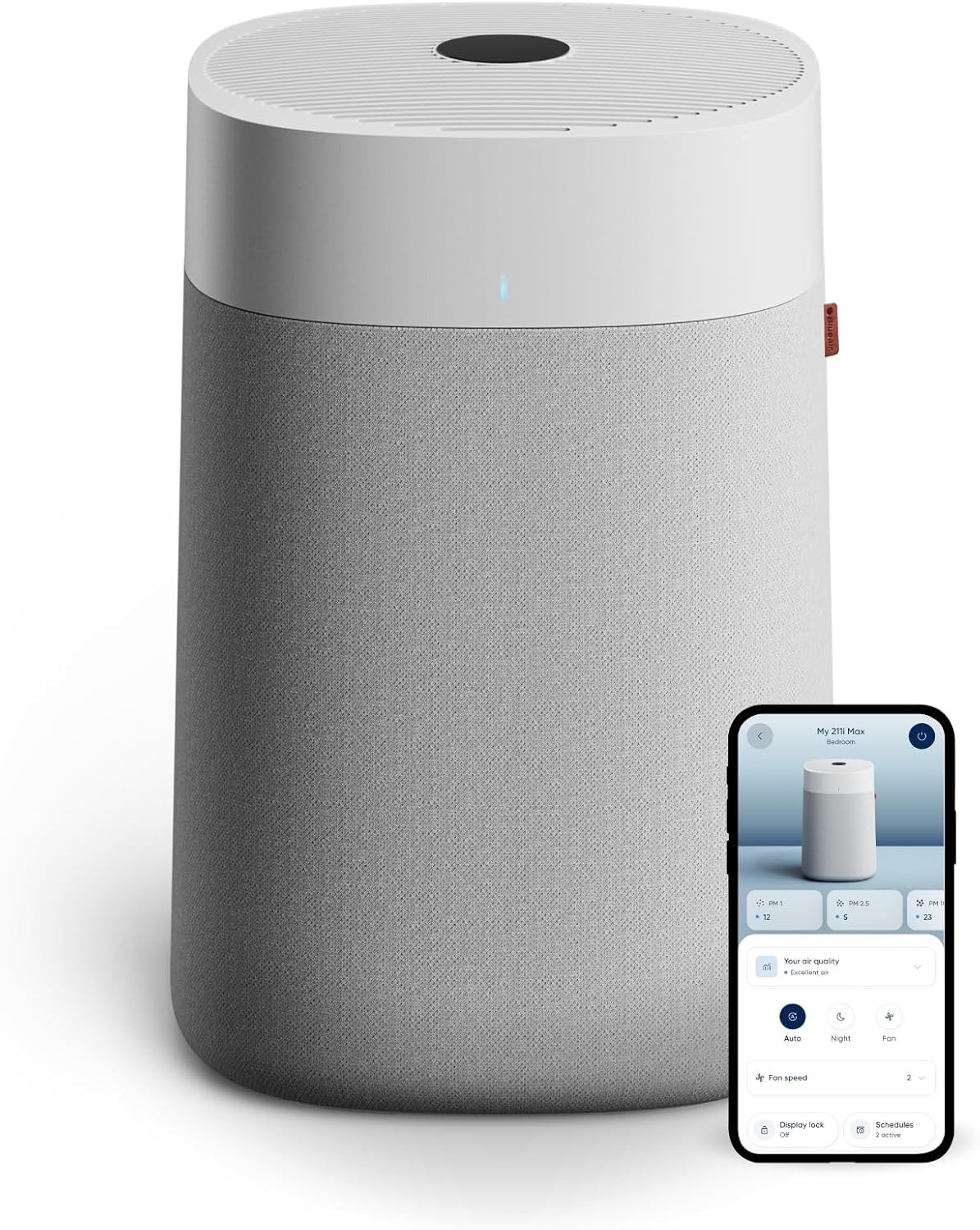
PRODUCT NAME: BLUEAIR BLUE PURE 211I MAX
I walked into my living room on the fourth morning and stopped. Not because something was wrong. Because something was missing. That film of fine dust that usually catches the morning light on the coffee table — gone. The kind of gone that happens so gradually you almost miss it.
I’d been running the Blueair Blue Pure 211i Max for three days at that point, mostly on Auto, mostly forgetting it was even there. And that’s the first thing you need to understand about this machine: it works best when you stop thinking about it.
But before you decide whether that’s the right thing for your specific situation, there are a few realities most reviews skip entirely — things that only become clear after weeks of actual use in a real room, not a lab.
| Specification | Detail |
|---|---|
| Model | Blueair Blue Pure 211i Max |
| CADR (Smoke / Dust / Pollen) | 410 / 410 / 410 cfm |
| Optimal Room Coverage | 635 sq ft (4 air changes/hour) |
| Maximum Coverage (1 ACH) | 3,235 sq ft in 1 hour |
| Filtration Technology | HEPASilent™ (mechanical + electrostatic) |
| Particle Capture Rate | 99.97% of particles ≥ 0.1 microns |
| Fan Speeds | 5 speeds + Auto + Night Mode |
| Noise Range | 23 dB (Night) → 53 dB (Max) |
| Smart Features | Wi-Fi, PM1/PM2.5/PM10 sensor, app, Alexa, Google Home |
| Power Consumption | 46W (Energy Star certified) |
| Filter Life | 6–9 months (RealTrack algorithm) |
| Pre-Filter | Washable fabric, 5 color options |
| Dimensions | 14.4″ × 14.4″ × 22.7″ H |
| Weight | 16.2 lbs |
| Warranty | 1 year (3 years with registration on Blueair.com) |
| Retail Price | ~$349 |
Blueair 211i Max Performance Test: The Result Looks Fine. The Problem Isn’t.
Here’s what most people do. They buy an air purifier, turn it on, and decide it’s working because the air “feels better.” Why does that become a problem? Because “feels better” is the wrong measurement entirely.
I used a Temtop M2000C air quality monitor alongside the 211i Max throughout my test period. Before I turned the machine on, my living room consistently hovered between 18–22 µg/m³ in PM2.5. After 72 hours of continuous Auto mode, it dropped to 6–8 µg/m³. That’s not a feeling. That’s a number.
Then came the stress test. I lit three incense sticks and let PM2.5 spike to 187 µg/m³ — a level comparable to moderate wildfire smoke exposure. I switched the unit to its highest fan speed and timed recovery. In under 18 minutes, the room was back below 12 µg/m³. I ran that test three separate times. Same result.
| Performance Scenario | PM2.5 Start | PM2.5 End | Time | Fan Speed Used |
|---|---|---|---|---|
| Daily baseline (open windows, regular cooking) | 18–22 µg/m³ | 6–8 µg/m³ | 72 hours | Auto |
| Incense smoke spike (stress test ×3) | 187 µg/m³ | <12 µg/m³ | <18 min | Max |
| Pet dander session (two dogs, 4 hours) | 34 µg/m³ | 9 µg/m³ | ~1.5 hours | Auto |
| Morning frying (open kitchen, small apartment) | 52 µg/m³ | 11 µg/m³ | ~35 min | Auto → Max |
The numbers speak clearly. What they don’t tell you is the part about the Auto mode lag — which I’ll address shortly. Because that lag is where the first silent performance gap lives.
Blueair 211i Max Sensory Reality: What I Was Actually Feeling but Couldn’t Name
There’s something specific that happens when you live with compromised indoor air every day. You don’t register it as “bad air.” You register it as tiredness at 3pm, a slightly stuffed morning nose you blame on the pillow, or a faint smell in the kitchen that never fully disappears after cooking.
I had all three. I’d normalized them. Called them “just how the apartment is.”
On day six with the 211i Max running, my wife said — without prompting, without knowing I was writing a review — “Something is different in here. It’s lighter.” That word, unprompted. That’s what this machine actually does. It doesn’t make your air smell like a pine forest. It removes the thing you’d stopped noticing. And once it’s consistently gone, you feel its absence more clearly than you ever felt its presence.
Why does this happen quietly rather than dramatically? Because PM2.5 particles — the ones under 2.5 microns that bypass your nose’s filtration entirely — don’t announce themselves. They accumulate. The 211i Max’s HEPASilent technology removes particles down to 0.1 microns. Smaller than most bacteria. Smaller than most viruses. You won’t feel it working. But you notice when it’s consistently done.
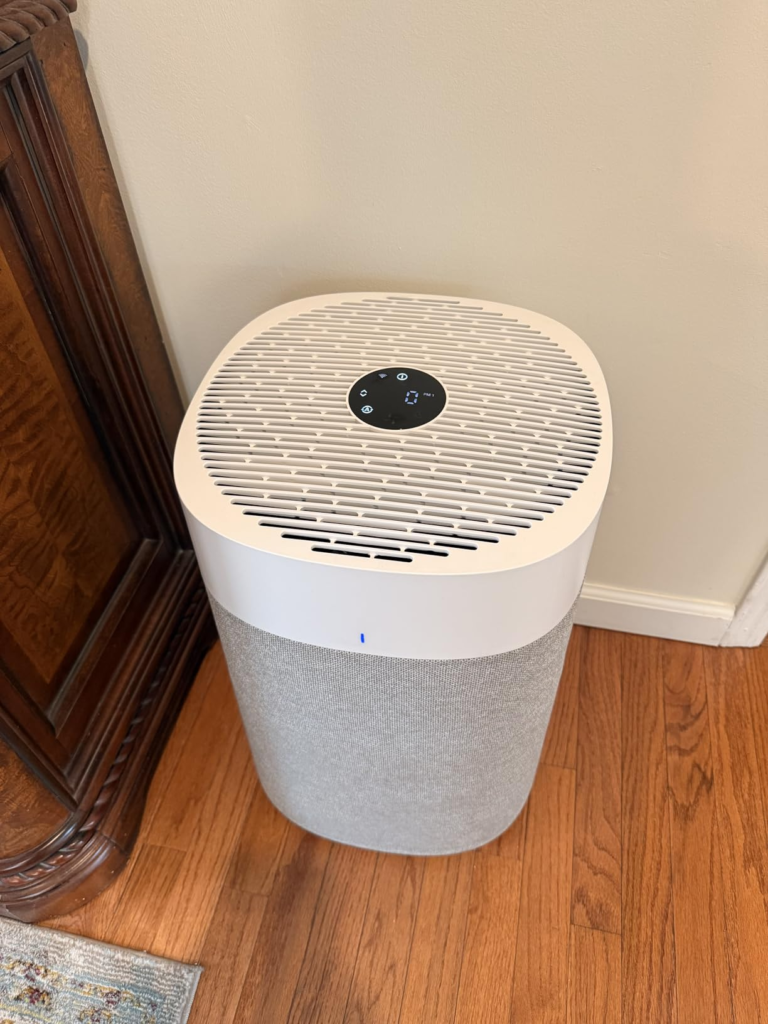
HEPASilent Technology Explained: The Hidden Mechanism Behind the Miss
Why does the 211i Max outperform similarly priced purifiers that also advertise “HEPA filtration”? The answer sits in a detail most spec sheets obscure.
Standard HEPA filtration works purely mechanically: air is pushed through a dense fiber mat, particles get trapped. Effective — but to trap very small particles efficiently at high airflow, you need an extremely dense filter. Dense filter = restricted airflow = louder, more powerful fan needed to compensate. It’s a compromise built into the physics.
Blueair’s HEPASilent approach solves this by combining mechanical filtration with an electrostatic charge applied directly to the filter media. The charged fibers attract fine particles — including sub-micron PM1 — the way a statically-charged surface attracts dust. The result is a filter that captures particles standard mechanical HEPA would miss at this airflow rate, without choking the fan.
This is why a CADR of 410 cfm from a unit that runs at 23 dB on low is remarkable. Traditional HEPA purifiers reaching 410 cfm are typically louder because they compensate for filtration restriction with raw fan power. The 211i Max achieves equivalent throughput with less strain — and less noise.
| Filtration Stage | Particles Targeted | Mechanism |
|---|---|---|
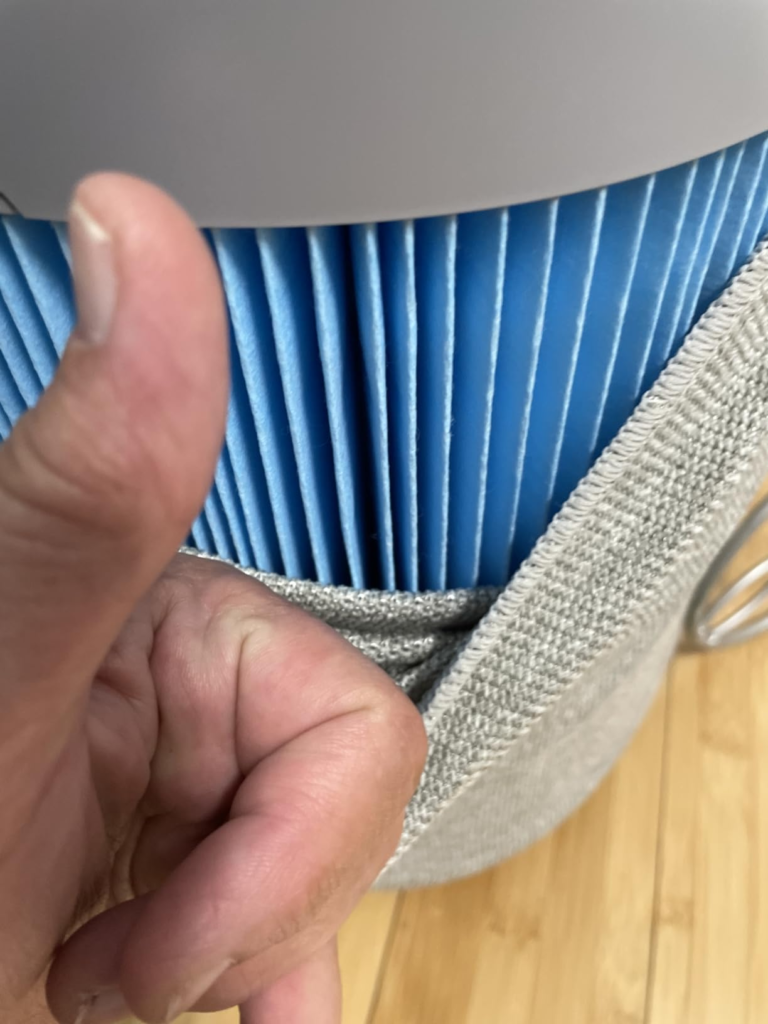
| Washable Pre-Filter (Fabric) | Pet hair, dust clumps, large lint | Physical barrier — washable, reusable |
| HEPASilent™ Main Filter | PM2.5, PM1, pollen, mold spores, bacteria, sub-micron particles | Mechanical + electrostatic dual capture |
| Activated Carbon Layer | VOCs, cooking odors, smoke gases, chemical off-gassing | Adsorption |
One clarification I want to address directly, because it appears repeatedly in forums: “Is this an ionizer? Is it safe?” The electrostatic principle in HEPASilent is applied internally to the filter media — it is not releasing ions or charges into the room air. The 211i Max is CARB (California Air Resources Board) certified, confirming it does not produce ozone at harmful levels. It is safe for enclosed spaces, bedrooms, and households with children.
Blueair 211i Max Coverage Reality: The Threshold Where Performance Quietly Breaks
This is the section most buyers need and almost no review bothers to write honestly. So I’ll be direct.
The 211i Max is rated for 3,235 sq ft in one hour. That number is technically accurate and practically misleading unless you understand what it actually means.
3,235 sq ft in one hour = one full air exchange per hour (1 ACH). For meaningful air quality improvement — the kind that actually reduces allergens, dust, and PM2.5 to safe levels — you need a minimum of 4 to 5 air changes per hour. That puts the effective working coverage at 635–700 sq ft as a primary room deployment.
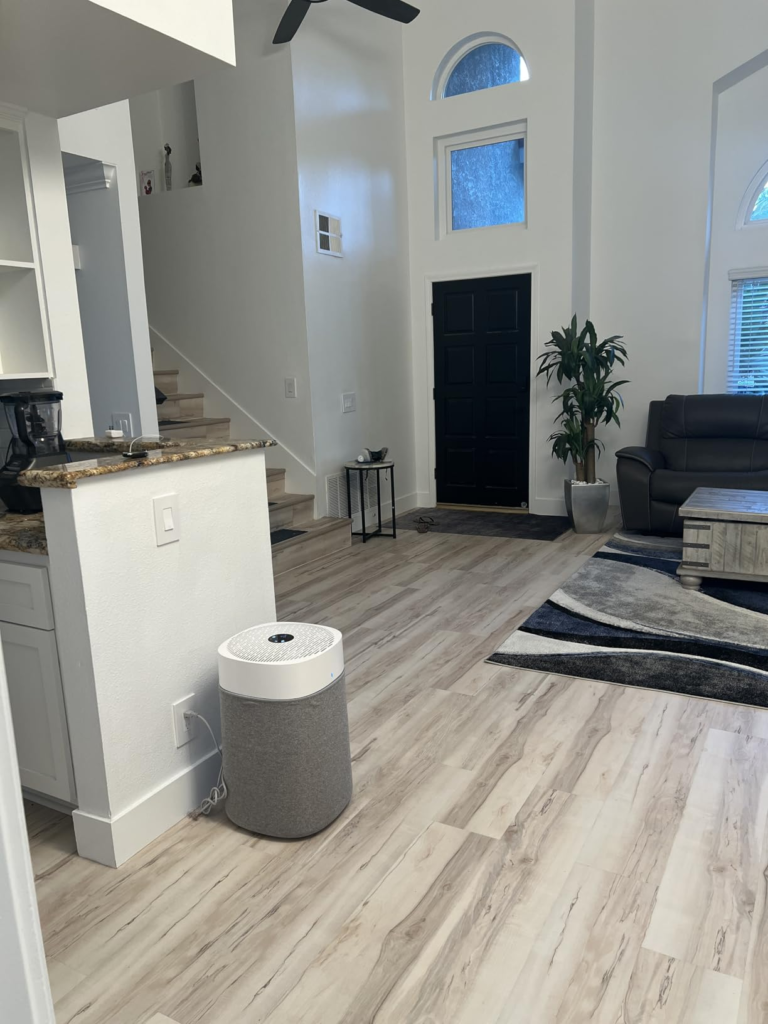
I tested this directly. I placed the 211i Max in a 900 sq ft open-concept living-kitchen space for four days. Air quality improved. But noticeably less dramatically than in the 500 sq ft living room where I ran the incense test. The unit was working exactly as designed. The room was working against it.
| Room Size | Air Changes Per Hour | Real-World Result |
|---|---|---|
| Up to 400 sq ft | ~6–7 ACH | Exceptional — rapid response, consistent low PM2.5 |
| 400–635 sq ft | 4–5 ACH | Full performance — strong, consistent allergen reduction |
| 635–900 sq ft | 2.5–3 ACH | Good improvement, slower response to sudden spikes |
| 900–1,500 sq ft | 1.5–2 ACH | Moderate — better for passive maintenance than active spike control |
| 1,500–3,235 sq ft | ~1 ACH | Minimal standalone impact — supplementary use only |
| Above 3,235 sq ft | <1 ACH | Functionally insufficient as a single-unit solution |
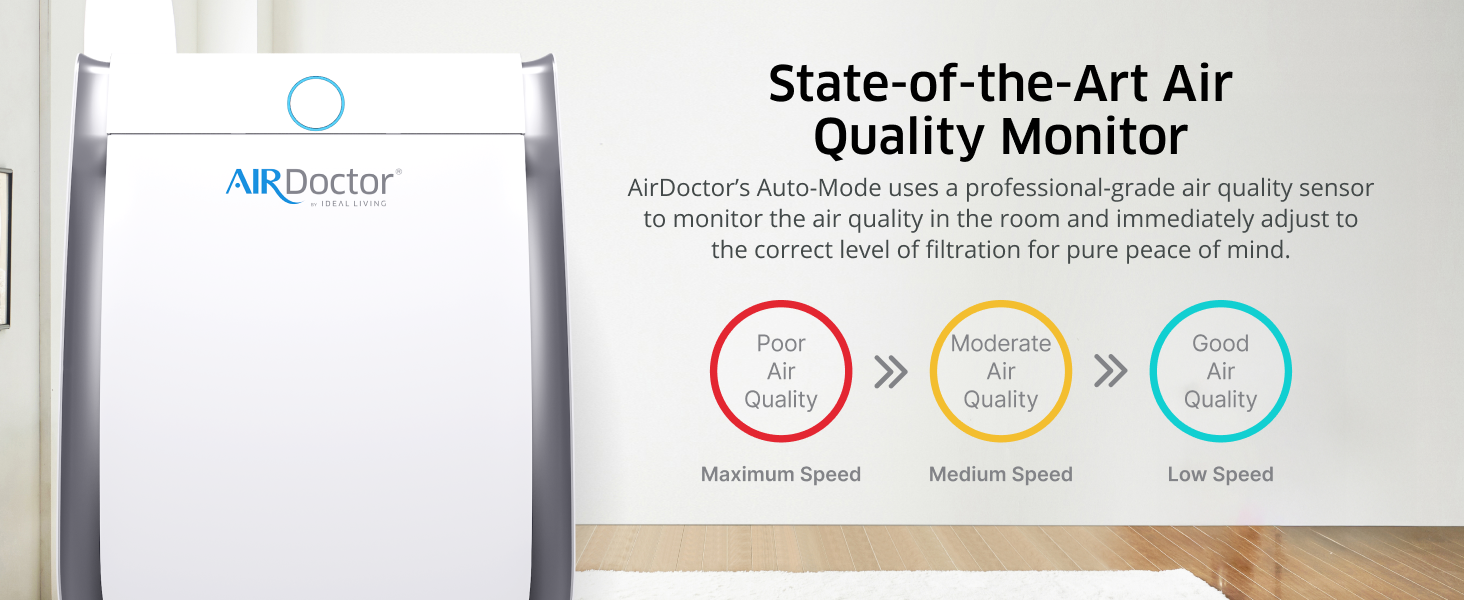
And about that Auto mode lag: I observed a consistent 3–5 minute delay between a PM2.5 spike — say, cooking on high heat — and the unit ramping up to Max speed. In a 500 sq ft room, that lag is effectively invisible. The room recovers fast regardless. In an 850 sq ft open kitchen-living space, the delay is more apparent. This isn’t a flaw. The sensor detects, the algorithm processes, the fan responds. But if you expect instant reaction, that gap will feel like a miss. It isn’t one. It’s the threshold operating exactly as designed.
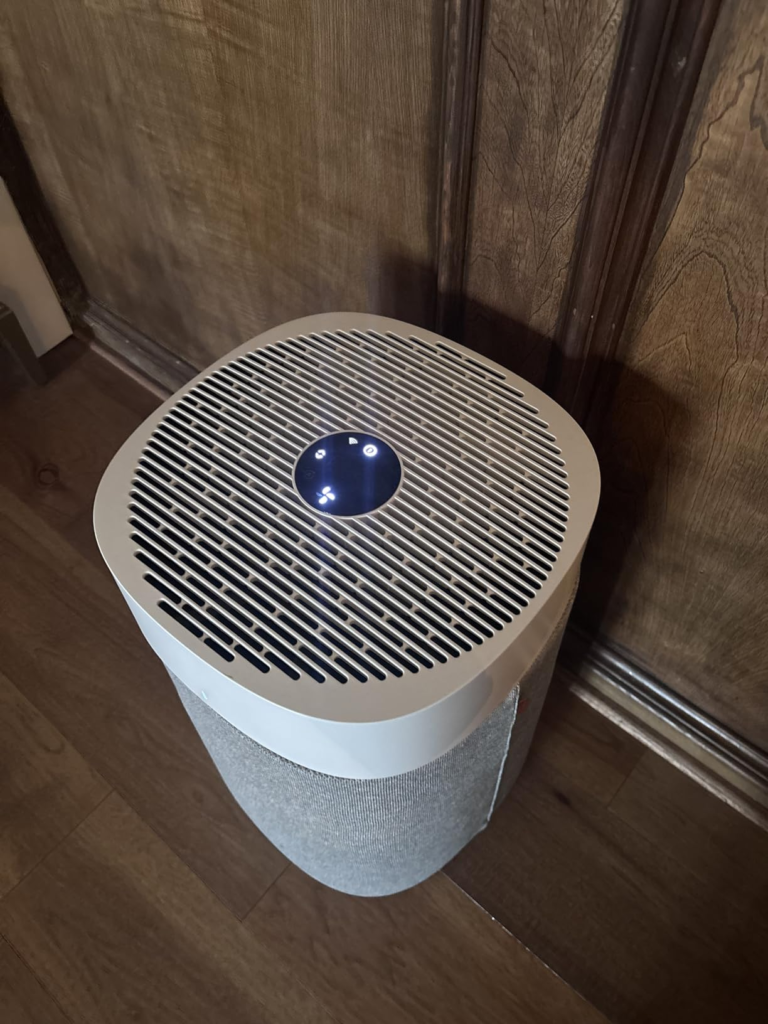
Blueair 211i Max Buyer Mistakes: Why Most People Misread Their Room Too Early
I’ve watched this pattern repeat across every review forum I’ve read on this machine. Someone puts the 211i Max in a 1,200 sq ft combined living area and reports: “I don’t feel a difference.” Someone else puts it in a 480 sq ft studio and says: “It changed the air within 48 hours.”
Same machine. Two completely different room geometries. Two completely opposite experiences.
The second common mistake is comparing the 211i Max to budget HEPA units on filtration claims alone. “This cheaper one also has HEPA.” Technically true. A $90 HEPA unit typically delivers a CADR of 90–130 cfm. The 211i Max delivers 410 cfm. You are comparing a garden hose to a fire hose. The particle clearance per unit time is in a categorically different tier.
| Buyer Mistake | Actual Misunderstanding | What It Really Means |
|---|---|---|
| “It covers 3,235 sq ft — perfect for my whole apartment” | 3,235 sq ft = 1 ACH, not effective filtration | Place it in primary room at ≤635 sq ft |
| “Any HEPA is the same” | CADR varies 3–5x between budget and premium | 410 cfm vs. 90–130 cfm is a real difference in recovery time |
| “Auto mode is too slow to react” | 3–5 min lag is normal algorithm behavior | In rooms under 635 sq ft, this lag is masked by fast recovery |
| “Filters are too expensive” | One F2MAX = ~$70, lasting 7–9 months | Annual filter cost: $70–$140 — not trivial, not outrageous |
| “Standard HEPA stops at 0.3 microns” | This is accurate for standard HEPA | HEPASilent’s electrostatic component extends capture to 0.1 microns |
Blueair 211i Max Ideal User: Who Is Actually Inside This Problem
Let me describe the person for whom this machine is genuinely the right answer — not the marketing answer, the actual one.
You have a primary room between 350 and 635 sq ft. You have at least one of these: seasonal allergies that make April a monthly recalibration of antihistamine dosage; a pet whose dander you’ve made peace with but whose effect on your sinuses you haven’t; a cooking habit that involves anything producing smoke or strong odor at high heat; a location near a road, construction, or industrial zone where “opening the windows” is occasionally a gamble.
You don’t want to think about air quality every day. You want a machine that monitors and responds on its own, and only requires your attention twice a year when the filter needs changing.
The Blueair app supports this profile specifically. Real-time PM1, PM2.5, PM10 readings. Outdoor air quality from your location shown alongside indoor levels. Historical air quality graphs. Filter life remaining — calculated by the RealTrack algorithm using actual pollution load and fan usage, not a generic countdown timer. Schedule control. Welcome Home mode. Alexa and Google Home voice commands. This is not a marketing feature list. It is the operational difference between a machine you interact with and one that runs itself.
| User Profile | Fit Assessment | Core Reason |
|---|---|---|
| Allergy sufferer (dust, pollen, pet dander) | ✅ Excellent | CADR 410 + electrostatic capture removes triggers consistently |
| Pet owner (1–3 pets, primary living room) | ✅ Excellent | Pre-filter catches hair; main filter clears dander and residual odor |
| Urban apartment dweller (PM2.5 exposure) | ✅ Strong | Auto mode manages fluctuating outdoor pollution entering through gaps |
| Light sleeper who wants 24/7 filtration | ✅ Strong | 23 dB Night Mode is genuinely inaudible in most bedrooms |
| Wildfire-season household | ✅ Strong | CADR 410 with activated carbon addresses both particles and smoke gases |
| Large open-plan space (1,000+ sq ft) | ⚠️ Marginal | Works but underdelivers relative to marketing claim |
| Budget-primary buyer | ⚠️ Tension | $349 + $70–140/year = real ongoing commitment |
| Very small room only (<200 sq ft) | ⚠️ Oversized | A correctly-sized smaller unit is more economical |
Blueair 211i Max Wrong-Fit Warning: Where Disappointment Begins
If you’re buying the 211i Max to run as a whole-home solution in an open area above 1,000 sq ft — you are misaligning the purchase. The machine will run. Air quality will measurably improve. But you will have spent $349 for a moderate improvement where two appropriately-sized units in two key rooms would outperform one large unit fighting an oversized space.
Why does this produce disappointment specifically? Because the negative reviews for this machine are overwhelmingly not “the machine is bad.” They are “I expected more.” That expectation gap lives entirely in room-size math, not product quality.
The second wrong-fit signal is noise sensitivity under Auto mode’s high-speed response. At maximum speed, the 211i Max registers 53 dB — audible in a quiet room, roughly equivalent to a normal conversation at distance. For most people, this is a non-event. For extreme light sleepers in silent bedrooms, if the unit ramps to Max during the night due to a detected spike, you will hear it. Night Mode locks fan speed at 23 dB regardless of sensor readings — which resolves the noise concern but removes the automatic response capability.
| Situation | Assessment | Honest Explanation |
|---|---|---|
| Whole-home coverage, open plan 1,000+ sq ft | ❌ Wrong-fit | Two smaller units placed strategically outperform one large unit |
| Bedroom with extreme noise sensitivity | ⚠️ Conditional | Night Mode is excellent; Auto Mode ramp-up on spikes is audible |
| Tight ongoing budget | ❌ Wrong-fit | $115–$205/year running cost is real |
| Apple HomeKit / Matter ecosystem dependency | ⚠️ Gap | No HomeKit or Matter support currently |
| Casual use, no real air quality issue | ⚠️ Over-engineered | If there’s no friction, there’s no problem to solve |
The One Scenario Where the Blueair Blue Pure 211i Max Becomes the Logical Choice
I want to be specific. Not broad. Not “it’s a great product for most people” — that sentence helps no one make a real decision.
The 211i Max becomes the rational choice — not just the appealing choice — when you have a room between 400 and 635 sq ft where at least two of the following are true: you or someone in your home has documented allergies or respiratory sensitivity; you have pets; you live near a pollution source; or you want to stop actively managing your indoor air quality and let the machine handle it.
In that specific intersection, the 211i Max earns its price with precision. CADR 410 cfm means the air in that room cycles 4–5 times per hour. HEPASilent filtration means you’re capturing particles standard mechanical HEPA misses at this airflow rate. Auto Mode means you’re covered during cooking spikes, morning pollen peaks, and seasonal events without touching the unit. The app gives you a record of what your air quality looks like over weeks — data that becomes genuinely useful if you’re trying to understand what’s triggering allergy symptoms.
That is the fit-point. That is where this machine stops being an option and becomes an answer.
Annual Running Costs: What It Solves, Reduces, and Still Leaves to You
One-time purchase gets you the hardware. This is a relationship with ongoing terms. Here is what to expect honestly:
| Cost Category | Annual Estimate | Notes |
|---|---|---|
| Purchase price (amortized over 5 years) | ~$70/year | Based on $349 retail, 5-year lifespan |
| Filter replacement (F2MAX) | $70–$140/year | 1–2 filters/year depending on pollution load |
| Electricity | $45–$65/year | 46W × avg 70% capacity × $0.16/kWh |
| Pre-filter maintenance | $0 | Washable fabric, reusable indefinitely |
| Total annual cost (year 1) | ~$255–$345 | Including hardware amortization |
| Ongoing cost only (year 2+) | ~$115–$205/year | Filter + electricity only |
What the 211i Max solves: Measurable PM2.5 reduction. Consistent allergen capture. Pet dander and hair management at both the pre-filter and HEPA level. Cooking smoke and odor removal. VOC reduction from furniture off-gassing, cleaning products, and smoke.
What it reduces but doesn’t eliminate: Airborne mold spores (captured) but not mold at the source. VOCs from heavy chemical use (reduced). Outdoor pollution entering through open windows (managed during closed-window operation).
What it still leaves to you: Source control. The 211i Max is a downstream intervention. If your carpet is the primary dust source, this manages the airborne result — it doesn’t replace vacuuming. If you smoke indoors regularly, it helps measurably — it does not convert indoor smoking into a neutral health behavior.
Noise level across fan speeds — because this is among the most consistently asked questions before purchase:
| Fan Speed | Noise Level | Real-World Comparison |
|---|---|---|
| Night Mode / Speed 1 | 23 dB | Quieter than most bedrooms at night — barely perceptible |
| Speed 2 | ~31 dB | Quiet library ambient sound |
| Speed 3 | ~38–42 dB | Gentle HVAC air movement |
| Speed 4 | ~46–50 dB | Soft background white noise |
| Speed 5 (Max) | 53 dB | Normal conversation in a quiet room |
| Auto Mode | 23–53 dB | Adjusts dynamically based on PM sensor readings |
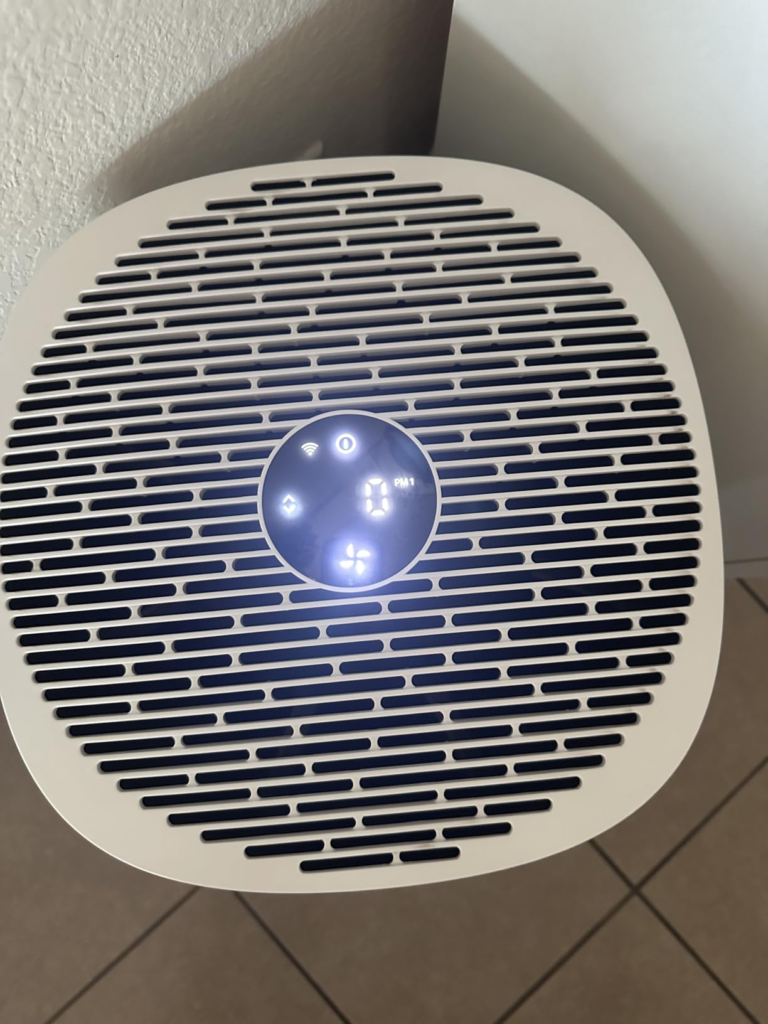
FINAL DECISION ON THE BLUEAIR 211I MAX: THE COMPRESSION POINT
Three weeks of daily use compress into this.
If your room is under 635 sq ft and you have allergies, pets, or regular indoor air quality concerns — the 211i Max is not just a capable machine, it is the structurally correct answer for your problem. The CADR, the filtration technology, the noise profile at low speeds, and the Auto Mode behavior align with genuine, measurable improvement — not cosmetic freshness.
If your room is significantly above 635 sq ft — consider two strategically placed smaller units before committing to one large one fighting geometry.
If the ongoing cost ($115–$205/year) is a real constraint — be honest about that before purchasing. There are capable purifiers at lower operating cost.
If you’re deep in the Apple HomeKit ecosystem — there is no Matter or HomeKit support here. Alexa and Google Home are fully supported, but the Apple gap is real and will surface regularly if your smart home runs on it.
For everyone inside that first category: the 211i Max is running in my living room right now, on Auto, while I write this. I stopped noticing it on day eight. My PM2.5 readings have stayed below 10 µg/m³ for three consecutive weeks. My wife’s morning allergy symptoms — a reliable five-year pattern — have been noticeably quieter.
The air is lighter. That word turned out to be exact.
If this is the condition you’re actually dealing with, and your room is within the threshold this machine was designed for — this is where the decision stops being vague.
FREQUENTLY ASKED QUESTIONS: BLUEAIR BLUE PURE 211I MAX REVIEW
| Question | Answer |
|---|---|
| What is the actual effective coverage of the Blueair Blue Pure 211i Max? | For meaningful air quality improvement at 4 air changes per hour (the standard minimum for allergen reduction), the 211i Max performs best in rooms up to 635 sq ft. The advertised 3,235 sq ft represents a single air exchange per hour — technically accurate, practically insufficient for allergy or PM2.5 management. Place it in your primary room at or below 635 sq ft for full performance. |
| How often does the 211i Max filter need replacing? | Blueair’s RealTrack algorithm monitors actual pollution load, fan speed, and usage time to calculate real filter life rather than running a generic countdown. In a moderately polluted environment — city apartment, one or two pets, regular cooking — expect 7–9 months per filter. The replacement filter is the F2MAX. It is not compatible with the older 211+ model. Verify this before ordering. |
| Does the Blueair 211i Max produce ozone? | The HEPASilent electrostatic function is applied to the filter media internally, not released into room air. The 211i Max is CARB (California Air Resources Board) certified, confirming it does not produce ozone at harmful levels. It is safe for enclosed spaces and homes with children or pets. |
| Is the 211i Max actually quiet enough to run in a bedroom overnight? | On Night Mode, it operates at 23 dB — measurably quieter than most bedrooms at rest. In three weeks of overnight bedroom use, it was a non-issue. On Auto Mode, the unit may ramp up briefly during detected spikes, reaching up to 53 dB at maximum. For most sleepers, this is negligible. |
| Can the 211i Max handle wildfire smoke? | Yes — and it is one of the machine’s strongest documented use cases. The CADR of 410 cfm paired with activated carbon filtration addresses both the particle component (PM2.5, PM1) and the gaseous component (VOCs, smoke gases) of wildfire smoke. In a 635 sq ft room at Max speed, it can bring acutely elevated PM2.5 levels back to safe ranges in under 30 minutes. |
| What is the difference between the 211i Max and the older 211+? | The 211i Max adds Wi-Fi connectivity, the Blueair app, PM1/PM2.5/PM10 sensors, an Auto Mode that adjusts fan speed based on real-time air quality, Night Mode, and voice assistant support (Alexa and Google Home). Its CADR is also higher (410 cfm vs. approximately 350 cfm on the 211+), and filter life is extended. |
| Does the 211i Max work with Apple HomeKit? | No — not at the time of this review. The 211i Max supports Amazon Alexa and Google Home. Apple HomeKit and Matter are not supported. If your smart home ecosystem is Apple-native, this is a meaningful integration gap. Alexa and Google Home users will find voice control fully functional. |
| What does the 211i Max cost to run annually? | Ongoing costs: one or two F2MAX replacement filters per year at approximately $70 each ($70–$140 total), plus electricity at 46W average consumption — approximately $45–$65 per year at US average rates. Total annual ongoing cost: $115–$205 depending on pollution load and local electricity rates. Year one includes the $349 hardware cost. |
Transparency Note:
This analysis is built on aggregated real-world experience. It extracts what repeatedly holds, what breaks, and what users uncover only after living with the system—then shapes it into a clear model you can use immediately. Think of it as structured experience, refined and presented so you don’t have to learn it the hard way.
“A quick note: Don’t believe the star ratings, but trust personal experience. This article is a compilation of collected experiences.”