Dreo TurboPoly 565S Review: I Trusted the 950 CFM Number Until I Measured the Room
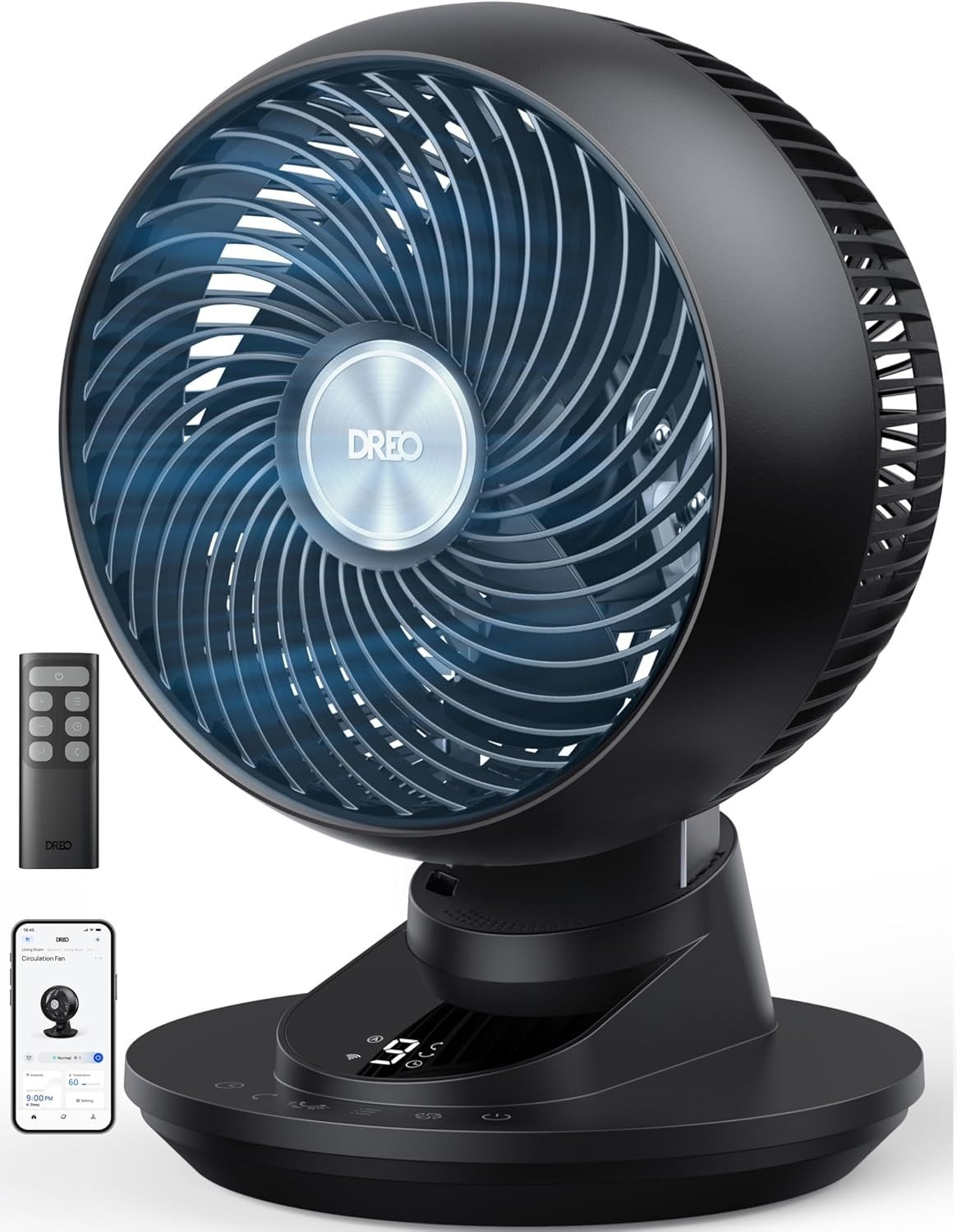
PRODUCT NAME: DREO TURBOPOLY 565S
The Result Looks Fine. The Problem Isn’t.
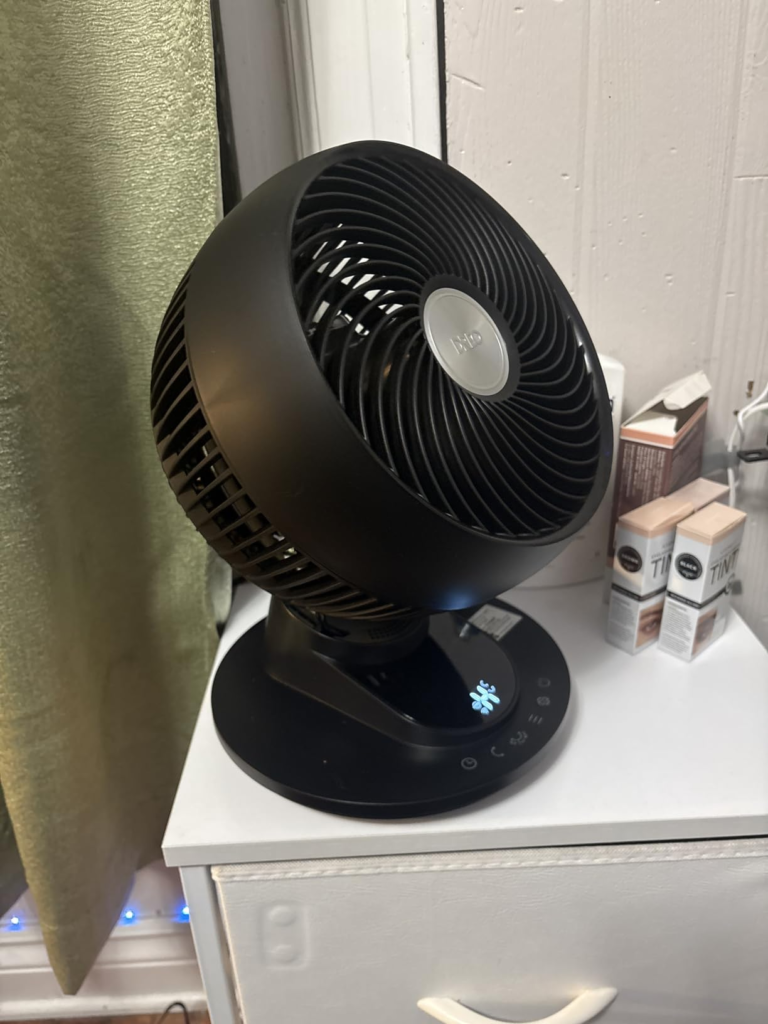
The display reads Auto Mode. The app shows a clean little fan icon spinning. The room sounds almost silent — 20 decibels does that. By every visible signal, the Dreo TurboPoly 565S is doing exactly what the box promised.
Then you take three steps back from the desk, or roll onto your other side in bed, and the air just… stops. Not literally. The fan is still running. But the cooling sensation that was on your skin a moment ago isn’t there anymore. Nothing on the display tells you this happened. The numbers — 950 CFM, 85 feet of throw — are still technically true. They’re just not true where you are.
That gap between what the spec sheet says and what your body actually feels is the entire story of this fan. Not a defect. A mismatch between what the numbers imply and what a 12-inch table fan can physically do.
What You’re Actually Feeling but Not Naming
Most people who end up disappointed with a compact smart fan don’t say “the airflow is weak.” They say something vaguer: it works great right in front of it, but the rest of the room still feels stuffy. Or: I keep nudging it back toward the bed every night.
That’s not a malfunction. That’s the unnamed friction of treating a personal-zone fan like a room-filling one. You’re not chasing a broken product. You’re chasing the narrow cone of air it was actually built to produce, and quietly resenting the work of repositioning it.
There’s a second, smaller friction too: the assumption that “smart” and “app-controlled” automatically means “powerful.” It doesn’t. Voice control and Wi-Fi pairing are about convenience — adjusting speed without getting up. They have nothing to do with how far or how wide the air actually spreads.
The Hidden Mechanism Behind the Miss
Here’s the part the spec sheet doesn’t explain: the 565S isn’t built to diffuse air outward into a room. It’s built to compress it into a directed jet.
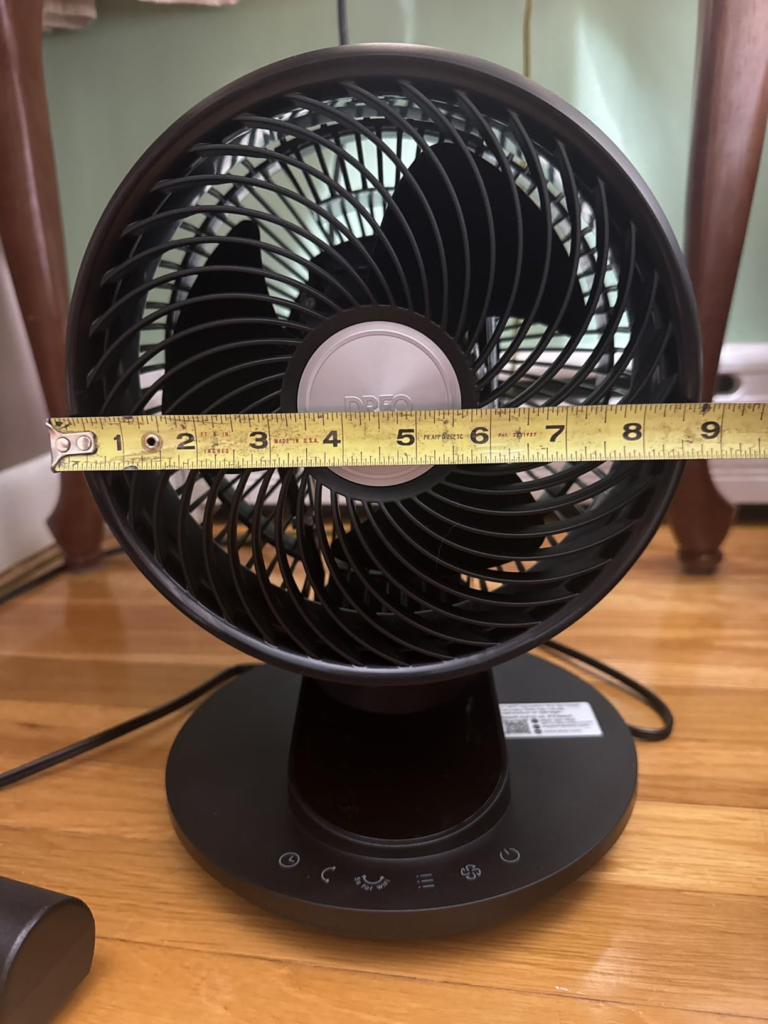
Dreo’s own engineering language for this fan family describes a Spiral Grille and what it calls an Air Booster Structure working with a 7-inch blade and a brushless DC motor to give air “more direction and control” as it leaves the housing. In plain terms: instead of pushing a wide column of air that spreads as it travels, the design narrows the stream so it holds together over distance — which is exactly how a compact fan claims an 85-foot throw without a 16-inch blade behind it.
That’s a genuinely useful trick for one job: putting moving air directly on a person sitting at a desk or lying in bed. It’s the wrong trick for another job: equalizing temperature across an entire bedroom or living room. A taller pedestal-style circulator — sitting 37 to 43 inches up, with a wider dual-axis arc — is solving room-volume coverage from a higher, more central point. This fan, at 12.2 inches tall on a tabletop, is solving body-level, close-range comfort. Same brand, same “TurboPoly” badge, two different physical problems.
| Dreo TurboPoly 565S | |
|---|---|
| Format | Table / desk fan |
| Height | 12.2 in (9.45 x 9.45 in footprint) |
| Blade diameter | 7 in |
| Airflow (rated) | 950 CFM |
| Throw (rated) | Up to 85 ft |
| Noise floor | 20 dB |
| Oscillation | 90° horizontal + 90° vertical |
| Speeds / modes | 9 speeds, 6 modes |
| Control | Touch panel, remote, Dreo app, Alexa/Google |
| Timer | 8H (panel/remote), up to 12H (app) |
| Warranty (US, standard) | 12 months |
| List price | $69.99 |
The Threshold Where the Outcome Quietly Breaks
There’s a fairly specific line where this fan stops behaving like a room cooler and starts behaving like a personal one: roughly the width of the 90° arc, and the distance you’d comfortably sit or lie from a desk or nightstand.
Inside that cone, the air is real and noticeable even on lower speeds. Step outside the arc — around a corner, behind a headboard, on the far side of a 180-square-foot room — and the moving-air sensation falls off fast, because the design traded width for reach.
It’s also worth knowing that this isn’t unique paranoia on my part. Independent lab testing of a related Dreo TurboPoly circulator — using the same family’s airflow-rating method — measured real-world CFM landing noticeably below the number printed in the spec sheet, particularly at top speed. Rated numbers across this fan family tend to represent a best-case, close-range, lab-controlled figure. Useful for comparing models against each other. Less useful as a literal promise of how far cold air will reach into your actual furniture-filled room.
Why Most Buyers Misread This Too Early
The misread usually starts with a single comparison: 950 CFM is way more than my old box fan, so this should cool way more room. It’s an understandable jump, and it’s the wrong one.
CFM measured near the source tells you how much air is moving past that point — not how much of your room ends up in motion. A wide, slow box fan blade can stir more total room air than a narrow high-velocity jet, even with a lower CFM number on the box.
The second misread comes from shopping by family resemblance. Dreo sells this exact airflow language — TurboPoly, brushless DC motor, app and voice control — across both this compact table fan and its taller floor-standing circulators. If you cross-shop on price and CFM alone without noticing the height, blade size, and oscillation arc, it’s easy to expect pedestal-level room coverage from a desk-sized unit. The smart features are identical across the lineup. The physics behind the airflow is not.
Who Is Actually Inside This Problem
This fan earns its place with a fairly specific person, not everyone with a hot room:
- Hot sleepers who want a direct, quiet stream of air aimed at their body overnight, in a normal bedroom — not someone trying to cool the whole house from one corner.
- Desk and work-from-home setups where the fan sits within a few feet of you, all day, and just needs to be quiet enough to ignore.
- Small bedrooms, dorm rooms, and studio apartments where the entire usable space already falls inside a short throw distance.
- Anyone currently running a loud AC-motor box fan purely for white noise and direct airflow, who wants the same effect without the rattle, and without crossing the room to change the speed.
Where Wrong-Fit Begins
And it loses its footing just as clearly with another kind of buyer:
- Anyone trying to cool an open living room, a large or multi-window bedroom, or a space where the fan has to be placed off to one side and still reach across the whole floor.
- Anyone planning to set it on an uneven nightstand, a soft surface, or anything not perfectly flat — Dreo’s own troubleshooting documentation for this exact model states plainly that a shaky, wobbling unit means the surface isn’t level, not that the unit is faulty.
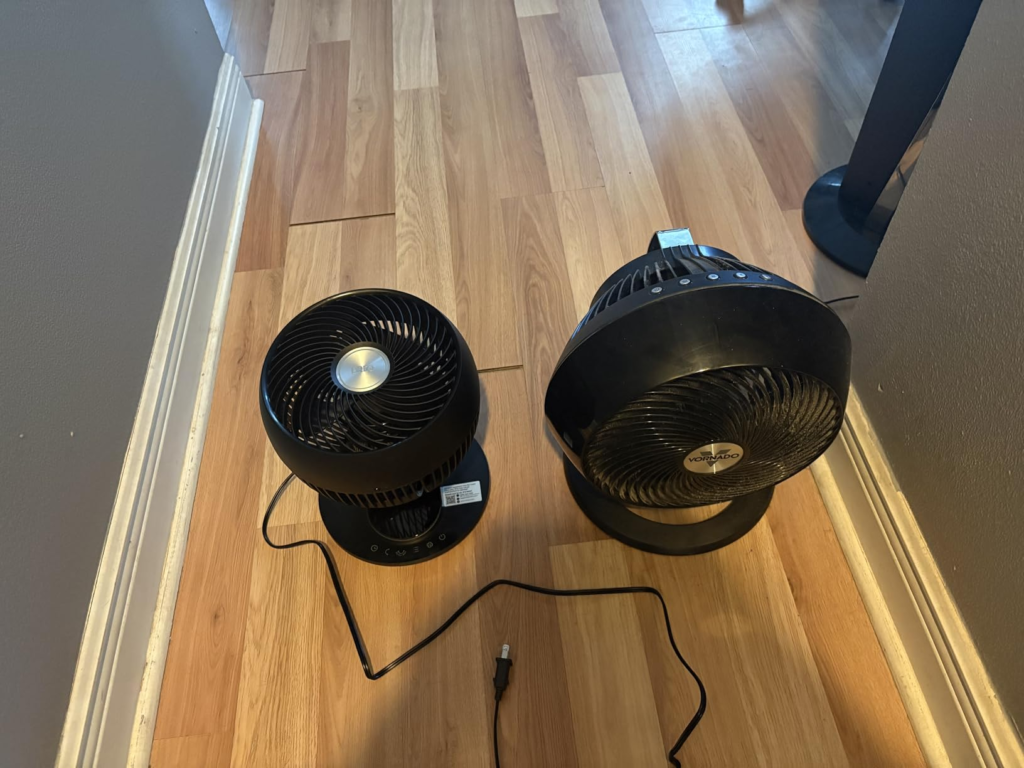
- Anyone comparing warranty coverage against a brand like Vornado and expecting similar multi-year protection. Dreo’s standard US coverage on this fan sits at 12 months; recent company policy updates have moved away from the longer, registration-extended coverage some older Dreo products used to offer.
| True Fit | Near Fit | False Fit | |
|---|---|---|---|
| Space | Desk, nightstand, small bedroom | Mid-size bedroom, used close-range | Open living room, large multi-window room |
| Goal | Direct personal airflow | Some general circulation, mostly local | Whole-room temperature equalization |
| Surface | Flat desk or dresser top | Mostly flat, occasionally adjusted | Uneven nightstand, soft or sloped surface |
| Expectation | Quiet, controllable, close-range cooling | Decent reach within the 90° arc | Pedestal-fan-level room coverage |
The One Situation Where This Product Becomes Logical
Strip away the marketing numbers and what’s left is a fan correctly sized to one job: quiet, directional, app-and-voice-controlled airflow aimed at a person, in a space small enough that the 90° arc actually covers it.
If that’s your condition — a desk, a bed, a room under roughly 150 square feet, a preference for not getting up to change speeds at midnight — the 565S isn’t competing with the bigger circulators in its own product family. It’s not trying to. At $69.99, it’s priced like exactly what it is: a compact personal-comfort tool with smart-home convenience layered on top, not a whole-room cooling appliance wearing a desk fan’s body.
What It Solves, What It Reduces, and What It Still Leaves to You
| Solves | Reduces | Still Yours to Manage |
|---|---|---|
| Rattly, loud AC-motor box fans | Energy draw, via brushless DC motor vs. older AC designs | Placement on a genuinely flat surface |
| Manual reaching for a speed dial at night | Need to physically adjust — app, voice, and timer cover it | Treating it as a zone fan, not a room fan |
| Lack of direct, controllable airflow at a desk | Repeated manual oscillation adjustments | Accepting a standard 12-month warranty, not a multi-year one |
| Mode | What It Actually Does |
|---|---|
| Normal | Fixed speed, manual control |
| Natural | Variable airflow pattern, mimics outdoor breeze |
| Sleep | Gradually steps down speed and volume overnight |
| Auto | Adjusts speed to ambient temperature automatically |
| Turbo | Maximum output, highest noise floor |
| Custom | User-defined schedule via the Dreo app |
Quick Answers Before You Decide
Is the Dreo TurboPoly 565S good for cooling a whole bedroom, or just one spot?
It’s built for direct, personal-zone airflow within its 90° arc and a moderate distance — not for equalizing temperature across a large or multi-window room.
How loud is it at the lowest speed, in practice?
Rated at 20 dB at low settings, which most users describe as easy to sleep through; Turbo mode is noticeably louder, as with any compact high-velocity fan.
Do I need Wi-Fi or the app to use it day-to-day?
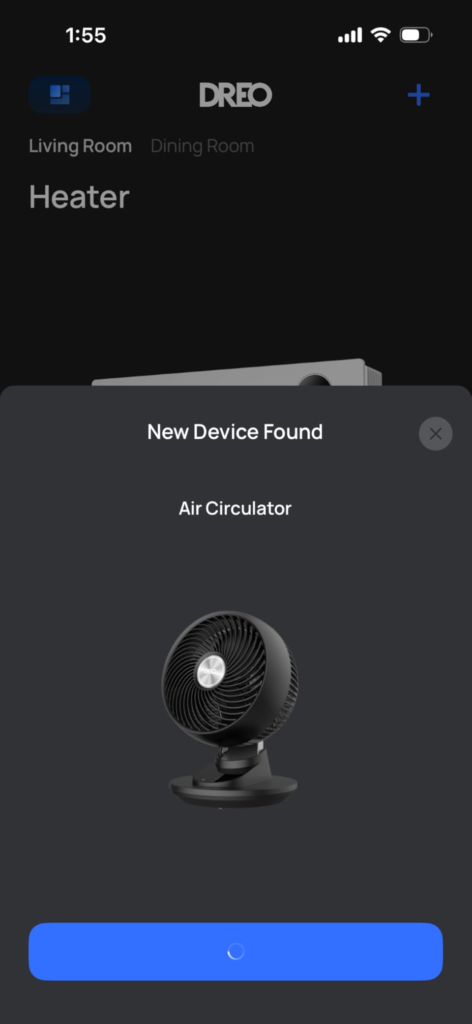
No. The touch panel and included remote control speed, oscillation, and timer without any app or account. Wi-Fi and voice control are optional layers on top.
Does the remote use an unusual battery?
No — it ships with two standard AAA batteries, which is more convenient than the coin-cell batteries used in some other Dreo remote-control fans.
Will it wobble on my nightstand?
Only if the surface isn’t fully flat and level. Dreo’s own support documentation confirms this directly: shakiness traces back to surface, not the unit.
What’s the actual warranty?
A standard 12 months in the US under current company policy, shorter than the multi-year coverage offered by some competing circulator brands.
Final Compression
The number on the box was never the lie. 950 CFM and 85 feet are real, lab-measured figures. The miscalculation happens one step later — when a buyer assumes those numbers describe a room, when they actually describe a narrow, well-engineered jet of air aimed at one spot.
If your actual condition is a desk, a bed, or a room small enough to sit inside that 90° arc, and you want that airflow quiet, app-controllable, and off your hands at 2 a.m., the threshold this fan is built for is exactly the one you’re standing in — and the current listing is here if you want to check today’s price and availability. If your actual condition is a living room or a large bedroom needing wall-to-wall air movement, this isn’t the wrong fan because it’s bad — it’s the wrong fan because it’s solving a different room than the one you have.
Transparency Note:
This analysis is built on aggregated real-world experience.
It extracts what repeatedly holds, what breaks, and what users uncover only after living with the system—then shapes it into a clear model you can use immediately.
Think of it as structured experience, refined and presented so you don’t have to learn it the hard way.
“A quick note: Don’t believe the star ratings, but trust personal experience. This article is a compilation of collected experiences”