FOSI AUDIO Q4 REVIEW: THE HEADPHONE THRESHOLD NOBODY TELLS YOU BEFORE YOU BUY
The Result Looks Fine. The Problem Isn’t.
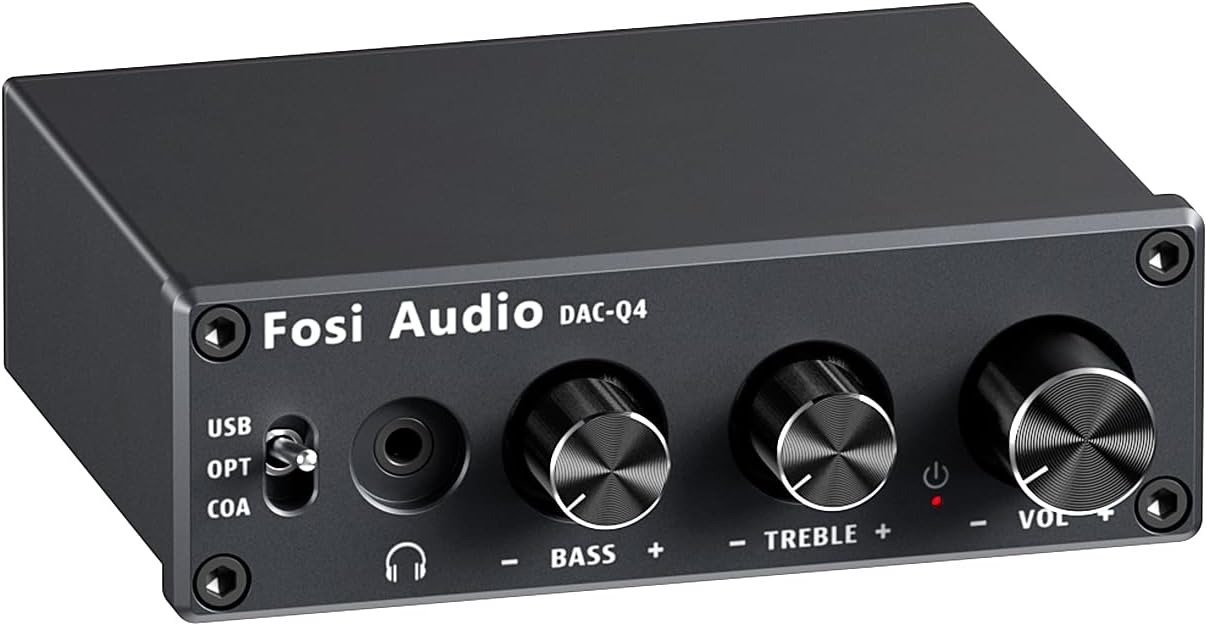
You plug a pair of headphones into the Fosi Audio Q4, the light comes on, the sound is louder and fuller than your laptop’s headphone jack ever gave you, and by every visible signal, the purchase worked. It’s a device with more than 3,000 Amazon customer reviews averaging 4.4 out of 5 stars, and an earlier professional tally found 87% of over 2,000 reviews landed at four or five stars. That kind of consensus usually means a product is simply doing its job.
What that consensus doesn’t tell you is which job. The Q4 will run, light up, and output sound for almost anyone who plugs anything into it. It will not quietly tell you when it’s underpowered for what you connected. There’s no error message for “this headphone needed more amplifier than this amplifier has.” It just plays — a little flatter, a little less dynamic — and most people never trace the flatness back to its actual cause.
What You’re Actually Feeling but Not Naming
If you’re reading this, you’re probably in one of two places. Either your PC, laptop, or TV audio sounds thin and you want to know if a separate DAC/amp actually fixes that, or you already own a $70 box like this one and something about your headphones still feels capped — not broken, just not quite arriving.
That second feeling has a name, and it’s rarely the headphone’s fault. It’s an amplifier running out of voltage swing before your headphone runs out of demand. You turn the volume knob further than feels right. The bass control adds weight but not texture. Loud passages compress instead of opening up. None of that registers as “the DAC is underpowered” — it registers as “this just sounds like this,” which is exactly the kind of quiet, mislabeled disappointment that gets headphones blamed for an amplifier’s limit.
The Hidden Mechanism Behind the Miss
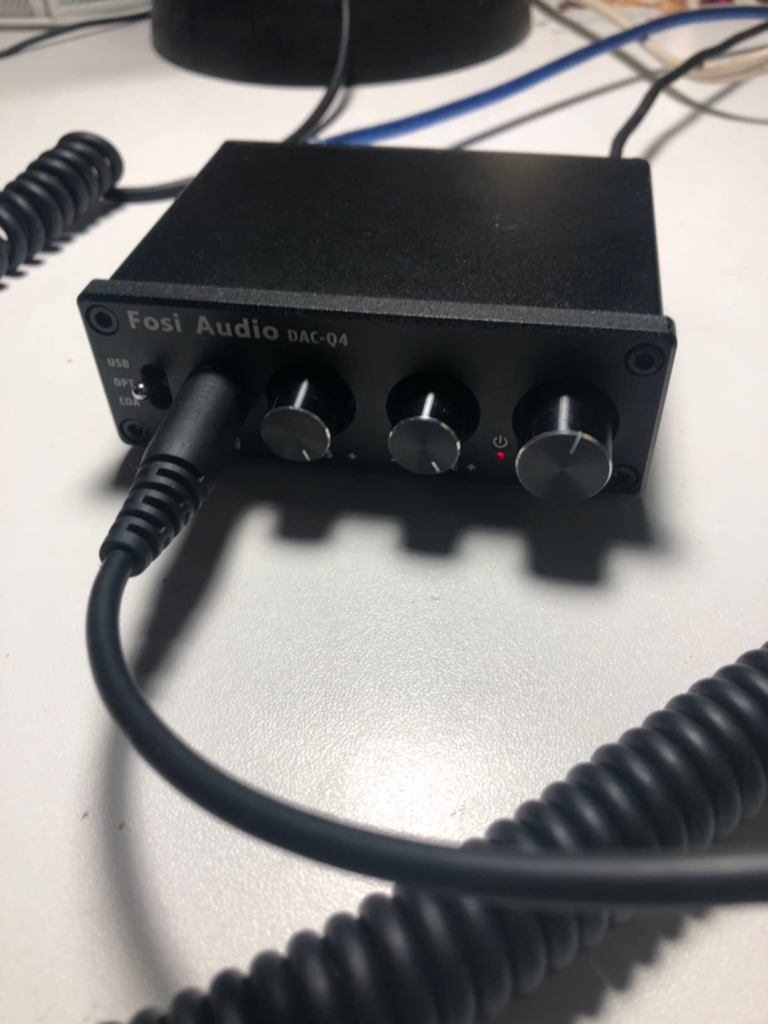
The Q4’s headphone amp stage runs on a Texas Instruments NE5532 chip, chosen specifically for low noise and a clean drive characteristic at low-to-moderate loads. Fosi rates the output at roughly 160mW into 32 ohms with 0.01% distortion — a number that looks respectable in isolation and is genuinely fine for the headphone class it was built for.
Here’s the part the spec sheet doesn’t translate for you: a 32-ohm headphone needs relatively little voltage swing to reach full, dynamic volume. A 300-ohm headphone needs far more swing to reach that same loudness and the same sense of snap on transients. The NE5532 stage has a fixed amount of swing available, constrained in part by the Q4’s bus-powered 5V design. Below roughly 150 ohms, that ceiling sits comfortably above what the headphone asks for. Above it, the amplifier runs out of headroom before the headphone does — and the sound narrows in a way that’s easy to misread as “this headphone just isn’t that good” rather than “this amplifier wasn’t built to drive it.”
There’s a second, quieter version of the same gap, on the input side rather than the output side. Fosi’s own specification sheet lists the optical and coaxial inputs as supporting 24-bit/192kHz, while the PC-USB input is rated only to 24-bit/96kHz. Marketing copy that says “24-bit/192kHz” without that asterisk leads a lot of USB-connected buyers to assume they’re getting the full rate through their computer. They aren’t — that ceiling belongs to optical and coaxial only.
It’s also worth being honest about what isn’t fully nailed down: at least one independent technical review has flagged inconsistent and conflicting documentation across retail listings regarding the Q4’s actual internal DAC chip, separate from the NE5532 analog stage. The amplifier chip is confirmed and consistent. The DAC chip identity, depending on which listing you read, is not.
The Threshold Where the Outcome Quietly Breaks
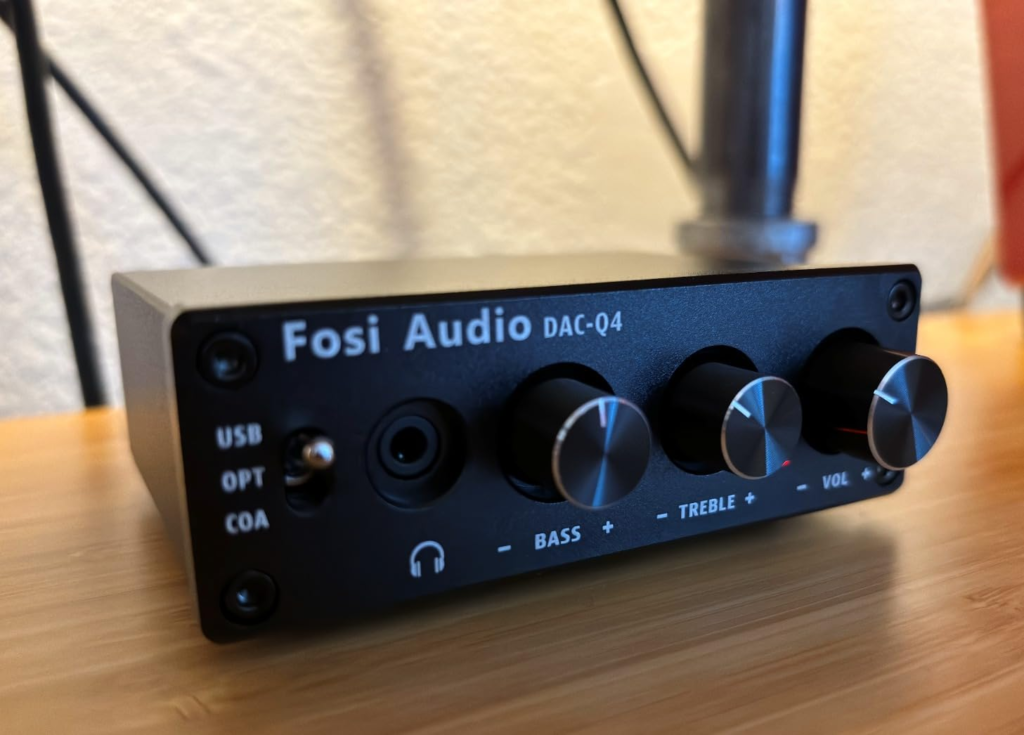
There’s one number that decides whether the Q4 is the right tool or the wrong one: the impedance of the headphone you’re plugging in. Call it the Power Ceiling.
| Headphone impedance | What actually happens through the Q4 |
|---|---|
| 16Ω – 60Ω (most IEMs, gaming headsets) | Clean, comfortably loud drive; ample headroom left over |
| 60Ω – 150Ω (most consumer and studio cans) | Solid, dynamic drive at normal-to-loud volumes — the Q4’s intended zone |
| 150Ω – 250Ω (semi-pro monitor headphones) | Usable, but headroom thins; volume sits higher than feels comfortable |
| 250Ω – 600Ω (HD650, HD6XX, DT880/990 600Ω) | The amplifier’s ceiling arrives before the headphone’s full dynamic range opens up |
Independent testing places the comfortable-drive line under roughly 150 ohms, noting that 300-ohm headphones like the Sennheiser HD6XX and HD650 come through thinner and less dynamic than their potential allows, with units like the FiiO K11 ESS or Topping L30II NFCA being the more appropriate choice for that class of headphone. That’s not a defect in the Q4. It’s a boundary the Q4 was never priced or engineered to cross.
Why Most Buyers Misread This Too Early
The mistake almost always starts at the spec sheet, not the listening session. The official listing states the Q4 “drives headphones from 16Ω to 200Ω,” and a lot of buyers read “drives” as “drives properly.” It means something narrower: it will produce sound across that range without damage. It does not promise equal headroom at every point in it.
The second mistake is comparing on the wrong axis. Shoppers line up the Q4’s three digital inputs and bass/treble knobs against pricier units and conclude the cheaper box wins on features — without weighing that the gap in price between a $70 DAC/amp and a $150–200 one usually maps directly onto output power and headroom, not knob count. Tone controls are visible and tangible. Voltage swing is invisible until you’re already three songs into a 300-ohm headphone wondering why it sounds smaller than it should.
The third, and most avoidable: buying the Q4 specifically to “finally unlock” an existing high-end, high-impedance headphone. That’s not what closes the gap between a $400 headphone and its full potential — it’s a mismatch of instrument to job, not a flaw in either one.
Who Is Actually Inside This Problem
This product earns its price for a specific reader, and it’s worth being precise about who that is:
- Desktop and laptop users whose built-in audio sounds thin, hissy, or flat through headphones
- Gamers and PC users who want a separate volume and tone stage between their computer and their headset
- Anyone bridging an older or simpler source — a CD player, a TV without good internal DACs, a turntable preamp — into modern headphones or powered speakers via optical or coaxial
- Owners of headphones and IEMs in the 16–150Ω band, which covers the large majority of consumer, gaming, and many semi-pro closed-back headphones
- First-time buyers who want a low-risk way to find out whether a dedicated DAC/amp makes any real difference before spending three or four times this much
Where Wrong-Fit Begins
The exclusion list is just as clear as the fit list:
- Owners of 250–600Ω reference headphones (HD600, HD650, HD6XX, DT880/990 600Ω, and similar) expecting full dynamic scale
- Anyone who needs a balanced 4.4mm output
- Anyone who needs a built-in microphone input for gaming or calls — the Q4’s own documentation confirms it does not support microphones, and Fosi’s current lineup has moved that capability to the newer K5 Pro, which also adds USB-C and full-rate 192kHz USB support the Q4 doesn’t carry
- Anyone needing Bluetooth connectivity
- Critical listeners running close A/B comparisons against reference-grade desktop systems — the tonal compromises a professional listening session flagged become audible at that level of scrutiny
The regret point, specifically, is the buyer who pairs this with an expensive, high-impedance headphone expecting transformation, and then can’t tell whether the bottleneck is the amp, the headphone, or the source. It’s almost always the amp.
The One Situation Where This Product Becomes Logical
If your headphones sit at or under roughly 150 ohms, your source is a desktop, laptop, or TV with USB, optical, or coaxial output, and what you want is a real, audible step up from built-in audio with physical tone control and zero driver installation — the Fosi Audio Q4 is a sound choice at this price, not because it’s the best DAC/amp money can buy, but because it solves the single most common complaint (thin, hissy built-in audio) for under $80, with a build and chip choice that’s well documented and a company that has stayed in this category long enough to support what it sells.
What It Solves, What It Reduces, and What It Still Leaves to You
| What works | What doesn’t |
|---|---|
| Clear upgrade over built-in laptop, motherboard, or TV audio | Power ceiling above roughly 150–200Ω |
| Three physical digital inputs at this price point | USB capped at 24-bit/96kHz vs. 24-bit/192kHz via optical/coaxial |
| All-metal build, tactile bass and treble knobs | No microphone input, no Bluetooth, no balanced output |
| Plug-and-play, no drivers, works across Windows, Mac, and Linux | TV remotes can’t adjust volume over optical or coaxial input |
| Backed by Fosi’s documented warranty and support | Occasional faint hiss with very sensitive IEMs at maximum volume |
It solves the thin, flat sound coming out of integrated audio chips. It reduces, but doesn’t eliminate, the temptation to keep upgrading before you actually know what you need. What it leaves to you is knowing your own headphone’s impedance before you buy — and treating this as “cleaner and louder,” not “transformed.”
Frequently Asked Questions
| Question | Answer |
|---|---|
| Does the Fosi Audio Q4 have enough power for high-impedance headphones like the Sennheiser HD6XX or HD650? | Not comfortably. Those 300-ohm headphones sound thinner and less dynamic through the Q4 than their full potential allows, and a unit built for higher-impedance loads is the better fit. |
| Why does USB sound different from optical or coaxial on the Q4? | The PC-USB input is rated to 24-bit/96kHz, while the optical and coaxial inputs support the full 24-bit/192kHz advertised elsewhere. If you’re feeding it hi-res files over USB specifically, you’re not getting the top-rate path. |
| Does the Q4 have a microphone input? | No — the official specification explicitly states it does not support microphones. If you need mic passthrough for gaming or calls, Fosi’s newer K5 Pro covers that. |
| Is the Q4 still Fosi’s current model? | It’s been effectively succeeded in Fosi’s lineup by the K5 Pro, which adds USB-C, microphone support, and the full-rate USB input the Q4 lacks. The Q4 remains widely sold and supported, but it’s the older design in the family. |
| Is there any background hiss? | A faint residual hiss can appear at maximum volume with very sensitive in-ear monitors, though most users in most setups never encounter it. Fosi’s own troubleshooting documentation attributes most reported USB noise to unstable cables or aging power adapters. |
| Does it need a separate power adapter? | It’s bus-powered over USB at 5V. A USB cable from a computer or a basic 5V adapter is enough — no dedicated power brick is required. |
Final Compression
If your headphones sit under roughly 150 ohms and you’re trying to fix thin, flat sound from a laptop, PC, or TV, the threshold question has already been answered in your favor — this is the logical next step, not a gamble. If you’re sitting on 300-ohm reference headphones hoping this closes the gap, it won’t, and no amount of bass-knob turning will change that math.
Transparency Note:
This analysis is built on aggregated real-world experience. It extracts what repeatedly holds, what breaks, and what users uncover only after living with the system—then shapes it into a clear model you can use immediately. Think of it as structured experience, refined and presented so you don’t have to learn it the hard way.
“A quick note: Don’t believe the star ratings, but trust personal experience. This article is a compilation of collected experiences”