We Almost Bought It for the 20 Bars—Until We Asked Why Our Espresso Changed on Day 12
DECISION ANALYSIS
The first days felt powerful.
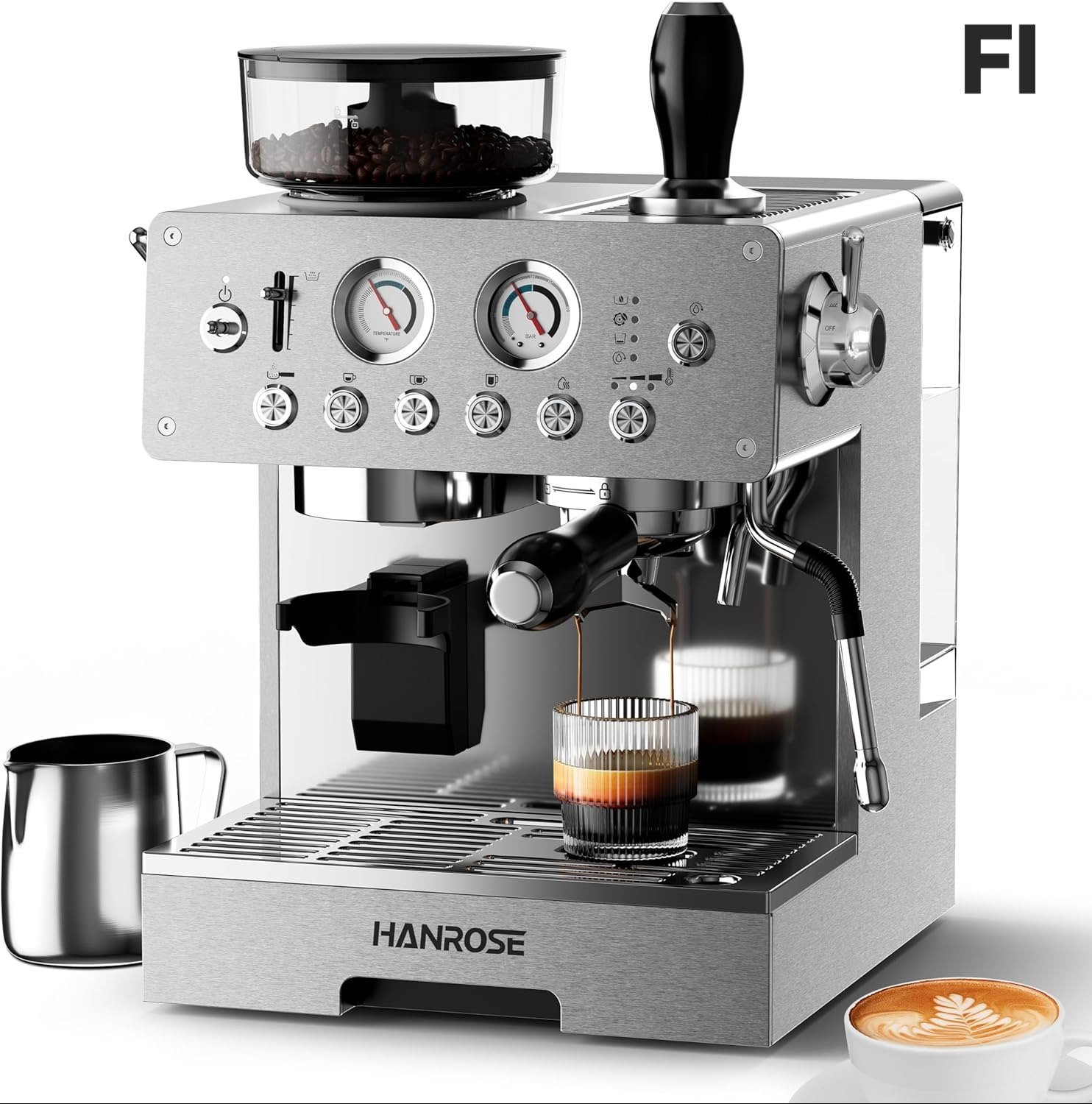
We unboxed stainless steel confidence.
We heard the grinder spin.
We watched the pressure gauge rise
like a promise.
Crema looked thick, serious, cinematic.
Then on day twelve, something shifted.
Same beans.
Same setting.
Different taste.
Why?
That was the moment we stopped admiring the numbers and started interrogating the system.
If you are considering this machine, pause the excitement for one minute.
🔗 View the product configuration and current pricing here → 🔗 View on Amazon
Now ask the only question that matters:
Can we live with its stability curve?
Because that is what we are actually buying.
When Power Feels Impressive but Stability Decides the Outcome
Yes, it has a 20-bar pump.
Yes, it carries 1500W heating power.
Yes, it uses a 58mm portafilter with pre-infusion.
Why do these matter?
Because on paper they suggest control.
But control is not the same as stability.
The real test begins when our morning is rushed.
A slightly uneven tamp.
Beans that have aged one more day.
A grind adjustment we forgot to reset.
Does the system absorb that imperfection, or does it amplify it?
This machine can produce excellent espresso.
But it expects participation.
Expert advice:
If we enjoy dialing in variables and observing cause and effect, this architecture rewards us.
If we expect the machine to neutralize our inconsistency automatically, tension appears.
The Grinder Convenience Illusion and the Hidden Retention Variable
An integrated grinder feels like freedom.
Less counter space.
Fewer cables.
One unified machine.
But why do many integrated systems feel slightly different after a few weeks?
Retention.
Old grounds remain.
Micro-fines accumulate.
Static shifts distribution.
The first week tastes stable.
By week three, we adjust grind size and still wonder why bitterness lingers.
Why?
Because the system quietly became nonlinear.
If we commit to regular cleaning, stability returns.
If we delay maintenance, flavor drift becomes psychological fatigue.
Expert advice:
Buy this system only if we are willing to treat the grinder as a living component, not a sealed box.
Steam Speed Sounds Exciting—But Milk Reveals Structural Truth
“Froth in 30 seconds.”
That sounds decisive.
But why does milk sometimes stretch beautifully and sometimes collapse into foam bubbles?
Steam transition stability.
Pulling two shots back-to-back and then switching to steam is a stress test.
Does pressure remain dry and consistent?
Does thermal recovery lag?
Milk exposes instability faster than espresso.
If our goal is occasional cappuccino, satisfaction is likely.
If our goal is consistent microfoam for detailed latte art every morning, we must observe behavior carefully during the first weeks.
Expert advice:
Milk drinks are not about speed. They are about thermal discipline.
The Rating Split That Signals a Risk Threshold
When we examine sentiment patterns, one detail stands out:
Strong enthusiasm from many buyers.
A visible pocket of serious dissatisfaction.
Why is this important?
Because polarized ratings often indicate variance, not mediocrity.
Some units perform beautifully.
Some fail early.
Early mechanical failure is not just inconvenience. It breaks trust.
If we purchase with easy return protection, risk becomes manageable.
If returns are complicated in our region, the decision weight shifts dramatically.
Expert advice:
Our tolerance for uncertainty must match the machine’s variance profile.
The Real Question Is Not “Is It Good?” but “Are We the Right Scenario?”
Scenario one:
We enjoy calibration.
We treat espresso as ritual.
We accept that small shifts teach us something.
This machine fits.
Scenario two:
We want predictable drinks with minimal involvement.
Friction may accumulate.
Scenario three:
We dislike cleaning internal components.
Integrated architecture will test patience.
Why does this matter?
Because machines do not fail equally across personalities.
They fail when lifestyle and structure mismatch.
Our Final Decision Filter Before Clicking Buy
We buy this machine if:
We value control over automation.
We accept cleaning as part of ownership.
We enjoy watching pressure gauges and adjusting grind.
We hesitate if:
We want absolute consistency without engagement.
We dislike mechanical variance.
We have low tolerance for early reliability risk.
This is not a right-or-wrong machine.
It is a personality-aligned machine.
The 20 bars are not the decision.
The stability curve is.
And once we understand that, the purchase becomes calm instead of emotional.