How the Ninja Luxe Café Pro ES701 Truly Performs in a Real-World Espresso Routine
DECISION ANALYSIS
When I set out to analyze this category of guided espresso machines, I wasn’t looking for “espresso in a box.” I wanted to know whether a machine positioned between manual barista gear and superautomatics actually closes the gap between expectation and everyday performance — especially for households that want café-style drinks without endless tinkering.
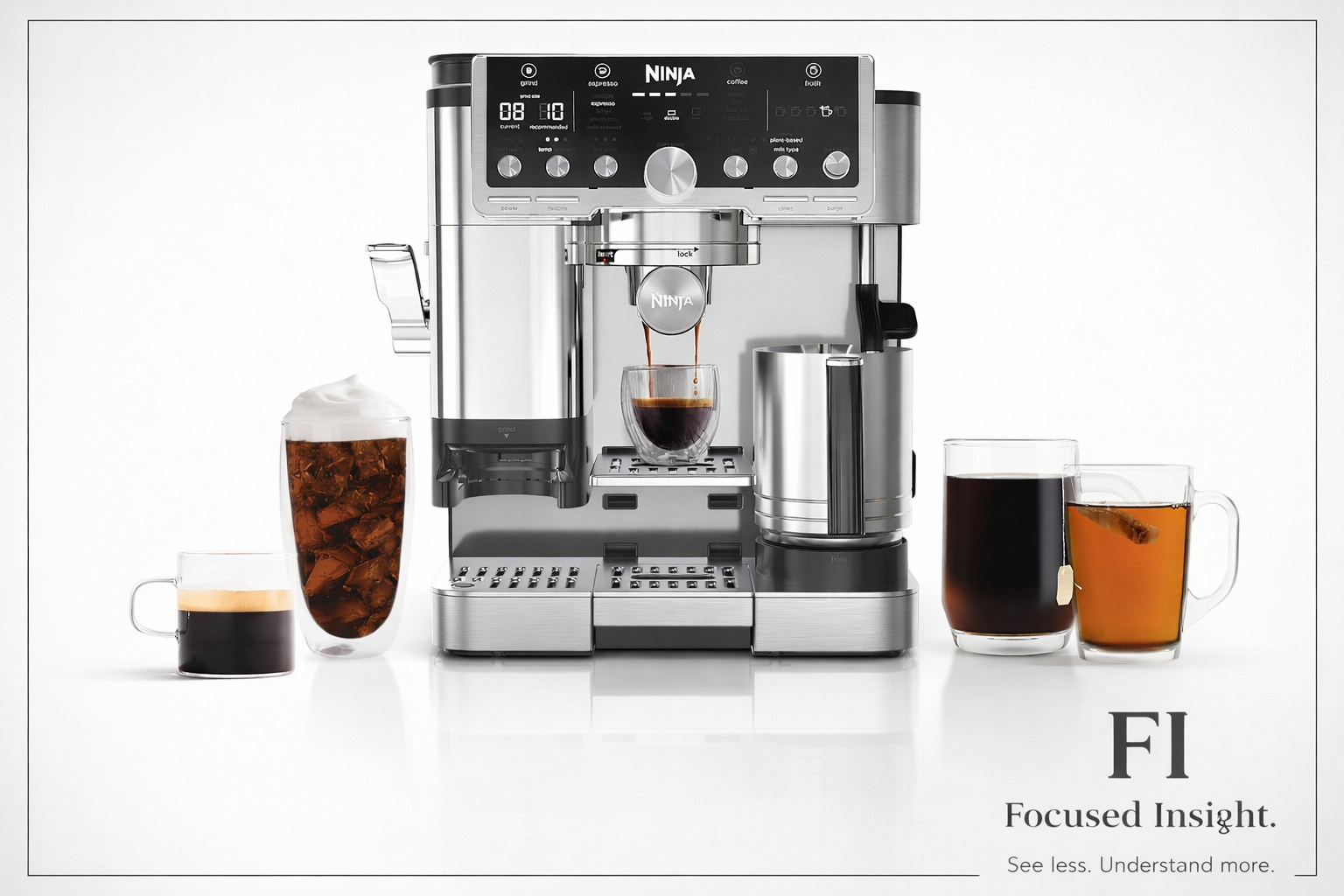
This Decision Article puts one machine under structural scrutiny: Ninja Luxe Café Pro Series 4‑in‑1 Espresso Machine — the hands-free cappuccino-capable espresso system with an integrated grinder, scale, and milk frothing. The goal is to assess how its design choices impact stability, behavior, and daily use — not to persuade, but to clarify.
Fit Summary — What This Machine Is Structurally Designed To Do
This machine isn’t a pure semi-automatic in the traditional line-up of espresso gear. It sits in a hybrid space: a bean-to-cup system with:
- Built-in grinder with weight-based dosing and 25 settings
- Barista Assist guidance on grind and extraction
- Integrated tamper lever
- Hands-free milk frothing with multiple texture settings
- Espresso, drip, cold brew, and hot water functions
- XL milk pitcher and insulated steam wand for expanded capacity
Put simply: it aims to reduce user technique reliance while expanding drink versatility. The machine’s structure turns several error-prone variables (grind, dose, tamp, milk texture) into mechanical events.
Technical Analysis — Spec → Mechanism → Behavior → Outcome
Integrated Grinder & Weight-Based Dosing
Spec: 25 grinder settings, integrated scale, weight-informed dosing.
Mechanism: The machine measures ground coffee mass to decide dosing instead of relying on time-based metrics.
Behavior: Weight-informed dosing generally yields more consistent puck volume across different beans and roast levels than time-only systems.
Outcome: Less guesswork during setup phase and a higher baseline repeatability for extraction — especially for users who are not familiar with manual grinder dialling.
Interpretation: Speaking from patterns in expert reviews, even seasoned users remarked that the weight-based system corrects many common beginner dosing errors which typically cause channeling and fast/slow shots. This is a structural improvement over time-based grinders.
Integrated Tamper Lever
Spec: Mechanical tamping arm built into the machine.
Mechanism: Lowers one significant source of variance: hand-tamping inconsistency.
Behavior: Consistent tamp pressure and surface level across shots.
Outcome: More uniform extraction behavior from shot to shot, especially when coupled with weight-based dosing.
Interpretation: In comparative tests, integrated tampers meaningfully reduced puck misalignments that casual users often introduce, without forcing full manual tamping technique.
Milk Frothing System
Spec: Dual froth system with multiple froth level presets and an XL milk pitcher.
Mechanism: Hands-free frothing with steam wand and internal whisk for texture control.
Behavior: Produces relatively thick foam consistently; performance varies by milk type.
Outcome: Dense, café-style foam on automatic settings; still capable of manual control.
Interpretation: Most ordinary users will find the automatic foam significantly easier than manual steaming on traditional steam wands. However, very fine microfoam (for latte art) is not universally reported, and the jug size may make delicate pours slightly awkward.
Versatility — Multiple Drink Functions
Spec: Espresso, drip coffee, cold brew, hot water.
Mechanism: Uses guided modes with interface prompts and internal logic.
Behavior: Seamlessly transitions between drinks with minimal button presses.
Outcome: High everyday usefulness across beverage styles.
Interpretation: This structural choice broadens appeal beyond espresso alone. It’s not just a machine for shots — it’s a daily centerpiece with utility beyond its core espresso functions.
Contextual Specification Notes
From aggregated testing and expert observations:
- The machine’s weight-based dosing is not infallible — some reviewers note initial shot tuning may still require user attention, particularly for very dense beans.
- The footprint is larger than typical single-purpose machines, reflecting its multi-function design.
- While Barista Assist guidance helps, skilled users may still override suggested grind settings for personal taste outcomes.
Use-Case Fit — Who This Machine Is Structurally Aligned With
Well-aligned:
- Users seeking café-style drinks at home without deep technical skill.
- Households with diverse drink preferences (espresso + milk drinks + coffee + cold brew).
- Those who want minimal day-to-day workflow variance.
Less well-aligned:
- Traditional espresso hobbyists who want manual control over every variable.
- Users prioritizing ultra-compact footprint or single-function machines.
- Users who focus primarily on espresso extraction finesse above all else.
Trade-Offs & Constraints
Trade-offs:
- Automation vs Control: The system guides choices and automates key steps — this boosts consistency but reduces manual nuance for some connoisseurs.
- Size & Complexity: Multi-function capability increases physical footprint and control layers.
- Milk Texture Specificity: Very fine microfoam (latte art standard) isn’t a guaranteed out-of-the-box outcome — automatic systems rarely match dedicated manual steaming.
Constraints:
- The integrated grinder’s optimal window is bounded — certain bean profiles may require local adjustment of grind settings.
- Some users report initial calibration shots are necessary before repeatable results out of the box.
Pricing Logic
At its typical price point (~$749), this machine is priced above basic consumer espresso machines but below many commercial-grade semi-automatics. The structural value emerges from:
- Upgraded dosing and tamping automation.
- Expanded drink modality.
- Guided user experience that reduces workflow variance.
When weighed against machines that offer only espresso or only drip capability, this design seeks to justify cost by consolidating multiple roles into one unit.
Observation validation layer (≤2)
OVL #1 — Grinder Behavior + User Consistency: Across community discussions, users report that when the grinder settled into a stable setting (often ~15), shots flowed more predictably and the machine felt “less finicky” than other all-in-one systems without weight dosing — a structural indicator that the dosing subsystem does more than just look smart.
OVL #2 — Milk System Usability: Observations from multiple reviewers show that automatic frothing yields dense foam reliably, but extremely refined microfoam capabilities remained domain of manual techniques — suggesting the milk subsystem is optimized for consistency and ease over artisanal texture precision.
OVL notes are technical alignments, not emotional claims.
Verdict
This machine fits a structural niche: repeatable café-style drinks for everyday use with reduced technique dependence. It doesn’t eliminate all variables — the user still makes choices — but it pushes several of the most unstable ones into mechanical domains that novices and seasoned users both can appreciate.
If your primary goal is predictability and versatility across beans and drink types without frequent manual intervention, this machine’s architecture aligns well with that objective.
Direct link: Discover its full specifications and availability here