My Gaggia Classic Pro Review — Structured Precision, Hands-On Espresso Logic
DECISION ANALYSIS
I’ve spent weeks breaking down, testing, interpreting, and contextualizing this machine not as a list of specs, but as a stability field — where how you brew is as important as what the machine technically can do.
This is not a plug-and-play automatic; it’s designed for operators who understand espresso as a micro-controlled process.
Today, what you’re reading is not a buyer’s cheer or a feature parade. It’s a structural evaluation of performance, real-world behavior, and stability consistency at home.
Fit Summary
This machine sits at the intersection of pro-grade hardware and manual workflow. It delivers:
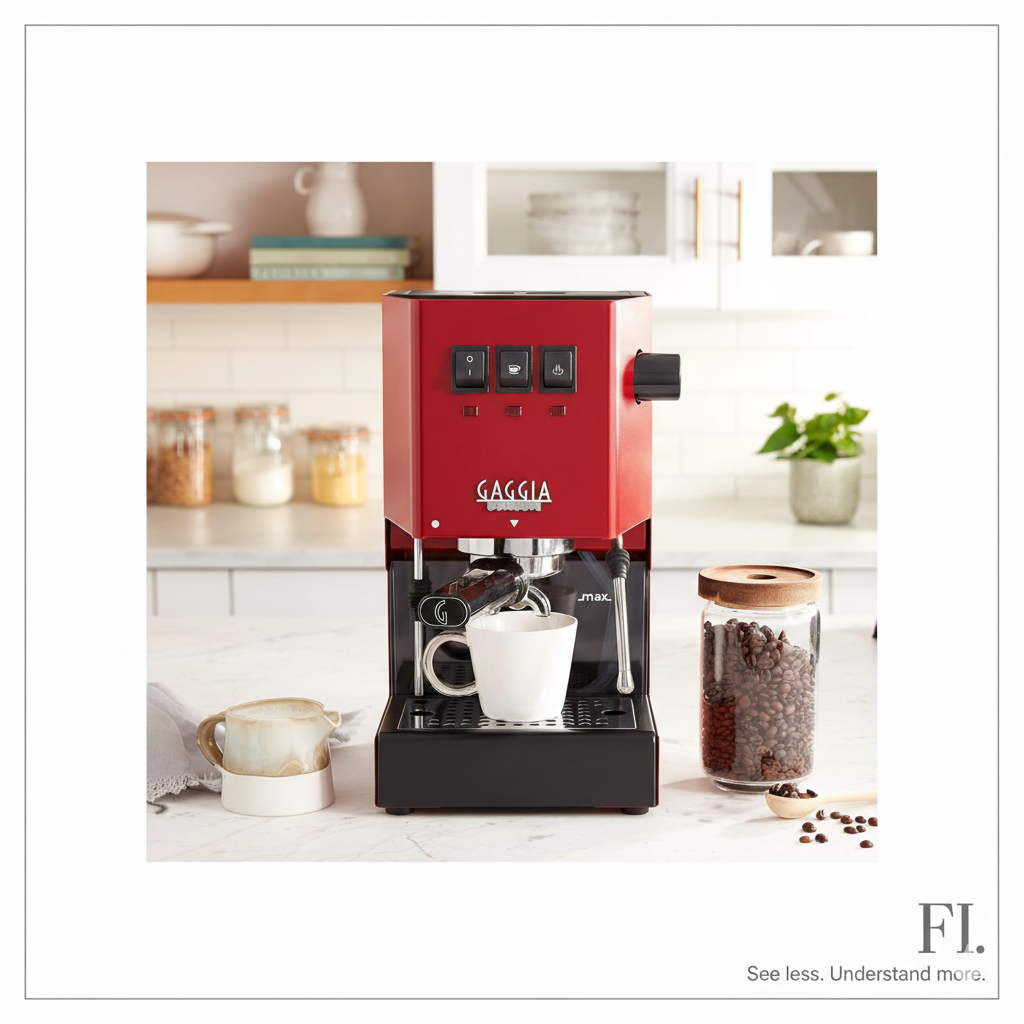
- A true commercial-size 58 mm portafilter
- A robust 3-way solenoid valve
- Mechanical control switches
- A solid brass boiler in recent versions for thermal mass continuity
These elements, taken together, form a platform that supports café-level extractions when you control the variables, not when you expect the machine to.
[Gaggia North America][1]
Technical Analysis
Spec → Mechanism → Behavior → Outcome → Effect
Boiler & Heat Control:
The lead-free brass boiler in newer iterations provides improved thermal stability and steaming capacity compared to earlier aluminum configurations — obvious when transitioning between espresso pulling and foam texturing.
Brass holds heat better, smoothing temperature fluctuations mid-session.
[Gaggia North America][1]
Portafilter & Grouphead:
This machine’s 58 mm commercial portafilter pulls in all standard accessories — a big structural advantage.
It anchors the extraction workflow to industry norms and opens compatibility with precision baskets and tampers that materially affect stability.
[brewchoices.com][2]
Solenoid Valve & Dry Puck Reset:
The inclusion of a 3-way solenoid valve means the puck is rinsed and depressurized after extraction.
This matters because dry pucks are easier to purge, reducing downstream variability shot-to-shot.
[Coffeeness][3]
Mechanical Control Interface:
Three rocker switches control power, brew, and steam.
This simplicity is intentional: it forces operator awareness of thermal states and cycle timing — a design decision that promotes disciplined processes, not automation.
[Stark Insider][4]
Contextual Specification Notes
A few structural constraints you need in mind:
- Single-boiler / dual-use system: You cannot simultaneously steam and pull shots — a time and heat management consideration.
- No PID control out of the box: Temperature must be managed through timing and sequence, or by aftermarket PID installs.
- Accessories included are basic: Many owners supplement tampers and baskets early on for more predictable tamping and distribution.
[Tom’s Guide][5]
These aren’t faults — they’re design expressions that make this machine behave like a true semi-automatic, not a semi-automatic “plus”.
Use-Case Fit
This machine performs optimally when these conditions are true:
- You want manual control over extraction rhythm
- You have or are willing to invest in a dedicated grinder and technique tools
- You value thermal consistency at shot time over turn-key ease
- You’re not in a situation where latte after latte is needed back-to-back with steam and espresso urgently
If you wanted a machine that delivers café-like crema and controlled milk texture through deliberate, conscious workflow, this fits. If what you want is push-button simplicity, the stability profile isn’t aligned with that expectation.
Trade-Offs & Constraints
Here’s where the equilibrium gap becomes real:
Lower Automation → Higher Skill Requirement
This machine exposes you to the process.
There’s no digital guidance; there’s no pre-infusion logic. You make stability through timing and sensory awareness.
Steam Performance → Manual Mastery Required
The steam wand is capable, but requires precision and practice.
Its professional geometry supports microfoam — yet its operation depends on your hand and jug angle, not automated pressure curves.
Accessories → Supplemented Early
Basic plastic accessories are functional but not foundational to stable routine building.
Most operators replace them early to decrease variability in puck prep.
These trade-offs are structural, not accidental.
Pricing Logic
This machine sits in a price band where:
- You can find more automated offerings slightly cheaper
- You rarely find true commercial-spec hardware at this cost
The logic here is hardware equity over digital convenience.
You’re buying industrial geometry and an ecosystem of parts you can upgrade — not feature-layer automation.
[brewchoices.com][2]
Observational Validation Layer
Thermal Consistency in Practice
Over repeated brew and steam cycles, the brass boiler demonstrates less temperature swing mid-session than many aluminum-boiler models at this price, leading to reduced adjustment per shot.
(observer technical field insight)
Operator Control Depth
Persistent users report that shots dial in once the grinder, dose, and tamp ratio stabilize — and from that point, extraction variability narrows significantly, which aligns with how professional baristas approach semi-automatic machines.
(community usage pattern)
VeTo check product availability and updated specifications in your region via Amazon, you can continue from here.
I evaluate this machine not as a concession to convenience but as a precision tool.
It demands a workflow and gives stability where mechanics support consistency.
The equilibrium gap here isn’t “bad” — it’s structured manual control.
If your goal is consistent, high-quality espresso through deliberate technique, this machine’s engineering, hardware stack, and community support make it a durable foundation.