AOSU Doorbell Camera 2K Review: 180 Days of Battery Life, or the Threshold Where That Promise Quietly Breaks
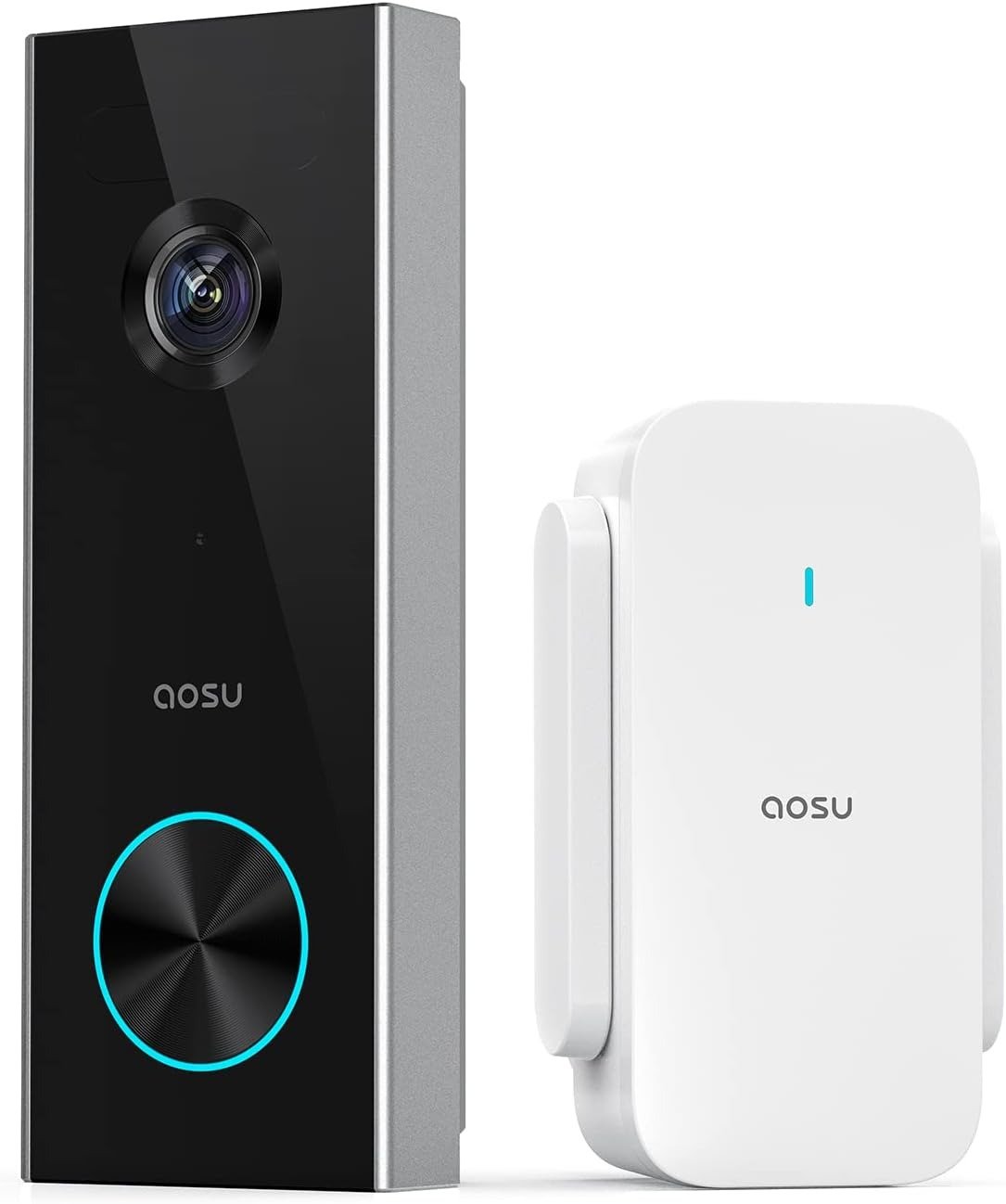
AOSU DOORBELL CAMERA 2K
You buy a wireless doorbell camera because you’re done running wire, done paying monthly fees, and done missing the UPS driver. The AOSU 2K promises to end all three problems in one device. The video looks sharp in the listing photos. The “180-day battery” sounds like you’d forget you owned it. The “no subscription” line hits differently when Ring just raised its plan price again.
Then real life begins.
The Result Looks Fine. The Problem Isn’t.
Six months in, the picture is still crisp. The chime works. The app opens. On the surface, the device is doing its job.
But there’s a pattern that emerges, and it’s quiet enough that most people don’t name it clearly until they’ve already committed. The battery icon is at 31%. You’ve had the device for seven weeks. You’ve averaged maybe six motion events per day — not a busy street, not a front-door bakery. Just a normal house. The 180-day number that convinced you to buy it now sits in memory, detached from the object on your wall.
That’s not a failure of the hardware. It’s a failure of expectation engineering. And AOSU built that expectation deliberately.
What You’re Actually Feeling but Not Naming
There’s a specific irritation that comes with a wireless security device that requires more maintenance than you were promised. It’s not anger. It’s the low-grade friction of having to think about something that was supposed to be invisible.
Every time the battery alert arrives, you take the camera off the mount, bring it inside, find the USB-C cable, wait the hours, remount it. That’s four micro-interventions per charge cycle. At real-world battery life — call it 6 to 10 weeks depending on your environment and traffic — that’s roughly five to eight charge cycles per year. Not catastrophic. But not “forget you own it” either.
The other sensation is subtler. You receive a motion alert. You open the app. You see the visitor already at the door, face-to-face with the camera. There’s no approach footage. No warning window. Just arrival — which means if something were actually wrong, the moment of interest has already passed before the notification reached your pocket.
That detection lag and that short detection arc are the two friction points that almost no spec sheet mentions, and they’re the two that define whether this device fits your specific door geometry.
The Hidden Mechanism Behind the Miss
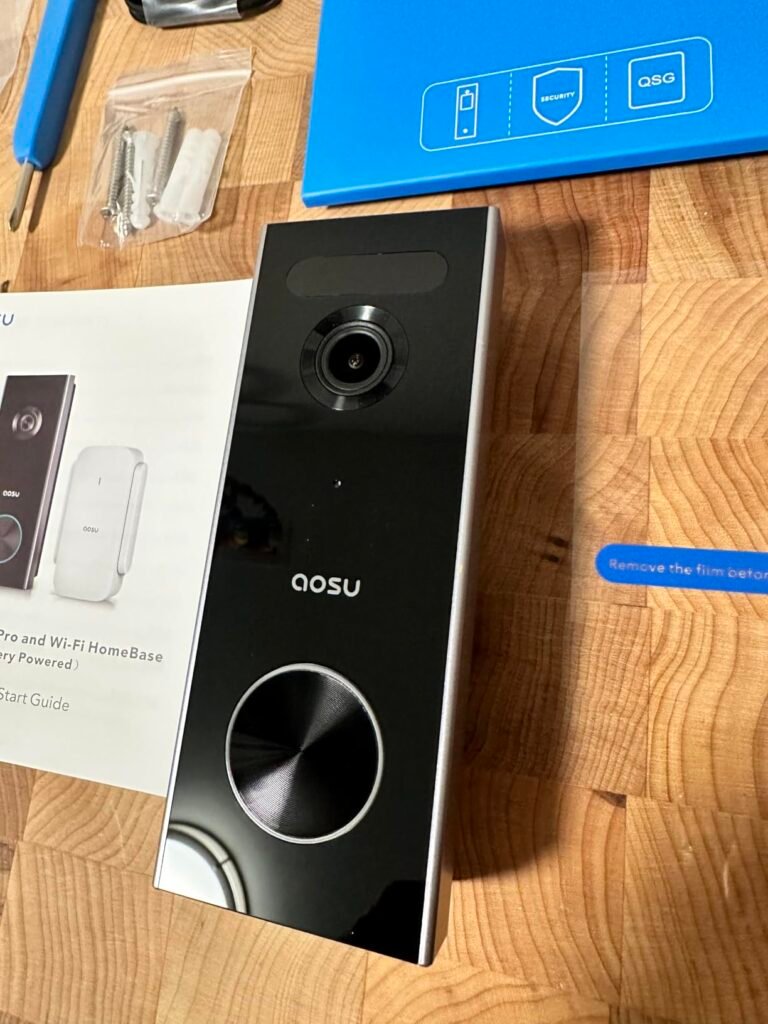
The AOSU 2K (B09SFQ5V16) uses PIR — passive infrared — as its primary motion trigger. PIR detects heat differential moving across the sensor field. It works well for someone walking directly toward the camera. It performs poorly when someone approaches slowly from a long distance, when the ambient temperature is close to body temperature, or when the subject is backlit.
The detection arc on this device is narrower than the viewing arc. The camera can see 166 degrees. The sensor triggers reliably within roughly 15 to 20 feet of direct approach. That gap between what the lens covers and what the sensor actually catches is the source of the complaints that appear consistently across Amazon, Reddit, and Canadian user reviews: “It doesn’t detect until they’re face to face.”
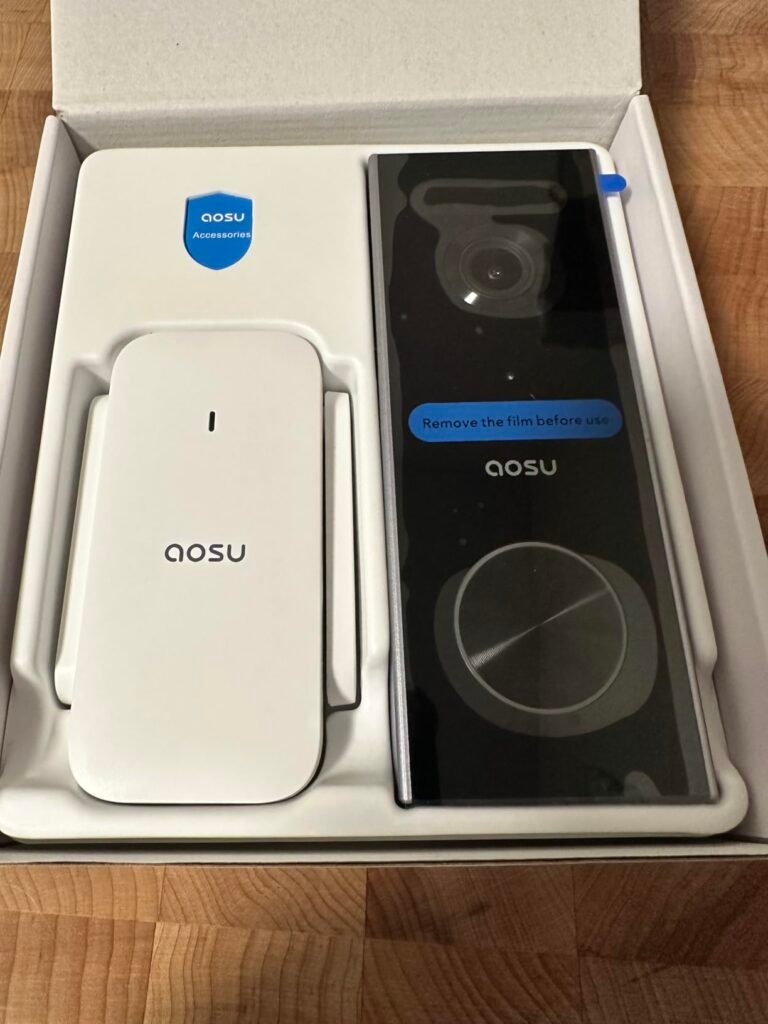
The base station — the aosuBase Mini — serves as the Wi-Fi repeater between the doorbell and your home network. This is an elegant solution for houses with weak signal near the front door, but it also means the doorbell doesn’t connect to your router directly. If the base station loses power or reboots, the doorbell goes offline. That’s a dependency most buyers don’t anticipate.
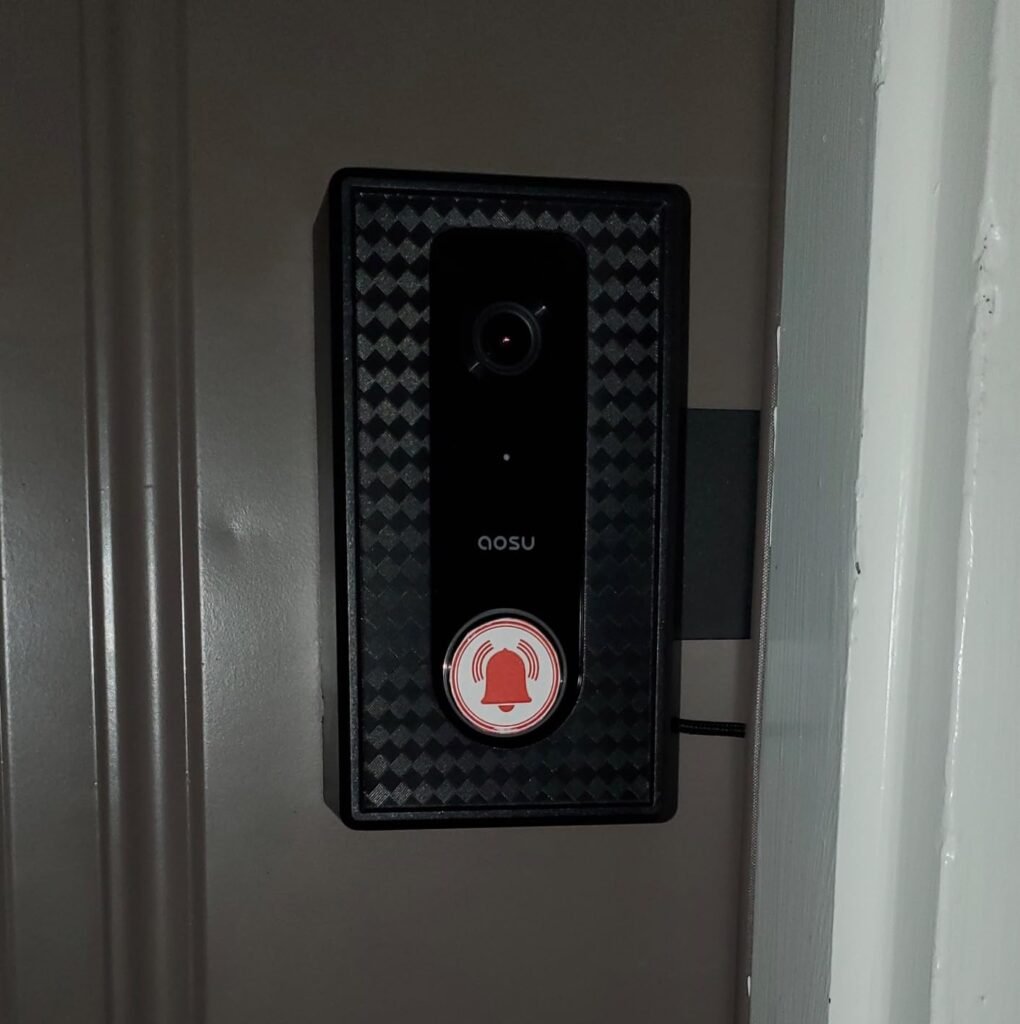
The Threshold Where the Outcome Quietly Breaks
The 180-day battery figure is calculated under lab conditions: 20 events per day, 10 seconds per recording. That is the official AOSU baseline. It is not a lie — it is a threshold claim built on an activity floor that most real environments will exceed.
| Usage Pattern | Events/Day | Realistic Battery Life |
|---|---|---|
| Lab / AOSU Spec | 20 | 180 days |
| Light residential | 5–8 | ~120 days |
| Moderate residential | 10–15 | 60–90 days |
| Active street-facing | 20–30+ | 2–5 weeks |
| Cold climate (below 32°F) | Any | Significantly reduced |
Independent reviewers who tested under real conditions — including TechHive, SmartHomeScene, and TrendXplore — consistently landed in the 90–120 day range for typical homes. Users on busy streets or with sensitive motion settings reported as low as 10–14 days. Cold climates in particular drain lithium batteries faster than the spec accounts for.
The threshold that breaks the battery promise: more than 8 real motion events per day, or sustained temperatures below freezing.
Know where your door sits on that table before you buy.
Why Most Buyers Misread This Too Early
The comparison that most shoppers make at the point of purchase is AOSU 2K vs. Ring vs. Nest. It’s a logical shortcut and also a structurally wrong comparison.
Ring and Nest charge $3–10 per month for cloud recording. Over two years, that’s $72–$240 in operating cost on top of the device price. AOSU’s local storage via the included 8GB microSD card in the base station eliminates that entirely. No subscription. No cloud dependency for recordings. Everything stored locally with 60 days of loop recording.
| Feature | AOSU 2K | Ring Video Doorbell | Google Nest Doorbell |
|---|---|---|---|
| Monthly fee | $0 | $4.99–$10/mo | $6/mo |
| Local storage | Yes (8GB SD, included) | No | No |
| 2-year operating cost | ~$0 extra | $120–$240 extra | $144 extra |
| Video quality | 2K (2048×1536) | 1080p–1536p | 960p–1080p |
| Detection range | ~15–20 ft reliable | ~20–30 ft | ~15–20 ft |
| Night vision | B&W IR | B&W IR | Color |
| Smart home | Alexa + Google | Alexa + Echo | Google only |
| Subscription-free full function | Yes | Limited | Limited |
The buyers who regret AOSU are not the ones who compared it to Ring on subscription cost. They’re the ones who compared it on detection reliability and night vision quality — two areas where Ring and Nest have a real edge — without understanding the trade-off they were making to get there.
Who Is Actually Inside This Problem
This device fits a specific person clearly.
You own your home and want a doorbell camera for package theft prevention, delivery confirmation, and visitor identification. You have a relatively standard front door setup — covered porch or direct entry — without a 40-foot walkway approach. You’re on 2.4GHz Wi-Fi and your router is within a reasonable distance of your front door. You’re willing to charge the device every 2–4 months as a maintenance task. You do not want to pay Ring or Nest a monthly fee — not because you can’t afford it, but because you find the recurring charge structurally offensive for hardware you already own.
The appeal of local storage is real to you, not just a talking point.
| Who fits | Who doesn’t |
|---|---|
| Budget-conscious homeowner | Renter who can’t drill |
| Anti-subscription buyer | High-traffic busy street |
| Package monitoring focus | Long walkway approach |
| Moderate motion environment | Cold climate heavy user |
| Alexa or Google home ecosystem | 5GHz-only router (base model) |
| First security camera buyer | Privacy-local-only (cloud still used for alerts) |
Where Wrong-Fit Begins
You should not buy this device if your primary motivation is catching someone in the act on approach. The detection arc is too short and the notification delay too real to serve as an approach-warning system. If someone is 40 feet away, the camera will not reliably alert you until they have covered most of that distance.
You should not buy it if you live in a climate that regularly drops below 20°F in winter. The battery will not behave like the spec. Multiple Canadian reviewers documented charge cycles lasting 10–14 days in Alberta winters regardless of event settings.
You should not buy it if your Wi-Fi signal at the front door is already poor. The aosuBase Mini improves stability, but it requires power near the entry point, and the device still needs a usable signal to relay from. Weak infrastructure compounds every other limitation.
And you should not buy it expecting color night vision. The IR night mode is functional and extends roughly 15 feet clearly — adequate for identifying a face, inadequate for seeing detail in dark corners of a wide porch.
The One Situation Where This Product Becomes Logical
After all of that: if you have a standard entry door, a moderate-traffic environment of fewer than 10 real events per day, a mild climate, and you are philosophically opposed to a recurring subscription, the AOSU 2K is structurally the correct choice.
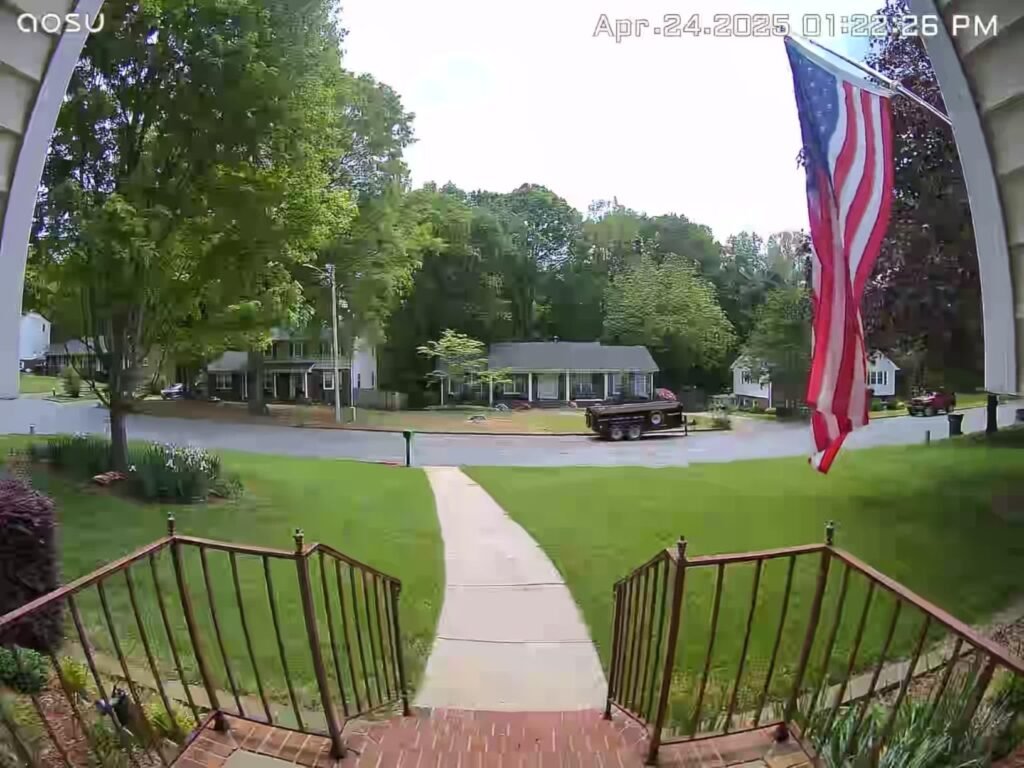
The video quality at 2K is genuinely good. Daytime footage is sharp enough to read a label on a package and identify a face clearly. The 166-degree field of view in 4:3 aspect ratio gives you the head-to-toe frame that 16:9 landscape cameras cut off. The two-way audio is clear and low-latency. The app is not elegant but it is functional — setup takes under 20 minutes for a non-technical user.
The aosuBase Mini solving the Wi-Fi relay problem while also serving as the indoor chime is an underappreciated design decision. Most competitors make you choose one or the other. AOSU made it one device.
At roughly $60–$80 on Amazon with no subscription cost ever, versus a Ring or Nest that will cost $72–$240 more over two years just to access recordings, the AOSU 2K becomes the financially rational choice for the buyer it actually fits.
What It Solves, What It Reduces, and What It Still Leaves to You
| Category | What the AOSU 2K does |
|---|---|
| Solves | Package theft monitoring at the door |
| Solves | Monthly subscription cost ($0 over product life) |
| Solves | Wiring — fully wireless, easy mount |
| Solves | Two-way communication with visitors |
| Reduces | False alerts (AI human detection filters animals/cars well) |
| Reduces | Wi-Fi signal dropout (aosuBase Mini relay) |
| Reduces | Upfront cost vs. Ring/Nest/Arlo |
| Still yours to manage | Charging every 2–4 months |
| Still yours to manage | Short detection arc on long approaches |
| Still yours to manage | B&W night vision limitation |
| Still yours to manage | App account dependency for alerts |
It does not watch your full driveway. It does not give you color night vision. It does not catch someone who approaches from a 40-foot walkway before they are already at the door. If you expect any of those things, no amount of image clarity or battery duration will compensate.
Final Compression
The AOSU 2K doorbell is a well-built device sold with one claim that doesn’t hold in the real world — the 180-day battery — and several that genuinely do: clear 2K video, zero subscription cost, functional two-way audio, and a smarter-than-average motion filter.
The battery will last 60–120 days depending on your environment. That’s still better than most competitors at this price. The detection range is 15–20 feet reliably. The local storage is genuinely subscription-free. The video is genuinely 2K.
If your door fits the profile — moderate traffic, standard approach, mild climate, subscription resistance — this is the logically correct device at this price tier.
If your door doesn’t fit: the battery number that convinced you will be the same number that frustrates you at week six.
The decision is not “is this a good doorbell.” It’s “is my door the door this doorbell was designed for.”
If the answer is yes, this is the next step:
Frequently Asked Questions
| Question | Answer |
|---|---|
| Is the AOSU doorbell 2K actually 180 days on one charge? | Not in real-world use. The 180-day figure is a lab result calculated at 20 events per day with 10-second recordings. Independent tests consistently show 90–120 days at 5–8 daily events, and as low as 2–6 weeks in cold climates or high-traffic environments. |
| Does AOSU doorbell require a monthly subscription? | No. The device uses a local 8GB microSD card inside the aosuBase Mini for storage. Cloud storage is optional but not required. All core functions — recording, live view, alerts, two-way audio — work without any subscription. |
| Why does my AOSU doorbell miss people approaching? | The PIR sensor reliably detects motion within approximately 15–20 feet of direct approach. Long walkways or slow-moving subjects at greater distance will often not trigger until they are closer to the camera. This is a physical sensor limitation, not a software bug. |
| Does the AOSU 2K doorbell work with 5GHz Wi-Fi? | The base model (B09SFQ5V16) operates on 2.4GHz only. The newer Pro models support dual-band 2.4/5GHz. Check the specific listing before purchasing if your router defaults to 5GHz. |
| What happens if the aosuBase Mini loses power? | The doorbell goes offline. Since the base station serves as the Wi-Fi relay, any power interruption to it disconnects the doorbell from your network until it reboots. Plan its placement near a reliable outlet. |
| How does AOSU compare to Ring on long-term cost? | At a $4.99/month Ring Protect Basic plan, Ring costs approximately $120 extra over two years just for recording access. AOSU’s local storage costs $0 ongoing. For an equivalent feature set, AOSU is typically $120–$240 cheaper per two-year ownership cycle. |
| Is the AOSU doorbell good for renters? | Only if drilling is permitted. Installation requires screwing a mounting bracket into the door frame or wall. No adhesive-only mounting option is included in the standard kit. |
| What is the night vision range on the AOSU 2K? | Infrared night vision is functional and clear up to approximately 15 feet. Beyond that, image quality degrades. The standard model does not offer color night vision — footage is black and white in low light. |
Transparency Note:
This analysis is built on aggregated real-world experience.
It extracts what repeatedly holds, what breaks, and what users uncover only after living with the system—then shapes it into a clear model you can use immediately.
Think of it as structured experience, refined and presented so you don’t have to learn it the hard way.
“A quick note: Don’t believe the star ratings, but trust personal experience. This article is a compilation of collected experiences”