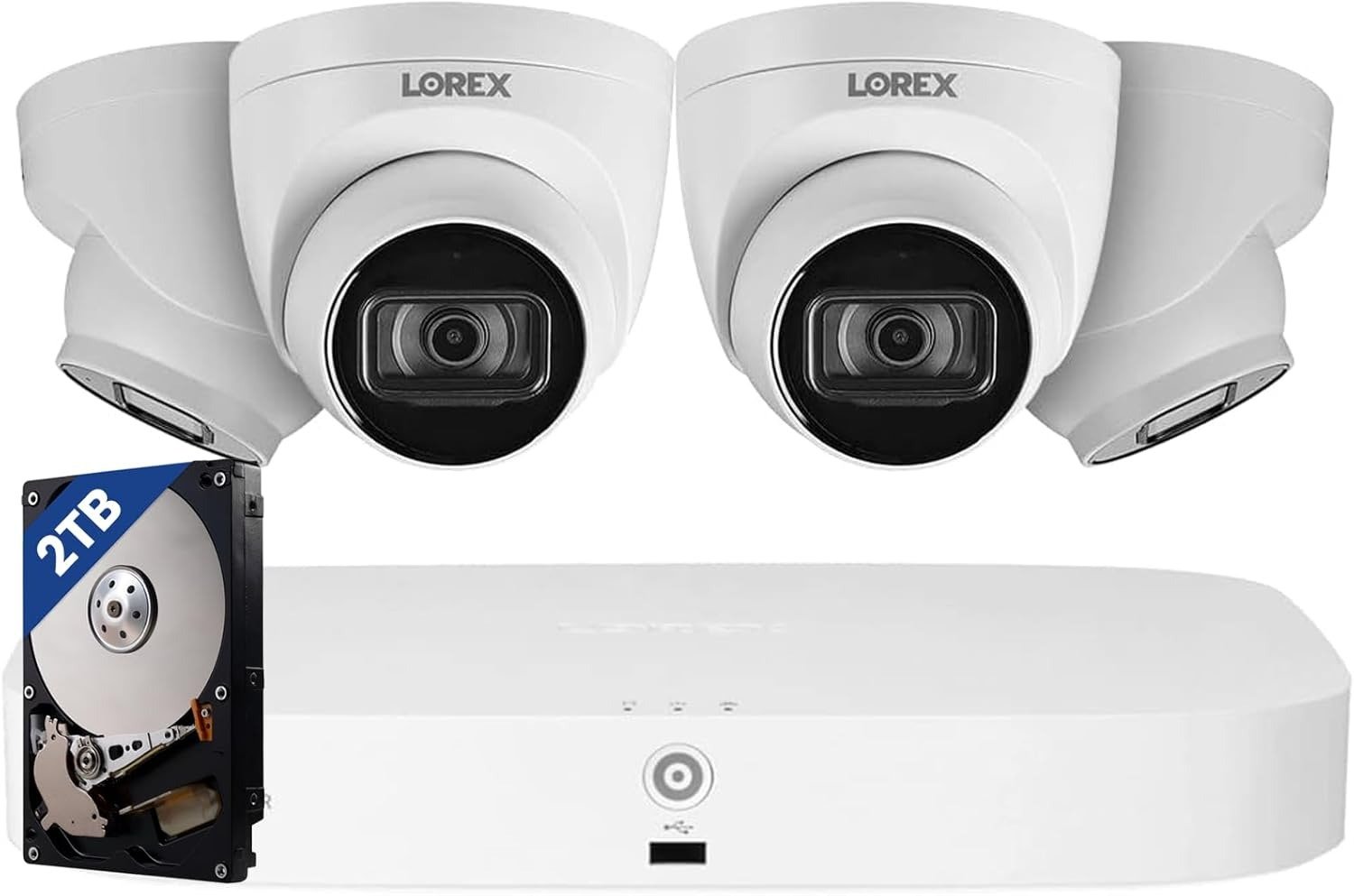
LOREX 4K DUAL LENS WIFI SECURITY SYSTEM
The Coverage Looks Complete. The Gap Isn’t Where You’re Looking.
You mount it. You open the app. The 180° view fills your screen and something clicks — this is it. You can see the driveway, the side gate, and the front walk all at once. One camera. One feed. No blind spots.
That feeling is real. The coverage is real. And the gap is real too — it just doesn’t announce itself at setup.
What most buyers don’t discover until weeks later is that the Lorex 4K Dual Lens WiFi Security System’s most consequential limitation isn’t in the lens. It’s in the conditions those lenses require to deliver what the spec sheet implies. The 180° panoramic view exists. The dual professional-grade lenses connect two adjacent scenes into one continuous panoramic view. What the product page doesn’t front-load is the precise operating threshold at which that full-color, full-detail coverage actually works — and the point where it quietly degrades into something fundamentally different.
This article is about that threshold.
What You’re Actually Feeling but Not Naming
You’re not looking for a security camera. You’re trying to stop checking.
You’ve looked up from the dinner table because you heard something outside. You’ve replayed a clip that was too dark to read. You’ve wondered whether a motion notification was the delivery driver or someone walking slowly past the gate — and by the time you unlocked your phone, it was gone.
The irritation isn’t dramatic. It’s low-grade and continuous: the sense that you have a system, but the system has conditions. And you never quite know when those conditions are being met.
That’s the friction this camera is built for. Not the dramatic break-in scenario. The quiet, accumulated uncertainty of having footage that sort of covers you — but not quite enough that you stop second-guessing it.
The Hidden Mechanism Behind the Miss
Here is the mechanism most comparisons skip past.
The camera uses two built-in professional-grade lenses joined through image stitching technology to create its 180° view. That stitched image runs at 4K — which means more than 8 million pixels distributed across a very wide field. This is structurally different from a single 4K lens pointed at a narrow zone: the resolution is stretched horizontally, and fine detail at the edges of each lens is doing more work than it appears.
This matters most at night. In complete darkness, the camera switches from Color Night Vision to Infrared Night Vision, recording crisp black and white video. But the threshold between those two modes isn’t a switch the user controls — it’s determined by ambient light levels. To force Color Night Vision, ambient lighting is required; in the absence of it, the camera defaults to infrared. And infrared across a 180° stitched frame produces noticeably less usable detail than infrared from a single, narrower-angle lens — because the same IR throw is being asked to illuminate a much wider field.
Additionally, at only 15 frames per second, anything moving through the frame is blurry — which means that 4K detail exists, in full clarity, only when the subject is stationary. A person walking across your driveway at night is precisely the scenario where the system’s two biggest constraints — low ambient light and motion — compound simultaneously.
This is the mechanism behind the miss. Not a defect. An architecture.
The Threshold Where the Outcome Quietly Breaks
| Condition | What You Expect | What Actually Happens |
|---|---|---|
| Daylight, subject still | Full 4K panoramic detail | ✅ Delivered |
| Daylight, subject moving | Clear tracking with auto-frame | ✅ Delivered |
| Night, ambient lighting present | Full-color detail across 180° | ✅ Delivered |
| Night, total darkness | Color night vision with detail | ❌ Switches to IR black & white |
| Night, darkness + motion | Readable plate / face detail | ❌ Blur + reduced IR range |
| Night, darkness + motion + edge of frame | Evidence-grade footage | ❌ Significant degradation |
| Cloud coverage area | No monthly fee, full recording | ✅ Delivered (SD + optional NVR) |
| WiFi signal at camera position | Stable 24/7 recording | ⚠️ Requires ≥3 Mbps upload per camera |
The break point is not darkness alone. It’s the combination of darkness plus motion plus wide-angle stretch. Each condition is manageable independently. Together, they form the threshold where footage goes from useful to architectural — you can see something happened, but you can’t tell exactly what.
You’ll need about 25 Mbps upload speed for smooth streaming, and over 25 GB of storage per hour of continuous 4K recording — compared to 1.5 to 3 GB per hour for 1080p footage. This is not a fine print detail. It is the infrastructure requirement that determines whether the 4K spec you purchased is actually functioning on your network at the moment you need it.
Why Most Buyers Misread This Too Early
The comparison that kills good decisions here is the channel count trade-off.
The reasoning goes: eight standard cameras versus four dual-lens cameras. Dual-lens covers the same perimeter with half the hardware. Simple math, simple win.
What that math skips is the fundamental difference between resolution-per-zone and resolution-per-pixel-density-under-stress. A single 4K camera pointed at a 90° zone concentrates 8 million pixels into a narrow field. The same 4K sensor across 180° is spreading those pixels more than twice as wide. At medium distances, in daylight, this difference is invisible. Under the threshold conditions above, it becomes the reason a license plate isn’t readable.
| Metric | Single 4K Camera (90° FOV) | Lorex 4K Dual Lens (180° FOV) |
|---|---|---|
| Total resolution | 8MP | 7.6MP effective (2×5MP stitched) |
| Pixel density per degree | High | Lower per degree |
| Coverage area per unit | Narrow | Panoramic |
| Night vision clarity | Strong in zone | Distributed across wider field |
| Best use case | Entry points, license plates | Wide open areas, yards, driveways |
| Frame rate | Varies by model | 15 FPS (limits motion clarity) |
The camera is not worse than the single-lens alternative. It is different. And that difference only costs you something in specific conditions — which happen to be the conditions most security events occur in.
Security experts recommend placing 4K cameras strategically at entry points and large outdoor areas where you need to capture details like faces or license plates — using lower resolution cameras for hallways, indoor rooms, and secondary areas. The dual-lens wide-angle format excels at the latter category — broad spatial awareness — and is not optimized for the former — close, fine-detail capture.
Who Is Actually Inside This Problem
This system is the correct choice for a specific, identifiable type of property situation:
You are inside this problem if:
- You have one or more wide-open zones — a yard, a side passage, a courtyard, a large driveway — where a single camera’s 90° view leaves you choosing which portion to monitor.
- You want no monthly subscription and are comfortable managing local storage on a 32GB microSD card (expandable to 256GB) or pairing with a Lorex Fusion NVR for continuous recording.
- Your installation points have access to a power outlet within approximately 10 feet, or you’re willing to run a weatherproof extension.
- Your property has ambient lighting — porch lights, streetlights, neighbor lighting — that activates even partially at night.
- You primarily want deterrence and broad spatial awareness, not forensic-grade footage of fast-moving subjects at distance.
You are not inside this problem if:
- Your primary concern is reading license plates of vehicles passing at speed, in full darkness, at the far edge of the camera’s range.
- You expect the “4K” spec to apply uniformly across all conditions without infrastructure requirements.
- Your WiFi signal at the camera’s mounting position is weak or borderline — the camera requires at least 3 Mbps upload speed and performs better on 2.4GHz for broader reliability.
- You are looking for a camera that works as a standalone NVR system without any additional hardware or app dependency.
Where Wrong-Fit Begins
The regret scenario has a recognizable shape.
The buyer compares two or three cameras. The Lorex dual-lens wins on coverage math. They mount it at the driveway, facing outward, under a soffit with no nearby lighting. The motion alerts come in at 2AM showing a shape — clearly a person — but the frame rate and IR distribution across 180° makes the face unreadable and the plate impossible.
That footage doesn’t fail because the camera is broken. It fails because the buyer was inside a different problem than the camera was designed to solve: forensic identification of fast-moving subjects in total darkness at range.
Real user reports include experiences with pairing difficulty, setup friction, and camera reset issues that required professional installer involvement. These are not universal, but they cluster around one type of user: the buyer who mounted first and read the compatibility requirements second.
| Wrong-Fit Signal | Why It Matters |
|---|---|
| Zero ambient lighting at mount point | Color Night Vision won’t activate; IR across 180° is thinner than IR across 90° |
| Primary goal: license plate capture | 15 FPS + wide-angle stretch reduces readability of moving vehicles |
| Weak WiFi at mount location | Connectivity failures during recording events |
| Expecting plug-and-play without NVR | SD card fills in ~1 week at 4K continuous; requires active management |
| Comparing price to single-lens 4K cameras | Coverage area, not pixel density, is the differentiator — and they serve different needs |
The One Situation Where This System Becomes Logical
After everything above, here is the situation where the Lorex 4K Dual Lens WiFi Security System stops being a compromise and becomes the structurally correct answer.
You have a wide-open zone — a backyard, a long side passage, a large driveway with ambient lighting — where a single-angle camera forces you to choose which portion of the space to cover. You’ve already tried one camera and lived with a persistent blind spot on one side. You don’t want to run additional cabling for a second camera, and you don’t want a cloud subscription.
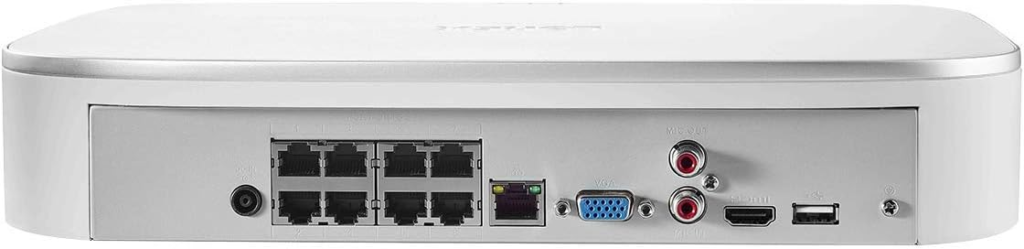
The camera records even when internet goes down, thanks to AC power connection and onboard local storage — with no monthly fees required. Pairing it with a Lorex Fusion NVR enables 24/7 continuous recording to a local hard drive, expandable up to 16TB. The IP67 weather rating and tamper-resistant design allow it to handle temperatures from -40 to 131°F.
For this user — broad spatial awareness, ambient lighting, no subscription tolerance, wide zone coverage — this is not a trade-off. It’s the architecture that fits.
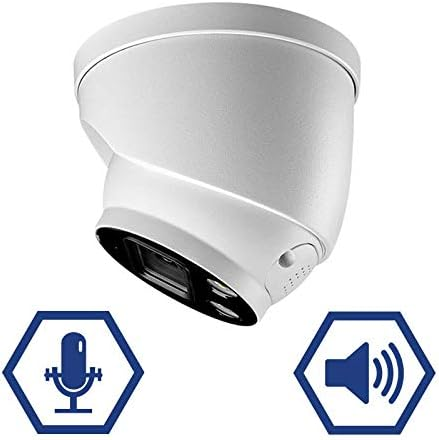
What It Solves, What It Reduces, and What It Still Leaves to You
| Category | System Performance |
|---|---|
| Blind spot coverage in wide-open zones | Solved — 180° panoramic eliminates the need for two cameras in most yard configurations |
| Monthly subscription cost | Solved — zero fees with local 32GB SD (upgradable to 256GB) or optional NVR |
| Daytime identification clarity | Solved — 4K with HDR and auto-framing tracks moving subjects across the full view |
| Night color detail (with ambient light) | Solved — Color Night Vision activates with any nearby ambient lighting |
| Deterrence function | Significantly reduced — motion-activated Smart Security Lighting and siren are visible deterrents |
| Setup complexity | Reduced — plug and play WiFi pairing with 2.4GHz/5GHz support and QR code onboarding |
| Night forensic detail (total darkness, moving subject) | Still leaves this to you — IR across 180° + 15 FPS limits evidentiary value in this specific condition |
| WiFi reliability management | Still leaves this to you — upload speed, router distance, and signal strength must be validated before mounting |
| Customer service responsiveness | Still leaves this to you — support is limited to specific business hours, not 24/7 |
Final Compression
The Lorex 4K Dual Lens WiFi Security System solves a real and specific problem: wide-zone coverage, no subscription, strong daytime clarity, and meaningful deterrence through smart lighting and sirens. It does this well. It does not solve the adjacent problem — forensic-grade, evidence-quality footage of fast-moving subjects in total darkness at distance.
The decision compresses to this: identify your ambient lighting situation at the intended mount point before anything else. If there is ambient light, even partial, this system performs at or above its class. If there is total darkness and your primary need is identification rather than awareness, this is the wrong architecture — not because the camera fails, but because you’re asking it to solve a different problem than the one it was designed for.
If you are buying for spatial awareness, broad deterrence, subscription-free local recording, and a property zone that no single-angle camera covers cleanly — and your mounting point has power access and reasonable WiFi signal — then the decision is already made. Delaying it doesn’t change the architecture. It just delays the coverage.
Frequently Asked Questions
| Question | Answer |
|---|---|
| Does the Lorex 4K Dual Lens WiFi system require a monthly subscription? | No. The camera stores footage locally on an included 32GB microSD card with no monthly fees, expandable to 256GB. Pairing with a Lorex Fusion NVR adds continuous local recording to a hard drive — also without subscription. |
| Does Color Night Vision work in complete darkness? | No. In complete darkness the camera switches to Infrared Night Vision, recording in black and white. Color Night Vision requires ambient light to activate. This is the most commonly misunderstood specification. |
| What WiFi speed does the Lorex 4K Dual Lens camera require? | A minimum of 3 Mbps upload speed is required for optimal video streaming and remote access. For the 8-channel system running multiple cameras simultaneously, your router’s upload speed and proximity to the cameras becomes a critical installation variable. |
| What is the effective resolution of the dual-lens system? | The camera uses a dual-lens system with 2×5MP sensors, producing 7.6MP effective resolution across the full 180° panoramic view — not two separate 4K feeds. |
| Can the Lorex dual-lens WiFi camera record 24/7 continuously? | On the onboard SD card, continuous recording depends on card capacity — a 32GB card fills in approximately one week at 4K. Pairing with a compatible Lorex Fusion NVR enables 24/7 continuous local recording to an upgradeable hard drive. |
| What weather conditions can the camera handle? | The outdoor models carry an IP67 rating and can handle extreme temperatures from -40 to 131 degrees Fahrenheit. The IP66-rated WiFi model is suitable for outdoor use and standard weather conditions. |
| Is the auto-framing feature available during all recording modes? | Auto-Framing detects a moving object and uses one lens to automatically zoom in and follow it across the 180° view. It functions during live view and standard recording, but is not available when Smart Motion Detection (SMD) is simultaneously enabled. |
| Who should not buy the Lorex 4K Dual Lens WiFi system? | Anyone whose primary security need is forensic identification — readable license plates or faces of fast-moving subjects in total darkness at the outer range of the camera — will find the 15 FPS frame rate and wide-angle IR distribution insufficient for that specific use case. The system is built for awareness and deterrence over a wide zone, not for close-range forensic capture in complete darkness. |
Transparency Note:
This analysis is built on aggregated real-world experience.
It extracts what repeatedly holds, what breaks, and what users uncover only after living with the system—then shapes it into a clear model you can use immediately.
Think of it as structured experience, refined and presented so you don’t have to learn it the hard way.
“A quick note: Don’t believe the star ratings, but trust personal experience. This article is a compilation of collected experiences”