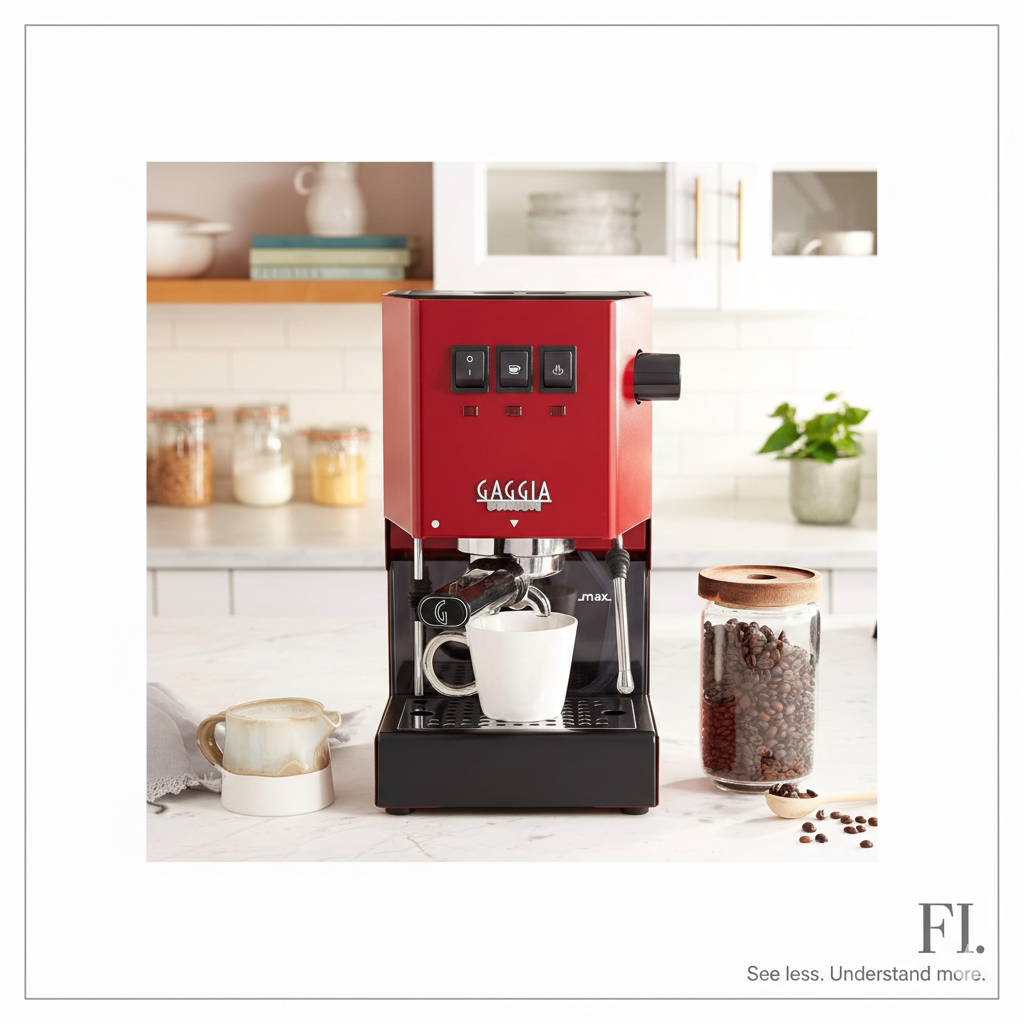
The Espresso Looks Serious. The Workflow Is What Decides Whether the Gaggia Classic Pro Is Worth It
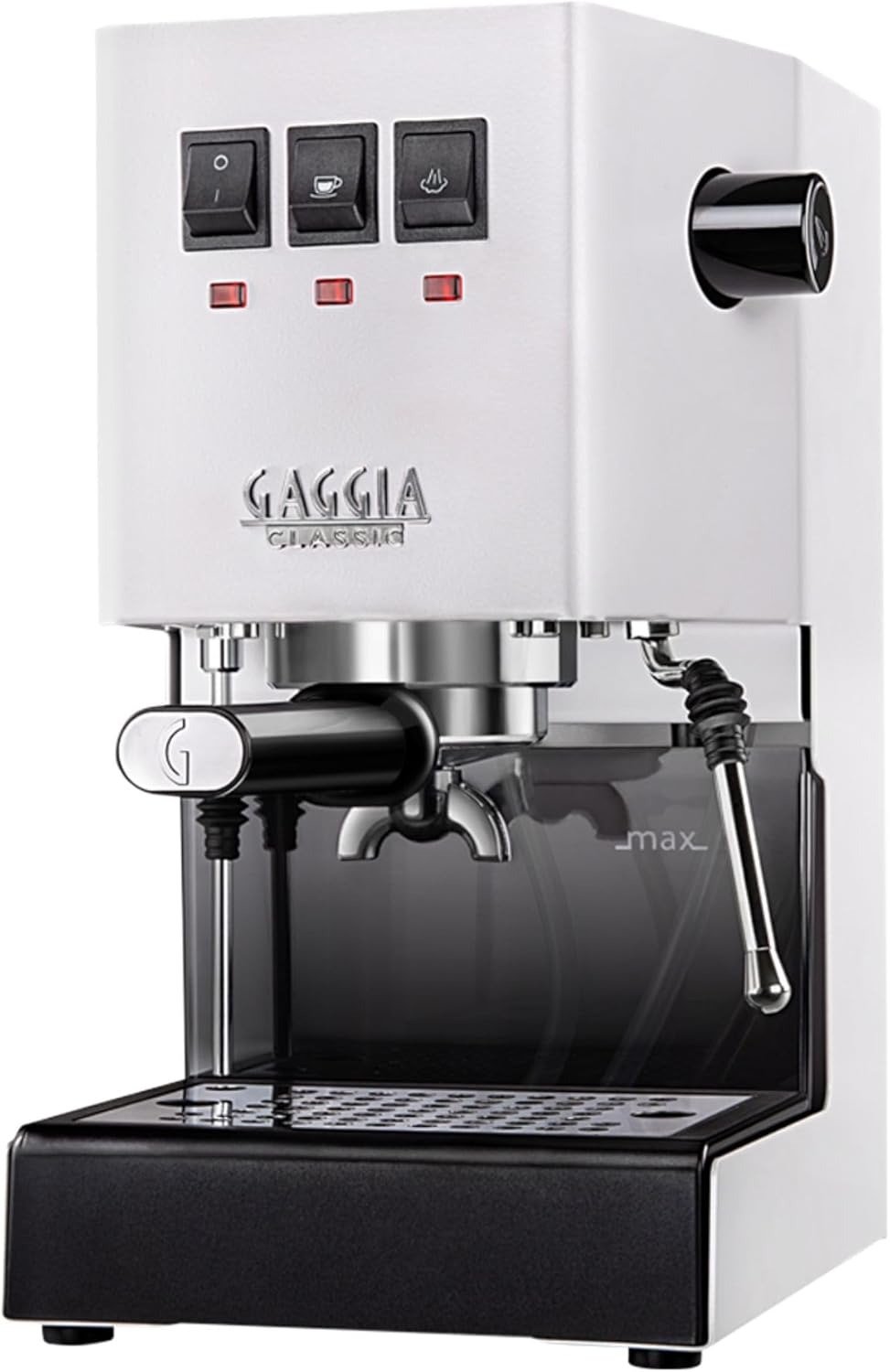
GAGGIA CLASSIC PRO
The Result Looks Fine. The Problem Isn’t.
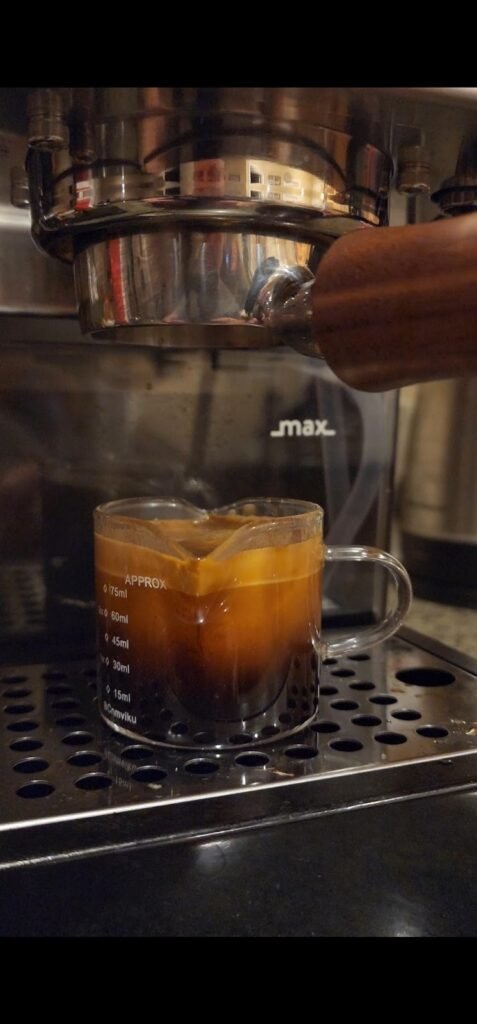
A bad home espresso setup rarely fails in a dramatic way. It fails quietly. The shot lands with a tiger-striped crema, the cup looks dense enough to photograph, and thirty seconds later you are standing there with something flat, sharp, or vaguely hollow, wondering why a machine that looks this serious still leaves you adjusting your grinder like a man trying to crack a safe in the dark.
That is the real trap around the Gaggia Classic Pro. Not whether it can make espresso. It can. Not whether it is built well. It is. The trap is simpler than that: the machine looks easier than the workflow actually is. And if you miss that threshold, you do not buy a tool. You buy a ritual you may not enjoy.
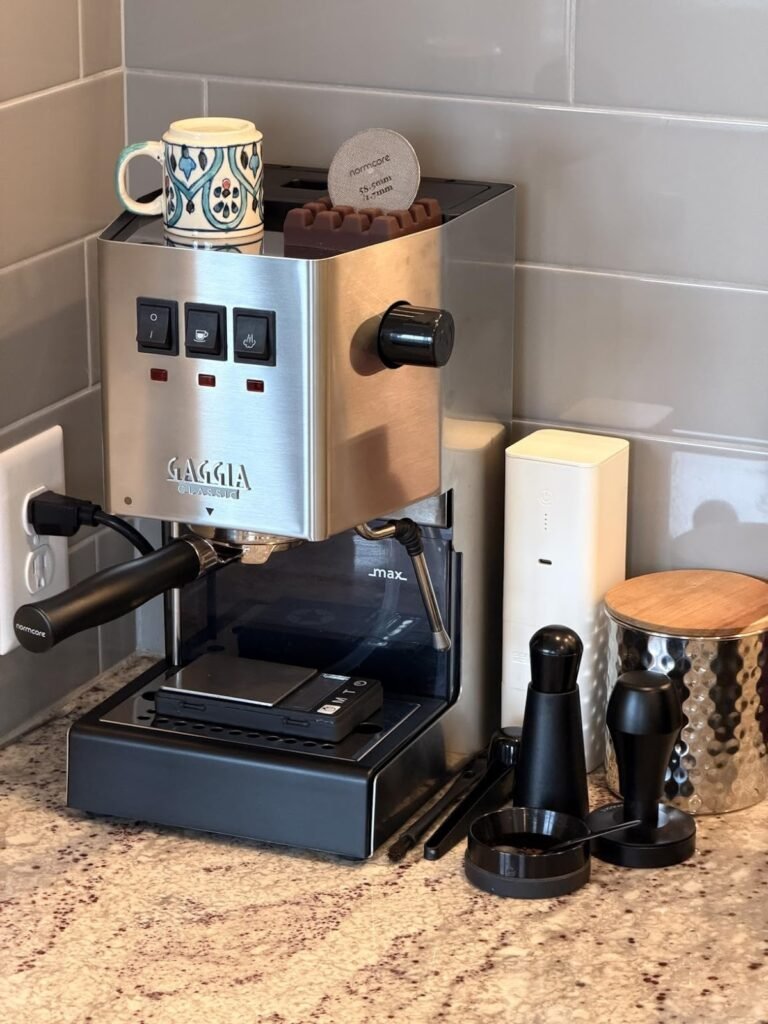
The current RI9380/46 listing is built around a steel body, a 58 mm commercial-style portafilter, a three-way solenoid valve, and a commercial steam wand, while the latest E24 version adds a lead-free brass boiler intended to improve thermal stability. Major review roundups still place the Classic Pro family in the enthusiast category rather than the convenience category.
What You’re Actually Feeling but Not Naming
Most people do not say, “I am struggling with thermal drift inside a single-boiler dual-use machine.” They say something much more human.
They say:
| What you think is happening | What is usually happening |
|---|---|
| “My grinder is off again.” | The machine was not at the same thermal point when you pulled the shot. |
| “This coffee is inconsistent.” | Your workflow is inconsistent, and this machine exposes that brutally. |
| “The espresso looks fine but tastes thin.” | You hit the cup before the machine hit the right point in its cycle. |
That is why this machine divides people so hard. One group sees a compact Italian tank that teaches real espresso fundamentals. Another sees a handsome stainless steel box that demands too much ceremony before breakfast. Both groups are telling the truth. Serious Eats places it as a sub-$500 option for enthusiasts, not beginners; Bon Appétit makes nearly the same distinction by praising the 58 mm portafilter and steam wand while warning that, as a single boiler, it forces you to wait between brewing and steaming.
The Hidden Mechanism Behind the Miss
The hidden variable is not glamour. It is rhythm.
The Gaggia Classic Pro is a single-boiler, dual-use machine. That means one heating system is doing two jobs: brewing espresso and producing steam. On paper, that sounds manageable. On a sleepy Tuesday morning, it feels like trying to conduct an orchestra with one hand. You are not only choosing dose, grind, distribution, and yield. You are also choosing when inside the machine’s heat cycle you pull the shot.
That is why “temperature surfing” keeps showing up in serious Gaggia discussions, guides, and owner routines: users are compensating for the fact that thermostat-driven machines drift around the target zone instead of locking it digitally. Community routines commonly call for a 15–20 minute warm-up, a purge, and a timed wait before brewing; CoffeeGeek’s 2025 guide frames temperature surfing as learning the boiler’s rhythm rather than pretending the drift is not there.
The mechanical upside is real. The three-way solenoid valve is not fluff; it relieves pressure after the shot, which makes cleanup cleaner and the puck drier. The 58 mm portafilter is also not cosmetic theater; it gives the machine access to the wider ecosystem of baskets, tampers, and accessories that serious home baristas actually use. The newer North American Evo/Pro positioning also centers a 9-bar extraction target through an updated OPV, which matters because that pressure point is much closer to real espresso standards than the inflated “15-bar” marketing language common in cheaper machines.
And then there is the E24 change. The latest official version swaps in a lead-free brass boiler and lists a 3.5 oz boiler capacity at 1370 W, with Gaggia saying the move improves thermal stability and steaming performance. Tom’s Guide, after testing the newer E24, found that the brass-boiler update reduced severe shot variation enough to make the machine feel more livable without a PID, though not perfectly immune to light surfing. That matters because the old criticism was never that the Classic could not make good espresso. It was that consistency had to be earned.
The Threshold Where the Outcome Quietly Breaks
This machine has a clear break point.
I would name it this way:
The Workflow Threshold = the point where you stop expecting the machine to rescue your routine and start accepting that your routine is part of the machine.
Below that threshold, the Gaggia Classic Pro feels annoying. Above it, the same machine feels precise.
That is the whole story.
Here is the threshold in plain terms:
| Below the threshold | Above the threshold |
|---|---|
| You want fast espresso before work. | You are willing to preheat, purge, and time your shot. |
| You expect consistency from the machine alone. | You accept consistency as a workflow outcome. |
| You want accessories included and ready. | You are comfortable upgrading tools over time. |
| You want push-button forgiveness. | You want commercial-adjacent fundamentals in a small chassis. |
This is why opinions swing from admiration to irritation. Tom’s Guide liked the newer E24 specifically because it made the machine less fussy than expected, but still criticized the cheap included tamp and lack of beginner-friendly extras. Reddit owners and critics have been even blunter for years: weak stock accessories, more difficulty than newcomers expect, and real rewards only if you are willing to learn the machine’s habits.
Why Most Buyers Misread This Too Early
Because they compare the wrong things.
They compare steel to plastic.
They compare 58 mm to 54 mm.
They compare “made in Italy” to “made somewhere else.”
That is decorative comparison. The real comparison is this: does this machine reduce decision fog, or does it move the fog from the buying stage into the daily workflow?
The Gaggia wins on the first question and can lose on the second.
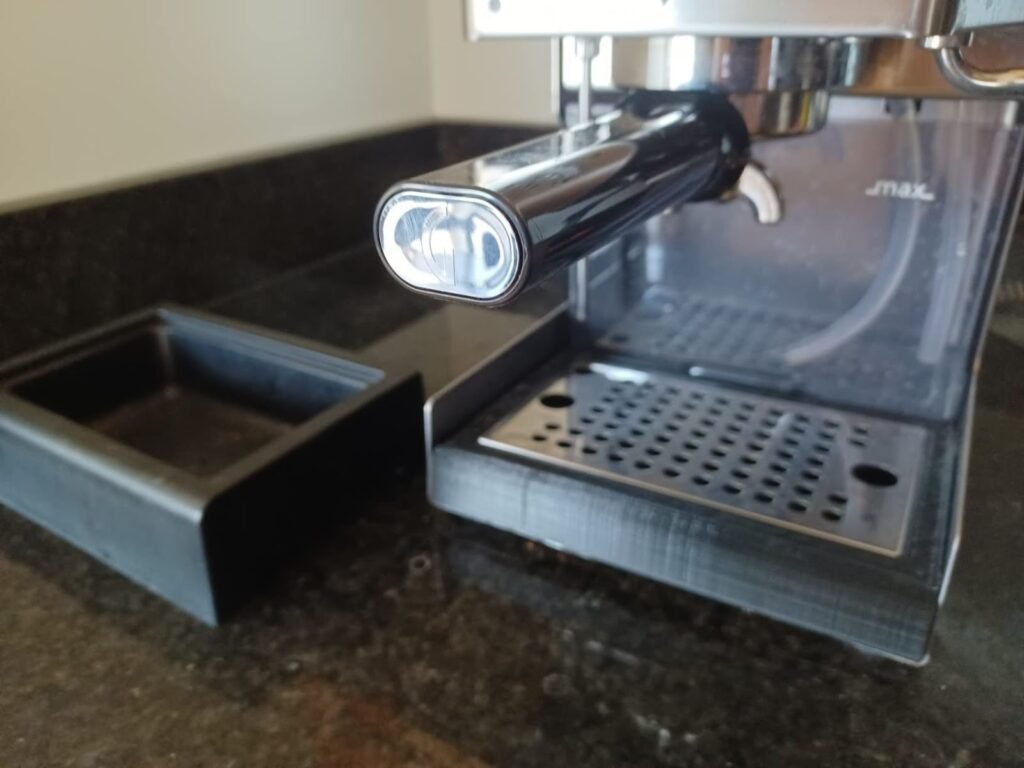
This is where a lot of glossy praise misses the mark. Yes, the frame is solid. Yes, the form factor is compact, at roughly 8 by 9.5 by 14.2 inches and about 19–20 pounds, with a 72 oz / 2.1 L reservoir. Yes, it gives you a proper steam wand, a three-way valve, ESE pod compatibility, and serviceability that many cheaper machines simply do not offer. Serious Eats and Bon Appétit both signal the same underlying truth: this machine makes sense for someone who wants to get closer to a real espresso workflow, not for someone who wants the workflow hidden from them.
And the market has changed. That matters. The old reason to buy the Classic was simple: it gave you a path into “real espresso” without paying prosumer money. Today, machines like the Bambino line have raised the floor for convenience, warm-up speed, and beginner tolerance. So the Gaggia is no longer the obvious answer to “What should I buy under $500?” It is the more specific answer to a harder question: “What should I buy if I want the bones of a serious machine and I do not mind learning its rhythm?” That distinction keeps appearing across 2025–2026 reviews and buyer guides.
Who Is Actually Inside This Problem
You are inside this problem if three things are true.
First, you care more about the cup than the spectacle. You are not shopping for a touchscreen. You are shopping for pressure management, thermal behavior, steam control, and a machine that does not feel disposable after one good year.
Second, you do not mind repetition. Not endless tinkering. Not hobby theater. Just repetition. Heat the machine. Lock in the portafilter. Purge. Wait. Pull. Steam. Clean. This machine rewards rhythm more than impulse.
Third, you are building a coffee station, not buying a kitchen prop. That means you understand the machine is only one piece. A Gaggia paired with a weak grinder is like a sharp lens on a foggy camera body. The machine will reveal the problem, not hide it.
That is why so many positive reviews sound almost stern. Even supportive outlets frame it as an enthusiast’s machine. Serious Eats does. Bon Appétit does. Tom’s Guide ultimately stuck with the E24 because it balanced compact size, strong steaming, and acceptable stability for someone already living in espresso logic.
Where Wrong-Fit Begins
Wrong-fit begins earlier than most buyers think.
Not when you fail to pull a perfect shot.
When you resent the machine for asking you to care.
That is the line.
If you hate preheating, this is wrong-fit.
If you want milk drinks back-to-back for a household, this is wrong-fit.
If you expect the box to include excellent tools, this is wrong-fit.
If you want digital temperature control out of the gate, this is wrong-fit.
A lot of the criticism around the Classic Pro is not actually criticism of its build or cup potential. It is criticism of mismatch. Owners repeatedly call out temperature surfing, accessory compromises, and the reality that the machine makes more sense once paired with better baskets, tampers, or later mods. CoffeeGeek praised the steaming more than expected on the Evo generation, but the broader enthusiast conversation still treats PID upgrades and accessory replacements as common next steps for people chasing tighter consistency.
That is not a defect in the moral sense. It is a boundary in the practical sense.
The One Situation Where This Product Becomes Logical
The Gaggia Classic Pro becomes logical in one very specific situation:
You want a compact semi-automatic espresso machine with real commercial-style fundamentals, and you are willing to trade convenience for control before you are willing to trade durability for convenience.
That is the sentence.
In that situation, the machine tightens into focus. The steel shell stops being aesthetic fluff and starts meaning sturdiness. The 58 mm portafilter stops being nerd bait and starts meaning ecosystem access. The three-way solenoid stops being spec-sheet decoration and starts meaning cleaner puck handling. The steam wand stops being a brag point and starts meaning actual milk texture control instead of bubbly approximation. The newer E24 boiler matters here too, because improved thermal stability does not make the machine automatic; it simply makes the machine less punishing at the margin.
Here is the clean version of the case:
| If your real priority is… | Then the Gaggia Classic Pro makes sense because… |
|---|---|
| Longevity | It uses commercial-style parts and is widely serviceable. |
| Learning espresso properly | It exposes the variables instead of burying them. |
| Better milk texture than cheap thermoblocks | Its wand is consistently praised as more serious than entry-level rivals. |
| Small footprint with enthusiast upside | It stays compact while keeping real machine fundamentals. |
What It Solves, What It Reduces, and What It Still Leaves to You
What it solves:
- It solves the cheap-machine problem where the espresso side is mostly theater and the steam side is mostly air.
- It solves the dead-end problem where your accessories, baskets, and technique have nowhere to go.
- It solves the “I outgrew this too fast” problem better than most entry-level machines in its bracket.
What it reduces:
- It reduces cleanup mess through the three-way valve.
- It reduces structural compromise through a heavier, more durable chassis and commercial-format workflow.
- In the E24 generation, it reduces some of the thermal guesswork that made older iterations feel more temperamental.
What it still leaves to you:
- Shot timing.
- Grinder quality.
- Accessory upgrades.
- Warm-up discipline.
- Patience between brew and steam.
- The willingness to learn a machine that does not flatter sloppy habits.
That last part matters most. This machine does not remove the craft. It charges admission for it.
Final Compression
The Gaggia Classic Pro is not the machine I would point at if your deepest wish is frictionless espresso.
It is the machine I would point at if you are tired of polished shortcuts, tired of consumer-grade compromises dressed up as espresso, and ready to accept one uncomfortable truth: once you cross a certain line, better coffee at home is less about buttons and more about rhythm.
That is the threshold here.
If you are below it, this machine will feel fussy, stubborn, and occasionally unfair.
If you are above it, it starts to feel like one of the cleanest buys in the category.
Not because it does everything.
Because it does the important things honestly.
If this is the condition you are actually dealing with, the Gaggia Classic Pro becomes the logical next step.
Transparency Note:
This analysis is not based on quick personal impressions.
It is derived from documented system behavior, verified user patterns, and the physical constraints of storage capacity.
The goal is to translate complex technical behavior into a realistic performance model that helps you make a clear decision.
“A quick note: Don’t believe the star ratings, but trust personal experience. This article is a compilation of collected experiences”