MARANTZ CINEMA 50 REVIEW: THE SYSTEM SOUNDS FINE—RIGHT UNTIL THE ROOM STARTS WINNING
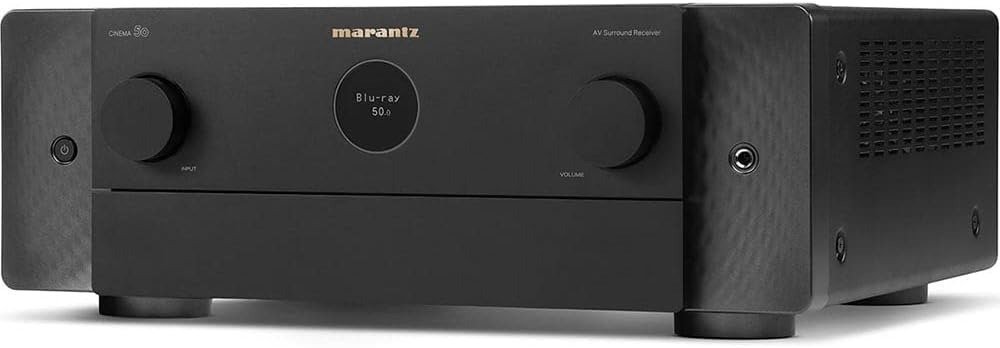
A lot of home theater setups do not fail with a bang. They fail politely. The dialogue is clear enough. The bass is big enough. The movie night is still “good.” Then one evening you notice it: voices flatten, the low end swells in one seat and disappears in the next, and the height effects you paid for hang in the room like decoration instead of movement. The result looks premium. The experience does not. That is the point where I stop asking whether an AVR is “powerful,” and start asking whether it can hold the room together when the room begins pulling the system apart. That is the real job the Marantz Cinema 50 is trying to do.
The Result Looks Fine. The Problem Isn’t.
This is the trap. A receiver can sound impressive in the shallow way a showroom does: louder center, broader stage, more bass, more badges on the box.
But the break rarely starts in the obvious places. It starts when your room, your subwoofer placement, your speaker spread, and your actual habits begin fighting each other in small, exhausting ways. You raise volume for clarity. You trim the sub because it feels bloated. You switch modes. You second-guess the purchase. The system does not collapse. It leaks confidence.
What persuaded me about the Cinema 50 is not the luxury faceplate or the Marantz mythology. It is the structure underneath it: nine amplified channels, processing for 11.4 channels, four independent subwoofer outputs, Audyssey MultEQ XT32 onboard, optional Dirac Live, and the video bandwidth to behave like a modern hub without turning into a relic the moment you add gaming or a new display. That is not a spec pile. It is a map of what tends to break first in real rooms.
What You’re Actually Feeling but Not Naming
Most people do not say, “My bass integration is unstable across seats.” They say, “Something feels off.”
They do not say, “My room is exaggerating decay and masking placement cues.” They say, “Movies hit hard, but music feels smeared.”
They do not say, “My current AVR is reaching the point where channel count, correction depth, and sub management are no longer enough.” They say, “I thought this setup would sound more expensive than it does.”
That gap matters. Because once the annoyance stays unnamed, buyers reach for the wrong fix. New speakers. A bigger sub. A shinier streamer. A different cable. The symptom moves. The weakness remains.
The Cinema 50 is not built for people who simply want sound. Almost anything gives you sound. It becomes interesting for the buyer whose irritation is no longer volume, but control; no longer output, but coherence; no longer feature count, but whether the whole room behaves as one system instead of a stack of expensive arguments.
The Hidden Mechanism Behind the Miss
Here is the hidden variable most buyers miss: the first thing that ruins a serious theater is not lack of wattage in the abstract. It is unmanaged interaction.
Speaker-to-room interaction.
Sub-to-seat interaction.
Source-to-mode interaction.
That is why the Cinema 50’s value is not captured by “110 watts per channel” alone. Officially, it delivers 110 watts per channel, supports 11.4-channel processing, includes four independent sub outputs, six HDMI inputs and three HDMI outputs, passes 8K/60 and 4K/120, and supports VRR, QFT, ALLM, Dolby Atmos, DTS:X, IMAX Enhanced, and Auro-3D. In plain English, it is built for the buyer whose system complexity has crossed from casual to structural.
The room-correction layer is where this becomes more than brochure language. Out of the box, you get Audyssey MultEQ XT32. Today, the Cinema 50 also has current support paths for Dirac Live Room Correction, Dirac Live Bass Control, and Dirac Live ART through paid upgrades. That matters because once you run more than one subwoofer, or care about consistency across seats instead of a single “hero chair,” bass stops being a blunt-force problem and becomes a coordination problem.
Sound & Vision’s listening tests are revealing here. In stereo, the receiver showed no obvious shortfall against the reviewer’s everyday 150-watt-per-channel amplifier on modestly inefficient speakers. In multichannel use, it handled a 5.1.4 layout confidently, and the reviewer found that adding a second sub through Audyssey produced a more even crossover region and tighter bass-heavy playback. That is exactly the kind of improvement that does not scream in a product photo but changes whether you keep fiddling or finally relax.
The Threshold Where the Outcome Quietly Breaks
Every category has a line. On one side, the cheaper solution is merely less refined. On the other, it becomes the wrong tool.
For the Cinema 50, that line is not “Do you love audio?” It is much narrower than that.
The threshold usually appears when at least three conditions start showing up at once: you want genuine immersive layouts like 5.1.4 without bolting on compromises; you care about subwoofer integration as a system issue rather than a boom-control issue; and you need the receiver to handle both cinema and music without becoming fatiguing, thin, or sloppy over time. Once those three stack together, the usual “good enough” AVR logic starts tearing.
The practical threshold looks like this. The data below comes from Marantz’s official specifications and Dirac’s current licensing availability.
| System pressure point | What usually starts going wrong | Why the Cinema 50 becomes relevant |
|---|---|---|
| 5.1.4 or 7.x.x ambitions | You run out of clean channel flexibility or future expansion | 9 amplified channels with 11.4 processing gives headroom for fuller layouts |
| One-seat bass sounds good, other seats do not | Bass becomes lumpy, bloated, or uneven | Four independent sub outputs plus Audyssey XT32/Dirac options target integration, not just output |
| TV, gaming, and streaming all live in one rack | Handshake issues, bandwidth anxiety, outdated I/O | 6 HDMI in / 3 out, all 8K-capable, with 8K/60, 4K/120, VRR, QFT, ALLM |
| Music matters as much as movies | Home theater muscle, weak two-channel grace | Reviews and user feedback repeatedly point to a smoother, warmer, less abrasive musical presentation |
| You plan to keep the unit for years | Receiver becomes a dead end too soon | Dirac upgrade path, 11.4 pre-outs, HEOS ecosystem, 5-year warranty |
Why Most Buyers Misread This Too Early
Because they shop the easy metric.
Watts.
Logos.
Inputs.
That is the lazy comparison trap. It feels rational because the numbers are visible. But the real threshold is not what the carton lists first. It is how the receiver behaves after the honeymoon, when you stop admiring it and start living with it. When the center channel has to stay intelligible at sane levels. When bass has to stop smearing across the room. When a Saturday night film, a streamed concert, and a quiet two-channel session all need to make sense through one machine.
This is also where the Cinema 50 gets both praise and pushback in exactly the places I would expect. Sound & Vision liked the audio performance, multisub integration, and general ergonomics, but criticized the reliance on the HEOS app for much native streaming and the lack of front-panel confirmation for surround mode when using TV apps. Best Buy review summaries consistently highlight sound quality, power, design, and setup ease, while noting recurring complaints around HDMI switching and bass balance. That pattern tells me something important: buyers are not fighting whether the unit is capable. They are fighting setup friction and ecosystem friction—the kind of friction that matters a lot if you want polish, and much less if you only care that noise comes out.
Who Is Actually Inside This Problem
You are inside this problem if your system has already outgrown simple answers.
You watch enough films to notice when overhead effects are present but not convincing. You care about music enough to resent that glassy, pushed sound some AVRs can produce over long sessions. You either already use more than one subwoofer or know that a single “good” sub in a difficult room can still leave half the couch behind. You want modern HDMI capability without building your rack around workarounds. And you are not buying for six months. You are buying for the stretch of years where the receiver becomes the center of the room’s behavior.
This buyer also tends to have a specific psychological fatigue: upgrade suspicion. Not excitement. Suspicion. The feeling that you have spent enough money already that the next box has to solve a real structural weakness, not just perfume it. That is why the Cinema 50 makes more sense as a correction than as a toy.
Where Wrong-Fit Begins
Wrong-fit starts earlier than most people think.
If you are building a modest 5.1 room, do not care about advanced room correction, have no plan for multiple subs, and mainly want a reliable switcher with decent movie impact, the Cinema 50 is probably more receiver than your problem requires. If your real budget weakness is speakers, subwoofer quality, or room treatment, this box will not perform magic around that neglect. And if you dislike app-centered ecosystems, you should know that even a favorable review described HEOS as usable but somewhat clunky.
Wrong-fit also begins when the purchase is driven by badge hunger. Some owners and forum users hear a meaningful difference in musical smoothness and front-stage ease compared with nearby Denon alternatives; others argue the differences are overstated or too subjective to justify the premium. I take that split seriously. It means the Cinema 50 should not be bought as a status shortcut. It should be bought because your system has crossed the threshold where its channel architecture, sub management, correction path, and long-term flexibility become specifically useful.
The One Situation Where This Product Becomes Logical
Here is the moment it turns from “expensive AVR” into a coherent decision.
You have a real room. Not a demo room. A room with reflections, furniture, compromises, and more than one seat that matters. You want an immersive layout that is not half-finished. You want bass that behaves across the room instead of showing off in one chair. You care about music enough to notice tonal fatigue. And you want a chassis that can sit at the center of movies, streaming, gaming, and future expansion without immediately painting you into a corner. That is where the [link]Marantz Cinema 50[/link] becomes logical.
Not because it is the loudest answer. Because it is the one built around the right failure point.
What It Solves, What It Reduces, and What It Still Leaves to You
What it solves is structural headroom. The Cinema 50 gives you nine channels of onboard amplification, 11.4 processing, four independent sub outs, strong format support, and a mature correction baseline with upgrade paths above it. That addresses the moment when a system stops needing “more AVR” in the abstract and starts needing better coordination.
What it reduces is doubt. Reviewers found it clean, controlled, and capable with both music and film, and user sentiment clusters around sound quality, build, and straightforward setup more than around regret. Even the recurring complaints are informative rather than disqualifying: HDMI switching quirks, bass tuning sensitivity, HEOS friction, and limited front-panel feedback when streaming from a TV. Those are not small annoyances, but they are the annoyances of a serious receiver, not the symptoms of a hollow one.
What it still leaves to you is the part no receiver can fake: speaker matching, sub placement, calibration patience, room realities, and restraint. A Cinema 50 in a lazy setup is still a lazy setup. The machine can pull the room into line more intelligently than lesser gear. It cannot turn carelessness into craft.
For clarity, this is the cleanest way I would frame the outcome. The table below synthesizes the published specs, review findings, and recurring owner feedback.
| If your current pain is… | The Cinema 50 most likely changes… | It does not guarantee… |
|---|---|---|
| Weak immersion from an incomplete Atmos setup | Enough powered channels for a proper 5.1.4 layout | That poor speaker placement suddenly disappears |
| Bass that feels big but inconsistent | Better multi-sub management and stronger correction options | Perfect bass without measurement, placement, and calibration work |
| Movie power but tiring music playback | A smoother, more refined balance many listeners prefer | Universal agreement that it is “worth it” over every rival |
| Feature anxiety around next-gen sources | Modern HDMI support and broader long-term flexibility | Zero handshake annoyances in every mixed-brand setup |
| Fear of buying another short-lived AVR | More expansion room and a serious upgrade path | That you will never want to upgrade again |
Final Compression
The Marantz Cinema 50 is not the answer to “Which AVR should I buy?” That is too soft a question.
It is the answer to a harder one: What do I buy when my room, layout, and expectations have crossed the point where ordinary receivers start sounding fine on paper and compromised in practice?
That is the threshold.
If you are already standing there—already hearing the soft blur in the bass, the polite ceiling of lesser channel layouts, the gap between cinematic force and musical ease—then this receiver stops looking indulgent and starts looking structurally correct. Officially it sits at $2,800, carries a five-year warranty, supports a full modern video stack, and gives you one of the more serious correction-and-expansion paths in this class. More importantly, it is aimed at the exact buyer whose system no longer needs decoration. It needs order.
If that is your break point, this is where the decision stops being vague.
Transparency Note:
This analysis is not based on quick personal impressions.
It is derived from documented system behavior, verified user patterns, and the physical constraints of storage capacity.
The goal is to translate complex technical behavior into a realistic performance model that helps you make a clear decision.
“A quick note: Don’t believe the star ratings, but trust personal experience. This article is a compilation of collected experiences”