When a Home Weather Station Starts Feeling Trustworthy Instead of Convenient
ANALYSIS FRAMEWORK
I’ve tested enough connected gear to know how often “smart” becomes a polite way of saying “unfinished.” A product can look advanced, stream data beautifully, and still leave me glancing out the window because I do not quite believe what it’s telling me.
That was the real question I brought to the Ambient Weather WS-4000. Not whether it looked modern. Not whether it could fill a dashboard with numbers. I wanted to know whether it crossed the line where backyard weather data starts to feel dependable instead of decorative.
The Trust Threshold I Actually Care About
For me, a home weather station becomes genuinely useful when four things happen at the same time:
| Threshold Factor | What I Need to See | Why It Matters |
|---|---|---|
| Wind credibility | Calm conditions look calm, gusts register quickly, direction changes make sense | Wind is usually the first category that reveals whether the hardware feels serious or flimsy |
| Rain credibility | Light rain, drizzle, and steady rainfall don’t vanish into under-reporting | Rain is where false confidence starts |
| Installation tolerance | The station does not become misleading the moment real-world mounting is less than perfect | Most homes are not ideal meteorological test sites |
| Platform stability | The console, app, and remote monitoring turn measurements into a usable habit | A station that is annoying to read gets ignored |
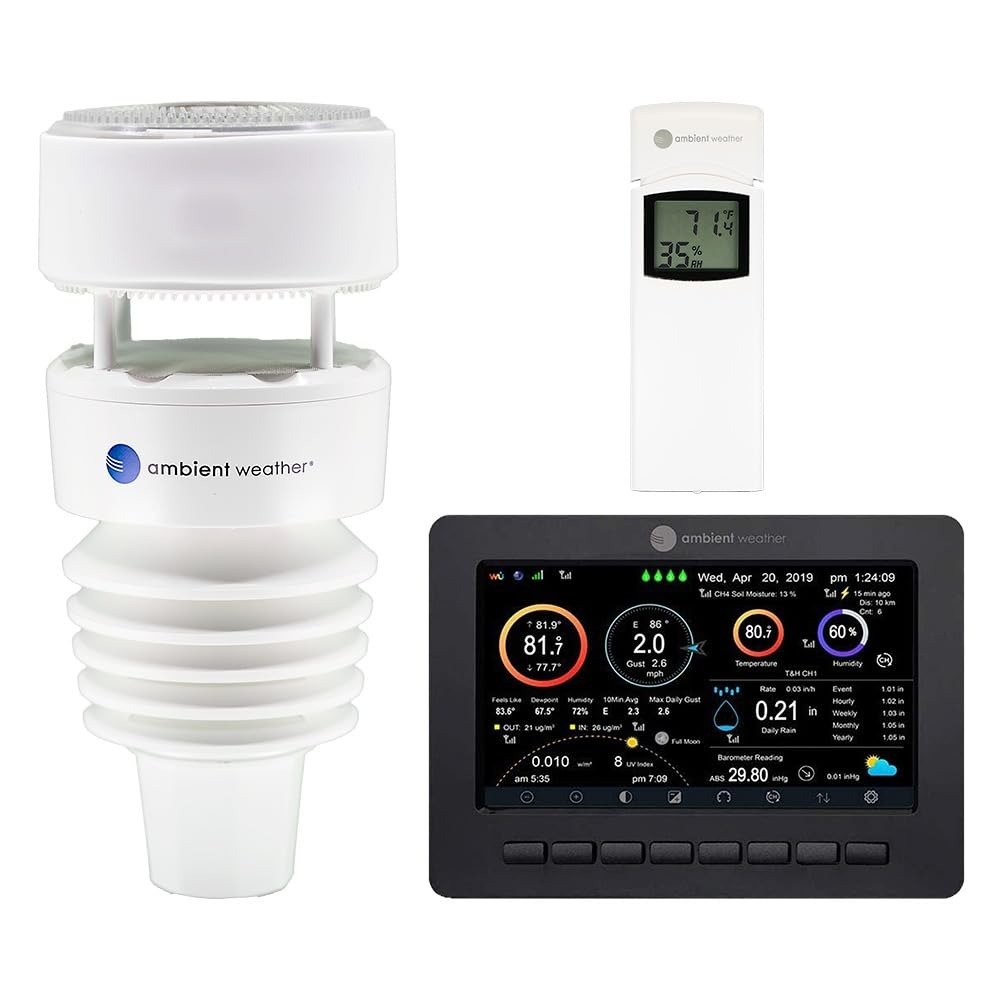
The WS-4000 is an all-in-one solar-powered station with ultrasonic wind, haptic rain, indoor sensing through the included WH32B sensor, a color console, and Ambient Weather Network connectivity. Official specs list outdoor temperature accuracy at ±0.6°F, humidity at ±3.5%, rain at ±5%, and wind speed accuracy of ±1 mph below 22 mph and ±5% above that, with a 4.9-second outdoor sensor update rate.
That matters because specs only become meaningful when they lower the amount of doubt you carry every day. In plain English, this is a station designed to reduce second-guessing. The question is where it actually succeeds.
What Pulled Me In Right Away
The first thing I noticed is that the WS-4000 looks like a product built for real homes, not just weather hobbyists who do not mind bulky hardware. It is compact, cleaner than many older systems, and easier on the eyes than stations with spinning cups, separate collectors, and a more cluttered footprint.
That design choice matters more than it seems. A station that looks intrusive often becomes something you tolerate. A station that looks integrated is something you actually keep mounted, monitor, and mentally trust over time.
The no-moving-parts approach also changes the ownership experience. Ultrasonic wind and haptic rain sensing promise less maintenance pressure in the long run. The included console helps even more. I have learned that a good indoor display is not a luxury with products like this. It is what transforms a weather station from a one-time installation into something that becomes part of the house.
There is also a connected-home appeal here that is easy to underestimate. The WS-4000 supports AWN remote monitoring, optional sensors, Alexa and IFTTT through Ambient Weather Network, and Home Assistant support through both Ambient Weather Station and Ambient Weather Network integrations. That gives the station a larger role. It stops being a gadget and starts acting more like a weather layer inside the home itself.
Where the Real Threshold Appears
The core story of the WS-4000 is simple, and it becomes obvious once you look past the polished presentation: I trust its wind, temperature, and humidity behavior much more quickly than I trust its rain behavior.
That split is the whole product.
Rain is where convenience meets reality. A station can look elegantly engineered, but if drizzle disappears or totals feel soft in mixed conditions, confidence starts to fracture. The WS-4000 does many things that feel advanced, but rain is the category where trust is not fully automatic.
That does not make it a weak product. It makes it a narrower product than many buyers expect.
| Measurement Area | My Read on the WS-4000 | Confidence Level |
|---|---|---|
| Temperature | Strong enough to trust daily use | High |
| Humidity | Feels stable and useful | High |
| Wind speed and direction | One of the strongest reasons to buy it | High |
| Rain totals in mixed or light events | Useful, but not automatically trustworthy | Moderate to low without calibration |
This is why reactions around this model tend to split so cleanly. If your idea of a good weather station is strong wind behavior, stable climate readings, low-maintenance design, and a platform you will actually use, the WS-4000 makes a powerful first impression and usually sustains it. If your private definition of trust begins and ends with rainfall precision, especially in lighter events, your confidence may never settle in the same way.
The Hidden Cost Most Buyers Miss
The hidden cost here is not strictly financial. It is interpretive effort.
Older-style stations often ask more from you physically. You deal with moving parts, traditional collectors, and more obvious maintenance routines. The WS-4000 shifts some of that burden. But in exchange, it may ask you to think harder about what the rain number means, when recalibration matters, and whether your mounting conditions are influencing what you see.
That matters because trust is behavioral, not theoretical. If I instinctively pause before believing the rain total every time a light shower rolls through, then the station has not fully crossed the threshold I care about, even if everything else on the dashboard looks excellent.
Placement also matters more than many shoppers assume. Wind readings are sensitive to obstructions, and the station is most convincing when its environment allows it to behave like the serious instrument it wants to be. It mounts on a 1-inch pole, which is one of those small details that feels minor until you are working through a real installation.
The Compatibility Split
This is where the decision starts getting clean.
| Buyer Type | How the WS-4000 Feels in Practice |
|---|---|
| Smart-home user who wants strong wind/climate data plus integrations | Very compelling |
| Homeowner who values a real console and expandable sensor ecosystem | Very compelling |
| Backyard hobbyist who hates maintenance and likes compact hardware | Very compelling |
| User whose main priority is rainfall precision in all conditions | Less convincing |
| Buyer comparing only on hardware value | Harder to justify because the Ecowitt Wittboy Pro is cheaper and the WS-4000 is based on that design |
| Storm-focused buyer who wants built-in lightning detection | Not the best fit compared with Tempest |
That table is the real emotional map of this product. When the buyer and the station line up, the WS-4000 feels modern, capable, and easy to live with. When they do not, the same design that looked elegant on day one starts to feel like a compromise.
What I’d Want You to Understand Before Moving On
After studying the specs, the calibration logic, the mounting realities, the platform behavior, and the way this station tends to land with real buyers, I do not think the WS-4000 wins by being universally better. I think it wins by being sharply right for the person who values daily usability, wind credibility, climate tracking, and ecosystem fit more than absolute rainfall confidence.
That is the threshold.
If your version of trust is “show me responsive wind, stable temperature and humidity, clean remote monitoring, and a station I’ll still enjoy using six months from now,” this model makes a lot of sense. If your version of trust is “I never want to second-guess rain,” your decision becomes more complicated.
That is exactly where I’d pause, and exactly where I’d move next.
If you want the buying decision broken down without the noise, go to [DECISION_LINK].
Short Product-Page Summary
The Ambient Weather WS-4000 starts making sense when you stop asking whether it does a lot and start asking whether it feels trustworthy in the ways that matter most every day.
In my read, this station crosses that line through wind responsiveness, stable temperature and humidity tracking, a clean all-in-one design, a useful console, and a connected ecosystem that keeps the data relevant after the novelty wears off. It is an all-in-one solar-powered station with ultrasonic wind, haptic rain, indoor sensing through the included WH32B sensor, a color console, and Ambient Weather Network connectivity. Official specs list outdoor temperature accuracy at ±0.6°F, humidity at ±3.5%, rain at ±5%, and wind speed accuracy of ±1 mph below 22 mph and ±5% above that, with a 4.9-second outdoor sensor update rate.
Where the decision gets real is rain. The WS-4000 feels strongest in wind, temperature, and humidity. Rain is the category that asks for more patience, more interpretation, and sometimes calibration before confidence settles in. That does not ruin the product. It simply defines it.
If you want a modern home weather station that feels compact, connected, and genuinely useful day after day, this one has a strong case. If rainfall accuracy is the one number you care about most, that is where hesitation becomes rational.
Final verdict: Consider.
Transparency Note:
This analysis is not based on quick personal impressions.
It is derived from documented system behavior, verified user patterns, and the physical constraints of storage capacity.
The goal is to translate complex technical behavior into a realistic performance model that helps you make a clear decision