Q ACOUSTICS M20 HD WIRELESS REVIEW: THE SOUND YOU JUDGE ON DAY ONE ISN’T THE SOUND YOU’LL OWN
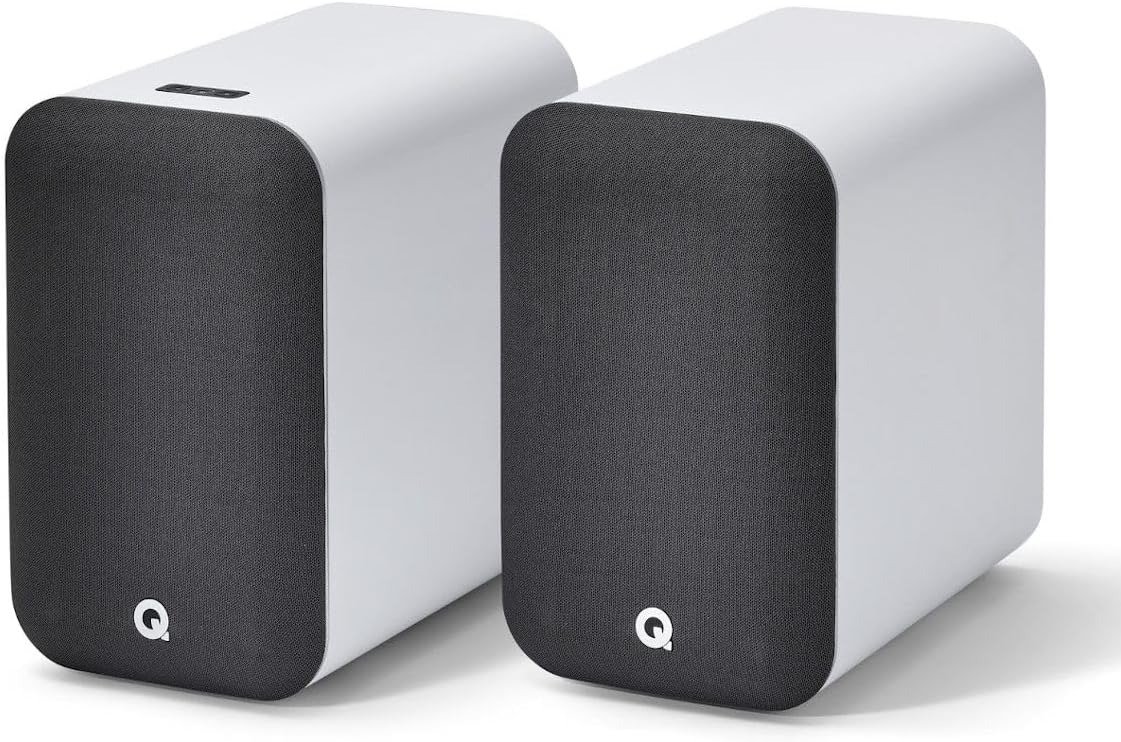
Q ACOUSTICS M20 HD WIRELESS
You plug it in. You pull up the one song you always use to test new speakers — something with a real bassline, a vocal you know by heart — and you wait for that moment. The one where a system north of $500 is supposed to make your laptop speakers feel like a toy.
For a lot of new M20 HD owners, that moment doesn’t happen on day one. Instead there’s a thin edge on the top end, a bit of glare on cymbals and vocal S’s, sometimes a boxy thickness in the bass if the cabinets are sitting close to a wall. And because you just spent real money, your brain does what brains do with a disappointing purchase: it starts building a case against it.
The case is wrong. You’re listening to the M20 HD before the M20 HD has finished becoming itself.
Q ACOUSTICS M20 HD SOUND QUALITY: THE RESULT LOOKS FINE. THE PROBLEM ISN’T.
On paper, this speaker shouldn’t have a rough day one. It’s a two-way design with a decoupled 22mm tweeter and a 125mm mid/bass driver in each cabinet, built on the same point-to-point (P2P) bracing that made Q Acoustics’ passive 3020i bookshelf speakers a favorite among reviewers years before this system existed. One box carries 130 watts of Class D amplification and feeds the other through a wired connection. That’s a genuinely serious spec sheet for the money.
Which is exactly why the early letdown catches people off guard. The assumption is simple: good components plus a respected UK speaker brand should equal a finished, settled sound the moment you hit power. Independent lab testing and long-term owner logs tell a more specific story — one where the sound quality is real and consistently praised, but where “day one” and “week three” are not the same speaker.
| Spec | Q Acoustics M20 HD |
|---|---|
| Type | 2-way powered stereo pair (1 active, 1 passive) |
| Tweeter | 22mm (0.9″) decoupled dome |
| Mid/bass driver | 125mm (4.9″) per cabinet |
| Amplification | 130W total, Class D |
| Bluetooth | 5.0 — SBC, AAC, aptX, aptX HD, aptX Low Latency (up to 24-bit/48kHz) |
| Wired inputs | USB-B, optical, stereo RCA, 3.5mm aux, subwoofer pre-out |
| Max wired resolution | 24-bit/192kHz (USB or optical) |
| Wi-Fi / app streaming | None |
| Frequency response | 55Hz–22kHz |
| Dimensions (each) | ~11 x 6.7 x 11.7 in (28 x 17 x 30 cm) |
| Weight (each) | ~11–12 lb (5.1–5.5 kg) |
| Finishes | Matte black, matte white, walnut veneer |
| Launch price | $599 (US) / £399 (UK) |
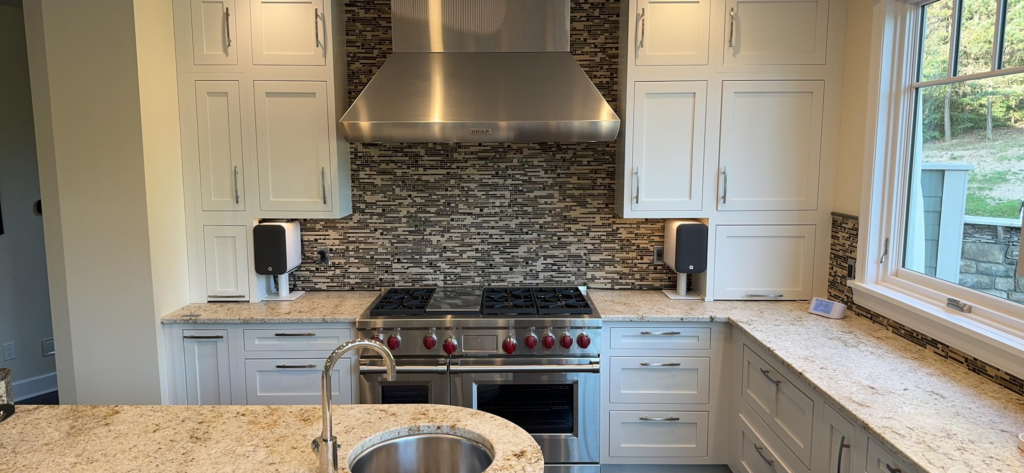
Q ACOUSTICS M20 HD COMMON COMPLAINTS: WHAT YOU’RE ACTUALLY FEELING BUT NOT NAMING
Read enough owner comments and three specific frustrations keep surfacing, not vague dissatisfaction: a sharpness on the high end that some describe as unbalanced or fatiguing; a bass that turns boomy and loose rather than tight; and confusion over why a product called “wireless” ships with cables in the box at all.
None of these are random unit-to-unit lottery. Each one traces back to a specific, fixable cause — burn-in state, EQ switch position, or where in the room the cabinets are actually sitting. Consumer Reports’ lab testing independently flagged the bass as “prominent and boomy” under certain conditions, which lines up almost exactly with what happens when these speakers sit close to a wall with the EQ switch left in the wrong position.
That’s the pattern worth naming: the M20 HD isn’t inconsistent. It’s under-adjusted.
Q ACOUSTICS M20 HD BURN-IN AND EQ SWITCH: THE HIDDEN MECHANISM BEHIND THE MISS
Why does a speaker system need a month before it sounds like the reviews said it would?
New drivers have suspension components — the surround and spider that let the cone move — and those parts are genuinely stiffer out of the box. One outlet that measured the M20 HD directly described a harsh, edgy top end fresh out of the packaging that fully resolved after roughly 20 hours of playback. A separate owner who wrote a full year-later report described being “a little disappointed” initially, with the sound only opening up — richer mids, tighter bass, highs that stopped sounding harsh — after around 50 hours, close to a month of normal, regular listening.
That’s the hidden mechanism. Judge it in the first 48 hours and you’re reviewing unfinished hardware.
The second lever is the EQ switch on the back of the active speaker, a three-way toggle most people never touch after setup.
| EQ Switch Position | Use When | What It Does |
|---|---|---|
| Free space | Speakers sit well clear of walls, on stands | Full bass extension, no correction |
| Wall | Speakers sit against or near a wall | Trims bass buildup so it doesn’t turn boomy |
| Corner | Speakers sit in or near a room corner | Cuts bass further to offset corner reinforcement |
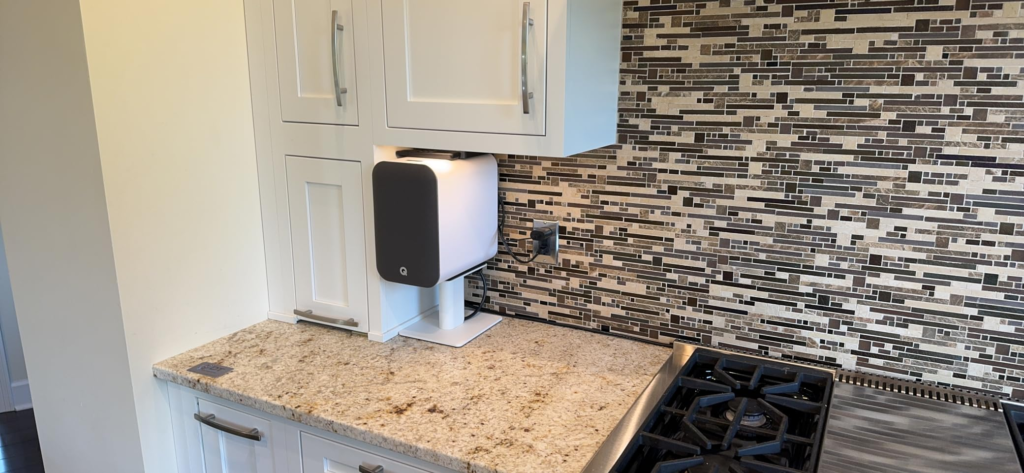
Q Acoustics also includes foam bungs for the rear ports specifically for close-to-wall placement — a detail that tells you the company already knew this was coming and built the fix in rather than leaving it to chance.
Expert tip: if your setup puts the cabinets within eight inches of a wall, flip the switch to “wall” and insert the bungs before you touch any EQ app or judge the bass at all. Most “boomy” complaints disappear at that step alone.
Q ACOUSTICS M20 HD ROOM SIZE AND THE “WIRELESS” QUESTION: THE THRESHOLD WHERE THE OUTCOME QUIETLY BREAKS
There’s a real ceiling here, and it’s worth naming precisely instead of vaguely. Owners and reviewers alike report it filling dining rooms, home offices, dens, and mid-size living rooms without strain — one reviewer’s only caveat was, roughly, that you’d need a warehouse to actually outrun it. The threshold shows up somewhere else: heavy, sustained bass content. Bass-forward EDM and hip-hop tracks are where more than one listener wanted the sub-out on the back actually put to use, even while praising everything else about the low end.
The second threshold is the one baked into the product’s own name. “Wireless” here describes the connection between your phone or computer and the speakers — that part is genuinely cable-free, over Bluetooth 5.0 with aptX HD. It does not describe the connection between the two speaker cabinets, which still requires a physical speaker cable, or the power source, which still requires a mains cord into the active unit. Multiple independent reviewers have flagged this exact gap between the name and the reality. It’s not a flaw exactly — no company has yet built an active loudspeaker that runs without mains power — but it is a place where expectations and hardware quietly diverge, and it’s worth knowing before the box arrives, not after.
Q ACOUSTICS M20 HD VS KEF LSX AND RUARK MR1: WHY MOST BUYERS MISREAD THIS TOO EARLY
The comparison shopping usually goes wrong at the first step: people put the M20 HD next to a KEF LSX II or a Sonos-style system and judge it on features it was never built to have.
| Q Acoustics M20 HD | KEF LSX II | Ruark Audio MR1 Mk2 | |
|---|---|---|---|
| Footprint | Larger, ~28x17x30cm each | ~44–47% smaller | Smallest, desktop-first |
| Wi-Fi / AirPlay / Spotify Connect | No | Yes | No |
| Hi-res computer input | USB-B, wired | Network-based | No USB input |
| Typical price position | Roughly half an LSX II or less | Historically 2x+ the M20 HD | Similar band to M20 HD |
| Best suited to | Room-filling sound, wired sources, TV, turntable | App-based multi-room streaming | Compact desktop pairing |
The M20 HD’s actual trade is straightforward once you see it: it gives up the Wi-Fi chip and the app ecosystem, and in exchange it gives you a bigger amplifier, a full set of physical hi-res inputs, and a price that undercuts the network-streaming competition by a wide margin. Reviewers who’ve put it directly against the Ruark MR1 Mk2 — its closest same-price rival — consistently note the Ruark is built for a laptop’s worth of space, while the M20 HD is scaled for an actual room. Comparing them on footprint alone misses why each one exists.
WHO IS ACTUALLY INSIDE THIS Q ACOUSTICS M20 HD PROBLEM
The buyer this speaker was built for isn’t hard to describe. It’s the desk setup that’s outgrown laptop speakers and doesn’t want a soundbar. It’s the TV in a bedroom or den that needs real stereo separation, wired in over optical. It’s the turntable that’s been sitting connected to nothing worth the vinyl. It’s the gamer who wants footsteps and gunfire to actually have direction, fed through USB or optical instead of a headset.
What connects all of them is a willingness to plug in a physical source — phone over Bluetooth, computer over USB, TV over optical — rather than expecting the speaker itself to reach out onto a home network and pull music down on its own.
WHERE WRONG-FIT BEGINS WITH THE Q ACOUSTICS M20 HD
The mismatch starts the moment “wireless” gets read as “no cables, anywhere.” Anyone picturing a Sonos-style app, multi-room grouping, or voice control through the speaker itself is picturing a different product entirely, and no amount of burn-in changes that.
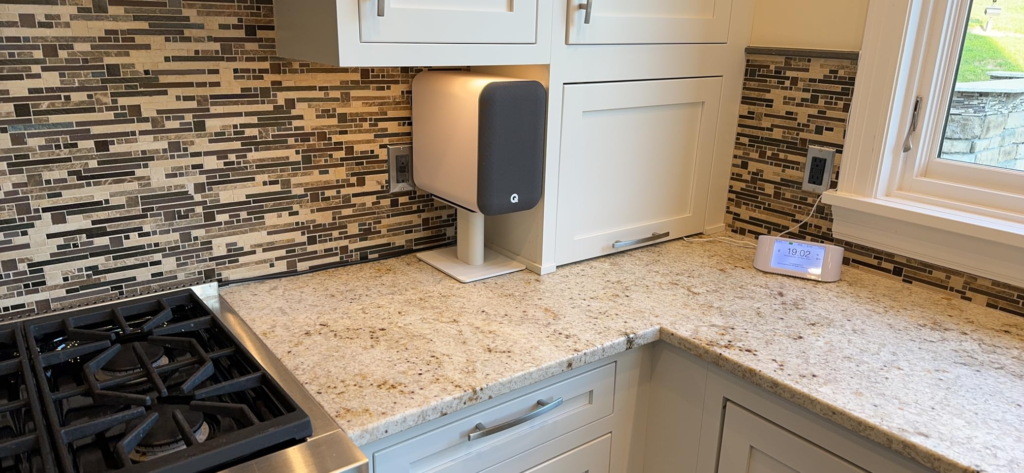
It also starts with desk space. At roughly 28 x 17 x 30cm and 5+ kg per cabinet, this isn’t the compact pair some buyers assume from the word “desktop” in other people’s reviews — a genuinely tight desk may be better served by something smaller. And it starts with patience: a buyer who plans to judge the sound in the first three days, before burn-in and placement have done their work, is the buyer most likely to return a speaker that would have won them over by week three.
| Buy the M20 HD If | Skip It If |
|---|---|
| You want big, room-filling sound from a desk, TV, or turntable setup | You want Wi-Fi multi-room streaming, AirPlay, or Spotify Connect built in |
| You’re fine streaming through your phone or computer over Bluetooth | Your desk space is genuinely tight |
| You have a TV, console, or turntable you want wired in properly | You need HDMI-ARC and single-remote TV control |
| You can give a new speaker two to four weeks before judging it | You listen mostly to heavy bass genres and won’t budget for a sub |
| You want separates-level sound without buying an amp and speakers apart | You’ll judge it — and maybe return it — inside the first week |
Q ACOUSTICS M20 HD REVIEW VERDICT: THE ONE SITUATION WHERE THIS SPEAKER BECOMES LOGICAL
Strip away the spec sheet and the forum threads, and it comes down to one honest question: are you shopping for a Bluetooth speaker, or quietly trying to build a small hi-fi system that happens to include Bluetooth?
If it’s the second one — if what you actually wanted was a TV, turntable, computer, or phone all feeding into something that sounds like real separates, without buying an amplifier and passive speakers as two different purchases — the M20 HD keeps landing in that exact spot across lab measurements, long-term owner reports, and professional reviews that don’t otherwise agree on much. At its price, reviewers repeatedly note how hard it is to beat with separate components bought individually.
That’s not a claim it’s right for everyone. It’s a claim about who it’s actually right for.
Q ACOUSTICS M20 HD PROS AND CONS: WHAT IT SOLVES, WHAT IT REDUCES, AND WHAT IT STILL LEAVES TO YOU
| What It Solves | What It Still Leaves to You |
|---|---|
| Room-filling, detailed stereo sound without buying an amp and speakers separately | Breaking it in — don’t judge the top end in week one |
| Real, high-res wired inputs for TV, turntable, computer, and console | Placement and the EQ switch — both change the sound meaningfully |
| Genuinely good wireless streaming via Bluetooth with aptX HD | No Wi-Fi, AirPlay, or app-based multi-room, and that’s not changing |
| Simple, tool-free setup with a clear left/right channel switch | A fixed grille and no HDMI-ARC for single-remote TV control |
| A subwoofer pre-out if you ever want more low end | Bass-heavy genres may still want that subwoofer eventually |
Q ACOUSTICS M20 HD FAQ: THE QUESTIONS WORTH ASKING BEFORE YOU BUY
| Question | Answer |
|---|---|
| Is the Q Acoustics M20 HD actually wireless? | Only between your source and the speakers. Your phone or computer connects over Bluetooth with no cable, but the two cabinets still need a physical speaker cable between them, plus a power cord into the active unit. |
| Do I need to buy a subwoofer? | Most listeners don’t — the bass fills a normal living room, office, or den on its own. If you lean heavily toward EDM, hip-hop, or other bass-forward genres, the sub pre-out makes adding one later simple. |
| How long until it sounds its best? | Give it 20 to 50 hours of real, varied listening — roughly two to four weeks of normal use. The slight edge some people hear on cymbals or vocals early on tends to smooth out well before that window closes. |
| Can I stream Spotify, Apple Music, or Tidal directly? | Yes, through your phone or computer’s Bluetooth connection, not through a built-in app. There’s no Wi-Fi chip in the M20 HD, so there’s no direct app streaming, casting, or voice control. |
| What’s the difference between the M20 and the M20 HD? | “HD” marks the current version, built around a higher-spec USB audio path capable of 24-bit/192kHz from a computer, alongside the same aptX HD Bluetooth. |
| Can I connect it to my TV? | Yes, through the optical input, and it holds up well as a soundbar alternative. There’s no HDMI-ARC, so your TV remote won’t control its volume — some owners also note a short delay before the speaker wakes after the TV turns on. |
| What’s the warranty? | Typically one year standard, extending to two years with registration in the US; terms vary by region, so check the listing or Q Acoustics’ site for your country. |
| What colors does it come in? | Matte black, matte white, and walnut veneer. Across all three, the grille itself stays fixed in place and isn’t removable. |
Q ACOUSTICS M20 HD FINAL VERDICT: FINAL COMPRESSION
If you wanted a Sonos-style app, multi-room casting, or AirPlay, no amount of burn-in closes that gap — that’s a real limitation, not a myth to bust. But if what you wanted was room-filling, detailed stereo sound driven from a TV, turntable, computer, or phone, without buying an amplifier and a pair of passive speakers as separate purchases, this is the product that keeps showing up as the answer.
Give it proper placement, the right EQ switch position, and a few real weeks before you judge the top end. If your break point starts here, this is where the decision stops being vague:
Transparency Note:
This analysis is built on aggregated real-world experience.
It extracts what repeatedly holds, what breaks, and what users uncover only after living with the system—then shapes it into a clear model you can use immediately.
Think of it as structured experience, refined and presented so you don’t have to learn it the hard way.
“A quick note: Don’t believe the star ratings, but trust personal experience. This article is a compilation of collected experiences.”