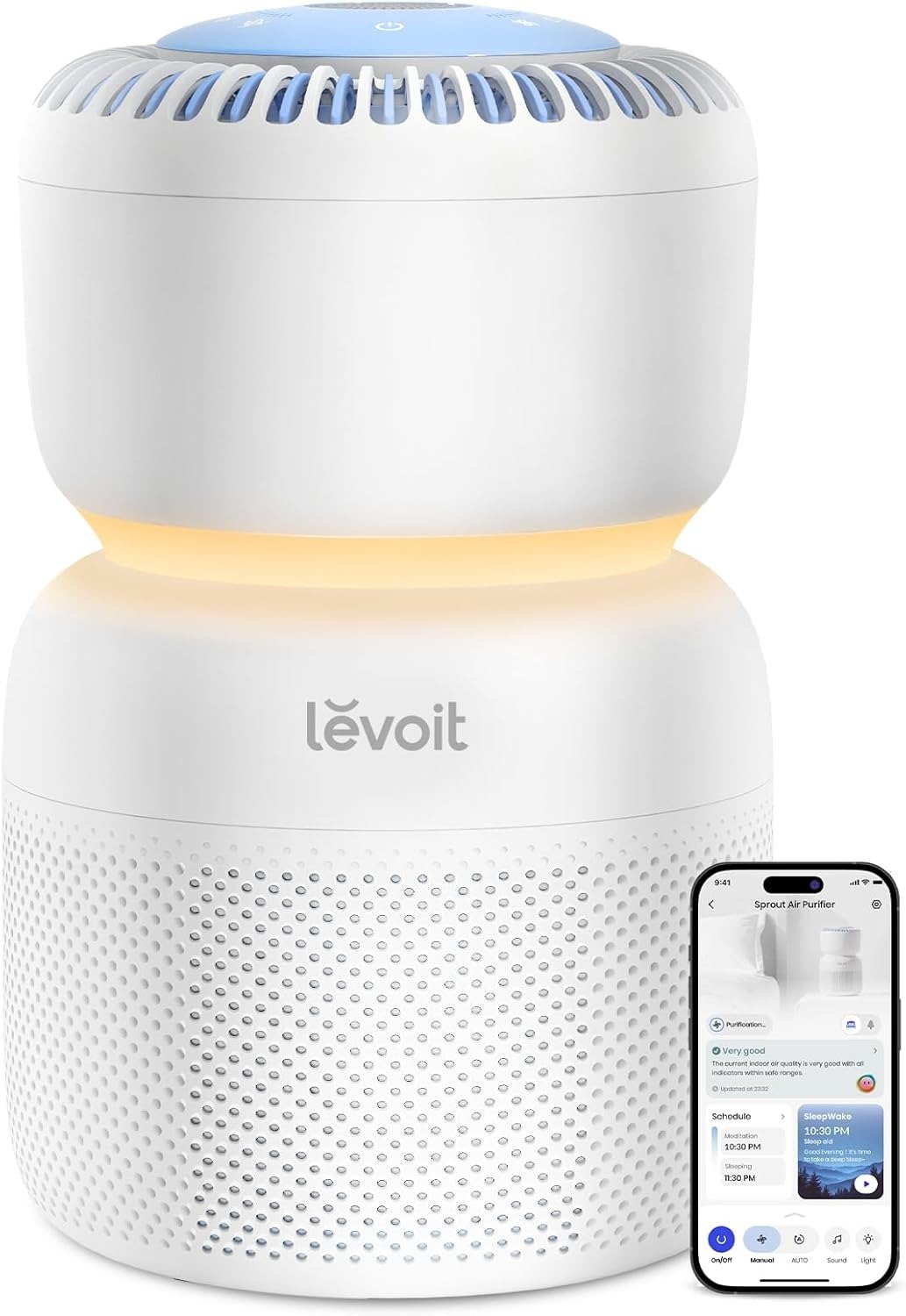
LEVOIT SPROUT AIR PURIFIER REVIEW: THE COVERAGE NUMBER I DON’T LET BUYERS SKIP
The Result Looks Fine. The Problem Isn’t.
The box says 634 square feet. The app shows a green air-quality reading. The baby is sleeping. On paper, nothing is wrong.
Here’s the snapshot most buyers stop at before checking out:
| Spec as advertised | What it says |
|---|---|
| Coverage claim | Up to 634 ft² |
| Filtration | 3-stage, True HEPA + activated carbon |
| Monitoring | 5 sensors, 7 air factors (PM1.0/2.5/10, TVOC, CO2, temp, humidity) |
| Certification | AHAM VERIFIDE |
| Smart control | VeSync app, Alexa, Google Assistant |
| Price range | ~$279.99, with periodic Amazon promotions |
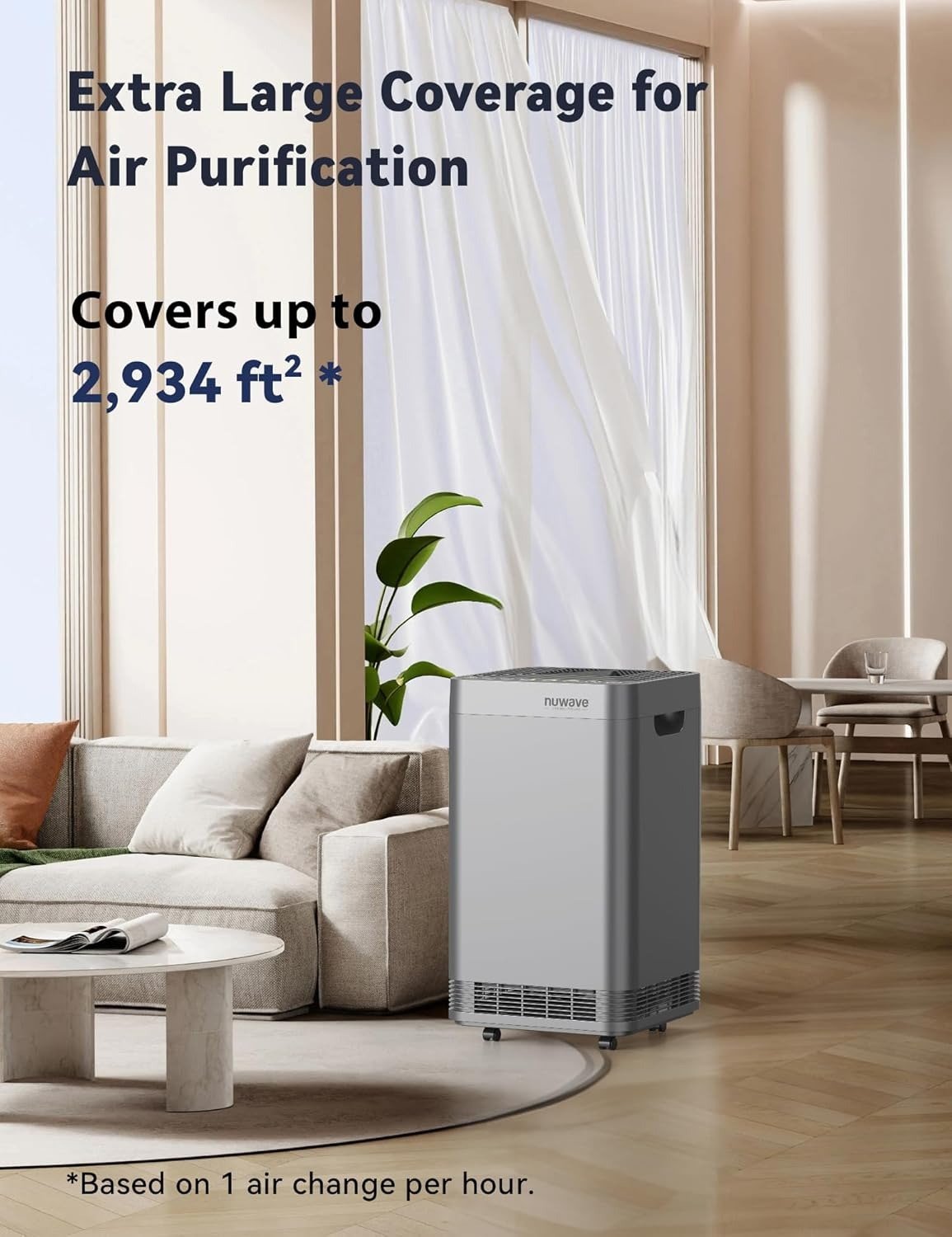
That number — 634 ft² — is the one that decides whether someone buys this for a 110 sq ft nursery or tries to stretch it across a combined playroom-and-bedroom. And it’s also the one figure on that list that doesn’t mean what it looks like it means.
What You’re Actually Feeling but Not Naming
It isn’t doubt about whether the unit is “good.” It’s a quieter unease: the green light on the app says fine, but you can’t tell if that’s because the room is actually clean, or because the room is just calm enough that a weak fan looks adequate. You’re not worried about the purifier breaking. You’re worried about not being able to tell the difference between it working and it idling.
That’s a measurement problem, not a trust problem. And it has a specific, named cause.
The Hidden Mechanism Behind the Miss
The “634 ft²” claim is based on clearing a room once per hour. That’s an air-turnover number, not a cleaning-performance number — it tells you the fan can move that volume of air, not that it can scrub it fast enough to matter.
The number that actually matters is CADR (Clean Air Delivery Rate), the metric AHAM certification is built on. Independent testing of this unit puts its CADR at roughly 144.5 m³/h for smoke, 152.9 m³/h for dust, and 185.2 m³/h for pollen. Run that through the standard CADR-to-room-size conversion used for meaningful air cleaning, and the same independent test caps effective coverage at about 30 m² — roughly 323 ft². That’s just over half of the marketed figure.
There’s a second inflated number worth flagging. Some regional listings advertise 99.9% capture of particles down to 0.01 microns. The figure actually backed by testing — and the one CADR is calculated from — is the standard True HEPA benchmark: 99.97% at 0.3 microns. That’s still a solid, certified result. It’s just not the more dramatic number printed on some boxes.
The Threshold Where the Outcome Quietly Breaks
Here’s where the marketing number and the real number diverge into different outcomes:
| Room size | What actually happens |
|---|---|
| Under 150 ft² (standard nursery) | Fast, active cleaning. Fan rarely needs to run on high. |
| 150–320 ft² (larger bedroom) | Adequate, AHAM-supported cleaning. Auto mode runs more often. |
| 320–634 ft² (claimed maximum) | Air turnover continues, but particle removal slows well below nursery-grade. You get circulation, not real filtration speed. |
| Above 634 ft² | Outside the spec entirely. |
Above roughly 320 ft², the unit doesn’t stop working — it just stops doing the job people buy a nursery purifier to do. It shifts from active filtration to ambient air movement. For most living rooms, that’s a minor shortfall. For a nursery during wildfire smoke or pollen season, it’s the gap that matters.
Why Most Buyers Misread This Too Early
The mistake isn’t carelessness — it’s comparing the wrong column. Shoppers line up square-footage claims across competing purifiers because it’s the easiest number to put side by side. A bigger number reads as a better deal.
But square footage at “once per hour” and square footage at “CADR-certified” aren’t the same unit of measurement, even though they’re printed in the same font on the same listing. Comparing them directly is like comparing two cars’ top speeds when one number is for a flat highway and the other is for a downhill straightaway. The number isn’t false. It’s just answering a different question than the one being asked.
Who Is Actually Inside This Problem
This unit is being correctly evaluated by:
- Parents furnishing a real nursery or single kid’s bedroom, typically 80–250 ft²
- Buyers who want air monitoring, filtration, a sleep-safe night light, and white noise in one device instead of four
- Anyone who’d rather trust an AHAM-verified number than a marketing one
- Households willing to pay a premium for design and smart-home integration over raw filtration power per dollar
Where Wrong-Fit Begins
This is also where I tell people to stop and reconsider:
| Walk away if… | Because… |
|---|---|
| The room is a combined playroom + bedroom over 320 ft² | You’re buying for the marketed number, not the tested one |
| You’re shopping for wildfire-season or heavy-smoke protection | CADR here is mid-tier, not built for maximum-load air crises |
| You don’t need monitoring, night light, or white noise | A basic Levoit Core model covers more square footage for less money |
| Budget is the primary constraint | Filter replacements run $39.99–$59.99 every 6–8 months, on top of a ~$280 unit |
None of this makes the product flawed. It makes it room-specific, and the room is the variable most listings don’t make obvious.
The One Situation Where This Product Becomes Logical
If the room is an actual nursery or a single child’s bedroom under roughly 300 ft², and the priority is one honestly-specced device that monitors, filters, and manages the sleep environment without assembling four separate gadgets — this stops being a marketing-driven purchase and becomes a reasonably justified one. The CADR is real. The AHAM certification is real. The room-size ceiling is just smaller than the number on the box.
What It Solves, What It Reduces, and What It Still Leaves to You
| Solves | Reduces | Still on you |
|---|---|---|
| Real-time readings for PM1.0/2.5/10, TVOC, CO2, temp, humidity | Guesswork about whether the room’s air is actually clean | Filter swaps every 6–8 months (~$40–$60 each) |
| Certified filtration at the correct room size | Blue-light disruption at bedtime via the night light | Confirming your room falls under ~300 ft² before buying |
| One device instead of monitor + purifier + sound machine + night light | Clutter and cost of buying those four separately | It won’t stretch to a large open-plan space, no matter the app settings |
Frequently Asked Questions
| Question | Answer |
|---|---|
| Does it really clean a 634 ft² room? | No — that figure is a once-per-hour air-turnover claim. Independently tested, certified cleaning performance tops out around 320 ft². |
| How loud is it overnight? | Reviewers consistently describe sleep mode as a quiet, steady hum, well below a level that disturbs sleep. |
| How often does the filter need replacing, and what does that cost? | Every 6–8 months, at roughly $39.99–$59.99 depending on retailer. |
| Does it work without WiFi? | Basic fan speed, night light, and white noise run from the onboard buttons with no connection. The app — scheduling, remote control, filter alerts — needs WiFi. |
| Is it safe to run all night near a baby? | It’s a standard 3-stage HEPA and activated-carbon design with no ionizer or ozone generation, which is the profile generally considered acceptable for continuous nursery use. |
| Is the air-quality monitoring accurate, or just for show? | It uses 5 dedicated sensors rather than a single proxy sensor, which is more than most purifiers in this price range offer — though, like any consumer sensor, treat the readings as a useful trend, not a lab-grade measurement. |
Final Compression
Strip away the box copy and two numbers are left standing: a CADR-backed coverage ceiling of about 320 ft², and a filtration standard verified at 99.97% down to 0.3 microns. Everything else — the night light, the white noise, the app — is real, but secondary to that ceiling.
If your room sits under that line, the rest of the spec sheet is simply a bonus on top of a unit that’s doing exactly what it’s certified to do. If it doesn’t, no feature list closes that gap.
If your room fits, this is where the decision stops being vague:
Transparency Note:
This analysis is built on aggregated real-world experience. It extracts what repeatedly holds, what breaks, and what users uncover only after living with the system—then shapes it into a clear model you can use immediately. Think of it as structured experience, refined and presented so you don’t have to learn it the hard way.
“A quick note: Don’t believe the star ratings, but trust personal experience. This article is a compilation of collected experiences”