We Thought We Needed More Coffee. We Actually Needed Fewer Surprises.
DECISION ANALYSIS
The first time we ran a high-volume station like this, everything looked perfect.
Two brew heads. Multiple glass carafes lined up. Stainless steel body reflecting the room. The promise of speed. The promise of “no waiting.”
Then the second batch felt different.
Not dramatically different. Just enough.
Why?
Because commercial coffee failure rarely begins with flavor. It begins with instability. Tiny thermal shifts. Slight recovery lag. A warmer plate running hotter than expected. A circuit sharing more load than it should.
And once we feel inconsistency, we start monitoring. Once we start monitoring, trust is gone.
This is where we begin.
Product under structural evaluation:
To check product availability and updated specifications in your region via Amazon, you can continue from here
That link represents the exact mechanical object we are dissecting.
Decisive Definition — What This Machine Actually Is
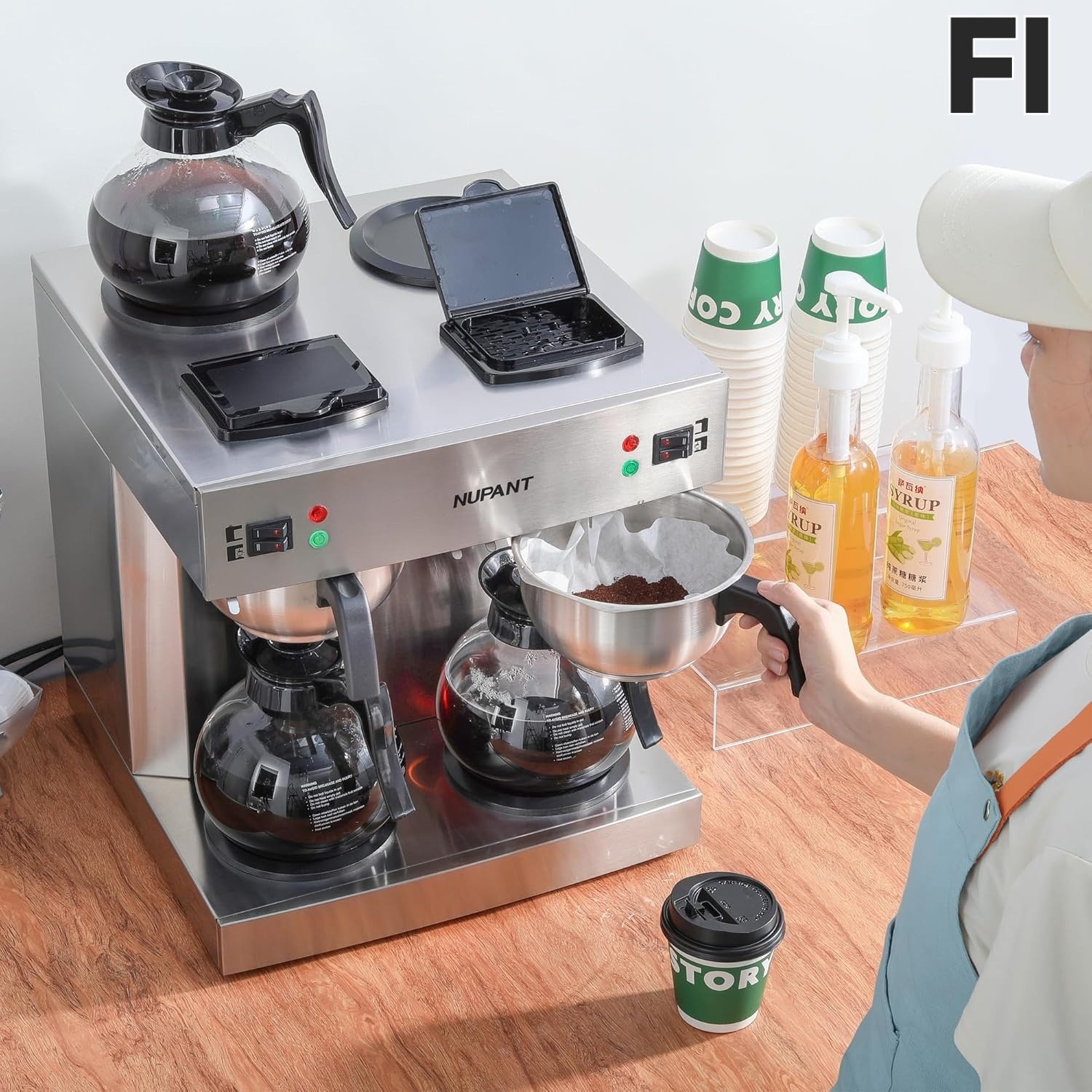
This is a dual-station, manual pour-over commercial drip brewer designed for bulk service.
No programming menus.
No digital calibration.
No algorithm managing extraction curves.
Just:
- Dual heating columns
- Multiple glass carafes
- Independent warmer plates
- High-watt heating elements
- Manual water fill
Why does that matter?
Because simplicity reduces software failure risk.
But it increases operator responsibility.
That trade-off defines everything.
Mechanism Transparency — What We Actually Experience in Use
Let’s translate mechanics into sensory reality.
Dual Brewing Columns
→ We feel parallel capacity. The station looks alive during rush periods.
→ Behaviorally, we stop staggering batches.
Large Batch Output
→ The room fills with the smell of fresh brew quickly.
→ We experience “throughput confidence.”
Multiple Warmer Plates
→ Carafes stay visibly ready.
→ But if one plate runs hotter or stays engaged too long, we smell the edge of overheat before we taste it.
Manual Pour-Over Operation
→ No confusion. Flip switches. Brew.
→ But precision depends entirely on how carefully we fill.
This machine does not hide our mistakes.
It exposes them.
Full Constraint Mapping — Where Stability Can Fracture
Mechanical Constraints
Overheat Protection
When internal temperature exceeds safe range, protective cutoff can trigger.
→ We experience sudden silence.
→ We ask, “Did it break?” even if it is protecting itself.
Glass Carafe Thermal Behavior
Glass loses heat quickly if warmer is disengaged.
→ We feel warmth drop fast.
→ We question freshness.
Fill Discipline
Overfilling manual systems can cause overflow.
→ We experience visible mess.
→ Staff begin underfilling next cycle to avoid embarrassment.
Environmental Constraints
Electrical Load
High-watt commercial heaters draw serious power.
→ On shared circuits, we may feel delayed recovery or unexpected interruption.
→ The machine appears “temperamental,” even when the outlet is the culprit.
Ventilation and Counter Heat
Stainless housing radiates heat under continuous use.
→ We touch it and feel warmth.
→ Some interpret heat as malfunction.
User Skill Constraints
In rotating staff environments, consistency collapses if instructions are vague.
One person measures carefully.
Another fills to the brim.
A third leaves plates engaged too long.
The machine reflects human variance.
Maintenance Constraints
Mineral buildup changes flow behavior.
Old grounds alter taste perception.
Cleaning skipped for two days compounds instability.
Financial Constraints
Lower acquisition cost than premium brands.
But long-term perception hinges on environment stability.
Explicit Trade-Off Logic — Where It Wins and Where It Demands Discipline
Simplicity
↓
Fewer digital failure points
↑
Greater reliance on operator precision
Glass Carafes
↓
Lower cost and visual clarity
↑
Higher dependence on warmer consistency
High Throughput
↓
Fast group service
↑
Higher electrical demand
Why is this important?
Because this machine is not unstable.
But it is unforgiving of unstable environments.
Worst-Case Simulation — A Real Stress Scenario
Let’s simulate a busy event morning.
Three rapid brew cycles.
Microwave shares the outlet.
One staff member overfills slightly.
Another forgets to rotate carafes.
We begin to notice:
Recovery feels slower.
One pot smells sharper.
Heat radiates stronger from the housing.
Someone says, “Is that normal?”
At that moment, perception decides the verdict.
Even if the unit is operating within design limits, doubt spreads faster than data.
That is how instability becomes social.
The Expert Question We Must Ask
Why are we choosing this unit?
If the answer is:
“We need automation to eliminate human error.”
Then this is misaligned.
If the answer is:
“We need bulk output with mechanical simplicity, and we can control the environment.”
Then this aligns.
This machine rewards order.
It punishes chaos.
Structural Self-Filtration Frame
Structurally Fits If:
- Power supply is stable and dedicated
- Staff follow fill limits consistently
- Cleaning discipline exists
- You prioritize throughput over micro-control
Structurally Misaligned If:
- Circuits are overloaded regularly
- Staff turnover is high with minimal instruction
- You expect insulated server heat retention
- You want automated precision management
Final Closure — The Calm Verdict
This is not a “best coffee brewer” conversation.
It is a stability compatibility decision.
In controlled environments, this unit becomes background utility. It runs. It serves. It disappears into routine.
In chaotic environments, it becomes a monitored object.
And once we must monitor a coffee station constantly, the station has already failed psychologically.
The object is neutral.
The environment determines whether it becomes a workhorse
or a burden.
Now we decide which environment we actually have.