Audio-Technica AT-LP60X Review: The Turntable That Rewards the Right Buyer and Quietly Punishes the Wrong One
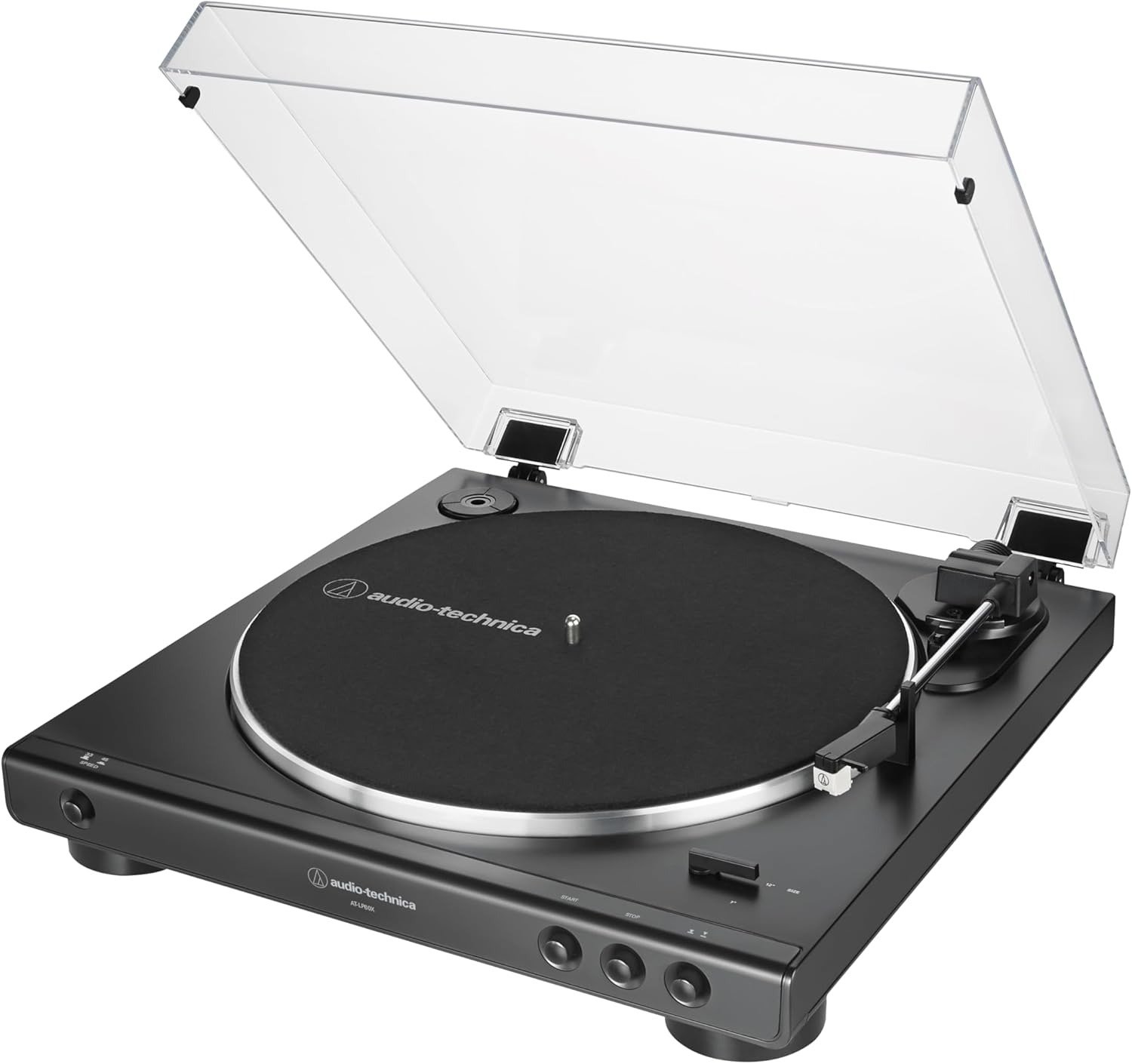
AUDIO-TECHNICA AT-LP60X
You put the record on. The arm drops by itself. The music starts. It sounds good — warm, present, real in a way Spotify never quite is. You think: this works.
And it does work. The problem isn’t the first spin. The problem is what happens twelve months later, when you’ve bought forty records, started reading about cartridges, noticed a faint brightness missing from the high end, and realized the machine you’re holding has no path forward. The tonearm is sealed. The cartridge is fixed. The tracking force is set at the factory and cannot be adjusted. There is no counterweight. There is no anti-skate control. There is no upgrade available inside this chassis.
None of that is hidden information. But it’s information that lands very differently depending on which listener you are.
This review exists to locate which one you are — before you find out the hard way.
The Result Sounds Fine. That’s Exactly What Makes the Diagnosis Hard.
Most people who buy the AT-LP60X report satisfaction. The Walmart and eBay verified reviews cluster around 4.3 to 5 stars. Users describe easy setup, solid sound, clean automatic operation. None of that is manufactured. The turntable genuinely performs above its price point for a specific kind of listening.
The problem isn’t that it fails. The problem is that it succeeds quietly enough to delay an important question.
When a turntable sounds “pretty good,” you stop interrogating the signal chain. You don’t notice what isn’t there. The compressed upper register. The slightly rounded image. The conical stylus tracing the groove at 3 grams — heavier than most mid-tier tables, light enough to be technically safe, but not accurate enough to pull fine detail from a well-pressed 180g record.
The LP60X produces an enjoyable output. It does not produce a maximized output. The difference between those two things is irrelevant to one kind of listener and quietly corrosive to another.
What You’re Actually Feeling but Not Naming
There’s a specific version of dissatisfaction that appears about six to eighteen months into LP60X ownership among listeners who were not quite the right fit.
It doesn’t announce itself. It arrives as a vague sense that something is boxed in. The music is present but not open. Vocals sit in the upper-mid register without fully separating. Bass is there but doesn’t resolve into texture. You buy a better record — a proper audiophile pressing, maybe a 45rpm single cut at high speed — and it sounds better, but still not as good as you expected. You wonder if it’s your speakers. You wonder if it’s the room.
It isn’t the speakers.
It’s the stylus geometry.
A 0.6mm conical diamond reads the groove by touching its walls at a relatively large contact point. It captures the macro signal cleanly. It does not read the micro-detail encoded in the groove wall the way an elliptical or line-contact stylus does. That detail — the air around an instrument, the attack of a piano key, the exact position of voices across the stereo field — is present on the record. The LP60X simply cannot retrieve it.
This is not a defect. It is a design choice made in service of simplicity and price. The cost of that choice is paid slowly, across dozens of sessions, in the quiet accumulation of something slightly less than what the record actually contains.
The Hidden Mechanism Behind the Miss
The LP60X operates as a closed system. This phrase gets used casually, but its structural implications are worth naming precisely.
The headshell and tonearm are integrated into a single non-removable assembly. This means you cannot install a different cartridge body. The only service available is a stylus swap — replacing the ATN3600L with the ATN3600LE elliptical stylus, which is a genuine upgrade and costs around $25–35. That upgrade is real, and worth doing if you already own the turntable.
But the cartridge body itself — the generator, the cantilever, the output signal architecture — remains the factory unit. You cannot install an Ortofon 2M Red. You cannot install an AT-VM95E. You cannot access the next level of resolution through this machine.
The factory-set tracking force sits at approximately 3 grams. This is mechanically safe — it will not damage your records — but it is heavier than the 1.5–2.0 grams typical of quality turntables. More importantly, it is fixed. You cannot reduce it. You cannot dial it in to match the optimal tracking weight of a different cartridge, because there is no counterweight to adjust and no cartridge to swap.
This isn’t an oversight. It’s a load-bearing constraint of the design philosophy. A turntable built for plug-and-play cannot also be a turntable built for optimization. The LP60X made a deliberate trade. The question is whether that trade works for you.
The Threshold Where the Outcome Quietly Breaks
The LP60X performs correctly until you cross one of three thresholds. Cross any of them and the return on the machine drops sharply — not because it breaks, but because your needs outgrow what it was designed to deliver.
| Threshold | What It Looks Like | What It Means |
|---|---|---|
| Record count crosses ~50 | You start caring about stylus wear per record | The ATN3600L stylus lasts ~400 hours. At moderate use, that’s two to three years. Replacement is cheap. But you’re also accumulating records the LP60X cannot fully resolve. |
| Vinyl spend exceeds $300 | You’re buying serious pressings | A $30 audiophile pressing on a $100 turntable is a mismatch. The record contains detail the stylus cannot retrieve. |
| You want to change anything | Cartridge upgrade, anti-skate adjustment, tracking force dial-in | None of these are available. The system is sealed. Wanting them means you’ve outgrown the LP60X — the machine didn’t fail, your requirement changed. |
Knowing which side of these thresholds you’re on before purchase is the entire decision.
Why Most Buyers Misread This Too Early
The LP60X gets compared to Crosley suitcase players. This comparison flatters the LP60X and creates a false ceiling — it makes the machine seem categorically better than all entry-level alternatives when the real question is whether it’s the right entry-level alternative for you.
The comparison that actually matters is the one most buyers skip:
| Spec | AT-LP60X | AT-LP120XUSB | Rega Planar 1 |
|---|---|---|---|
| Price | ~$129–149 | ~$349 | ~$475 |
| Drive | Belt | Direct | Belt |
| Cartridge | Fixed integrated headshell | Removable headshell (AT-VM95E) | Fixed but upgradeable Rega Carbon |
| Tracking Force Adjustment | None (factory set ~3g) | Yes, adjustable counterweight | Yes, adjustable |
| Anti-Skate | None | Yes | Yes |
| Stylus Upgrade Path | ATN3600LE only | Full VM95 series, plus headshell swap | Full Rega cartridge range |
| Automation | Fully automatic | Manual | Manual |
| Built-in Phono Preamp | Yes, switchable | Yes, switchable | No (add ~$60–100) |
| Best For | Casual, set-and-forget listener | Committed vinyl buyer wanting room to grow | Listener prioritizing sound quality above all |
The LP120X costs more than twice as much. The Rega costs more than three times as much. Neither comparison makes the LP60X wrong. They make the LP60X specific.
The mistake most buyers make is buying the LP60X while carrying LP120X-level aspirations. Those two things are incompatible — not because the LP60X is deficient, but because it was built for a different listener.
Who Is Actually Inside This Problem
The LP60X is genuinely the right answer for a well-defined group of people.
You are the right buyer if:
- This is your first turntable and you genuinely don’t know yet whether vinyl will become a serious habit.
- You have a collection in storage from the 80s or 90s and you want to hear it again without learning a new skill set.
- You are visually impaired or have fine motor limitations — the fully automatic arm is a functional advantage that more expensive manual tables cannot replicate.
- Your living situation is casual: a secondary system, a bedroom setup, a first apartment.
- You want records to play without configuration, adjustment, or equipment management.
- Your total budget including speakers is under $350.
You are likely the right buyer if:
- You’ve been looking at turntables for less than three months and haven’t yet started cataloguing your listening by quality tier.
- You respond more to ease of use than to sonic maximization.
These are not compromised positions. They are honest positions. The LP60X serves them correctly.
Where Wrong-Fit Begins
The LP60X misidentifies its own audience when purchased by people in any of these situations:
You are not the right buyer if:
- You already know you will want to upgrade the cartridge within a year. You cannot.
- You are buying 180g audiophile pressings or original pressings valued above $20 per record. You are consistently underreading those records with a conical stylus at 3 grams.
- You are converting from a mid-tier or high-tier table that failed or broke. The LP60X will sound like a step backward, not a temporary replacement.
- You are buying this because it’s the cheapest Audio-Technica and you assume you can grow into it. You cannot grow into the LP60X — the architecture is fixed.
- You are drawn to vinyl specifically for its resolution advantage over streaming. The LP60X narrows that advantage considerably relative to what the record actually contains.
The regret point, when it arrives, is typically not dramatic. It’s the moment you read about elliptical stylus upgrade options for a different table and realize the LP60X doesn’t offer a path to them. Small frustration. Disproportionate effect on your relationship with the purchase.
The One Situation Where This Product Becomes Logical
After everything above, there is still a situation where the AT-LP60X is not just acceptable — it is the correct, well-reasoned choice.
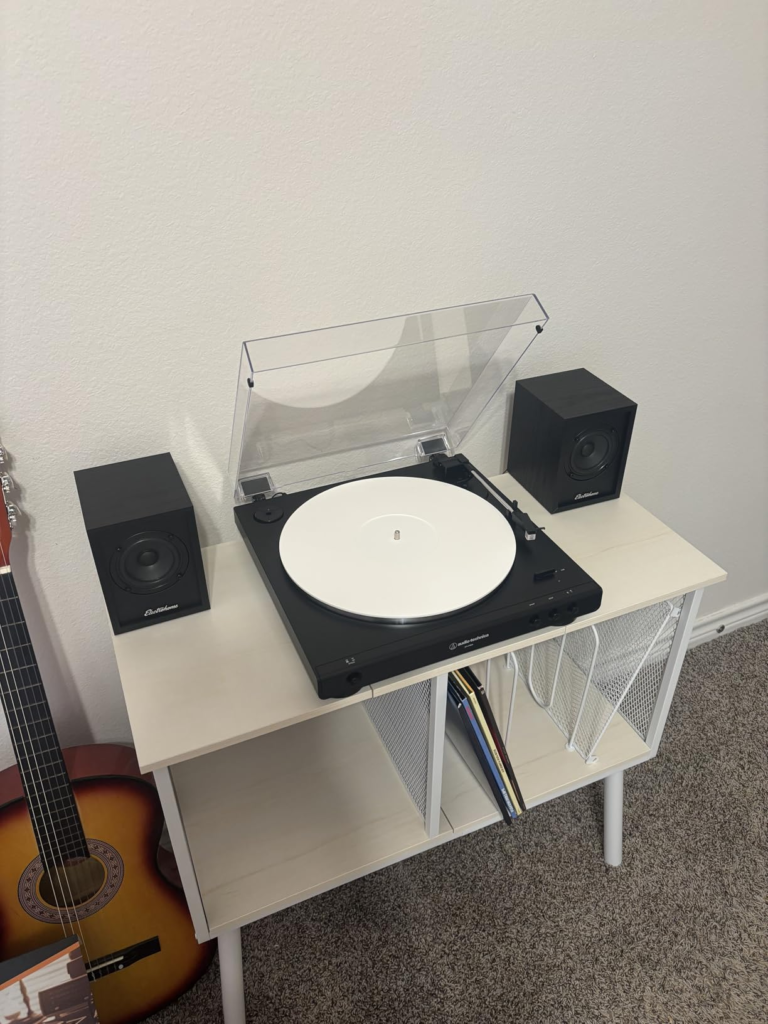
You have a record collection you haven’t played in years. You want to hear it. You do not want to manage a turntable. You want to press Play and get music. You have a receiver with an RCA input or powered speakers, or you want the Bluetooth variant to send signal to your existing wireless setup wirelessly. You are not planning to build a hi-fi system around this turntable. You are planning to enjoy your records.
In that situation, the LP60X removes every friction point that more capable machines introduce. There is no cartridge alignment. No counterweight ritual. No anti-skate guesswork. No cartridge compatibility research. Setup takes fifteen minutes including unpacking. The arm drops, the platter spins, the record plays.
For that listener, spending $349 on the LP120X buys features they will never use and introduces setup complexity they will likely do wrong. The LP60X is the precise answer for a precise kind of listening.
| Feature | What It Delivers | What It Costs You |
|---|---|---|
| Fully automatic operation | Zero user skill required | No manual cue control |
| Integrated headshell | No setup errors | No cartridge upgrades |
| Built-in phono preamp | Works with any speaker system | Slightly elevated noise floor vs. external preamp |
| Belt drive with servo motor | Stable speed, low vibration | No pitch control |
| Die-cast aluminum platter | Reduced resonance | Compact form factor only |
| AC adapter external to chassis | Lower electrical noise in signal | External power brick to manage |
What It Solves, What It Reduces, and What It Still Leaves to You
What the AT-LP60X solves completely:
- Setup anxiety. There is nothing to align, balance, or configure.
- Compatibility complexity. The built-in switchable preamp means it connects to anything — receiver, powered speakers, computer interface, Bluetooth speakers with the BT variant.
- Stylus replacement. The ATN3600L is widely available and inexpensive. When it wears out at ~400 hours, replacement takes thirty seconds.
- Tonearm safety. The automatic mechanism lifts the arm at the end of the record. No stylus dragging across the label when you fall asleep.
What it reduces but does not eliminate:
- Groove noise from dirty records. The conical stylus is slightly more forgiving of dust and surface noise than a precision elliptical, but dirty records still sound dirty.
- Rumble. The belt drive isolates motor vibration reasonably well. Not perfectly.
- Signal-to-noise. The internal preamp is adequate, not exceptional.
What it still leaves to you:
- Speaker quality. The LP60X will not correct for underpowered or poorly positioned speakers.
- Record cleanliness. Surface noise is your responsibility. A carbon fiber brush ($10) is not optional.
- Level surface. The feet are not adjustable. A tilted shelf introduces tracking irregularities.
- Stylus inspection. The ATN3600L shows no external wear signal. You’re tracking hours manually or replacing on a schedule.
Final Compression
The AT-LP60X is not a flawed turntable pretending to be more than it is. It is a correctly designed turntable that has been systematically misidentified by buyers who needed something slightly different.
Its actual strength is architectural simplicity in service of frictionless listening. Its actual limitation is that architectural simplicity is irreversible — there is no path out of the sealed system into more capable playback.
| Buyer Type | Right Move |
|---|---|
| First-time buyer, uncertain about vinyl commitment | AT-LP60X — correct starting point |
| Buyer with 50+ records wanting sonic improvement | AT-LP60X + ATN3600LE stylus upgrade ($30) — immediate resolution gain |
| Buyer planning to grow into vinyl seriously | AT-LP120XUSB — invest the difference now, avoid replacing in 18 months |
| Budget under $150, needs something that just works | AT-LP60X — nothing else at this price competes honestly |
| Audiophile-curious, wants cartridge path | Rega Planar 1 or AT-LP120X — the LP60X will frustrate within a year |
If you are a casual, set-and-forget listener with records to play and no interest in the mechanics of playback, this turntable was built for you and it will serve you well for years.
If you already feel the pull toward optimization — if you’ve already read about cartridge upgrades, if you’re already comparing stylus geometries, if you already resent not being able to adjust tracking force — then buying the LP60X is a decision you will reverse inside eighteen months.
The machine does not have a wrong answer. You do. Locate yourself accurately, and the decision compresses cleanly.
Frequently Asked Questions
| Question | Answer |
|---|---|
| Does the AT-LP60X damage records? | No. The factory-set 3-gram tracking force is heavier than audiophile-tier tables but well within safe limits. It will not damage records under normal use. More aggressive stylus wear may accumulate on high-resolution pressings over time, but groove damage from normal playback is not a documented concern. |
| Can I upgrade the cartridge on the AT-LP60X? | No. The headshell and tonearm are a fixed integrated assembly. You cannot swap the cartridge body. The only available upgrade is the stylus — replacing the stock ATN3600L with the elliptical ATN3600LE, which runs about $25–35 and is a genuine improvement worth doing. |
| Does the AT-LP60X need a phono preamp? | No. It includes a built-in switchable phono preamp. Flip the switch to LINE and connect to any amplifier or powered speakers with RCA inputs. Flip it to PHONO if your receiver has a dedicated phono stage and you prefer to use that instead. |
| What is the stylus lifespan on the AT-LP60X? | Audio-Technica rates the ATN3600L at approximately 400 hours. At two hours of daily listening, that’s roughly six months before replacement. Stylus replacement costs around $20 and takes about thirty seconds. |
| Is the AT-LP60X good enough for audiophile records? | It plays them. It does not maximize them. A 180g audiophile pressing contains detail the conical ATN3600L cannot fully retrieve. You will hear a better version of that record on a turntable with an elliptical or fine-line stylus. If you are spending serious money on pressing quality, the LP60X is the wrong tool — not because it harms the record, but because it leaves resolution on the table. |
| What’s the difference between the AT-LP60X and AT-LP60XBT? | The BT variant adds Bluetooth 5.0 with aptX transmission, allowing you to send the phono signal wirelessly to compatible speakers or headphones. It costs slightly more. If you have Bluetooth speakers or headphones you already use, the BT variant eliminates a cable run and simplifies setup further. The analog audio quality is equivalent between the two. |
| When should I upgrade from the AT-LP60X? | When you want to change the cartridge. That desire is the threshold signal. If you reach a point where you want to install an Ortofon 2M Red or Audio-Technica VM95E, you have outgrown the LP60X. The correct next step at that point is the AT-LP120XUSB, which ships with a removable headshell and adjustable counterweight. |
Transparency Note:
This analysis is built on aggregated real-world experience.
It extracts what repeatedly holds, what breaks, and what users uncover only after living with the system—then shapes it into a clear model you can use immediately.
Think of it as structured experience, refined and presented so you don’t have to learn it the hard way.
“A quick note: Don’t believe the star ratings, but trust personal experience. This article is a compilation of collected experiences”