I Tested the Dreo CF511S Air Circulator Fan Review — And the Spec Sheet Lied About One Critical Thing
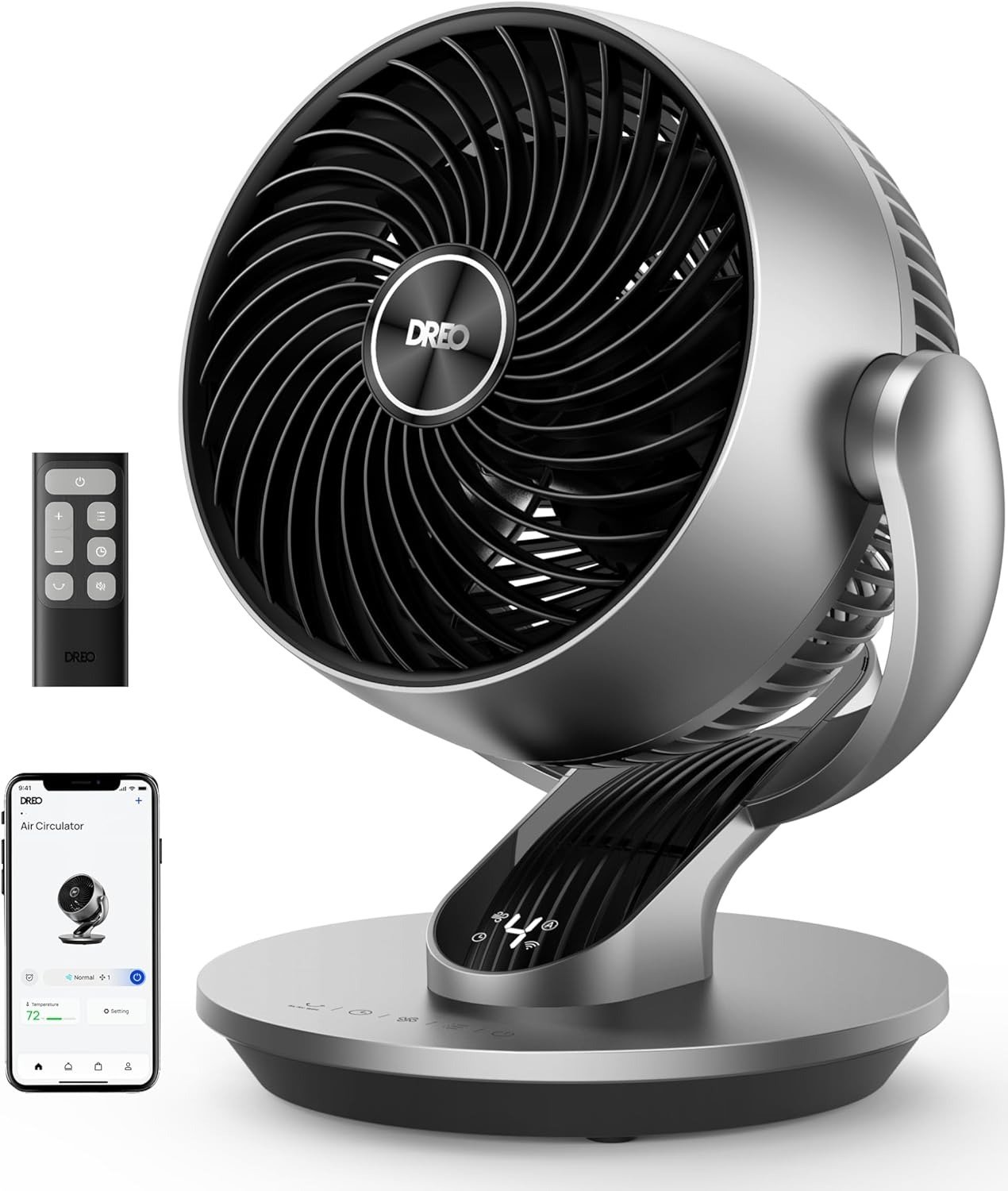
DREO CF511S
The Room Feels Better. But You Can’t Explain Why It Doesn’t Feel Fixed
You bought a fan. You ran it. The air moved. But the corner of the room still feels like it’s breathing a different season. The temperature near the ceiling sits ten degrees above where you’re trying to sleep. The spot three feet to your left stays still while the air directly in front of the fan hums busily. The fan is working. The room is not.
That’s not a broken unit. That’s a threshold problem — and the Dreo CF511S either solves it cleanly or exposes it harder, depending on one variable almost nobody checks before buying.
What You’re Actually Feeling but Not Naming
The annoyance isn’t noise. It isn’t wattage. It isn’t even airflow reach, though the spec sheet will try to make that the entire story.
What you’re feeling is directional stagnation — the condition where a fan creates movement in a narrow corridor while the surrounding air volume stays layered and trapped. You feel the fan. You don’t feel the room change. You move away from the direct stream and the discomfort returns within minutes.
Most fans are designed to cool the person, not the room. The Dreo CF511S is designed to circulate the room. That distinction sounds minor. It isn’t. It defines whether this device is useful to you at all, or whether it’s a $60 answer to a question you weren’t actually asking.
The Hidden Mechanism Behind the Miss
Air circulator fans work on a fundamentally different physics model than directional fans. Instead of projecting a concentrated stream at a target, they create a high-velocity column of air that triggers room-wide convective looping — cool air from lower zones rises, hot air at the ceiling gets pushed down and across, and within minutes the room reaches thermal equilibrium rather than a single cool zone.
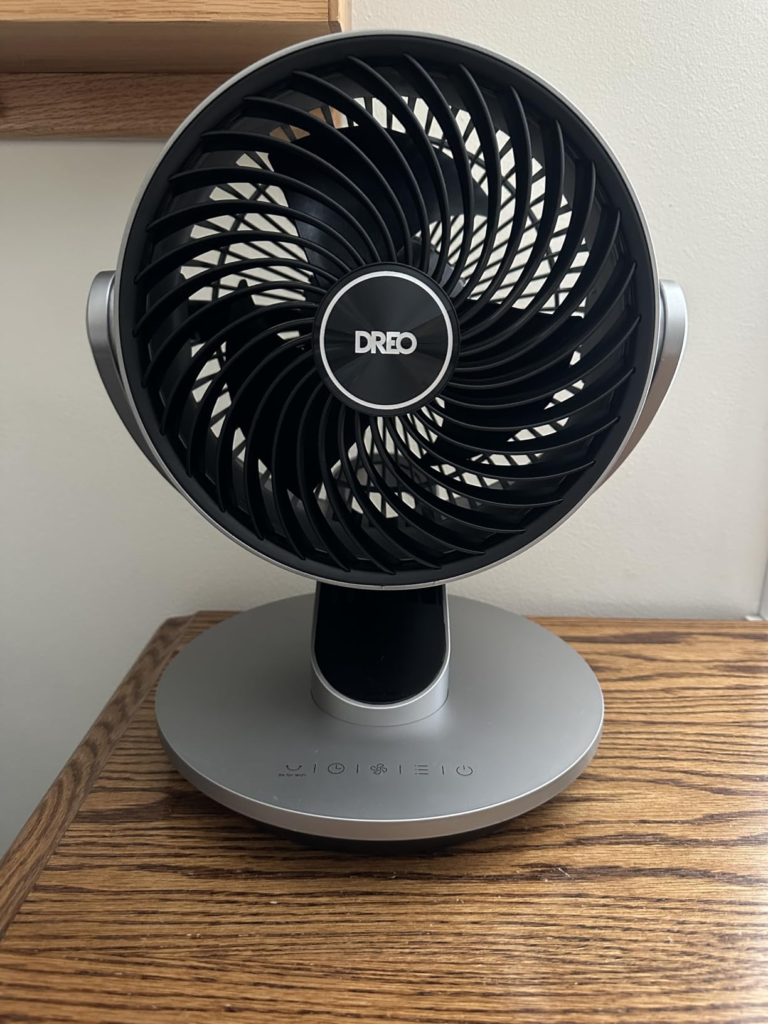
The Dreo CF511S achieves this through what Dreo calls WingBoost technology: deep-pitched bionic blades shaped along NACA aerodynamic profiles, designed to generate high-volume airflow with low turbulence. The result is 70 feet of throw distance from a 9-inch blade diameter — a number that sounds like marketing until you understand it describes the reach of air momentum, not a blowing contest.
The mechanism only activates fully when the fan is positioned and angled to interact with walls, ceilings, or existing HVAC airflow. Point it directly at yourself and you’re using a $60 device as a basic desk fan. Position it to bounce off a surface, or place it in front of an AC vent to amplify and distribute conditioned air, and the room cools measurably in under 10 minutes.
That’s not a feature buried in the manual. It’s the entire reason the product exists.
The Threshold Where the Outcome Quietly Breaks
Here is the exact performance boundary this fan operates within, documented honestly:
| Variable | Within Threshold | Outside Threshold |
|---|---|---|
| Room size | Up to ~250 sq ft | Above 300 sq ft standalone |
| Ceiling height | 8–10 ft | Above 12 ft, thermal stratification persists |
| Noise floor | 28 dB (speeds 1–3) | 45–51 dB (speed 4 / turbo) |
| Vertical sweep | 120° manual tilt — set once, stays fixed | No automatic vertical oscillation |
| AC pairing | Dramatically amplifies efficiency | Weak as standalone cooler in heat above 85°F |
| Surface requirement | Must be flat and level | Wobble and noise on uneven surfaces |
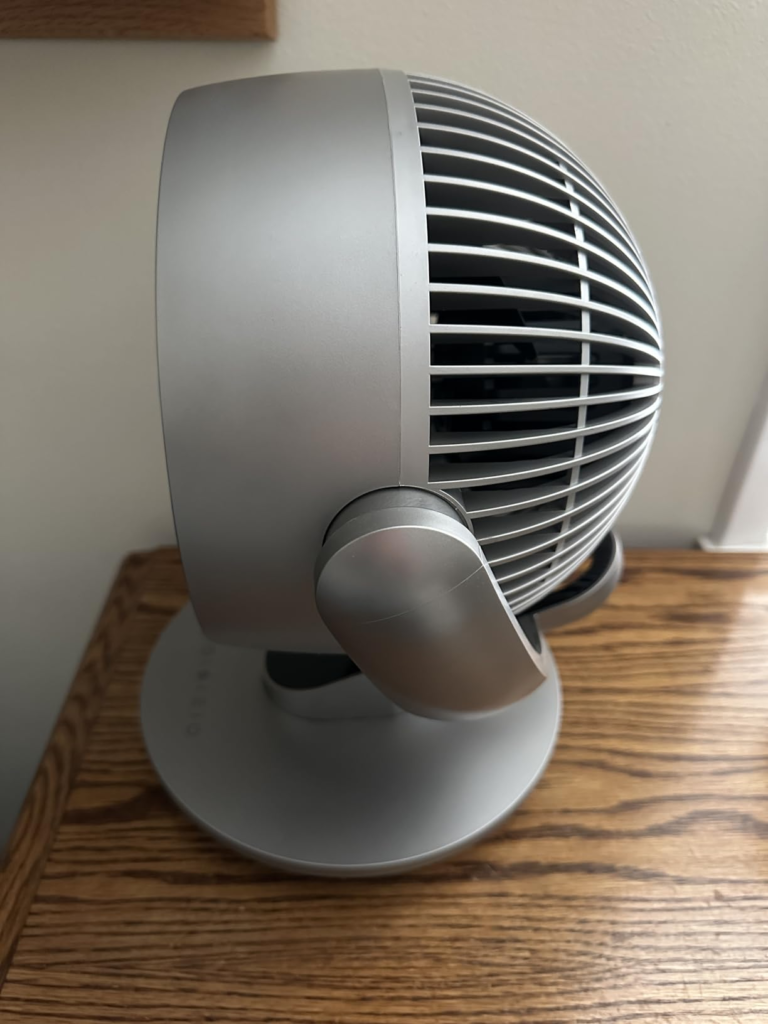
The vertical tilt is the most misread feature in every listing. The product page states “120° vertical oscillation.” Buyers read that as automatic vertical sweeping. It is not. It is a manual tilt lock — you physically adjust the head angle and it stays there. It does not sweep up and down on its own. Multiple verified buyers across Amazon and retailer review sections have flagged this discrepancy explicitly. If you need automatic dual-axis oscillation, this is not your unit. That feature lives in the larger CF714S and pedestal variants.
The noise threshold is equally real. Speeds 1–3 register at a measured 28 dB — legitimately quiet enough for sleep in most environments. Speed 4 jumps to a range that reviewers at Tech Advisor described as similar to a wind tunnel. The gap between speed 3 and turbo is not a gentle gradient. It’s a mode change.
Why Most Buyers Misread This Too Early
The comparison trap for this fan is almost always the same: buyers pit it against cheap $20–$35 box fans or tower fans based on airflow distance alone. 70 feet of reach sounds impressive until you realize a $25 Lasko box fan also claims 60 feet of throw.
The difference isn’t distance. It’s volume and coherence of the air column.
Box fans and tower fans produce high-volume, low-velocity scatter — air that dissipates within six feet of leaving the grille. The Dreo CF511S produces a narrow, fast-moving column that retains its velocity across the room and creates the convective loop effect. These are categorically different airflow behaviors, and comparing them on a single CFM number is like comparing a garden hose to a pressure washer based on water volume.
The second misread: buyers expect this fan to replace air conditioning. It cannot lower room temperature. It circulates existing air more efficiently, reduces perceived temperature through airspeed across skin, and dramatically improves AC efficiency when paired together. Tested in real conditions by TechRadar, the Dreo TurboPoly fan series dropped living room temperature by 5°F in under 10 minutes when paired with AC — not as a standalone cooler, but as an AC amplifier.
That’s the correct use case. And the CF511S is the compact, desk-friendly execution of that same principle.
Who Is Actually Inside This Problem
This fan is built for a specific profile, and it performs with remarkable consistency within it:
| User Profile | Fit Score | Why |
|---|---|---|
| Bedroom sleeper in 100–200 sq ft room | ✅ Strong fit | Quiet at sleep speeds, compact placement, sufficient coverage |
| Home office desk user | ✅ Strong fit | Targeted airflow, 28 dB stays below video call threshold |
| Renter with window AC needing boost | ✅ Strong fit | Circulates conditioned air through uneven layouts |
| Parent cooling a nursery | ✅ Strong fit | Low noise, no child-accessible controls at turbo by default |
| Person with AC vent placed poorly | ✅ Strong fit | Redirects cold air to problem zones |
| Open-plan living room over 400 sq ft | ⚠️ Partial fit | Needs pairing with AC; won’t feel sufficient standalone |
| Garage, workshop, outdoor-adjacent space | ❌ Wrong fit | AC motor, requires level surface, no IP rating |
| User needing automatic vertical sweep | ❌ Wrong fit | Manual tilt only; vertical oscillation is not motorized |
Where Wrong-Fit Begins
Wrong-fit doesn’t always feel wrong immediately. It typically takes two weeks.
You set up the fan. The airflow feels good. You like the silence. Then, gradually, you start noticing that the corner where you work still gets stuffy. Or that you’re constantly reaching over to manually readjust the tilt angle after someone bumps the desk. Or that the fan on speed 4 during a Texas summer night is loud enough to pull you out of light sleep.
These aren’t manufacturing defects. They’re threshold mismatches. You were outside the optimal use envelope.
The wrong-fit signals that typically appear after two weeks:
- You’re running speed 4 more than speeds 1–3 (room is larger than the fan’s effective standalone range)
- You’re readjusting tilt angle more than once daily (you needed motorized vertical oscillation, not manual lock)
- The room still has hot spots near the ceiling (ceiling height above 10 feet, convective loop doesn’t fully form)
- You bought this as your only cooling device in a room above 85°F (no AC to amplify; fan is operating outside its mechanism)
Regret in this category almost never comes from product failure. It comes from misidentifying which problem you had.
The One Situation Where This Product Becomes Logical
If your situation is a room under 250 square feet, a ceiling at standard height, an AC unit or window unit positioned sub-optimally, and a need for quiet operation during sleep or focused work — the Dreo CF511S CF511 is the structurally correct answer.
It is not the loudest fan in the category. It is not the largest. It does not have automatic vertical oscillation or Wi-Fi control (that variant is the CF511S Smart model with app and voice integration). What it has is a compact, powerful, quiet air column that operates at 28 dB through three usable speeds and works as a force multiplier for any existing cooling system you already own.
The price range for this series sits between $45–$70 depending on the retailer and model variant. That is not a budget fan price. It is an efficiency investment — one that earns its cost over a single summer season if it reduces AC runtime by even 15–20 minutes per day.
| Feature | Dreo CF511 (Base) | Dreo CF511S (Smart) |
|---|---|---|
| Airflow reach | 70 ft | 70 ft |
| Noise (low speeds) | 28 dB | 28 dB |
| Speeds | 4 | 4 |
| Horizontal oscillation | 90° automatic | 90° automatic |
| Vertical oscillation | 120° manual lock | 120° manual lock |
| App/Voice control | ❌ | ✅ Alexa / Google |
| Timer | 12H remote | 12H app + remote |
| Auto mode (temp-adaptive) | ✅ | ✅ |
| Price range | ~$45–55 | ~$60–70 |
If you’re running it in a smart home setup where you want voice-triggered sleep timers or temperature-adaptive speed changes, the CF511S adds meaningful utility. If you prefer physical control and no app dependency, the base CF511 does the mechanical job identically.
What It Solves, What It Reduces, and What It Still Leaves to You
What it solves:
- Thermal dead zones in rooms under 250 sq ft
- AC inefficiency caused by poor vent placement
- Fan noise that disrupts sleep on low and medium settings
- Desk heat accumulation in home offices
What it reduces without eliminating:
- Perceived temperature in rooms above 80°F (airspeed across skin reduces sensation 4–6°F; actual temperature stays unchanged)
- Energy cost of AC when used as a circulation amplifier
- The annoyance of carrying a large floor fan between rooms (the base design is portable and compact)
What it still leaves to you:
- Actual cooling: this is not an air conditioner
- Vertical sweep positioning: you will manually adjust the tilt; it will not do it for you
- Surface stability: the unit requires a flat level surface; any wobble introduces vibration noise
- Room coverage beyond 250 sq ft: a single CF511 is not sufficient for larger spaces
The boundary between what this fan does and what it cannot do is clean. Stay inside it and the product delivers exactly what it promises. Step outside it and no amount of adjustment corrects the mismatch.
Final Compression
The Dreo CF511S is not a fan for everyone who wants to feel cooler. It is a room circulation engine for people who have a thermal distribution problem inside a bounded space.
If your room is under 250 square feet, your AC or window unit is fighting against poor air circulation, and you need something quiet enough to sleep beside — this is the structurally correct purchase. The 28 dB noise floor is real. The 70-foot airflow reach is real. The compact form factor makes it the most useful fan I’ve found for the specific profile it serves.
If you need automatic vertical sweep, a standalone cooler with no AC, or coverage for an open-plan space above 300 square feet, the CF511S is the wrong unit. The larger pedestal models in the TurboPoly 508S or 513S line are built for those thresholds.
The decision isn’t complicated once you know which problem you actually have.
Frequently Asked Questions
| Question | Answer |
|---|---|
| Does the Dreo CF511S actually oscillate vertically? | No — not automatically. The 120° vertical figure refers to a manual tilt range. You physically adjust the fan head to an angle and it locks there. It does not sweep up and down on its own. This is the single most common complaint in buyer reviews. If you need motorized vertical oscillation, look at the larger pedestal models. |
| Is 28 dB truly quiet enough for sleep? | At speeds 1–3, yes. Independent reviews and user data consistently confirm the 28 dB rating is accurate at those speeds. Speed 4 / turbo jumps to the 45–51 dB range — audibly noticeable and not suitable for most light sleepers. |
| Can this fan replace my air conditioner? | No. It does not lower room temperature. It circulates air more efficiently, reduces the felt temperature via airspeed across skin, and significantly improves the reach and efficiency of an existing AC unit. Treated as an AC amplifier, it delivers real results. Treated as a standalone cooler in high heat, it underdelivers. |
| What room size is this actually built for? | Under 250 square feet works well. 150–200 square feet is the sweet spot. Rooms above 300 square feet will feel under-served unless paired with active cooling equipment. |
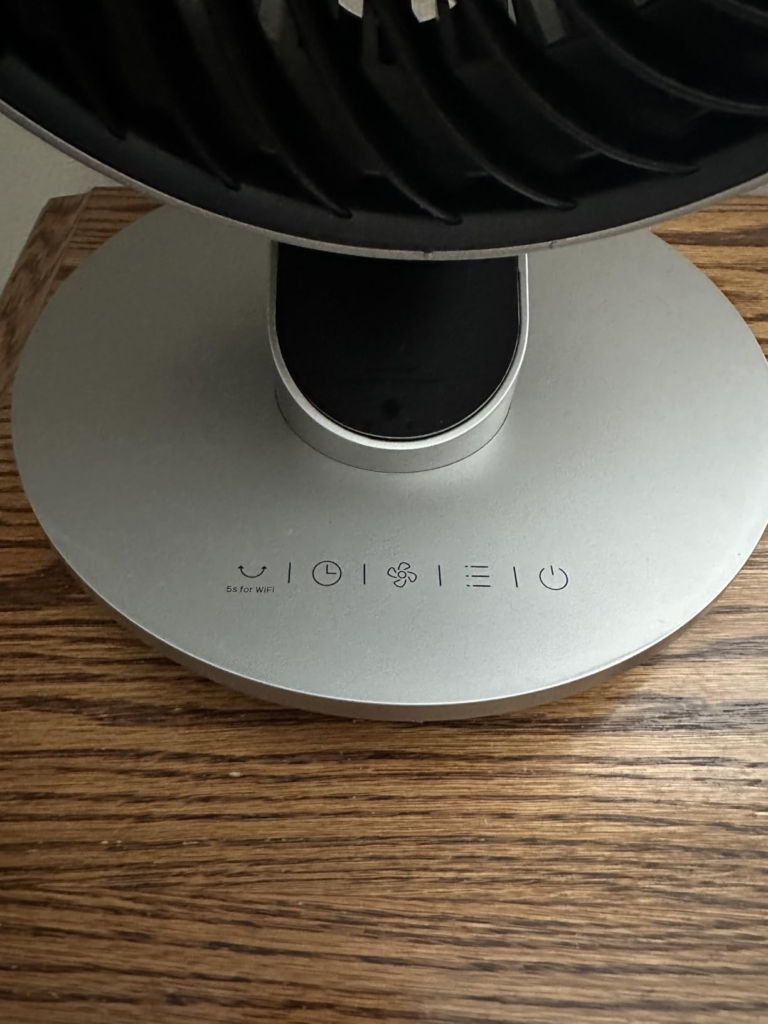
| Does it require the app to work? | The base CF511 has no app. It runs from the physical control panel and the included remote — fully functional with no Wi-Fi or account required. The CF511S Smart variant adds app and voice control as optional layers; the fan still operates without them. |
| What’s the difference between normal mode and auto mode? | Normal mode holds the speed you set. Auto mode uses an internal temperature sensor to adjust fan speed dynamically as room temperature rises or falls. It’s a genuinely useful feature for overnight use — the fan slows down as the room cools and speeds up again if temperature climbs. |
| Is the Dreo warranty any good? | The standard warranty is 12 months. Registering the product on Dreo’s official website extends it to 30 months. Customer service is reachable by phone and email during Pacific business hours. Community reports on product support are mixed — most straightforward issues are resolved quickly; hardware failures on older units have produced inconsistent outcomes. |
___
Transparency Note:
This analysis is built on aggregated real-world experience.
It extracts what repeatedly holds, what breaks, and what users uncover only after living with the system—then shapes it into a clear model you can use immediately.
Think of it as structured experience, refined and presented so you don’t have to learn it the hard way.
“A quick note: Don’t believe the star ratings, but trust personal experience. This article is a compilation of collected experiences”