Shark WandVac WV201 Review: Why Most People Either Love It Completely or Regret It Entirely — and the One Variable That Decides Which
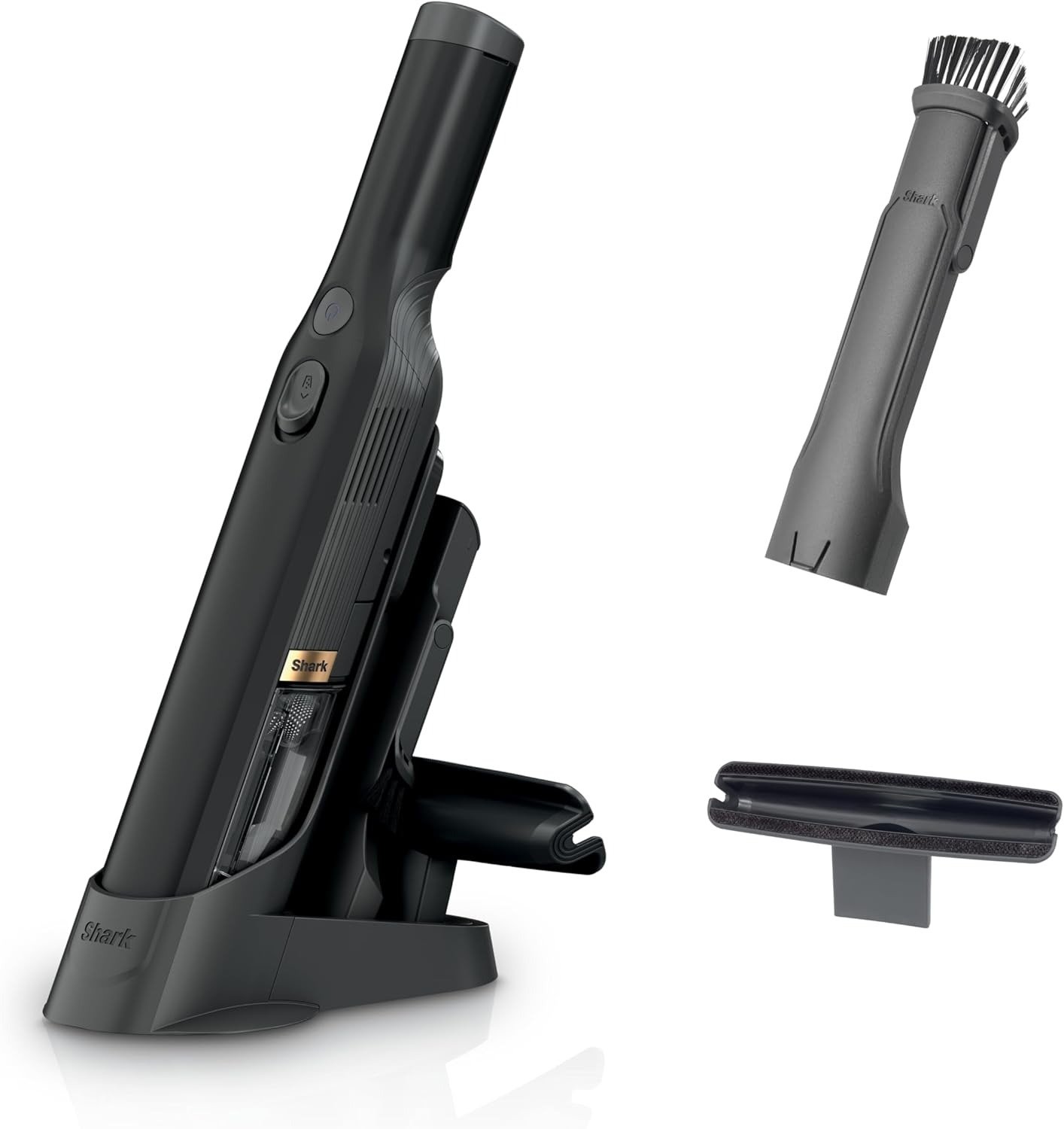
SHARK WANDVAC WV201
You grabbed your coffee. Crumbs on the couch. Cat hair on the passenger seat. A flour explosion across the kitchen counter at 7 AM. And in every one of those moments, your full-size vacuum felt like the wrong answer — too heavy, too loud, too much commitment for a 40-second problem.
That friction is real. And it has a name now: the spot-cleaning gap. The distance between the mess you can see and the tool you’re willing to reach for.
The Shark WandVac WV201 was built to live inside that gap. Whether it belongs there — for your version of that gap — is exactly what this review is designed to tell you.
The Result Looks Fine. The Problem Isn’t.
The WV201 pulls in 4.4 stars across tens of thousands of reviews. It wins awards. Consumer Reports named an early version the number-one rated rechargeable hand vac. Costco sold it for $80 and couldn’t keep it on shelves.
And yet a meaningful percentage of buyers return it, replace it within months, or quietly describe it as one of their more frustrating purchases.
Both groups are right. And they bought the same product.
That contradiction isn’t about quality control. It’s about a misread at the point of purchase — a moment where the buyer’s mental model of what they needed didn’t match what the machine actually does.
The product didn’t fail. The premise failed.
What You’re Actually Feeling but Not Naming
Here’s the problem that sends people to search for a handheld vacuum in the first place:
You don’t want a cleaning session. You want a cleaning gesture.
Something that lives on the counter, charged, visible, ready — that you can use in the same motion as wiping down a surface. No unplugging. No searching. No cord. No opening a closet. No dragging out a machine that requires two hands and a power outlet.
That friction point — the “getting the vacuum out” moment — is the actual problem people are solving. Not the mess. The deployment barrier around the mess.
When you see it that way, a lot of the WV201’s design decisions start to make perfect sense. The charging dock. The wall-mountable stand. The one-touch debris release. The wand shape that requires zero setup. The weight that a child could hold with one hand.
All of it is engineered around one behavioral truth: if retrieving the tool costs more energy than the mess demands, the mess wins. Every time.
The WV201 bets its entire design philosophy on breaking that pattern. And for a specific set of conditions, it succeeds with unusual precision.
The Hidden Mechanism Behind the Miss
Here’s what the spec sheet doesn’t explain — and what most reviews treat as a footnote instead of the central fact:
The WV201 runs on a high-speed brushless motor packed into a 1.4-pound chassis. That motor is genuinely powerful for its size. In controlled tests, it clears rice grains from hardwood, pulls pet hair from upholstery in two passes, and handles the flour-on-counter scenario without hesitation.
But a brushless motor at this power density burns energy fast. The battery — non-removable, non-upgradeable — lasts between 8 and 10 minutes of continuous use. Recharging requires between 1 hour 58 minutes and 2.5 hours, depending on the model variant and reviewer.
That ratio — 9 minutes of runtime, 2 hours of recovery — is the hidden mechanism. And it’s not a flaw in the engineering. It’s the engineering. The designers traded capacity for compactness. The motor is big. The battery, by necessity, is small.
Most buyers see “cordless” and mentally anchor to their experience with cordless drills or stick vacuums — tools where 20 to 40 minutes of runtime is standard. The WV201 doesn’t belong to that comparison class. It belongs to a different category entirely: the instant-access spot cleaner. A category with a runtime budget measured not in session length, but in task completion.
The machine was never meant to run for 20 minutes. It was meant to run for as long as your specific mess requires.
That’s the mechanism most buyers miss.

The Threshold Where the Outcome Quietly Breaks
There is a specific threshold in this product’s use case. Cross it, and the experience collapses.
The 10-Minute Threshold.
Below it: the WV201 is nearly perfect. You grab it, clean, dock it, and it’s recharged before you need it again. The dock ensures it’s always at full charge if you return it consistently. The one-touch empty means zero contact with debris. The weight means no fatigue, no grip strain, no awkward angles.
Above it: the product actively punishes you. You’re mid-cleaning session and the motor cuts. You set the vacuum down. You wait two hours. The mess is still there.
The threshold isn’t arbitrary. It maps directly to a set of cleaning behaviors:
| Cleaning Task | Typical Duration | WV201 Verdict |
|---|---|---|
| Counter crumbs after cooking | 30–90 seconds | Ideal |
| Pet hair on one couch cushion | 1–2 minutes | Ideal |
| Car seat spot clean (front only) | 3–5 minutes | Works well |
| Litter scatter around box | 1–2 minutes | Ideal |
| Car interior full detail | 12–20 minutes | Fails mid-session |
| Stairs (full flight) | 10–15 minutes | Borderline risky |
| Post-party floor sweep | 15–25 minutes | Wrong tool |
| Whole-apartment clean | 30+ minutes | Not this product |
The question to ask before purchasing is simple: Do your cleaning needs live above or below that threshold? Not as an average. In their worst-case version.
Why Most Buyers Misread This Too Early
There is a pattern that causes most return-and-regret stories with the WV201, and it starts at the comparison stage.
The typical buyer finds the WV201 in search results, sees its price ($80–$130 depending on the retailer and period), and begins comparing it to stick vacuums in the same price range. They look at runtime. The WV201 loses immediately. They look at dustbin capacity. The WV201 — at 0.08 quarts — loses again.
Then they read the reviews, see the 4.4 stars, buy it, and experience the runtime limitation firsthand during a car detailing session. They feel deceived. They weren’t.
The comparison was wrong from the start.
The WV201 is not competing with stick vacuums. It is competing with the decision to not clean at all in a specific moment. Its opponent isn’t the Dyson V7 or the Bissell Pet Hair Eraser. Its opponent is the moment when you look at the mess on the passenger seat and decide to deal with it later.
When you understand that the WV201 wins against “later” consistently, and loses against “full cleaning session” consistently, the buying decision becomes structurally clear.
| Comparison Factor | Shark WandVac WV201 | Dyson V7 Trigger | Bissell Pet Hair Eraser |
|---|---|---|---|
| Weight | 1.4 lbs | 3.3 lbs | 3.3 lbs |
| Runtime | 8–10 min | 30 min | 17 min |
| Dustbin Capacity | 0.08 qt | 0.14 qt | 0.5 qt |
| Charge Time | ~2 hrs | ~3.5 hrs | ~4 hrs |
| Storage/Dock | Included, freestanding | No dock | No dock |
| One-Touch Empty | Yes | No | No |
| Battery Replaceable | No | No | No |
| Best For | Instant spot tasks | Extended sessions | Pet hair focus |
| Worst For | Long sessions | Always-ready access | Compact storage |
Who Is Actually Inside This Problem
The WV201 serves a specific lifestyle profile with unusual precision. You recognize yourself in this list or you don’t.
This product fits you if:
You have a pet whose hair appears on furniture between full vacuuming sessions, and you want something within arm’s reach to handle it in under two minutes. You eat at your desk or work surface and want crumbs handled immediately rather than accumulated. You have a car you use daily and occasionally need to clean the front seat before a passenger gets in. You live in a kitchen-centric household where spills happen fast and you want the cleanup to match the pace. You are a pet owner with a dedicated litter zone and you want a stationed cleaner that doesn’t require a trip to the closet.
The Reddit WV201 owner who described keeping it stationed next to the litter box — charged, always ready, used for 60-second cleanups after the cat exits — is the canonical use case. That user reported years of consistent satisfaction.
This product fits your home if:
Your home has one or two recurring mess zones. The WV201 works best when it has a fixed territory — a kitchen counter, a bathroom shelf, a mudroom corner — rather than being deployed across a whole floor plan. It is a stationed specialist, not a roaming generalist.
Where Wrong-Fit Begins
The WV201’s wrong-fit cases are as specific as its right-fit ones.
You are outside this product’s range if:
You expect to clean your car fully in one session. The typical full car interior — seats, footwells, trunk — requires 15 to 20 minutes minimum. The WV201 will fail mid-session and require you to either stop or continue with a different tool. Several Amazon reviewers described exactly this frustration, calling the vacuum powerful but unable to finish a single automobile cleaning.
You intend to use it as your only vacuum. The 0.08-quart dustbin fills fast during any extended task. A standard-length hallway runner in a home with shedding pets will require multiple emptying cycles within one session. The tool was not designed for that load.
You travel, move the device between floors regularly, or expect a single charge to last across multiple zones. With 8–10 minutes of runtime, any gap between dock and task location becomes a liability.
You want the option to buy a spare battery. The WV201’s battery is non-removable. When the battery degrades — which several Reddit users reported happening at the 18-to-24-month mark under regular use — the unit either needs to be replaced or sent for service. This is a structural decision in the design, not a defect, but it sets a reliability ceiling that buyers should account for at purchase.

The One Situation Where the Shark WandVac WV201 Becomes Logical
After all of the above — the threshold, the comparison error, the use-case boundaries — one situation exists where the WV201 stops being a trade-off and becomes the cleaner answer.
You have a recurring small mess. It appears in a fixed location. It appears frequently. And your current behavior is either to ignore it between full vacuuming sessions or to bring out a larger tool that feels disproportionate to the task.
If that describes your daily cleaning reality, the WV201’s design philosophy aligns with your actual behavior at the operational level.
The charging dock is engineered for permanent placement. The machine’s weight and wand shape are designed for single-hand use at any angle. The one-touch empty is designed to remove any hesitation from the post-use sequence. The brushless motor is designed to deliver full suction from the first second of use — no warmup, no ramp.
The product is most logical when it lives in one place, handles one category of mess, and is used in bursts that stay under its runtime ceiling.
That is a narrow mandate. But within that mandate, it executes with a consistency that most handheld vacuums at twice the price cannot match on the dimension that actually matters in the moment: whether you’ll actually reach for it.
What It Solves, What It Reduces, and What It Still Leaves to You
What the Shark WandVac WV201 genuinely solves:
The deployment barrier. The moment when the mess is small enough that getting out a full vacuum feels absurd, but large enough that leaving it there bothers you. The WV201 removes the friction between that moment and the action.
| Performance Area | Rating | Notes |
|---|---|---|
| Suction for spot tasks | ★★★★★ | Brushless motor outperforms size expectation |
| Weight & ergonomics | ★★★★★ | 1.4 lbs, one-hand operation at any angle |
| Pet hair removal | ★★★★☆ | Excellent on upholstery; motorized brush upgrades available |
| Hard floor debris | ★★★★★ | Tapered nozzle, zero drop-back in testing |
| Storage & dock | ★★★★★ | Freestanding, accessory-integrated, always charged |
| One-touch empty | ★★★★☆ | Clean, fast; small bin fills quickly in longer sessions |
| Runtime per session | ★★☆☆☆ | 8–10 min; structurally by design, not a defect |
| Long-session suitability | ★☆☆☆☆ | Not designed for this; wrong use case |
| Battery replaceability | ★★☆☆☆ | Non-removable; plan for a 2–3 year replacement cycle |
| Noise level | ★★★★☆ | Significantly quieter than comparable-power vacuums |
| HEPA-class filtration | ★★★★☆ | Washable filter; captures fine dust effectively |
What it reduces but does not eliminate:
Pet hair accumulation between full vacuuming sessions. Car interior mess between detail cleans. The visual disorder of a kitchen after cooking. It reduces the gap, not the need for a full-size vacuum alongside it.
What it still leaves to you:
Extended sessions. Full-room cleaning. Stairs from top to bottom in one pass. Car interiors from door to door. Any task where you need more than 10 minutes of continuous suction without pausing to recharge.
The WV201 is not a replacement for your main vacuum. It is a stationed supplement to it. The households that use it this way — parked in one location, used for specific recurring tasks, docked immediately after — report years of consistent satisfaction. The households that use it as a stand-alone solution report the kind of frustration that shows up in one-star reviews.

Final Compression
The Shark WandVac WV201 is a precision tool that gets misclassified at the point of purchase more than almost any vacuum in its category.
The spec sheet reads like a handheld vacuum. The experience behaves like a stationed spot-cleaning appliance. That gap — between category label and actual function — is where most wrong-purchase decisions are made.
If your cleaning reality involves a recurring small mess in a fixed location, frequent enough that ignoring it between full sessions creates visible accumulation, and small enough that reaching for a full vacuum feels like overkill — the WV201 is not a compromise. It is the most logical tool for that specific condition.
If your cleaning reality involves extended sessions, multiple zones, car detailing, or the expectation of standalone vacuum coverage — no amount of suction power at 1.4 pounds resolves the battery physics of this machine.
The 8-minute runtime is not a bug. It is the design.
The question is whether your cleaning need fits inside those 8 minutes. If it does, consistently — this is the product.
Frequently Asked Questions
| Question | Answer |
|---|---|
| Is the Shark WandVac WV201 good for car cleaning? | For front-seat spot cleaning — crumbs, a spill, surface pet hair — yes. For full car interior detailing, no. The 8–10 minute runtime will not cover a complete automobile in one session. Users who’ve attempted full car detail sessions with the WV201 consistently report the battery running out mid-process. |
| How long does the Shark WandVac WV201 battery last? | Between 8 and 10 minutes of continuous use. Recharging takes approximately 2 to 2.5 hours. The battery is non-removable, meaning you cannot swap in a spare to extend runtime. |
| Can you replace the battery in the Shark WandVac WV201? | Not by the user. The battery is internally fixed. When battery performance degrades — typically at the 18–30 month mark under regular use — the unit either needs factory service or replacement. |
| Is the Shark WandVac WV201 good for pet hair? | Yes, within its runtime constraints. The brushless motor handles pet hair on upholstery and hard floors effectively. The multi-surface pet tool is included. For households with heavy shedding across large surfaces, the small dustbin (0.08 quarts) will require frequent emptying. |
| How often should I clean the Shark WandVac WV201 filter? | Shark recommends rinsing the filter monthly under regular use. Allow it to dry completely (24 hours) before reinserting. Skipping filter maintenance is the most common cause of premature suction loss and motor failure reported by long-term users. |
| Is the Shark WandVac WV201 worth it in 2025? | Yes — if you are buying it as a stationed spot-cleaning supplement to a full-size vacuum, with a recurring small-mess use case in a fixed location. No — if you expect it to replace or meaningfully reduce your need for a primary vacuum. |
| What is the dustbin capacity of the Shark WandVac WV201? | 0.08 quarts. This is intentionally small, consistent with the product’s design for short, high-frequency tasks rather than extended sessions. The one-touch empty feature mitigates the emptying friction in a fixed-station use scenario. |
| Why does my Shark WandVac lose suction quickly? | The most common causes are a clogged filter (clean monthly), a full dustbin (empty after each use), or a blocked tapered nozzle or attachment. If suction loss is sudden and persistent after cleaning all components, battery degradation affecting motor performance is the next likely cause. |
Transparency Note:
This analysis is built on aggregated real-world experience. It extracts what repeatedly holds, what breaks, and what users uncover only after living with the system—then shapes it into a clear model you can use immediately. Think of it as structured experience, refined and presented so you don’t have to learn it the hard way.
“A quick note: Don’t believe the star ratings, but trust personal experience. This article is a compilation of collected experiences”