The Room Can Look Expensive and Still Feel Flat. The Dangbei MP1 Max Fixes That Only After a Very Specific Threshold.
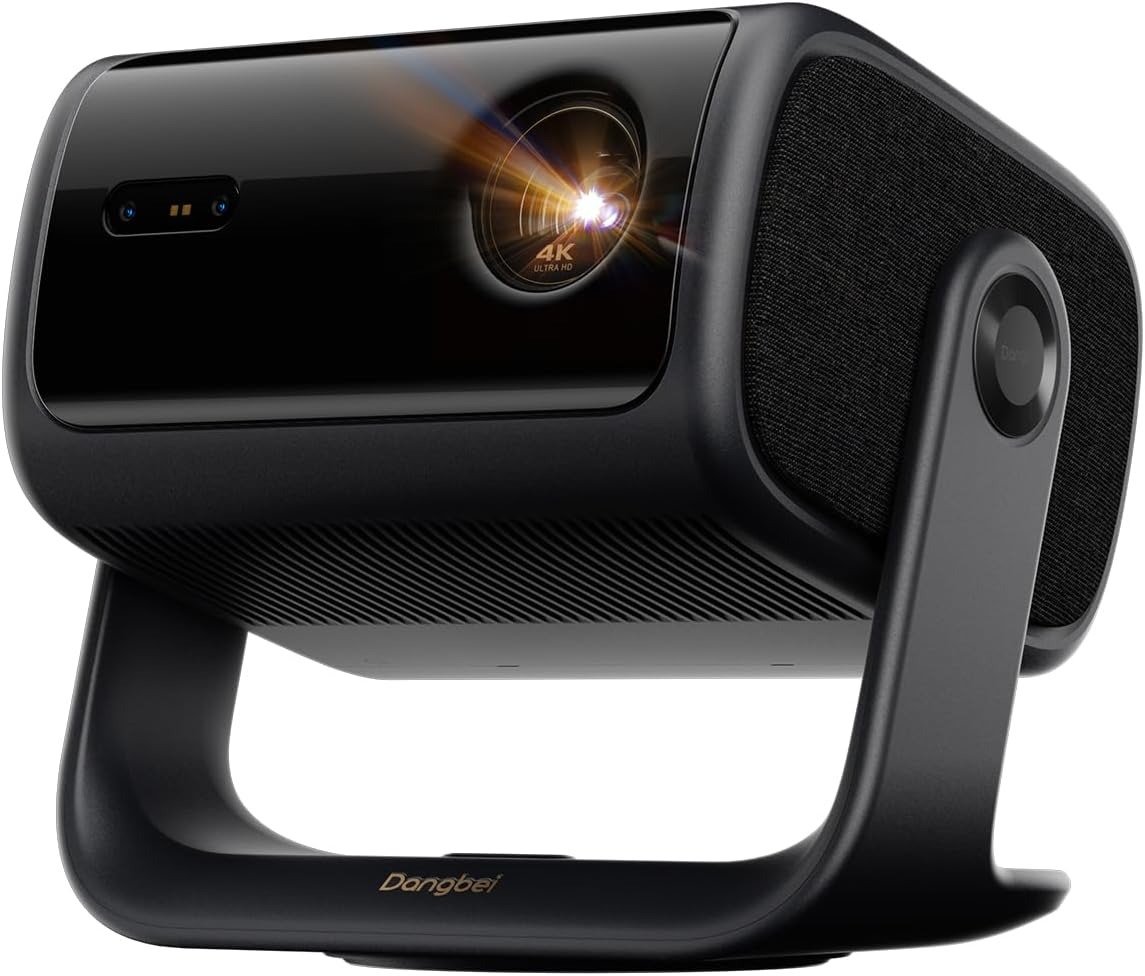
DANGBEI MP1 MAX
The Result Looks Fine. The Problem Isn’t.
A lot of living rooms already look “good enough” on paper. Large TV. Soft lamp behind the console. Clean wall. Maybe a soundbar under the screen.
But the room still feels capped. The wall is occupied, not transformed. Movie night starts, and the space does not open up. It just turns on.
That is the first lie big-screen buyers keep swallowing: size is the upgrade. It is not. The real upgrade is when the room stops behaving like a room and begins behaving like an event.
That is exactly where the Dangbei MP1 Max got interesting for me. Not because it throws a huge image. Plenty of projectors do that.
It got interesting because the package is unusually concentrated: native 4K, a triple-laser + LED hybrid light engine, a claimed 3,100 ISO lumens, Google TV with licensed Netflix, a 360° gimbal stand, dual HDMI 2.1 with eARC, Wi-Fi 6, Bluetooth 5.2, 40–300 inch image range, and a chassis small enough to move without turning setup into a weekend project.
On measurements, ProjectorCentral found it could hit 3,084 lumens in its brightest SDR mode and around 2,000 lumens in more usable calibrated-style modes, which matters far more than inflated spec-sheet theater.
The hook is not “it is bright.” The hook is uglier than that.
Most people do not buy the wrong projector because they misunderstood brightness. They buy the wrong projector because they misunderstood the break point where convenience, image authority, and room presence finally lock together.
What You’re Actually Feeling but Not Naming
You are not just chasing a larger image.
You are trying to kill three small irritations that pile up into one quiet disappointment:
| What you notice | What it really means | Why it matters |
|---|---|---|
| The room still looks like it belongs to the TV | The display is dominating furniture, not atmosphere | The space never becomes cinematic |
| You keep negotiating with placement | The setup is fragile, annoying, or visually awkward | You use it less than you imagined |
| Streaming and startup feel like chores | The “smart” part is a patchwork, not a system | Friction slowly murders usage |
That is why owners and reviewers keep circling the same praise from different angles: brightness that feels more serious than the usual lifestyle-projector class, setup that is unusually painless, and streaming that does not immediately force an external stick into the equation.
ProjectorCentral called it a capable all-in-one for people who prioritize convenience and brightness; Notebookcheck praised the image and AI optimization while criticizing the sound; user feedback on Reddit and retail pages keeps repeating a familiar pattern—sharp, vivid, easy to live with, but not perfect in fan noise or built-in audio.
That pattern matters because it reveals the emotional core of this category: people do not regret a projector because it failed a spec sheet. They regret it because it inserted one more tiny hassle into the room they wanted to simplify.
The Hidden Mechanism Behind the Miss
The hidden mechanism is not resolution. It is not “laser” as a marketing word either.
It is the stack.
When a projector starts to feel premium in real use, it is usually because four layers stop fighting each other:
| Layer | What breaks in weaker products | What the MP1 Max is doing |
|---|---|---|
| Light engine | Enough light on paper, weak color or poor comfort in practice | Triple laser + LED hybrid design with wide-gamut ambitions and strong measured output |
| Placement | The room dictates the projector | 360° horizontal rotation, 135° vertical tilt, 1.20:1 throw, AI screen fit/keystone/focus |
| Streaming | External dongles and menu ugliness creep back in | Google TV with licensed Netflix and major app support |
| Daily use | You keep tweaking every session | Auto adjustments, obstacle avoidance, adaptive brightness, easy startup flow |
That is why this projector does not feel like a raw hardware argument. It feels like an “interaction load” argument.
ProjectorCentral’s review is especially useful here because it moves past brochure language. It found the out-of-box contrast merely decent rather than magical, but also found that with tuning, black levels and shadow detail improved meaningfully.
It found highlight handling generally strong, minor clipping in demanding scenes, and multiple usable picture modes rather than one fake demo mode. That is the difference between a projector that flatters a showroom and a projector you can actually shape into your room.
The Threshold Where the Outcome Quietly Breaks
This is the threshold.
The MP1 Max becomes persuasive when you cross from “I want a projector” into “I want a projector that can live in a real room without acting fragile.”
Not earlier.
Because before that threshold, cheaper machines can imitate the fantasy. They can throw a big image in darkness and impress you for fifteen minutes. After that threshold, imitation starts to collapse.
Here is the clean version:
| Threshold question | If your answer is no | If your answer is yes |
|---|---|---|
| Do you need the image to hold up beyond a cave-dark room? | The MP1 Max may be more than you need | Its 3,100 ISO-lumen class starts making sense |
| Do you care whether setup feels almost automatic? | A more manual projector may be acceptable | The AI alignment system becomes part of the value |
| Do you want the room to stay clean, not crowded with extra boxes and mounts? | You can save money elsewhere | The gimbal stand + Google TV stack becomes disproportionately valuable |
| Do you watch movies, streaming, and casual games from one device? | Category overlap matters less | The all-in-one design earns its price more honestly |
The threshold is not brightness alone. It is brightness plus livability.
That is why the physical design matters more than it first appears. The matte dark-gray chassis and integrated stand let you place it on a low console, a side shelf, or even angle it upward in a bedroom without making the room look temporary.
On a walnut console or matte-black media unit, it reads less like office equipment and more like a deliberate object.
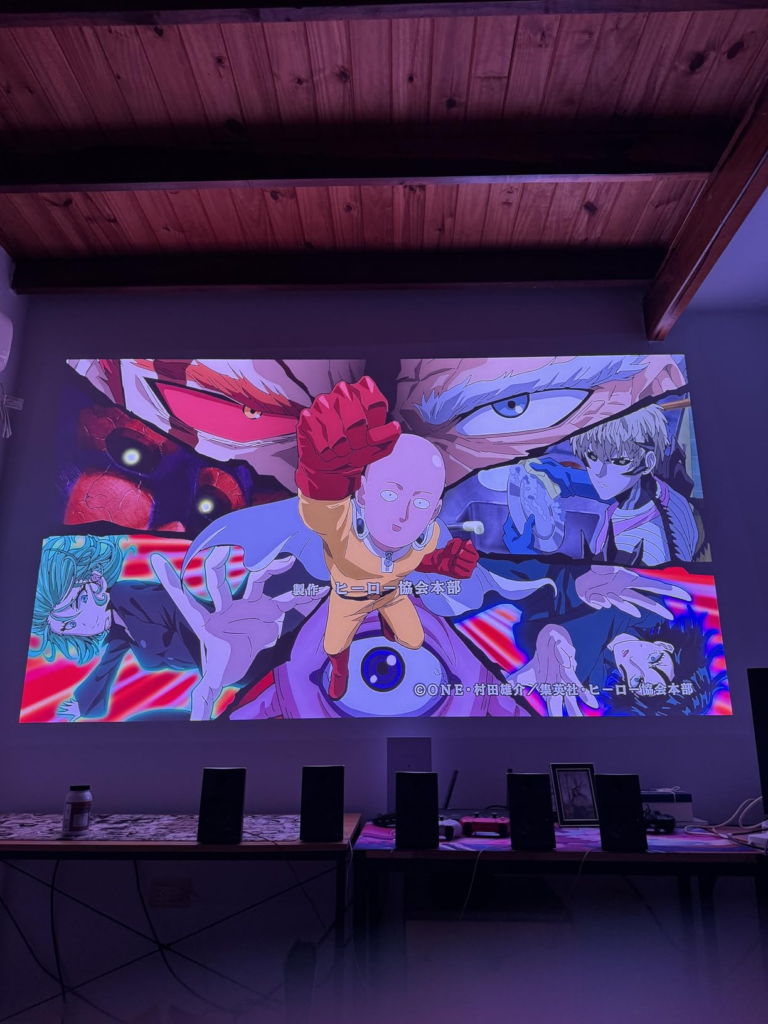
Put it slightly off-center on a console with a clean wall, dim table lamp, and hidden cable run, and the room gains that quiet “private screening room” authority people keep trying to fake with décor alone. The hardware does not just project onto the space. It edits the space.

Why Most Buyers Misread This Too Early
They stare at the wrong scoreboard.
They compare projectors the way people compare power tools they will never actually use under pressure: brightest claim, biggest promise, loudest spec, lowest price.
That is the early-comparison trap.
What matters sooner is this:
- Can I place it without redesigning the room?
- Can I start a film without solving five little problems first?
- Will the image still feel rich when the room is not perfectly controlled?
- Will I regret the built-in audio and end up buying extra gear immediately?
- Will gaming feel acceptable or irritating?
This is where the internet feedback lines up in a surprisingly disciplined way. ProjectorCentral measured 35 ms input lag at both 1080p and 4K/60, which is fine for casual gaming and weak for serious competitive play.
Notebookcheck liked the image but called out the sound and noted that standard operation could be relatively loud. Reddit users echoed that split almost word for word: brightness lands hard, the fan can be more audible than expected, and image settings benefit from some restraint rather than leaving every enhancement switched on.
Even Amazon retail sentiment leans the same direction—strong satisfaction overall, but setup nuance and room context still matter.
So the wrong way to read this product is: Does it do everything?
The right way is: Does it remove enough friction at the exact point where smaller compromises become expensive?
Who Is Actually Inside This Problem
I would place four people squarely inside the MP1 Max problem set.
| User type | Why this fits |
|---|---|
| The living-room upgrader | You want a serious image without turning the room into an AV science project |
| The style-conscious buyer | You care how the device sits in the room, not just what it outputs |
| The streaming-first viewer | Native Netflix and Google TV matter because you actually use them every day |
| The casual gamer / movie-heavy household | 35 ms lag is enough for relaxed play, not esports panic |
And one more type matters: the buyer who is tired of fake portability.
The MP1 Max is movable, yes, but it is not a battery toy. Notebookcheck notes there is no built-in battery and puts the weight at roughly 5.5 kg; Digital Camera World says it is still manageable to move and comes with a carry case, but mains power remains part of the reality.
In plain English: this is transportable authority, not grab-and-go minimalism.
If that is you, this product starts to click.
If you are imagining a truly casual picnic projector, it does not.
Where Wrong-Fit Begins
This is where I would cut the fantasy before it wastes your money.
The MP1 Max is a wrong fit if:
- you want competitive gaming latency rather than cinematic gaming;
- you expect built-in speakers to replace a proper sound system in a demanding home theater;
- you want deep-black purist projection with no tuning and no environmental control;
- you want ultra-portability with battery-powered freedom;
- you buy projectors mainly to brag about a spec list instead of living with them.
That is not me being harsh. It is the cleanest way to protect the decision.
ProjectorCentral’s measurements and viewing notes make it clear the MP1 Max is strong, but not supernatural: black levels improve with tuning, darker scenes still prefer controlled light, and the sweet spot is not “sunlit room, no compromises whatsoever.”
Notebookcheck is even blunter about the sound: great picture, weak sound. That split is healthy. A projector that strong still having hard edges is exactly what makes the praise believable.
The One Situation Where This Product Becomes Logical
Here is the one situation.
You have crossed the point where a television feels spatially dead, but you still refuse to build a fussy projector setup around cables, external streamers, manual alignment, and constant compromise.
That is the moment the Dangbei MP1 Max becomes logical.
Not because it is the cheapest route. Because it collapses too many real-world annoyances at once.
After going through the lab measurements, reviewer testing, owner impressions, and usage notes, the strongest case for this model is not raw theater fanaticism. It is this: you want a projector that feels premium before the movie starts.
That is a rarer trait than people admit.
And that is also why the room-placement story matters so much.
Put the MP1 Max on a low media cabinet facing an 100- to 120-inch ALR screen in a living room with partial ambient light, or place it on a shelf with a clean line of sight in a darker den, and the product starts behaving like what it is meant to be: not a gadget, but a controlled transformation device.
The gimbal lets you avoid awkward stacks and cheap-looking improvised stands. The OS lets you skip the add-on clutter. The brightness gives the room more tolerance. The product is not just throwing an image. It is reducing excuses.
If you need the forward step, place it here: [link].
What It Solves, What It Reduces, and What It Still Leaves to You
| It solves | It reduces | It still leaves to you |
|---|---|---|
| Weak lifestyle-projector brightness | Setup friction | Choosing whether to add external audio |
| Ugly smart-TV workarounds | Cable clutter | Managing ambient light for darker films |
| Awkward projection angles | Placement anxiety | Fine-tuning picture mode to taste |
| “Big image, cheap feeling” syndrome | Daily hesitation to use the projector | Being honest about whether you are a casual or competitive gamer |
This part matters because unmet expectations are where buyer remorse breeds.
The MP1 Max gives you real hardware substance: native 4K via a 0.47-inch TI DMD DLP platform, a 1.20:1 throw ratio, dual HDMI 2.1 with one eARC port, Google TV, 3D compatibility, and strong measured brightness uniformity with no visually obvious hotspots in ProjectorCentral’s testing.
But it also leaves you responsible for the final 20%: your screen choice, your room lighting discipline, and whether you are willing to let a soundbar or AVR finish the job if you care deeply about impact.
That is not a flaw in the decision. That is the honest shape of it.
Final Compression
Here is the clean answer.
If you are still in the “any big picture will impress me” stage, stop here. This is more projector than your threshold requires.
If you are already inside the stage where brightness, room elegance, streaming simplicity, and fast setup all need to coexist in one object, the Dangbei MP1 Max stops looking expensive and starts looking precise.
Its strongest case is not perfection. It is concentration: a bright 4K image, flexible placement, credible smart-TV integration, usable casual gaming, and a room presence that does not sabotage the aesthetic you were trying to build in the first place.
The weak spots are clear too—built-in sound is not the hero, deeper blacks still benefit from setup care, and competitive players should keep walking.
That is why I would not pitch this as a projector for everyone.
I would pitch it much more narrowly than that.
I would say this: if your break point starts where a normal big screen no longer feels cinematic enough, but you still want the room to look disciplined, modern, and easy to live with, this is where the decision stops being vague.
And if that is the condition you are actually dealing with, stepping forward through is not impulse. It is alignment.
Transparency Note:
This analysis is built on aggregated real-world experience. It extracts what repeatedly holds, what breaks, and what users uncover only after living with the system—then shapes it into a clear model you can use immediately. Think of it as structured experience, refined and presented so you don’t have to learn it the hard way.
“A quick note: Don’t believe the star ratings, but trust personal experience. This article is a compilation of collected experiences”