Kwikset Halo Select Plus Review: Final Decision and Technical Verdict
DECISION ANALYSIS
Opening Decision Context: The Real Question Is Not Security — It Is Operational Trust
At the decision stage, you are not evaluating features anymore. You are evaluating whether this lock can become trusted infrastructure, or whether it will remain a device you constantly think about.
A traditional lock disappears psychologically because it behaves predictably. A smart lock must reach the same state. If it introduces hesitation, delay, or uncertainty, it fails—even if its feature list is impressive.
The Halo Select Plus is engineered specifically to reduce hesitation during entry, eliminate uncertainty during absence, and maintain behavioral consistency across repeated daily use.
The real decision question is simple:
Will this lock reduce your daily friction, or add new friction you did not previously have?
Technical Analysis: System Architecture and Stability Under Real Conditions
Matter protocol integration and long-term ecosystem independence
Matter compatibility ensures the lock is not structurally dependent on a single ecosystem. This significantly reduces long-term obsolescence risk.
This allows stable integration across Apple Home, Google Home, and Alexa environments without forcing permanent platform commitment.
This is not a convenience feature. It is a system longevity feature.
Users who change phones, platforms, or ecosystems later will not be structurally locked into one environment.
Apple Home Key access speed and behavioral continuity
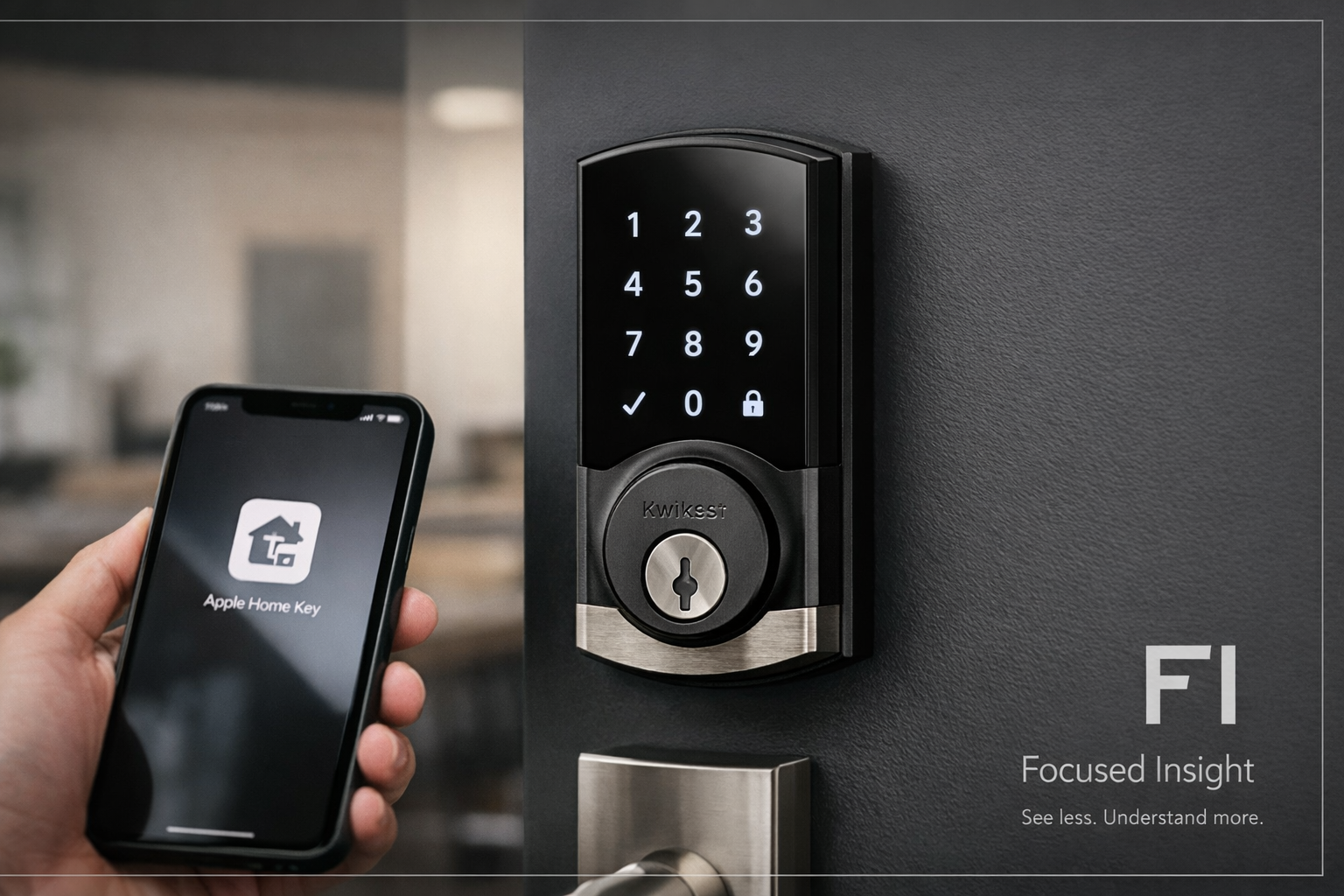
Apple Home Key transforms entry from a deliberate action into a natural gesture.
Instead of initiating a command sequence, the user performs a single tap.
This eliminates:
- application loading delay
- connection negotiation delay
- command transmission delay
The psychological result is important. The lock stops feeling like technology and starts feeling like a door.
When a smart lock reaches this level of behavioral invisibility, user satisfaction stabilizes long-term.
Door status sensing and mechanical reliability protection
The door status sensor is one of the most critical structural components of this lock.
Without door awareness, locks attempt actions blindly.
With door awareness, the lock confirms mechanical conditions before acting.
This prevents:
- bolt misalignment stress
- motor overcompensation
- repeated correction cycles
- long-term mechanical wear
This dramatically improves reliability perception over time.
Most negative smart lock experiences originate from mechanical misalignment—not software failure.
This sensor directly reduces that risk.
Intrusion detection and anomaly awareness stability
Intrusion detection serves as an early-warning behavioral system.
It does not physically stop intrusion.
It eliminates informational uncertainty.
The user knows whether abnormal interaction occurred.
This reduces persistent background anxiety and increases long-term trust in the system.
Trust is the actual product being delivered—not just hardware.
Use Case Fit Analysis: Where This Lock Performs Exceptionally Well
Highly optimal deployment environments
Halo Select Plus performs exceptionally well when:
- door alignment is mechanically correct
- home Wi-Fi connectivity is stable
- Apple ecosystem integration is actively used
- multiple users require structured access
- remote state verification is psychologically valuable
In these environments, the lock becomes operational infrastructure rather than an active device.
User attention toward the lock decreases over time, which is the ideal outcome.
Moderately optimal environments
Performance remains strong when:
- Wi-Fi coverage is adequate but not perfect
- automation features are used intermittently
- keypad and tap entry are both used
In these environments, reliability remains high, but behavioral invisibility may not be absolute.
Suboptimal environments
Performance may feel less optimal when:
- door alignment is mechanically inconsistent
- network reliability is poor
- ecosystem integration is not used
- automation features are disabled or avoided
In these conditions, the lock cannot fully deliver its structural advantage.
Competitive Positioning: Structural Tier Classification
Halo Select Plus occupies the upper structural tier of residential smart deadbolts due to its complete architectural stack:
- direct Wi-Fi control without bridge dependency
- Matter interoperability support
- Apple Home Key NFC access capability
- door status mechanical awareness
- intrusion anomaly detection layer
Its advantage is not based on novelty.
Its advantage is based on structural completeness and behavioral stability.
This reduces long-term ownership friction significantly compared to lower-tier locks.
Pricing Logic: Cost Relative to Stability Delivered
The price reflects system architecture, not just hardware materials.
You are paying for reduction in:
- access hesitation
- uncertainty cycles
- access coordination friction
- behavioral interruption frequency
You can review the technical specifications and official live prices on Amazon here.
When fully utilized, the system repays its cost through daily friction elimination.
When underutilized, its structural advantage remains dormant.
Value realization depends entirely on environment compatibility.
Final Verdict: Structural Decision Outcome
Kwikset Halo Select Plus is the correct decision if your objective is:
- long-term access stability
- minimal entry friction
- ecosystem independence
- reliable multi-user access control
- reduction of uncertainty and hesitation
It is not intended for minimal-use or purely mechanical-preference environments.
It is intended for environments where predictable access and behavioral continuity matter daily.
The lock succeeds when it disappears from your attention.
That disappearance is the true measure of its success.
Product Access and Availability
You can verify full technical specifications, compatibility details, and current availability here → 🔗 LINK: View Kwikset Halo Select Plus product page