YOUR SYSTEM ISN’T SMALL ANYMORE — THIS IS WHERE A BASIC AVR STARTS FAILING
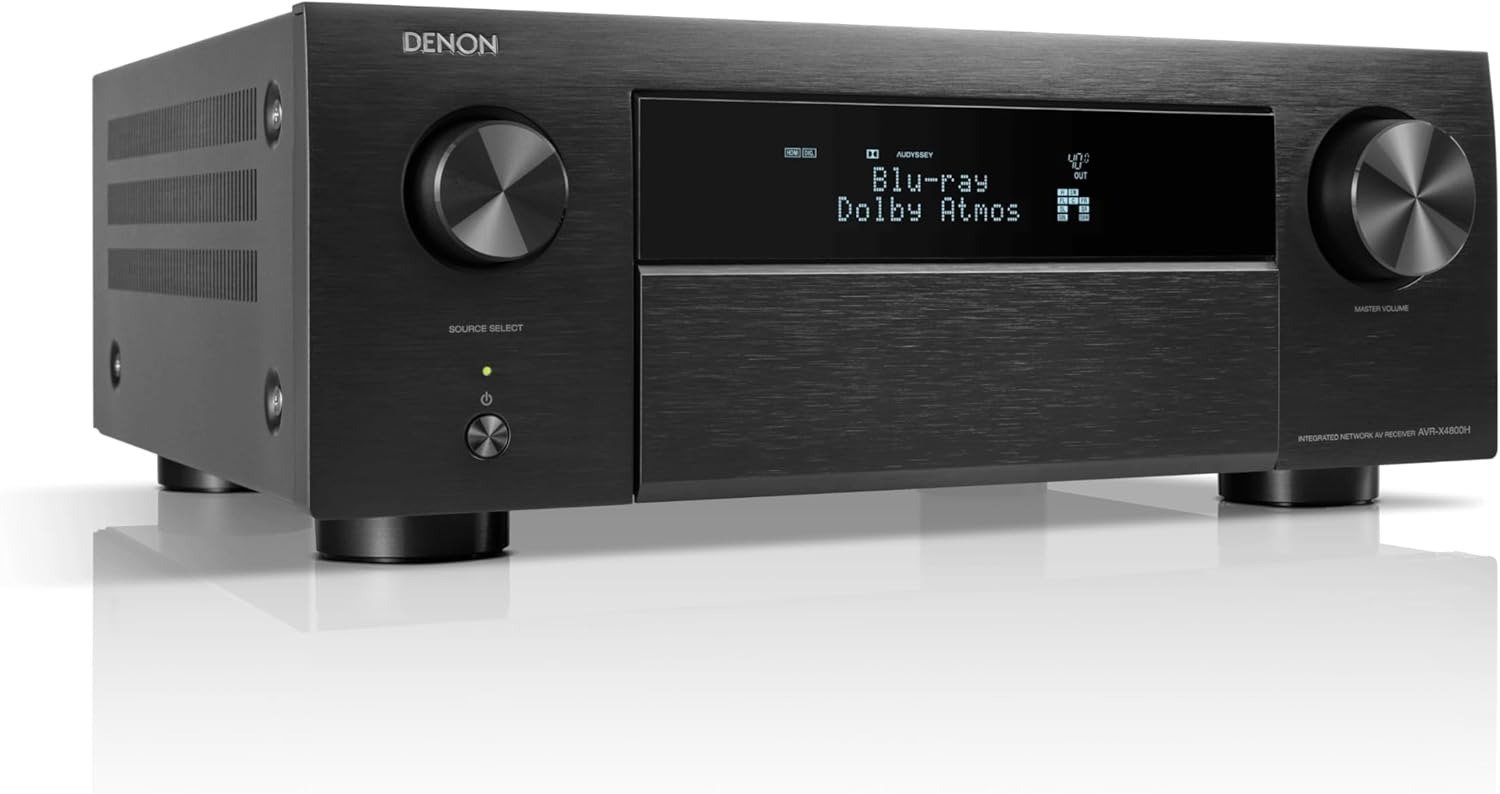
DENON AVR-X4800H
A lot of systems look fine on paper right up to the moment they stop feeling finished. The movie is loud enough. Dialogue is clear enough. Bass is present enough. Then you add height channels, a second subwoofer, a console that actually uses 4K/120, maybe a projector, maybe a second display, and suddenly the receiver in the middle starts behaving like a bottleneck instead of a control center. That is the point I kept coming back to while analyzing the Denon AVR-X4800H. It is not built for casual improvement. It is built for the threshold where “good enough” starts leaking from three places at once: channel layout, bass management, and room correction.
THE RESULT LOOKS FINE. THE PROBLEM ISN’T.
The failure here is subtle. A basic receiver can still make a system sound busy. It can still throw effects around the room. It can still make the front stage feel respectable. What it struggles to do, once the system grows, is keep everything organized under pressure. That is when sound stops breaking in obvious ways and starts breaking quietly: bass piles up in one seat and thins out in another, height channels feel decorative instead of structural, switching sources becomes messy, and the receiver starts looking less like the brain of the room and more like a compromise you postponed replacing.
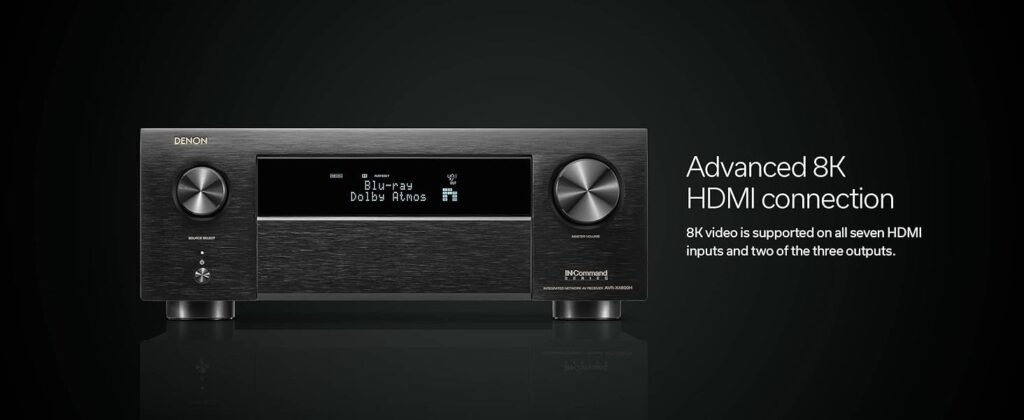
What makes the AVR-X4800H interesting is that Denon has positioned it exactly at that stress point. It gives you nine channels of onboard amplification, up to 11.4 channels of processing, four independent subwoofer outputs, seven HDMI inputs and three outputs, 8K/60 and 4K/120 support, Audyssey MultEQ XT32 built in, and optional Dirac Live upgrades for people whose room has become part of the problem. That is not a “specs for the brochure” set. It is a “your room and system are now too complex for shortcuts” set.
WHAT YOU’RE ACTUALLY FEELING BUT NOT NAMING
Most buyers do not name the real friction correctly. They say they want “more power.” Sometimes that is true. Often it is not. What they are really reacting to is one of these:
| What you notice | What it usually means |
|---|---|
| Surround feels large but not locked in | Processing and channel layout are ahead of the receiver beneath them |
| Bass sounds strong in one spot, weak in another | The room is shaping the result more than the speaker specs |
| Setup keeps getting more complicated with every added source | Connectivity and zone flexibility have crossed the simple-AVR threshold |
| Movies impress, but the system still feels unfinished | Calibration and control are lagging behind speaker ambition |
That pattern fits this Denon unusually well because it is designed to solve system friction, not just add wattage. Denon’s official specs and info sheet emphasize configuration flexibility, 11.4 processing, pre-amplifier mode, four independent sub outputs, and room-correction paths beyond the default setup. Reviewers also keep circling back to the same theme: this amp is easy to grow into, not just easy to unbox.
THE HIDDEN MECHANISM BEHIND THE MISS
The hidden variable is not volume. It is control density.
Once you move beyond a straightforward living-room setup, the receiver is no longer just powering speakers. It is managing timing, routing, decoding, bass distribution, HDMI behavior, room correction, format compatibility, source switching, and the small decisions that determine whether immersion feels cohesive or patched together. The AVR-X4800H is strong precisely because it does not force you to choose between modern connectivity and serious layout flexibility. It supports nine internal amps but can process 11.4 channels, which means a 5.1.4 or 7.1.2 system is realistic immediately, and more ambitious layouts become possible with external amplification.
That matters more than people expect. The usual mistake is buying on a headline feature — “Atmos,” “8K,” “125 watts” — and ignoring the point where the system becomes structurally harder to manage. Denon’s own documentation highlights 11.4 processing, pre-out flexibility, and optional Dirac. Home Cinema Choice specifically notes per-channel preamp assignment, individually set crossovers, and the ability to run layouts up to 7.4.4 with an added stereo amp. That is the difference between a receiver that merely supports a modern badge and one that still makes sense after the room gets serious.
THE THRESHOLD WHERE THE OUTCOME QUIETLY BREAKS
Here is the threshold I would use.
If your system is still a simple 5.1 or 5.1.2 setup in a modest room, with one display, one subwoofer, and no real intention to calibrate beyond the basics, this Denon is probably more receiver than you need.
If, however, you have moved into any two or three of the conditions below, the decision changes:
| Threshold signal | Why it matters here |
|---|---|
| You want 5.1.4, 7.1.2, or a route toward 11.4 processing | The X4800H has nine amps onboard and 11.4-channel processing capability |
| You use more than one high-bandwidth HDMI source | All seven rear HDMI inputs support 8K/60 and 4K/120, with gaming features like VRR and ALLM |
| You are fighting inconsistent bass | It offers four independent subwoofer outputs and more advanced bass management than entry-level units |
| Your room is now part of the sound | Audyssey XT32 is built in, and Dirac Live with Bass Control is available as an upgrade path |
| You want one chassis to handle theater, gaming, streaming, and vinyl | It includes HEOS, AirPlay 2, Bluetooth, Roon Tested support, phono input, and three HDMI outputs |
That is the quiet break point. Not “Do I want something nicer?” but “Has my system become too layered for a simpler AVR to keep organized?”
WHY MOST BUYERS MISREAD THIS TOO EARLY
They compare the wrong thing too early.
They compare wattage. Or logo prestige. Or whether the front panel looks premium enough for the rack. Or whether one model has a fashionable room-correction badge included out of the box. Those are not useless comparisons, but they are shallow ones. The deeper question is whether the receiver can absorb complexity without becoming the next upgrade target six months later.
This is also where the X4800H creates confusion. It is expensive enough that buyers start asking flagship questions, but it is not meant to be the all-out flagship. It is the upper-midpoint where system architecture becomes the real value. Reviewers praise its dynamic, muscular sound, its broad format support, its gaming readiness, and its setup assistant. The recurring criticisms are narrower: Dirac costs extra, there is no front HDMI input, the design is classic rather than flashy, and if you drive all nine channels hard in a larger room you can shave off a little headroom. Those are real trade-offs, but they are not structural flaws. They are the costs of choosing flexibility before extravagance.
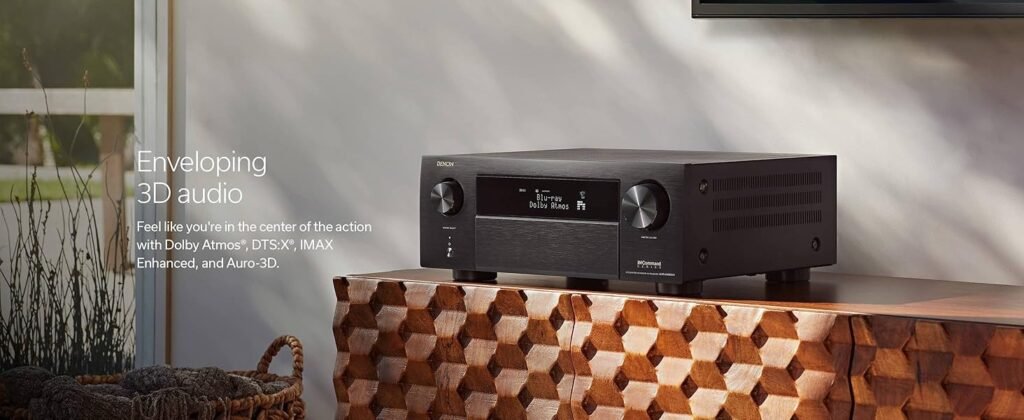
WHO IS ACTUALLY INSIDE THIS PROBLEM
This receiver makes the most sense for a very specific kind of buyer.
| Buyer condition | Fit |
|---|---|
| You are building a serious movie-first room and want real Atmos layouts | Strong |
| You care about calibration because the room is clearly affecting the result | Strong |
| You run multiple HDMI 2.1 sources and want fewer compromises | Strong |
| You expect to add channels or subwoofers later | Strong |
| You want simple stereo in a small room and do not plan to expand | Weak |
| You are chasing the cheapest route to “surround sound” | Wrong fit |
| You expect Dirac to be included at this price with no extra cost | Borderline |
| You want the receiver to disappear into a plug-and-forget lifestyle setup | Borderline |
That split lines up with both the feature set and the owner experience. Best Buy reviewers describe it as easy to set up, highly capable, and strong enough for 7.1.2 without external amplification, while one detailed owner note says the system took about two hours to install and about a month to fully dial in. That is exactly the right signal: this is not difficult in a chaotic way, but it does reward attention.
WHERE WRONG-FIT BEGINS
Wrong-fit begins when the room is too small, the speaker plan is too simple, or the buyer is still shopping emotionally instead of structurally.
This is not for someone who wants the cheapest path to movie night. It is not for someone who will run a basic 5.1 layout, never touch calibration again, and never use the extra routing, extra channels, or extra subwoofer control. It is also not for the buyer who thinks the existence of 11.4 processing means 11 powered channels are included. They are not. You get nine channels of amplification on board; bigger layouts need external help. Denon states the 11.4 processing capability clearly, and both Tom’s Guide and Home Cinema Choice frame expansion as something you unlock by adding a stereo amplifier when the room calls for it.
There is another wrong-fit that matters: the buyer who wants room correction solved by default, without paying again. Audyssey XT32 is built in and remains useful, but the stronger path for a demanding room is Dirac, and Dirac is a paid layer here. Denon says so. Dirac says so. Home Cinema Choice says it plainly as well. If that extra software spend already irritates you, that irritation will not disappear after purchase.
THE ONE SITUATION WHERE THIS PRODUCT BECOMES LOGICAL
The Denon AVR-X4800H becomes logical when your system has already crossed from “speaker collection” into “room-managed theater.”
That is the moment when four independent subwoofer outputs stop sounding like excess and start sounding like relief. When seven HDMI inputs and three outputs stop reading like abundance and start reading like fewer compromises. When nine onboard channels plus 11.4 processing stop feeling theoretical and start mapping directly to the layout you are trying to build. When built-in Audyssey is enough to get moving, but optional Dirac gives you a credible upgrade path without replacing the whole machine.
What pushed me toward this conclusion is that the praise is consistent across very different angles. Denon’s own materials emphasize flexibility and calibration. Tom’s Guide calls it close to future-proof and praises its dynamic, visceral character. Home Cinema Choice highlights installation flexibility, four-sub integration, and its ability to sound direct and powerful across several layouts. Owners keep repeating the same practical themes: strong movie performance, easy enough setup, and enough headroom and features to anchor a larger room without immediately needing separates.
WHAT IT SOLVES, WHAT IT REDUCES, AND WHAT IT STILL LEAVES TO YOU
Here is the cleanest way I can state the trade-off.
| What you gain | What you trade off |
|---|---|
| Real layout flexibility up to 11.4 processing | You may need an external amp to realize the biggest layouts |
| Four independent subwoofer outputs and stronger bass management | You still have to do the work of placement and calibration |
| Full modern HDMI support for serious gaming and theater use | There is no front HDMI input for quick temporary hookups |
| Built-in Audyssey with a paid path to Dirac | Dirac is not included in the box |
| Strong, muscular cinema performance with good music capability | It is a large, traditional AVR, not a slim lifestyle piece |
That is why I do not see this as a vanity upgrade. I see it as a structural one. It solves receiver fatigue. It reduces layout compromise. It lowers the chance that your next system improvement exposes the receiver as the weak link. What it does not do is eliminate the need for judgment. You still have to match speaker layout to room size, choose whether you really need Dirac, and be honest about whether your system has crossed the threshold this Denon is built for.
FINAL COMPRESSION
The shortest honest reading is this:
The Denon AVR-X4800H is not the receiver I would point at for a casual setup. It is the receiver I would point at when a casual setup has already turned into a serious room, and the old decision logic — watts, brand familiarity, or a single headline feature — is no longer enough. Its real value is not that it does everything. Its real value is that it keeps a growing system from becoming incoherent.
If your room has already crossed into multiple subs, immersive channels, HDMI 2.1 sources, and meaningful calibration needs, Denon AVR-X4800H stops looking like an upgrade and starts looking like the point where the decision finally becomes clean.
Transparency Note:
This analysis is not based on quick personal impressions.
It is derived from documented system behavior, verified user patterns, and the physical constraints of storage capacity.
The goal is to translate complex technical behavior into a realistic performance model that helps you make a clear decision.
“A quick note: Don’t believe the star ratings, but trust personal experience. This article is a compilation of collected experiences”