YOUR HOME CAN LOOK COVERED AND STILL MISS THE EXACT MOMENT THAT MATTERS
THE DANGEROUS PART IS NOT SEEING NOTHING. IT IS SEEING ALMOST ENOUGH.
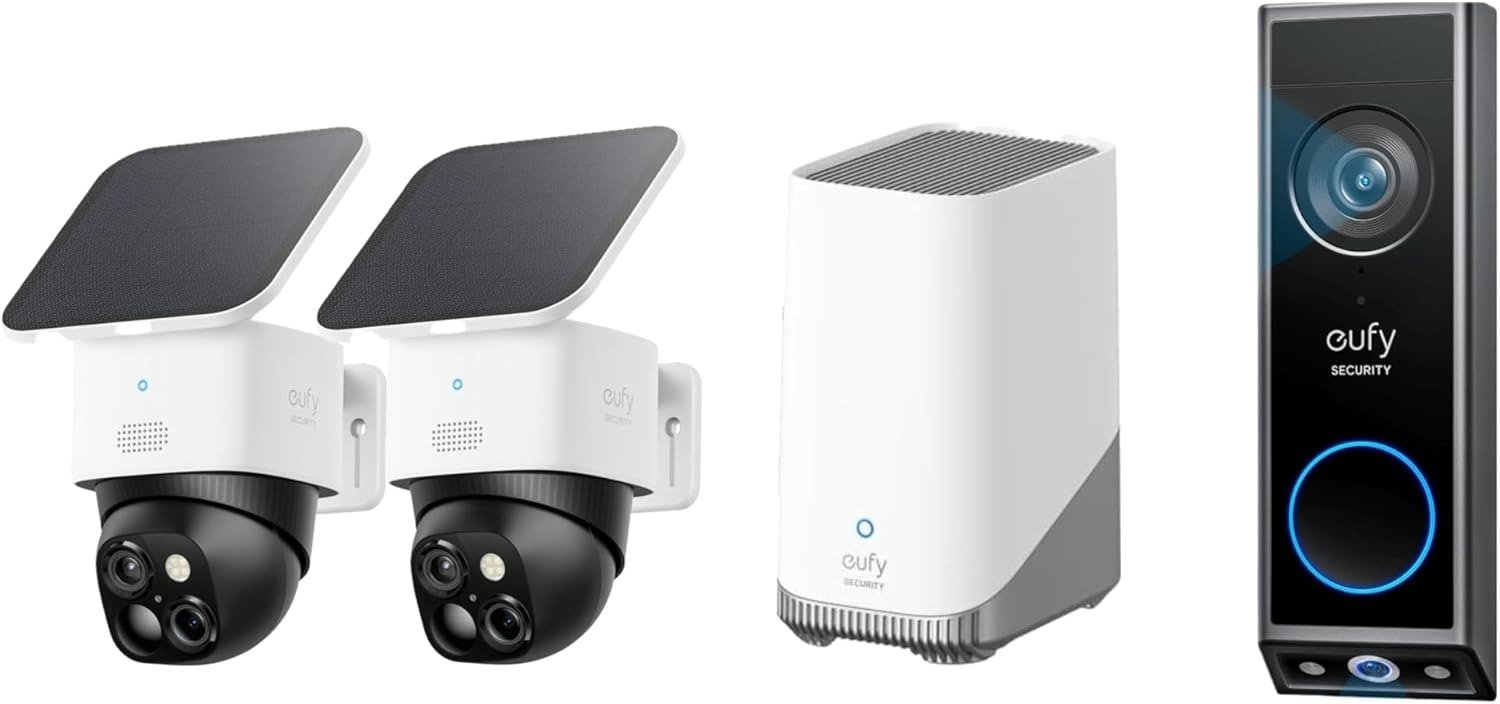
That is how people buy the wrong security setup. They see sharp footage, a clean app, a solar panel, a doorbell with two cameras, and a hub that promises local storage with no monthly bill. On paper, the eufy bundle built around the SoloCam S340, Video Doorbell E340, and HomeBase S380 looks like a quiet masterstroke: 3K outdoor coverage, dual-camera porch visibility, expandable local storage, package view, face recognition, and no forced subscription. The trap is that most buyers read those features as a blanket solution. They are not. They are a very specific answer to a very specific kind of home-security friction.
What pulled me into this bundle was not the marketing line. It was the shape of the problem it tries to solve. Not “I want cameras.” Not even “I want better image quality.” The real itch is uglier than that: you are tired of dead angles, tired of paying forever to keep clips, tired of realizing the camera sees the visitor but not the package, the driveway but not the side approach, the event but not the approach path. That is where this bundle becomes interesting. And that is also where most people start lying to themselves.
The Result Looks Fine. The Problem Isn’t.
A lot of bad security setups produce reassuring footage after the fact. Clean image. Nice thumbnail. Motion alert arrives. Clip saved. Everything looks competent until you ask the only question that matters: did it cover the weak point, or did it simply record a cleaner version of the wrong angle?
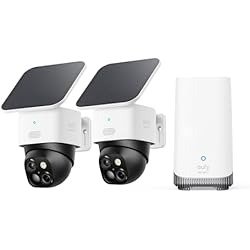
The SoloCam S340 attacks that problem with a dual-camera design, 3K wide-angle view, a 2K telephoto lens, hybrid 8× zoom, a 135° field of view, and pan/tilt coverage that reaches roughly 360° horizontally and 70° vertically. The doorbell attacks a different weak point: one camera watches the visitor, the second watches the floor area where packages live and disappear. The HomeBase S380 ties the system together with 16 GB built in, expansion up to 16 TB, and compatibility across both the SoloCam S340 and the battery Video Doorbell E340.
That sounds complete. It isn’t complete. It is selectively complete. And that distinction is everything.
What You’re Actually Feeling but Not Naming
What many people call “better security” is usually one of three different hungers:
I want to see more angles without wiring half the house.
I want to stop renting my own footage through subscription fees.
I want fewer stupid misses at the door, the driveway, or the package drop zone.
This bundle is strongest when those three pressures sit in the same house at the same time. It is weaker when your real anxiety is something else—continuous 24/7 recording, flawless AI judgment, instant live loading from weak Wi-Fi zones, or total indifference to a brand’s past privacy controversy.
That is the friction most buyers never name. They think they are buying “a premium system.” In reality, they are choosing between coverage logic and certainty logic. This bundle is built far more around coverage logic.
The Hidden Mechanism Behind the Miss
The hidden variable here is not resolution. It is coverage architecture.
The SoloCam S340 is valuable because it reduces the number of places you need separate fixed cameras to watch. The doorbell E340 is valuable because it fixes one of the oldest porch-camera failures: the camera that catches a face but misses the parcel sitting low and close to the wall. The HomeBase matters because it removes recurring storage fees and centralizes recordings across compatible devices. Put differently, this bundle is not selling raw image quality first. It is selling fewer blind spots, lower maintenance friction, and a cleaner ownership model.
| Component | What it actually changes |
|---|---|
| SoloCam S340 | Replaces a fixed-angle outdoor camera with a 3K/2K dual-lens, 8× zoom, pan/tilt camera meant to follow broader perimeter coverage without wiring. |
| Video Doorbell E340 | Fixes the “I saw the person, not the package” problem with two cameras, 2K main view, color night vision, and battery or wired operation. |
| HomeBase S380 | Turns “local storage” from a slogan into an actual system with 16 GB built in, storage expansion, and cross-device management. |
This is why the bundle keeps showing up as attractive to buyers who are tired of monthly fees. Even broader buyer guides still point to Eufy’s local-storage model as a meaningful differentiator in a category where many rivals keep their best functions behind subscriptions.
The Threshold Where the Outcome Quietly Breaks
Here is the threshold I would name for this bundle:
The Coverage-without-Commitment Threshold.
Below this threshold, the bundle feels clever. Above it, the weaknesses start to show.
It works when you need wide outdoor visibility, package-aware porch coverage, and local storage without paying every month. It starts to wobble when you expect battery-powered hardware to behave like a hardwired, always-recording, zero-latency professional system. The SoloCam S340 is 2.4 GHz only. The doorbell can be battery or wired, but even positive long-term reviews note that live view can feel slower when the router is far away. Some users also report frustration with missed detections or needing resets over time, and broader reviewer coverage notes that face recognition is useful but not perfectly reliable.
That is the quiet break point. Not picture quality. Not setup. Expectation.
Why Most Buyers Misread This Too Early
Because they compare feature lists the way people compare hotel photos.
Big room. Nice lighting. Clean bed. Then they arrive and discover the walls are thin, the lift is slow, and the “city view” is a slice of sky between two concrete blocks.
That is what happens when buyers evaluate this bundle by asking lazy questions:
How many cameras do I get?
What is the top resolution?
Does it have AI?
Is there a subscription?
Those are not useless questions. They are just early questions. The later questions are the ones that decide regret:
Will event-based coverage be enough for the incidents I actually worry about?
Is my Wi-Fi strong where the doorbell and outdoor camera will live?
Am I buying this for broad visibility, or because I secretly want forensic certainty?
Am I comfortable trusting a brand that had a public privacy failure and later had to improve encryption, disclosure, and testing?
That last point matters. Eufy’s local-first model is still a real advantage, and current materials emphasize encryption, local storage, privacy zones, and updated protections. But the brand’s 2022 security controversy and the 2025 New York settlement are not footnotes you wave away with a slogan. They are part of the buying context. A serious buyer should treat them as a reminder to value firmware updates, privacy settings, and realistic trust—not blind trust.
Who Is Actually Inside This Problem
You are inside this problem if your house has one or more of these traits:
A driveway, side path, porch, or yard line that makes fixed-angle coverage feel clumsy.
A front door where packages matter almost as much as faces.
A strong dislike for cloud subscriptions and recurring ownership creep.
A preference for simpler install paths: battery, solar assist, less wiring, less mess.
A need to unify outdoor camera and doorbell footage under one local system.
This is also where public and reviewer sentiment lines up in a useful way. The praise is remarkably consistent around three things: image clarity, easy installation, and the practical relief of local storage with no mandatory fee. The criticism is also consistent: Wi-Fi sensitivity, occasional lag or notification inconsistency, imperfect AI recognition, and the fact that event-based battery gear is still event-based battery gear.
Where Wrong-Fit Begins
Wrong-fit begins when you want this bundle to be something it is not.
It is not the right answer for someone who wants dense, hardwired, always-on perimeter surveillance with maximum pre-roll certainty. It is not ideal for homes with weak network coverage at the install points. It is not the cleanest fit for buyers who want the least possible dependence on app behavior or AI classification. And it is not a good emotional fit for someone who cannot tolerate a brand with a public privacy stain in its history, even if the current architecture still offers meaningful local-control advantages.
If your real fear is “I need full-time evidentiary coverage,” this bundle will feel polished right up until it does not. That is where buyer’s remorse starts: not in bad hardware, but in the wrong performance philosophy.
The One Situation Where This Product Becomes Logical
This bundle becomes logical when your real problem is this:
You need broad home-entry coverage without wiring chaos, without blind spots around the door and approach path, and without signing up to permanent monthly storage fees.
In that one situation, the architecture makes sense. The SoloCam S340 covers the flexible outdoor angle problem. The Video Doorbell E340 covers the face-plus-package problem. The HomeBase S380 turns the system into a local-storage ecosystem instead of a stack of isolated gadgets. That is the moment the purchase stops looking like gadget accumulation and starts looking like a coherent perimeter choice.
And this is the part many cheap comparisons miss: the value is not just in what the system records. It is in what it lets you stop doing. Fewer charging worries outdoors because of solar assist. Fewer angle compromises. Fewer subscription calculations every time you add another camera. Fewer porch guesses. That is the real pitch. Quiet. Structural. Hard to see in a spec box.
What It Solves, What It Reduces, and What It Still Leaves to You
| Category | What this bundle does well | What it still leaves to you |
|---|---|---|
| Coverage | Reduces blind spots with pan/tilt outdoor viewing and dual-camera doorstep coverage. | You still have to place cameras intelligently; bad placement can waste all that flexibility. |
| Ownership cost | Removes mandatory subscription fees and enables local storage expansion. | You still pay the higher upfront hardware cost. |
| Convenience | Easier install than many wired alternatives; solar support lowers outdoor maintenance. | You still need good Wi-Fi and sane notification tuning. |
| Detection quality | Human/package-focused alerts and activity zones can meaningfully cut noise. | AI recognition is useful, not magical; misses and false expectations still happen. |
| Privacy posture | Local-first storage is materially better than being forced into cloud dependence. | You still have to reckon with Eufy’s past privacy failures and keep your trust conditional, not naive. |
That is why I would frame this bundle carefully. It does not erase responsibility. It reduces a certain kind of friction. It does not remove judgment. It rewards accurate judgment.
Final Compression
Most people do not buy the wrong camera because they chose a bad brand. They buy the wrong camera because they diagnosed the wrong weakness.
If your weak point is coverage without clutter, package visibility at the door, and local storage without recurring fees, this eufy bundle is unusually coherent. If your weak point is hardwired certainty, constant recording logic, or zero tolerance for a brand with privacy baggage, the shine fades fast.
That is the whole decision.
Not “Is it good?”
Too vague.
Not “Is it worth it?”
Still vague.
The real question is simpler, colder, and far more useful: Is this the exact shape of my problem?
If that shape matches your home, this is where the decision stops being vague.
Transparency Note:
This analysis is not based on quick personal impressions.
It is derived from documented system behavior, verified user patterns, and the physical constraints of storage capacity.
The goal is to translate complex technical behavior into a realistic performance model that helps you make a clear decision.
“A quick note: Don’t believe the star ratings, but trust personal experience. This article is a compilation of collected experiences”