Samsung HW-Q990F Review: The Moment “Good Enough” TV Sound Stops Being Good Enough
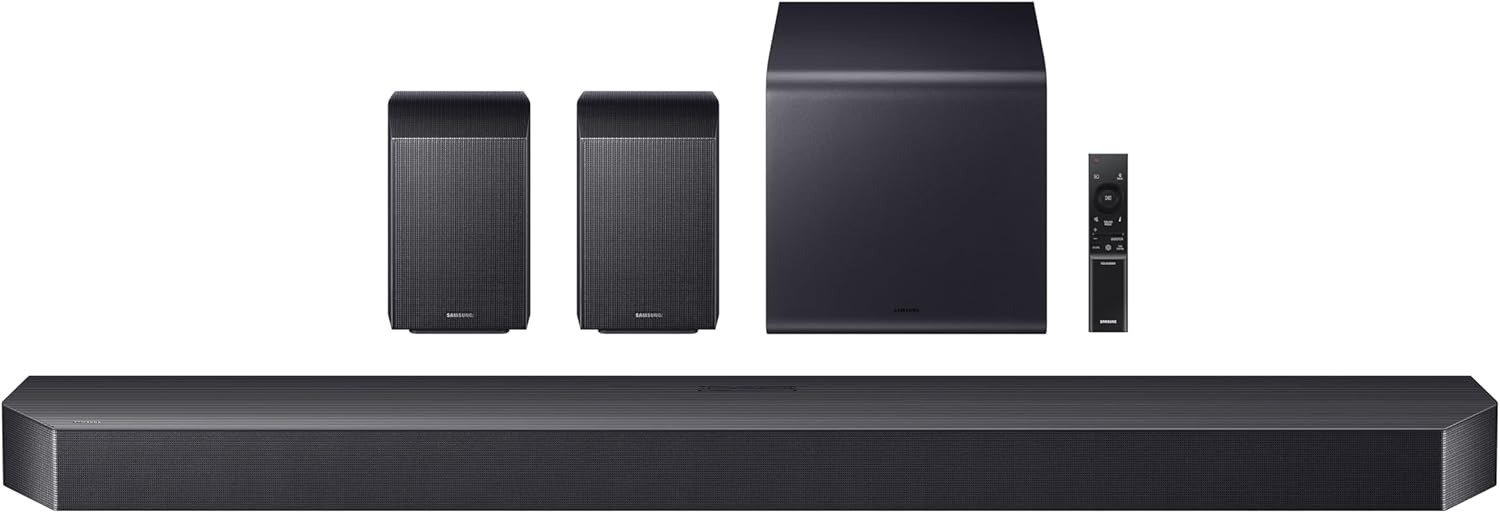
SAMSUNG HW-Q990F
You usually notice the failure late.
Not when the movie starts. Not when the first line of dialogue lands. Not when the soundtrack swells and gives you that brief, flattering illusion that your setup is doing fine.
It happens a little later, in the exact kind of scene that exposes weak audio without announcing it. A voice drops under pressure. A bass hit arrives with size but no shape. Something meant to move across the room just smears into the wall like wet paint. The result still sounds “big.” It just does not sound placed, controlled, or believable.
That is the threshold this system is built for.
After digging through Samsung’s official specs, RTINGS’ lab work, What Hi-Fi?’s listening notes, AVForums’ testing, and owner feedback across retail and enthusiast spaces, the Samsung HW-Q990F keeps showing the same pattern: it is not merely trying to be louder than a TV or more dramatic than a midrange soundbar. It is trying to hold structure when scenes get dense, when rooms get larger, and when Atmos stops being a badge and starts becoming a placement problem.
The Result Looks Fine. The Problem Isn’t.
This is the trap.
A lot of people think they have a detail problem. They do not. They have a collapse problem.
The system in front of them can sound clear in easy moments and still fail in hard ones. News. YouTube. casual streaming. even some movies at polite volume. Fine. But once the mix becomes crowded—dialogue, score, impact, motion, reverb, height cues all arriving at once—the illusion thins out. You are no longer hearing a scene. You are hearing a compressed summary of one.
That is why cheaper bars can feel impressive for ten minutes and disappointing for six months. They give you front-loaded gratification, then slowly start stealing precision from the moments you bought them for in the first place.
The HW-Q990F exists on the other side of that line. Samsung positions it as an 11.1.4-channel package with a soundbar, rear speakers, and subwoofer. RTINGS found it unusually well-rounded for mixed use, with broad format support, room correction, a seven-band EQ, adjustable channel levels, and HDMI 2.1 passthrough. This is not just feature padding. It is the infrastructure required to keep a scene from flattening when more is happening at once.
What You’re Actually Feeling but Not Naming
Most buyers do not say, “My current system fails under spatial load.”
They say something softer. More human.
“The voices disappear when everything gets loud.”
“It sounds big, but not real.”
“Bass is there, but it feels detached.”
“Atmos is on, but I’m not convinced anything is above me.”
“It gets intense, then messy.”
That last word matters.
Messy.
Because what people often describe as weak clarity is really weak separation. What they call weak Atmos is often weak localization. What they call disappointing bass is often bass without contour—pressure without discipline, force without shape, movement without stop-and-start texture.
The Q990F’s appeal, based on testing and user response, is not just that it throws sound around the room. It is that it keeps dialogue intelligible, gives effects a more stable path through space, and reins in the bass enough to feel more integrated instead of simply swollen. RTINGS repeatedly highlights its balanced tuning, clear center-channel performance, and broad adjustability, while What Hi-Fi? and AVForums both lean into the same core impression: crisp, dynamic sound with a more convincing low end than many one-box rivals manage.
The Hidden Mechanism Behind the Miss
Here is the part that specs pages rarely explain well.
Sound quality does not break first at the level of volume. It breaks at the level of organization.
Once a soundtrack grows crowded, a weak system starts trading away order. Dialogue shares space less cleanly. low frequencies bloom outward. directional cues lose edge definition. the room fills, yes—but with fog, not architecture.
The HW-Q990F’s design choices point directly at that problem. Samsung markets it as a true 11.1.4 system with rear speakers and up-firing channels, plus Wireless Dolby Atmos, Q-Symphony support, and SpaceFit Sound Pro room tuning. RTINGS notes that the bar supports a wide list of formats, including Dolby Atmos, DTS:X, and DTS-HD MA, and that it offers unusually deep sound shaping for a soundbar system through EQ and level adjustments.
The more important mechanical change, though, is the subwoofer.
That is where this generation stops being a cosmetic refresh and starts telling the truth about what Samsung thought needed fixing. RTINGS identifies the Q990F’s biggest update as a redesigned sealed subwoofer with dual drivers, replacing the earlier ported approach. What Hi-Fi? calls the bass richer, more controlled, and more tonally varied. Sound Advice goes even further and says the bass feels less directional—as if it exists in the room more naturally instead of announcing the box that produced it.
That matters because bass is often where “premium” systems quietly embarrass themselves. A subwoofer can impress in a showroom and still betray you at home by drawing attention to its own location, ringing too long, or turning impact into a blur. The Q990F’s redesign appears aimed at exactly that failure point. And the reviews, across very different outlets, largely agree that Samsung improved it.
The Threshold Where the Outcome Quietly Breaks
This article lives on one model only: Threshold.
Not everyone needs a flagship soundbar package. Many people buy one too early. That is the truth.
The real question is not “Is the Q990F good?” The real question is: When does a simpler setup stop holding the job you are actually asking it to do?
That break usually starts when three conditions stack:
| Threshold Signal | What It Feels Like in Real Life | Why Simpler Audio Starts to Slip |
|---|---|---|
| Room scale rises | The sound reaches you, but the scene doesn’t surround you | TV speakers and simpler bars struggle to project a stable multi-direction field |
| Mix density rises | Dialogue, score, and impact begin stepping on each other | Limited channel separation and weaker center control flatten the scene |
| Expectation rises from “louder” to “cinematic” | You stop wanting volume and start wanting placement | Virtual surround tricks stop feeling convincing once you listen for location |
The Q990F is logical when you are already inside that three-part threshold.
If you watch blockbuster films, Atmos mixes, console games, and dense streaming content in a medium-to-large room, the shift is not subtle. RTINGS ranks it as Samsung’s best-tested soundbar as of January 2026 and emphasizes both its immersion and its versatility. What Hi-Fi? calls it the best Dolby Atmos soundbar system they have tested in its class. AVForums describes it as delivering a true Atmos experience and especially strong movie performance.
If you mostly watch sitcoms at low volume in a small room and care more about tidiness than immersion, you are probably not there yet.
That distinction saves money.
Why Most Buyers Misread This Too Early
Because they compare the wrong things.
They compare loudness before control. Specs before behavior. “Atmos support” before Atmos credibility.
A soundbar can tick every fashionable box and still miss the reason people upgrade in the first place. This is especially true when buyers read 11.1.4 as a guarantee instead of an architecture. Channel count tells you there are drivers and paths. It does not tell you whether the presentation stays coherent when the room fills with competing information.
That is why the Q990F’s strongest case is not raw spec bragging. It is repeatable structural behavior across reviews:
- balanced default tuning rather than forced fireworks
- clear dialogue from a discrete center channel and optional voice assistance modes
- broad audio-format support for movies, music, and gaming rather than narrow specialization
- room correction and manual tuning tools that let the system adapt instead of simply dominate the room
The hidden buyer mistake is assuming a flagship soundbar should win by being dramatic all the time. In reality, the better system usually wins by losing less shape when things get difficult.
That is a quieter kind of superiority. But it is the one that lasts.
Who Is Actually Inside This Problem
You are inside this problem if you recognize yourself in this pattern:
You have already crossed from passive watching into active noticing. You hear when a room goes flat. You notice when bass smears. You notice when a supposedly immersive mix keeps clinging to the wall under the TV. And once you notice that, you cannot un-hear it.
More specifically, the Q990F fits people who want three things at once:
- cinematic surround without a traditional AVR-and-speakers build
- strong performance across films, games, and music rather than one narrow use case
- premium tuning flexibility without turning the living room into a cable project
That is why the package matters. This is not a lone soundbar trying to perform theater by suggestion. It ships as a full system with rears and subwoofer, and reviewers consistently describe it as unusually complete out of the box for people who want immersion without the friction of a component-based setup.
Owner feedback tracks the same pattern. Best Buy’s review summary points to sound quality, easy setup, and seamless connectivity as recurring positives. Reddit impressions from early owners repeatedly mention stronger dialogue clarity, a more obvious sense of space, and cleaner bass than older or cheaper bars, even when personal bass preference varies against the older Q990D.
Where Wrong-Fit Begins
This is where people waste money.
The Q990F is wrong-fit for you if your real priority is one of these:
| Wrong-Fit Pattern | Why the Q990F Starts Making Less Sense |
|---|---|
| You mainly want a simple TV-audio upgrade | This system is overbuilt for casual speech-heavy viewing |
| Your room is very small and placement is compromised | Rear speakers and spatial cues lose some of the reason you’re paying for them |
| You chase sheer bass violence above all else | Reviews suggest the older Q990D can feel more aggressive, while the Q990F is cleaner and more controlled rather than recklessly louder |
| You expect a soundbar to replace a serious separates system at any cost | Even excellent flagship bars are still optimizing convenience, integration, and footprint—not rewriting physics |
That third point is worth pausing on.
The Q990F’s subwoofer redesign seems to have reduced rattling and made bass more disciplined, but RTINGS also notes slightly more bass compression at maximum volume than the previous generation. In plain English: if your ideal result is brute-force rumble first and control second, you may actually prefer the older flavor. But if you care about bass behaving like part of the scene rather than a detached event, the newer tuning is easier to defend.
That is the kind of boundary honest buying needs.
The One Situation Where This Product Becomes Logical
It becomes logical when your problem is no longer “my TV sounds weak.”
It becomes logical when your problem is this:
I want theater-like scale, stable dialogue, credible Atmos placement, and real bass weight without stepping into a full separate-speaker ecosystem.
That is the exact lane the HW-Q990F keeps winning in.
Samsung’s own positioning is blunt: flagship 11.1.4 surround, Wireless Dolby Atmos, Q-Symphony, and room-adaptive tuning. RTINGS frames it as a premium soundbar that can handle nearly anything you throw at it. What Hi-Fi? says it is clearer, more dynamic, and substantially stronger in bass than before. AVForums calls it another flagship leader for music and films, especially for people who want a true Atmos experience without the usual setup burden.
That combination is rare because most products force a compromise: easy but thin, powerful but clumsy, immersive but inconsistent, premium but fiddly.
The Q990F’s case is that it misses fewer of those marks than most.
And that is exactly why it feels expensive until you define the job correctly.
What It Solves, What It Reduces, and What It Still Leaves to You
Here is the clean version.
| It Solves | It Reduces | It Still Leaves to You |
|---|---|---|
| Weak TV dialogue under dense mixes | The feeling that Atmos is mostly marketing | Proper placement, room realities, and setup discipline |
| Flat front-heavy presentation | Bass that calls attention to the subwoofer itself | The decision of whether your room truly justifies a flagship package |
| Fragmented cinematic scale in games and movies | Upgrade anxiety caused by half-measures | Price tolerance versus discounted prior-gen alternatives |
And there is one more piece of honesty that belongs here: this is still a soundbar system. A very good one. Arguably one of the best-contained Atmos packages available right now according to major review outlets. But still a soundbar system. If you demand the last word in scale, separation, and upgrade flexibility, a dedicated AVR-and-speakers path remains a different class of solution. RTINGS says as much indirectly when comparing the Q990F to much larger, more extreme systems like the Nakamichi Dragon.
That does not weaken the Q990F’s case. It sharpens it.
Because now the product has a boundary. And products with boundaries are easier to trust.
Final Compression
Here is the shortest honest version I can give you.
If your current setup only sounds convincing in easy scenes, you are already approaching the break.
If you have started noticing smeared bass, buried dialogue, and Atmos that feels more labeled than located, you are very likely already inside it.
And if what you want is not a hobbyist speaker project, but a single premium system that gives you real surround structure, serious format support, cleaner bass behavior, and less day-to-day friction, the Samsung HW-Q990F becomes the logical next step.
Not because it is magic.
Because it is built for the moment “good enough” stops holding.
Transparency Note:
This analysis is not based on quick personal impressions.
It is derived from documented system behavior, verified user patterns, and the physical constraints of storage capacity.
The goal is to translate complex technical behavior into a realistic performance model that helps you make a clear decision.
“A quick note: Don’t believe the star ratings, but trust personal experience. This article is a compilation of collected experiences”