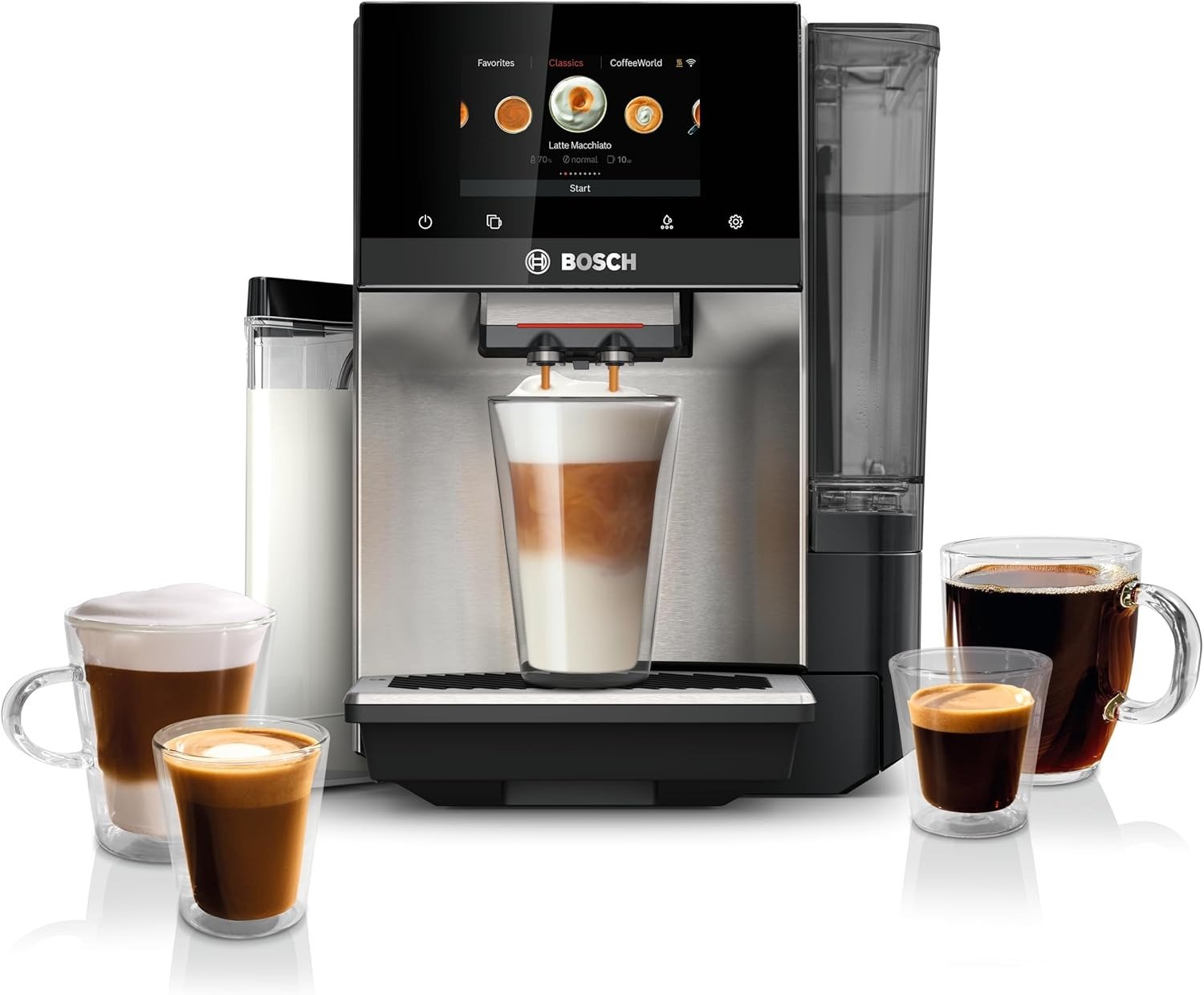
THE BOSCH 800 SERIES VEROCAFE LOOKS LIKE THE ANSWER. THE CUP IS WHERE THE REAL DECISION STARTS.
The Result Looks Fine. The Problem Isn’t.
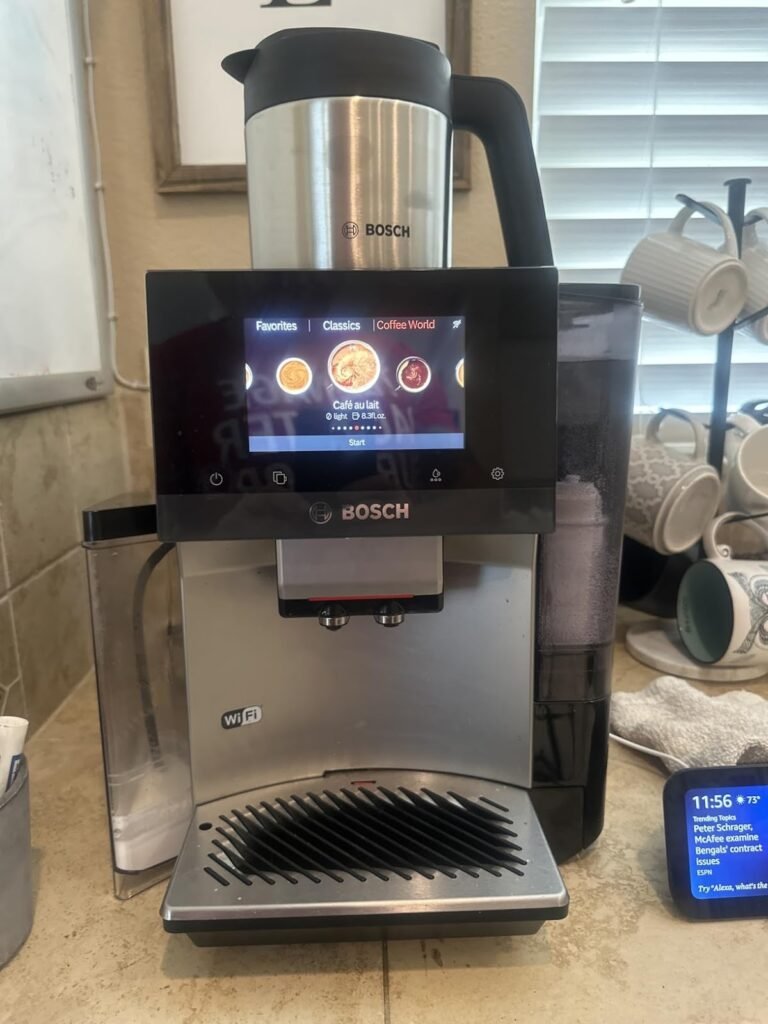
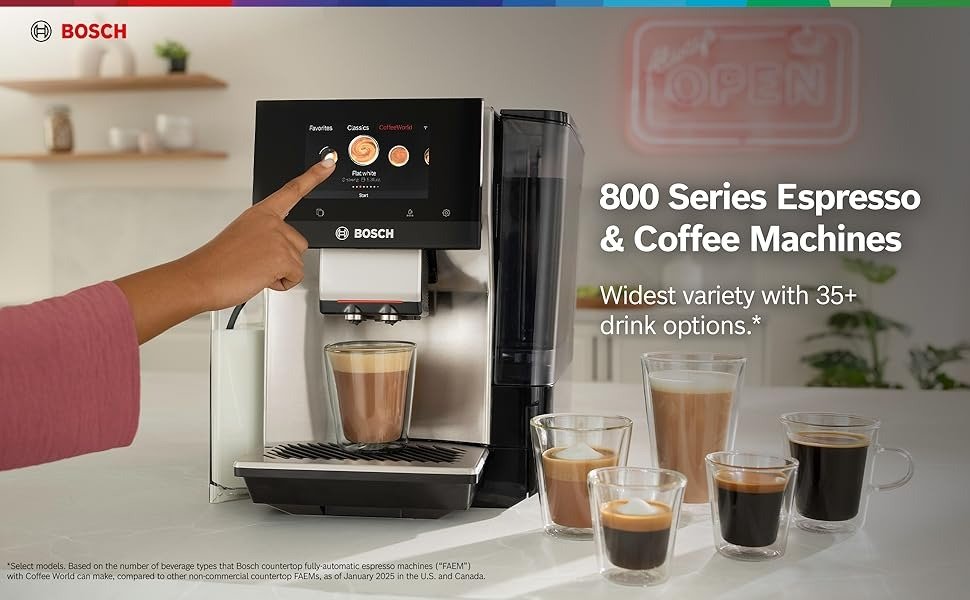
A machine like this does not lose you in the first minute. It wins there. The screen glows. The drinks list stretches out like a café menu with no queue, no grinder mess, no milk pitcher sweating on the counter. Bosch gives you 36 drink options, an integrated milk container, app connectivity through Home Connect, and a feature set built to make the machine feel less like an appliance and more like a polished system. On paper, it is the kind of espresso machine that seems to erase friction before you even ask.
That is exactly why this product is easy to misread.
The first mistake most buyers make is assuming the visible smoothness of the workflow guarantees depth in the cup. It does not. In independent testing, the Bosch 800 Series was praised for being genuinely intuitive, highly automated, and easy to maintain, but it was also criticized for coffee that could lean weak or watery and milk performance that was not always consistent across drinks. Owner feedback on Amazon shows the split clearly: many buyers love the convenience and easy cleaning, while a visible minority describe drinks that felt disappointingly thin or machines that failed early. The surface is polished. The threshold hides underneath it.
What You’re Actually Feeling but Not Naming
What bothers people here is not just “taste.” That word is too soft.
It is the moment when a machine does almost everything for you, yet the result lands with less weight than the ritual you were trying to escape. You wanted speed, consistency, relief. Instead, you may get a cup that looks composed, feels warm, foams correctly enough, and still leaves the strange aftertaste of compromise. Not on the tongue. In the decision.
That feeling has a shape:
| What you notice | What it really means |
|---|---|
| The interface feels smarter than the cup | usability is outrunning extraction quality |
| Milk drinks look café-like but don’t always feel rich | texture is present, but drink balance may not be |
| You keep adjusting settings more than expected | automation did not eliminate calibration, it merely moved it |
| The machine feels impressive in the kitchen | emotional reassurance is arriving earlier than sensory proof |
The Bosch is extremely good at reducing intimidation. Reviewed found there is almost no learning curve, with the machine grinding, frothing, rinsing, and guiding the user through upkeep. That is not trivial. For many people, that is the product. But the same testing also found that stronger espresso expectations were not consistently met, and that some milk drinks performed better than others. This is not a flaw in appearance. It is a mismatch in what kind of problem the machine actually solves.
The Hidden Mechanism Behind the Miss
The hidden variable is not whether the Bosch can make many drinks.
It can.
The hidden variable is how much you care about cup authority versus workflow authority.
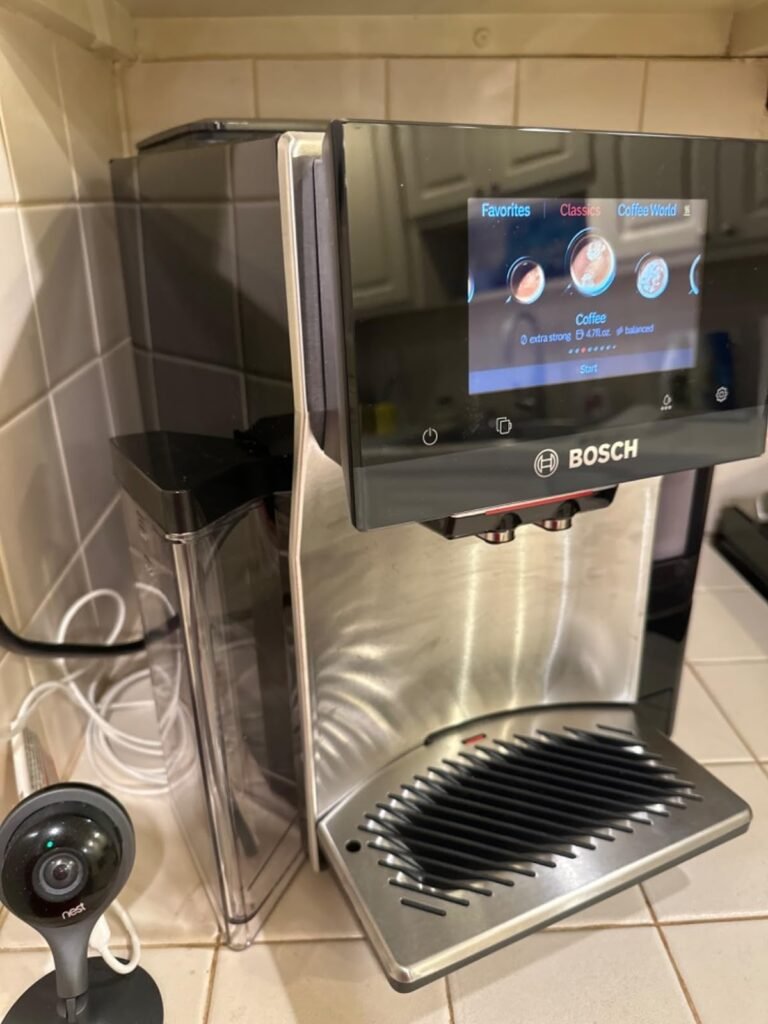
Bosch built this machine around controlled convenience: a built-in ceramic grinder with six settings, an 81-ounce water tank, one-touch milk handling, a large touchscreen, and guided cleaning logic. Coffeeness also notes Bosch’s AromaMax system, which manages dose, water volume, flow rate, and brew temperature automatically. That architecture is designed to make good coffee accessible without the usual manual friction. It is not designed to satisfy the person who wants to feel every lever of extraction in their hand.
And that difference matters more than spec sheets make it seem.
A superautomatic can win on three fronts at once: speed, repeatability, and cleanliness. But it often gives ground on a fourth front: the kind of concentrated, forceful espresso texture that makes a shot feel carved rather than dispensed. Reviewed’s testing called out weak-tasting coffee and inconsistent milk froth in some settings. Top Ten Reviews reached a similar conclusion from a different angle: the feature set is broad and the interface is excellent, but dialing in favorite drinks can involve real trial and error, and some default settings lacked flavor. When different reviewers, working independently, collide at the same point, that point deserves respect.
The Threshold Where the Outcome Quietly Breaks
Here is the threshold.
The Bosch 800 Series VeroCafe makes the most sense only while convenience is still more important to you than espresso force.
Once you cross that line, the machine starts to feel expensive in a different way. Not because it lacks features. Because it gives you abundant options while risking a cup that does not hit with enough authority to justify the spend.
I would frame the threshold like this:
| Threshold test | Still inside Bosch fit | Starting to break away from Bosch fit |
|---|---|---|
| Your morning priority | speed and no-fuss variety | shot depth and manual control |
| Your milk expectation | easy drinks with little effort | precise foam texture by drink type |
| Your patience for maintenance | wants guided cleaning and alerts | willing to trade convenience for more control |
| Your reaction to a merely “good” espresso | acceptable | irritating |
| Your ideal user identity | household convenience seeker | hobbyist home barista |
This is why the Bosch can delight one buyer and leave another cold. The machine itself did not change. The threshold did.
Why Most Buyers Misread This Too Early
Because they shop the category the wrong way.
They see “36 drinks,” “smart features,” “integrated milk container,” “double cup,” “cup warmer,” “self-cleaning,” and their brain quietly translates all of it into a single comforting sentence: this must be premium. Bosch certainly built the 800 Series to communicate that premium layer, and owner reviews repeatedly praise the display, the speed, the range, and the ease of maintenance.
But premium is not one thing.
There is premium in interaction. Premium in convenience. Premium in sensory output. Premium in service life. Premium in materials. Coffeeness points out that the machine is relatively compact and light because much of the body is plastic. Reviewed questions whether the cup quality fully cashes the check written by the price. Amazon review distribution is positive overall, but not spotless: 4.1 out of 5 across 116 ratings, with a meaningful 14% at one star on the U.S. listing snapshot we found. That combination does not spell disaster. It spells a product that needs correct buyer matching.
Could you assume that any weakness disappears once you tweak settings? You could. Some owners do love the results after living with the machine. But that assumption is exactly where lazy comparison begins. If a product at this level still needs you to fight your way toward your preferred cup, the relevant question is no longer “Can it eventually make something I like?” The sharper question is “Was effortless quality the thing I was paying for?”
Who Is Actually Inside This Problem
You are inside this problem if the coffee shop habit you want to replace is less about craft and more about interruption.
Not romance. Interruption.
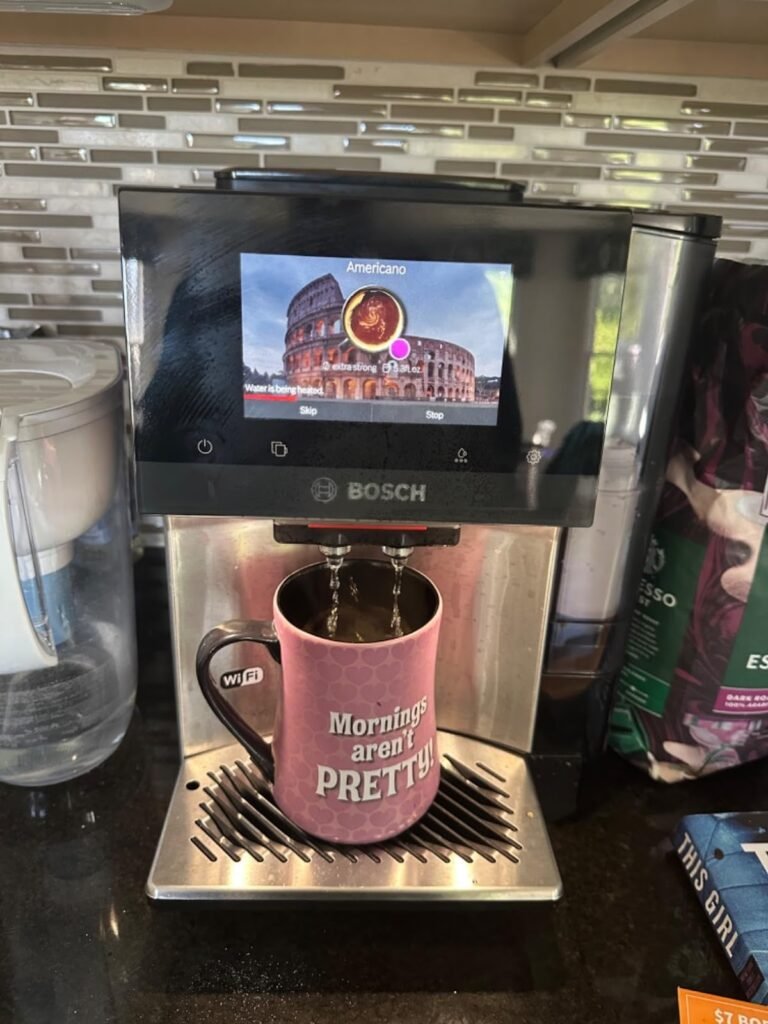
You do not want to learn tamp pressure before work. You do not want the counter to look like a bean landslide. You do not want milk management to become a side hobby. You want one machine to carry the burden. Grind, brew, foam, rinse, remind, repeat. Bosch is built for exactly that user, and the strongest external testing agrees: the interface is one of its best assets, the workflow is unusually beginner-friendly, and the machine is capable of back-to-back drinks with very little friction.
You are also inside the fit if more than one person uses the machine. This is where the Bosch starts to look less like a vanity appliance and more like a household system. A large water tank, many drink presets, quick swiping through a full-color display, app access, and simple milk handling all matter more when the user profile is not a single obsessive espresso purist but a rotating cast of tired humans with different drink habits. That is one reason Reviewed explicitly suggested the 800 Series might suit an office or shared workspace better than a home kitchen centered on espresso quality alone.
Where Wrong-Fit Begins
Wrong-fit begins the moment you say some version of this to yourself:
“I don’t care how easy it is. The shot has to punch.”
That buyer should slow down.
Wrong-fit also begins if you are unusually sensitive to milk texture differences by drink type, if you expect tall travel-mug flexibility under the spout, or if material heft matters to you as much as interface elegance. Coffeeness notes a maximum cup clearance of about 5.5 inches and a plastic-heavy build; Reviewed specifically called out inconsistent milk behavior and coffee that lacked body in testing. Even the milk container, while easy to attach and dishwasher-safe, is not insulated, so it adds one more small act of discipline after each use. None of these are catastrophic. Together, they draw the border.
I would put the exclusion zone this way:
- Not for the buyer chasing café-level shot density above all else.
- Not for the buyer who wants manual control disguised inside an automatic chassis.
- Not for the buyer who confuses beverage count with beverage seriousness.
That last one matters most.
The One Situation Where This Product Becomes Logical
This machine becomes logical when your real problem is not “How do I make the best possible espresso at home?”
It becomes logical when your real problem is:
“How do I get a clean, repeatable, low-friction coffee routine with enough variety to keep everyone satisfied, without turning my kitchen into a workshop?”
Inside that situation, the Bosch 800 Series VeroCafe stops looking overpriced and starts looking coherent.
Because then every major strength lines up:
| Bosch strength | Why it matters in the right scenario |
|---|---|
| 36 beverages and Coffee World access | reduces routine fatigue in multi-drink households |
| 5-inch color touchscreen and intuitive UI | lowers intimidation and speeds repeat use |
| Integrated milk container | simplifies milk drinks for people who do not want steam-wand ritual |
| 81-ounce water tank | cuts refill frequency in shared use |
| Guided cleaning and descaling | reduces neglect risk over time |
| Double-cup and coffee pot functions | makes the machine more system-like than single-user niche gear |
That is the one situation where I can see the Bosch feeling less like a gadget purchase and more like infrastructure.
What It Solves, What It Reduces, and What It Still Leaves to You
What it solves is obvious: cluttered workflow, café dependence for milk drinks, choice fatigue inside a shared household, and the low-grade annoyance of owning coffee equipment that always asks for one more manual step. Bosch attacks those points well. The machine is engineered to make the routine feel smooth. That is real value.
What it reduces is subtler: hesitation. The little pause before making a drink. The question of whether it is worth the cleanup. The mental tax of learning espresso terminology just to get a decent cappuccino on a Tuesday morning. That reduction is why reviewers who were underwhelmed by some drink quality still respected the Bosch’s convenience. Ease is not fluff. Ease changes behavior.
What it still leaves to you is judgment.
You still have to decide whether convenience is your top metric. You still have to accept that more beverages do not automatically mean better beverages. You still have to live with the fact that some owners report beautiful reliability while others report watery drinks or even early hardware trouble. And you still have to be honest about whether you want a coffee machine to remove effort or reward obsession. The Bosch is strong at the first. It is not designed to flatter the second.
Final Compression
The Bosch 800 Series VeroCafe is not a bad machine pretending to be a premium one.
It is a highly convenient machine that becomes expensive the second you ask it to satisfy a deeper espresso appetite than it was built to feed.
That is the whole decision.
If your real pain is mess, inconsistency of routine, drink variety, and household usability, this machine has a clean case. If your real pain is weak espresso, thin body, or milk texture that must obey you precisely, the shine of the display can become a very expensive distraction. External testing and owner feedback point to the same dividing line, again and again: this product wins on smoothness, breadth, and accessibility more reliably than it wins on force in the cup.
And that is why the right question is not whether the Bosch 800 Series can make coffee.
It can.
The right question is whether you are buying relief from effort, or authority in the cup. The machine only becomes obvious once you stop pretending those are the same thing.
Transparency Note:
This analysis is not based on quick personal impressions.
It is derived from documented system behavior, verified user patterns, and the physical constraints of storage capacity.
The goal is to translate complex technical behavior into a realistic performance model that helps you make a clear decision
“A quick note: Don’t believe the star ratings, but trust personal experience. This article is a compilation of collected experiences”