Why Large-Room Air Purifiers Start Strong but Lose Me Later
ANALYSIS FRAMEWORK
The first time I look at a large-room air purifier, it is easy to be impressed. The harder part comes later , when the novelty fades and I am left with the reality of living beside it every day.
That is exactly why I kept coming back to one central frame with the Blueair Blue Pure 211i Max: the performance threshold. Not whether it can clean air in a technical sense, but whether it can keep a room feeling cleaner without becoming loud, intrusive, or expensive enough to make me use it less. That is where good purifiers separate themselves from machines that only look convincing on a product page.
On paper, the Blueair Blue Pure 211i Max has the kind of numbers that immediately put it in serious large-room territory. Depending on where you look, CADR lands in the 410–452 cfm range. Coverage claims stretch to above 3,000 square feet per hour. Noise is listed at 23–53 dB. It offers app control, PM1/PM2.5/PM10 readouts, and filter tracking that adapts to real usage. Those are not casual specs. They suggest a purifier built for shared living spaces where weak airflow gets exposed quickly.
The Real Question Is Not “Can It Clean Air?”
That question sounds sensible, but it misses the part that matters in daily life.
The better question is this: Can it clean enough air to make a visible difference before I feel forced to turn it down? That is the threshold I care about. A purifier with strong airflow gives me options. It does not have to run flat-out all day to stay useful. It can work from a position of strength.
That is where the Blueair 211i Max gets interesting. Blueair puts the recommended use at around 674 square feet for fast, frequent cleaning, while also listing much larger one-hour and thirty-minute coverage numbers. To me, that signals something important: this is not just about extreme room size. It is about headroom. In a big open-plan room, that headroom matters because it lets the purifier do meaningful work at lower or mid-level settings more often. And that, in practice, is what makes a purifier easier to live with.
Where Most Purifiers Cross the Wrong Threshold
When large-room purifiers disappoint me, it usually happens in one of four ways:
| Threshold Breaker | What happens in real life |
|---|---|
| Noise drift | I stop using turbo modes except in emergencies |
| Size drift | The unit starts feeling like equipment, not furniture |
| Cost drift | Replacement filters make the original price look incomplete |
| Trust drift | Smart features or filtration claims start to feel less clear than they should |
What I like about the Blueair 211i Max is that it appears to manage the first two better than many rivals. The pattern around this machine is consistent: strong airflow, restrained noise, and a design that feels more acceptable in a lived-in room than the usual boxy appliance aesthetic. The washable outer pre-filter helps too. That may sound like a small detail, but psychologically it matters. When I can actually see dust buildup, the purifier feels less abstract. It reinforces the sense that the machine is doing real work.
What Makes This Model More Than a Spec Sheet
The Blueair story is not just “big purifier, smart app, done.” The more I looked at it, the clearer the pattern became.
The praise tends to center on fast particle cleanup, quiet operation, and low-friction daily use. The hesitation tends to cluster around filter cost, app inconsistency, sensor expectations, and the brand’s electrostatic/ionization approach. That split is important because it tells me this is not a universally right machine. It is a strong fit for a certain kind of buyer and a weaker fit for another.
Blueair states the 211i Max is CARB-certified and Intertek verified for zero ozone under 5 ppb. That will reassure a lot of people. At the same time, buyers who want a purely mechanical-filtration philosophy may still hesitate because of the electrostatic element in the HEPASilent approach. I do not see that as a flaw in the article logic. I see it as a legitimate compatibility line.
The Smart Layer Helps, but It Is Not the Main Story
I would not buy this purifier because it is “smart.” I would buy it because the smart layer reduces friction once the purifier is already doing its main job well.
That distinction matters. Scheduling, PM readings, remote control, and filter-life tracking are useful because they make ownership easier. They do not rescue a weak purifier. In this case, the smart features seem to support an already capable machine. Still, I would not over-romanticize that side of the experience. Helpful when it works well, but not the reason this product stands or falls.
The Emotional Pattern Behind the Reviews
What stood out to me most was not excitement. It was relief.
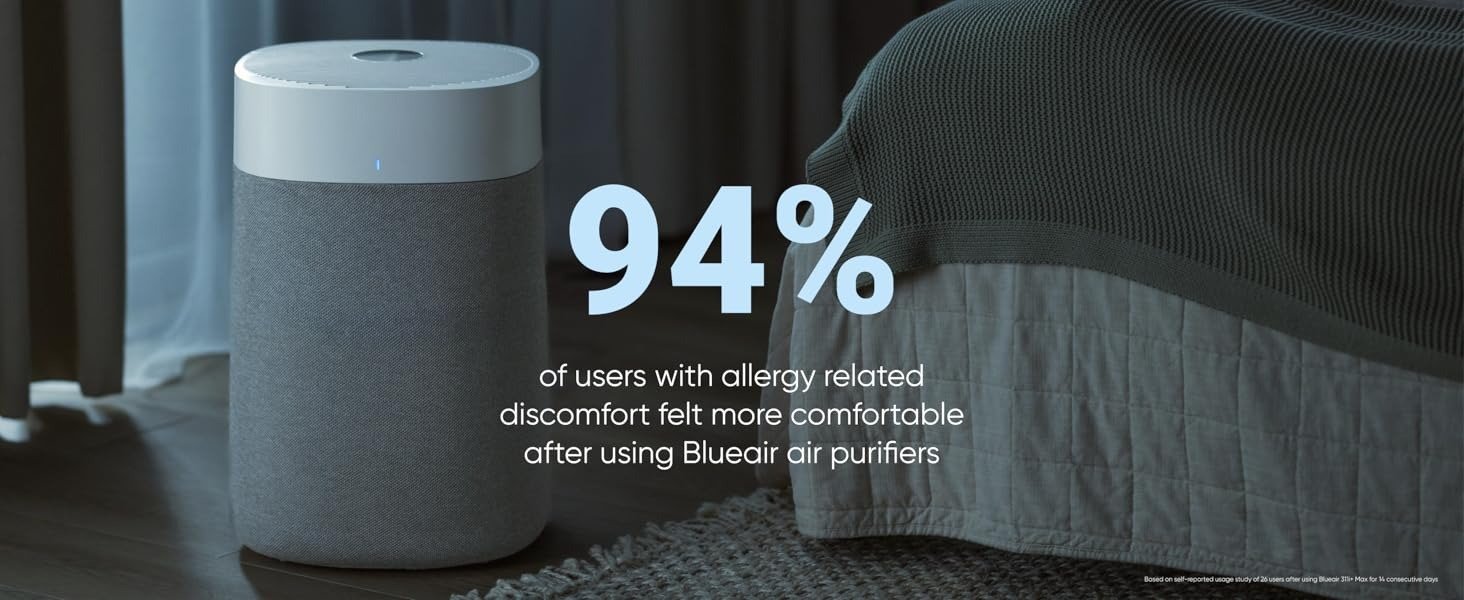
That is actually a good sign. People who respond well to this purifier do not usually sound dazzled. They sound like their room finally feels easier to live in. Cleaner air. Less dust. Less irritation from pets or allergies. A machine they can keep running without the noise taking over the room.
Blueair lists 4.6/5 from 1,894 reviews, which is a strong aggregate signal. Recent buyer commentary also reflects large shared spaces and asthma-related use in pet households. That fits the overall pattern: this is a product people tend to value when they are solving a real environmental problem, not chasing gadget novelty.
The One Threshold That Decides Whether It Fits
Here is the entire case in plain language:
If I need an air purifier that can move serious air in a large common room while still feeling quiet enough and practical enough for daily use, the Blueair Blue Pure 211i Max makes sense. If I care more about heavy odor control, ultra-low ownership cost, or a purely mechanical filtration philosophy, its appeal drops quickly.
That distinction becomes even clearer when I look at the filter setup. The standard filter is positioned more for light household odors, while SmokeBlock adds more carbon for heavier smoke scenarios. To me, that says the base strength here is particle handling first, deeper odor handling second.
Decision Table
| This makes sense for me if… | This probably does not fit me if… |
|---|---|
| I need strong particle cleanup in a large shared room | I am mainly trying to solve heavy odor or VOC concerns |
| I want a purifier I can leave running without constant noise fatigue | I want the lowest possible long-term filter cost |
| I value headroom so the machine can do more at lower settings | I dislike electrostatic-assisted filtration on principle |
| I want useful app controls without needing them to carry the whole experience | I want a purely non-smart appliance with no app layer at all |
| I care about dust, pollen, smoke particles, and pet dander | I need a compact purifier that is easy to move around often |
My Bottom Line Before the Product Decision
What stayed with me is not that the Blueair Blue Pure 211i Max is “the best” in some sweeping universal sense. It is that it seems especially good at staying on the right side of the daily-use threshold.
That matters more than many buyers realize. A purifier that is powerful but unpleasant to live with usually ends up underused. A purifier with enough airflow to work effectively at tolerable settings has a much better chance of becoming part of daily life. And that, in the end, is what makes an air purifier actually useful.
If you want the direct buying verdict, this is where I would go next:
Final verdict: Consider.
It offers 410–452 cfm-class airflow that gives large rooms meaningful headroom.
The 23–53 dB range suggests it has a better chance of staying usable day to day.
It fits best when the real problem is particles, not maximum odor control or minimum filter cost.
Transparency Note:
This analysis is not based on quick personal impressions.
It is derived from documented system behavior, verified user patterns, and the physical constraints of storage capacity.
The goal is to translate complex technical behavior into a realistic performance model that helps you make a clear decision