Why Reverse Osmosis Water Still Disappoints: The Threshold Problem Most Homes Miss
ANALYSIS FRAMEWORK
I do not think most people hate reverse osmosis water because the technology is weak. I think they get frustrated because the system quietly crosses operating thresholds they never see.
The water starts slower, flatter, stranger, or less trustworthy, and the decline feels random even when it is not. That pattern is exactly why under-sink RO systems create such split opinions in real homes.
The Real Problem Is Not Filtration, It Is Threshold Drift
What I kept seeing across manuals, product data, and owner feedback was not a single dramatic failure.
It was threshold drift. RO performance depends on feed pressure, water temperature, source-water TDS, membrane condition, and how the tank behaves over time.
When those conditions stay inside the band, the system feels clean and stable. When they drift, the experience changes before most people know why.
iSpring’s own manual sets minimum recommended pressure at 30 PSI for the pump-equipped model, maximum pressure at 70 PSI, maximum TDS at 750 ppm, and makes clear that colder water slows the process.
Why Water Taste Changes Even When the System Is “Working”
This is the part many buyers miss. A system can still produce water and still feel disappointing.
The membrane may continue filtering, but taste can shift because the post-carbon stage ages, the remineralization stage weakens, or the storage side starts introducing a smell that was not present at the faucet line itself.
One recent owner specifically isolated a rubber smell to the holding tank rather than the filtered line, which is a perfect example of how the “problem” can sit after the main purification stages.
Pressure Is the Quiet Divider Between “Great” and “Annoying”
The reason some people love an RO system and others regret it often comes down to pressure behavior.
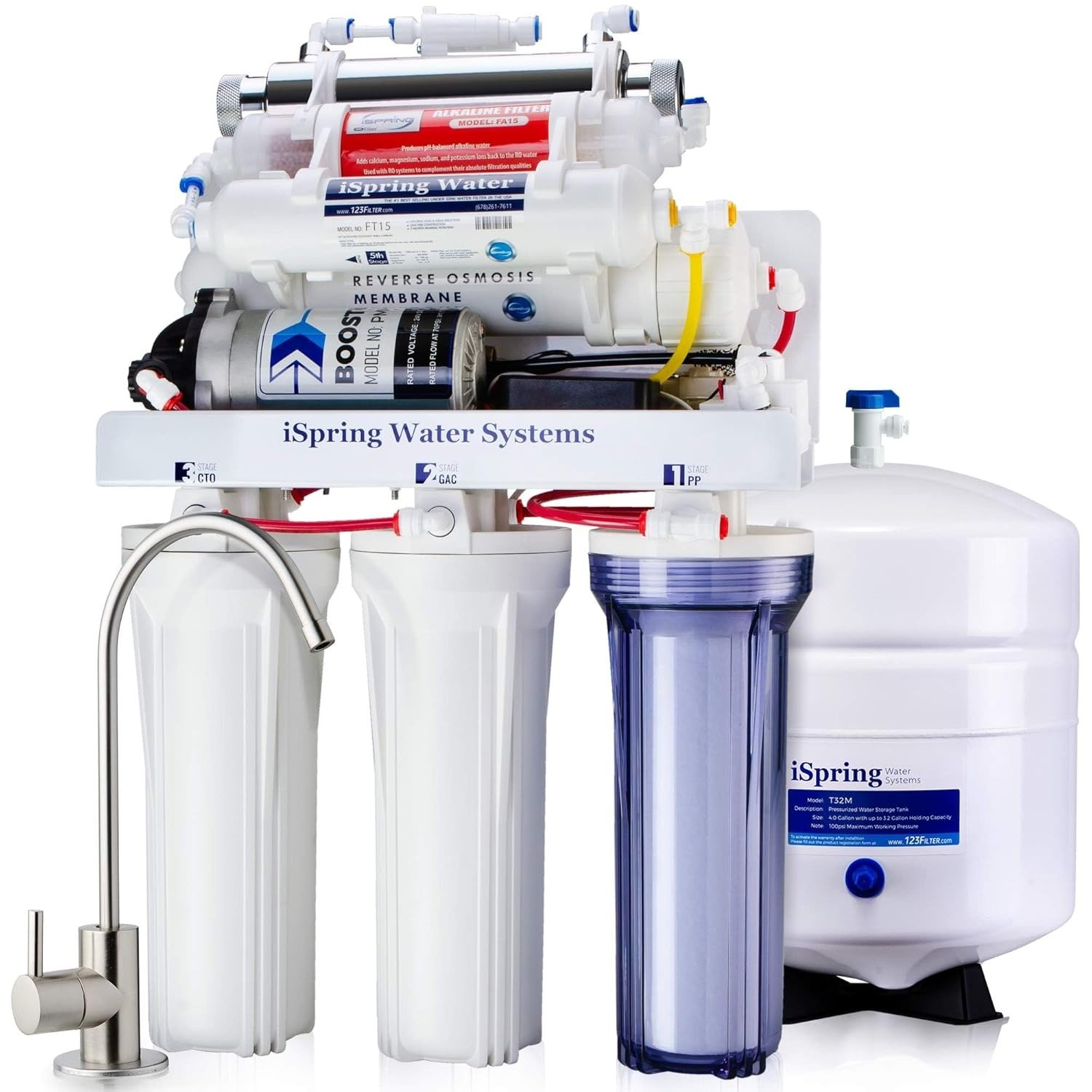
This model uses a booster pump, and the manual explains that the system can raise pressure to roughly 80 PSI entering the membrane housing, while the official product copy says the pump is meant to improve throughput and reduce wastewater compared with pumpless systems.
In plain English, low or unstable household pressure can turn a good RO design into a slow, wasteful one unless the system actively compensates for it.
The Best RO Systems Reduce Uncertainty, Not Just Contaminants
The strongest systems do more than remove contaminants. They reduce uncertainty.
This iSpring configuration combines three pre-filters, a 0.0001-micron RO membrane, a polishing stage, an alkaline remineralization stage, and a UV stage with a flow-sensor-controlled on/off cycle.
That matters because trust rises when the system is not doing only one thing well, but covering several failure paths at once: sediment load, chlorine exposure, membrane separation, taste finishing, mineral feel, and extra microbial protection at the end of the chain.
Where Real Owners Seem to Agree
The broad pattern in customer feedback is surprisingly consistent.
People repeatedly praise the water taste, the perceived jump in quality, and the support experience.
At the same time, review summaries and discussion threads show mixed experiences around leakage, installation complexity, and noise, which is exactly what I would expect from a more feature-dense under-sink RO setup with pump, tank, UV, and multiple quick-connect points.
When Performance Starts to Decline
I would define the decline window very simply:
- when flow starts falling sooner than expected
- when the water loses its crisp finish
- when the tank introduces odor or off-notes
- when filter timing slips because the system still “seems fine”
That last point matters more than most people think.
The manual says the stage 1–3 pre-filters should be replaced every 6 months or sooner if flow or quality drops, the post-carbon stage every 12 months, the alkaline stage every 6 months, and the membrane every 2–3 years depending on performance.
Once people miss those thresholds, trust usually drops before the system fully fails.
The Compatibility Split Most Buyers Need
This is where the decision becomes clearer for me.
Good fit: homes with inconsistent or low line pressure, buyers who care about taste after purification, people who want more than bare-bones RO, and households that value extra microbial protection or use water from sources that make them more cautious.
Questionable fit: buyers who want the simplest possible installation, people who hate maintenance schedules, and anyone who expects premium RO performance while ignoring tank condition and replacement timing.
Poor fit: homes outside the operating band, especially feed water above the manual’s stated limits, or users who need a whole-house solution rather than a point-of-use drinking-water system.
The Quiet Resolution
What I took away from this product class is simple: most RO disappointment is not caused by the idea of reverse osmosis.
It happens when buyers install a technically strong system into a weak operating context and then mistake threshold drift for product failure.
Once I look at RO through that lens, the right question stops being “Does this filter water?” and becomes “How much instability can this system absorb before my trust starts to slip?”
“how much instability can this system absorb”
Transparency Note:
This analysis is not based on quick personal impressions.
It is derived from documented system behavior, verified user patterns, and the physical constraints of storage capacity.
The goal is to translate complex technical behavior into a realistic performance model that helps you make a clear decision