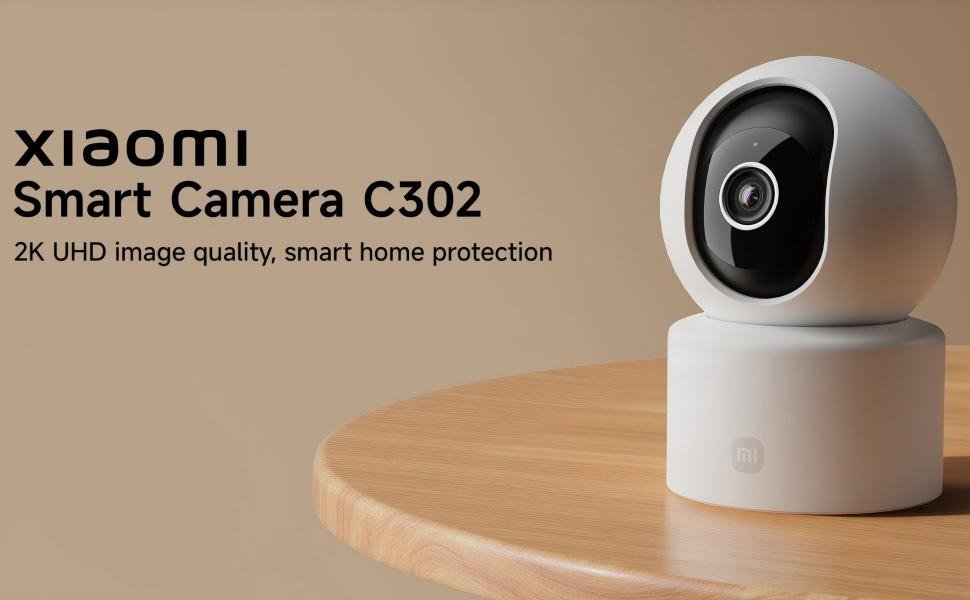
Xiaomi Smart Camera C302
A lot of indoor cameras fail in a strangely polite way. They do not collapse. They do not go dark. They do not announce that they are no longer enough. They simply give you footage, alerts, and a decent-looking app feed until the day you realize the problem was never whether the camera worked. The problem was whether it removed enough doubt to let you stop checking. That is the line I kept coming back to while studying the Xiaomi Smart Camera C302: not image quality in isolation, but the threshold where visible coverage starts to feel like actual reassurance. On paper, it brings 3MP / 2304×1296 video, 360° pan, Wi-Fi 6 on 2.4 GHz, AI detection features, two-way audio, a physical lens shield, microSD support up to 256 GB, and offline local recording under specific conditions. It also carries a 4.5/5 Amazon rating from 1,591 reviews on the U.S. listing, which tells me the product is broadly landing well with mainstream buyers.
The Result Looks Fine. The Problem Isn’t.
The first trap with indoor cameras is visual satisfaction. A clean 2K-style feed creates immediate confidence because it looks like evidence. But “clear enough to watch” is not the same as “clear enough to reduce intervention.” The C302 is built to solve the basic apartment-room, nursery, and pet-monitoring problem with a single indoor unit: it pans 360°, tilts 107°, offers human and pet tracking, supports crying baby and abnormal sound detection, and gives you local AI functions with privacy features that cheaper cameras often treat as an afterthought. That sounds complete. The hidden issue is that completeness on a feature list is not the same as completeness in a routine.
What matters in practice is not whether the camera can see the room. It is whether the camera reduces the number of times you feel compelled to re-check the room yourself. That is the emotional tax most people never name properly. A camera can be technically adequate and still leave behind a residue of doubt—small enough to ignore, persistent enough to matter.
What You’re Actually Feeling but Not Naming
What people often describe as “I just want a decent indoor camera” is usually something narrower.
It is not really about owning a camera.
It is about removing one of these recurring frictions:
| Friction you feel | What it usually means |
|---|---|
| “I keep opening the app just to make sure.” | The camera is not reducing uncertainty enough. |
| “I can see the room, but I still don’t trust the alerts.” | Detection matters more than raw resolution. |
| “I want privacy when I’m home, visibility when I’m out.” | Privacy control is part of the buying decision, not an extra. |
| “I don’t want another monthly obligation.” | Local storage and basic core use without subscription matter. |
The C302 is unusually relevant when the annoyance is not catastrophic security fear, but low-level domestic vigilance: checking on a sleeping baby, seeing whether a pet settled down, confirming movement in a hallway, or making sure a room is normal without walking into it every time. Xiaomi explicitly positions it around baby monitoring, pet monitoring, human detection, abnormal sound detection, custom zones, and a physical lens shield for privacy. Xiaomi’s UK security page also states that core functions like live streaming and local SD card recording do not inherently require a subscription, though cloud storage and some advanced recognition features may involve Xiaomi Home Secure on some models.
The Hidden Mechanism Behind the Miss
The hidden variable here is not resolution. It is intervention burden.
That is the real mechanism. Not enough people buy cameras with this in mind.
A camera becomes valuable when it lowers three kinds of work at the same time:
- Manual checking
- False interpretation
- Routine interruption
The C302 has a good base kit for that job. Its pan/tilt coverage reduces blind zones in a typical indoor room. Its local AI functions—human detection, pet detection, tracking, baby cry detection, and abnormal sound detection—try to convert passive watching into event-aware watching. Its physical lens shielding helps with the opposite problem: being observed when you do not want to be. Xiaomi also says the model includes an MJA1 security chip and AES-128 encryption for cloud data. Those are not decorative points. They directly affect whether the device remains acceptable inside lived-in spaces rather than feeling like a permanent compromise.
This is the uncomfortable truth most spec sheets never say plainly: a budget indoor camera succeeds less by stunning image quality than by removing enough micro-decisions that you stop thinking about it. If it still makes you babysit the app, troubleshoot the network, second-guess detection, or manually compensate for placement, then the savings were only visible at checkout. Xiaomi’s own support pages quietly reveal where that burden can reappear: connection failures, firmware-update issues, offline states, PTZ misalignment, SD card formatting problems, and the fact that offline microSD recording only works after the device has already been connected successfully before; if power is cycled and it does not reconnect, recording behavior changes. That is not a deal-breaker. It is the operational boundary.
The Threshold Where the Outcome Quietly Breaks
The threshold in this product category is simple:
A camera stops being “enough” when you need certainty without supervision.
That is the break point.
Below that threshold, the Xiaomi Smart Camera C302 makes a lot of sense. Above it, the compromises become structural.
Here is the threshold map I would use:
| Situation | C302 fit |
|---|---|
| One room, indoor use, broad coverage needed | Strong |
| Baby room / pet room / apartment overview | Strong |
| Privacy-sensitive shared space | Strong |
| Need local microSD option | Strong |
| Need fully outdoor use | Wrong fit |
| Need battery power | Wrong fit |
| Need high-end forensic detail or premium automation stack | Borderline to weak |
| Need rock-solid operation after network/power disruptions with minimal babysitting | Borderline |
That table is the whole story in compressed form. Xiaomi itself says the C302 is indoor-only, not waterproof, not dustproof, and requires wired power at 5V/1A. It supports microSD recording even when the network disconnects, but only if it had successfully connected before and remains powered; once power cycles without reconnection, conditions change. That single detail matters more than many shoppers realize because it defines the exact boundary between “local fallback” and “true set-and-forget resilience.”
Why Most Buyers Misread This Too Early
Most buyers misread indoor cameras by using the wrong decision metric.
They compare the shiny parts:
- resolution
- price
- pan/tilt
- app screenshots
- stand support
The mistake is subtle. They compare features before they define failure conditions.
That produces lazy equivalence. Two cameras can both say 2K, human detection, and two-way audio. One still ends up feeling more tiring to own because the stress sits elsewhere—in privacy, tracking behavior, network dependency, app friction, or how the device behaves once something goes slightly wrong. Xiaomi’s own FAQ reads like a quiet reminder of this: do not force the lens, calibrate PTZ in-app, tracking can make the camera rotate on its own, microSD behavior can become erratic if handled improperly, and firmware/network conditions influence reliability. In other words, the real category is not “indoor camera.” It is “indoor camera under routine friction.”
This is also why the Amazon rating matters, but only up to a point. A 4.5/5 average across 1,591 reviews is strong evidence that the C302 meets mainstream expectations for value and function. It is not evidence that it crosses the higher threshold of low-maintenance certainty for demanding users. Those are different standards.
Who Is Actually Inside This Problem
This product is logical for a very specific kind of buyer.
Not the hobbyist trying to build a surveillance system.
Not the privacy maximalist who wants full local independence from app ecosystems.
Not the person who treats every camera as if it should behave like a premium NVR endpoint.
It is for the buyer who needs one indoor node to handle an ordinary but emotionally sticky monitoring problem.
Usually that means one of these people:
| Buyer type | Why the C302 makes sense |
|---|---|
| Parent who wants to check a room without walking in | Cry detection, sound detection, broad pan coverage, two-way audio |
| Pet owner who wants movement awareness in one room | Pet detection, pet tracking, full-room visibility |
| Apartment user who wants one camera to cover a living area | 360° pan, 107° tilt, 3MP detail, compact indoor use |
| Privacy-conscious user who dislikes “always watching” devices | Physical lens shielding plus security-chip/encryption messaging |
| Budget buyer who still wants current-gen connectivity | Wi-Fi 6 support and core local storage path |
I would add one more category: the person who wants a camera that feels less creepy than many budget competitors. The physical lens-blocking feature changes the psychological contract. It gives the user a visible off-state rather than an abstract trust exercise. That matters more inside bedrooms, nurseries, and mixed-use home spaces than many brand pages admit.
Where Wrong-Fit Begins
Wrong-fit begins the moment you ask the C302 to solve a different class of problem.
This is not for outdoor monitoring. Xiaomi says so plainly. It is not waterproof or dustproof. It is not battery-powered. It is not the camera I would choose if your main requirement is operation outside the Xiaomi app environment, or if your tolerance for reconnecting, calibrating, or troubleshooting is near zero. Xiaomi’s support documentation makes it clear that networking, firmware, PTZ calibration, and microSD handling are all real parts of ownership. That is normal for this price tier. But it is still ownership load.
This is also not the right fit if your definition of security starts with courtroom-grade evidence, large-property coverage, or deep third-party integration. The C302 is a smart indoor camera, not a full surveillance doctrine.
The trade-off is straightforward:
| What you gain | What you trade off |
|---|---|
| Broad indoor coverage from one unit | Higher dependence on app/ecosystem behavior |
| Useful AI features in a low-cost tier | Some operational friction remains part of the package |
| Physical privacy shield | Still a connected camera with ecosystem assumptions |
| Local microSD option | Offline behavior has conditions, not absolute freedom |
| Strong mainstream value | Not a premium certainty machine |
That is not a flaw in the writing. That is the real shape of the product.
The One Situation Where This Product Becomes Logical
The Xiaomi Smart Camera C302 becomes logical when your actual problem is this:
You need one indoor camera to lower everyday checking, not to build a full security stack.
That is the condition.
If your break point is a single room, a sleeping child, a pet left alone, a hallway you want to glance at remotely, or an apartment space where coverage and privacy both matter, the C302 lines up well. It has enough resolution to be useful, enough motion coverage to reduce blind spots, enough AI to cut down on purely passive watching, and enough privacy framing to make indoor placement more acceptable. The Amazon reception suggests that mainstream buyers generally find the balance convincing, and the price positioning in the UK and Philippines signals Xiaomi is aiming squarely at affordable indoor coverage rather than premium overkill.
That is the point where the product stops sounding “feature-rich” and starts sounding correct.
What It Solves, What It Reduces, and What It Still Leaves to You
What it solves is basic indoor visibility with more intelligence than the cheapest cameras.
What it reduces is the need to physically check a room every time something feels off.
What it still leaves to you is system discipline.
You still need to place it well.
You still need stable power.
You still need a healthy network.
You still need to treat storage and app setup as part of the product, not an afterthought.
You still need to understand that local fallback is conditional, not magical.
That is precisely why I would not oversell it. The C302 is not impressive because it erases all friction. It is impressive because, at this tier, it seems to reduce the right friction first: room coverage, indoor awareness, privacy hesitation, and basic monitoring fatigue. That is a better kind of value than a louder spec sheet.
Transparency Note:
This analysis is not based on quick personal impressions.
It is derived from documented system behavior, verified user patterns, and the physical constraints of storage capacity.
The goal is to translate complex technical behavior into a realistic performance model that helps you make a clear decision.