When a UST Projector Actually Starts Feeling Stable
ANALYSIS FRAMEWORK
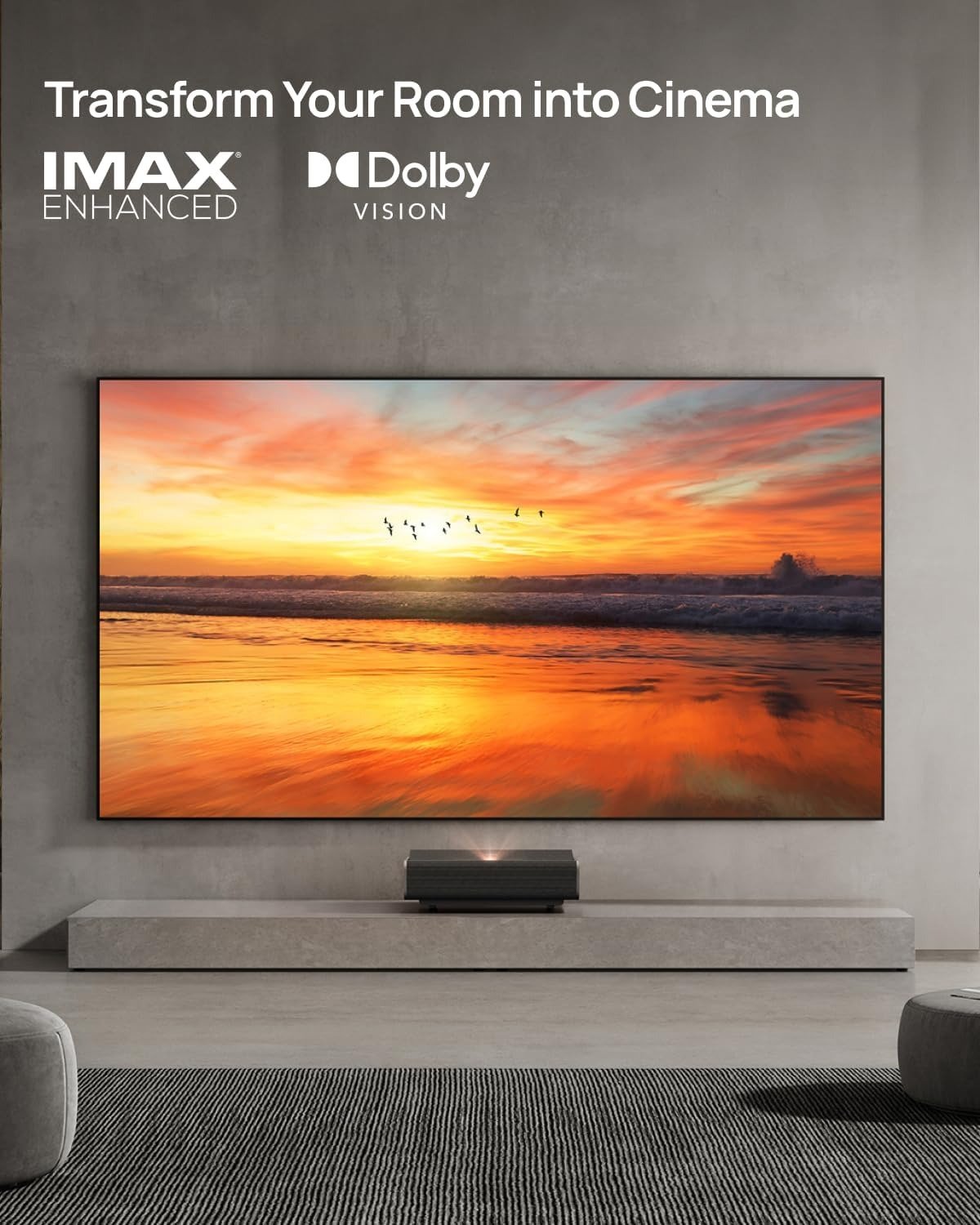
I remember the first time I put a 90-inch image on my living-room wall from just a few inches away and felt something shift: it stopped feeling fragile and started feeling like a real TV alternative. The XGIMI Aura 2 does that trick — projecting 90 inches from about 5.4 inches and scalable up to 150 inches — and its package (Dolby Vision, IMAX Enhanced, a dual LED-plus-laser light engine, and a built-in 60W Harman/Kardon audio system) makes it clear this is a living-room machine, not a hobbyist ceiling fixture.
The frame I keep returning to is the Living-Room Contrast Threshold. That’s the point where a projector looks composed in everyday conditions — not a pitch-black demo cave, not a sun-flooded nightmare, but a normal room with some light, reflections, and real compromises. Across lab data, critic reviews, and owner feedback, the Aura 2 consistently shows where that threshold sits: good enough to stop babysitting in many homes, but still limited by projector physics in the brightest situations.
The Threshold Is Not Brightness Alone
Numbers are useful: 2300 ISO lumens, 99% DCI-P3 coverage, and a quoted 1,000,000:1 dynamic contrast ratio. Those specs sound decisive until you test the projector with real content. In SDR, the Aura 2 stands out for natural skin tones and top-tier color accuracy. In difficult HDR scenes, however, it can clip highlights and lose detail unless the material is delivered in Dolby Vision — where the picture improves noticeably. That split is precisely what a threshold model should expose: where the image holds and where it begins to slip.
This pattern repeats across reviews and hands-on responses. The projector is bright, colorful, and easy to enjoy, but it won’t defeat a truly sunlit room the way a TV does. The Aura 2 moves the living-room tolerance farther than weaker UST options, but it does not erase projector physics.
What Stability Looks Like in Practice
Stability is psychological as much as technical. A projector becomes stressful when it demands too much from the room, setup, or your patience. The Aura 2 reduces those frictions. Its conveniences — auto focus, auto keystone, ISA 5.0 setup tools, three HDMI 2.0 ports with one eARC port, Wi‑Fi 6, Bluetooth 5.2, and low enough input lag to be around 19.7ms at 4K/60 in game mode — make it behaviorally cooperative. You spend less time tweaking and more time watching.
Owner sentiment mirrors lab results. People are happiest when they treat the Aura 2 as a serious UST system rather than a magic wall-filler. Praise clusters around quiet operation, strong image, good sound, and especially when it’s paired with a proper UST ALR screen. Complaints cluster too: expecting TV-level resistance to bright-room washout, setup or keystone frustrations, and sensitivity to DLP artifacts. That’s not random noise — it’s the threshold talking.
The Moment a Projector Stops Feeling Fragile
A projector stops feeling fragile when you stop babysitting it. The Aura 2 gets unusually close to that point because its strengths line up with what reduces buyer anxiety. It’s accurate without demanding calibration; it’s bright enough for moderate light; it has strong built-in sound; and reviewers frequently praised the package as a real one-box solution rather than a spec-sheet promise.
That doesn’t mean the threshold disappears. It just becomes easier to live above. If you mainly watch SDR, stream Dolby Vision often, value easy placement, and want an appliance-like projector rather than a tinkering project, the Aura 2 sits on the right side of the line. If your room is extremely bright, you obsess over every HDR highlight, or rainbow artifacts bother you, the line moves against you.
Transparency Note:
This analysis is not based on quick personal impressions.
It is derived from documented system behavior, verified user patterns, and the physical constraints of storage capacity.
The goal is to translate complex technical behavior into a realistic performance model that helps you make a clear decision