Typhur Dome 2 Review: The Rare Premium Air Fryer with a Real Reason to Exist
DECISION ANALYSIS
The first time I seriously studied the Typhur Dome 2, I realized it was not trying to win the usual air fryer argument. It was not built around the loudest fan, the tallest spec list, or the cheapest path into the category. It was built around one very specific frustration: crowding.
That matters, because crowding is where a lot of otherwise decent air fryers quietly fall apart. They look roomy until dinner actually goes in. Then the layering starts, airflow gets compromised, and the machine begins asking for more intervention than the marketing ever admits. The Typhur Dome 2 makes sense only if that is the problem you are trying to solve. When I judge it through that lens, its logic becomes much stronger.
The Threshold Model I’m Using
I am using one model only here: Threshold.
The threshold is simple. An air fryer becomes meaningfully reliable when it keeps enough food exposed to heat and airflow that I do not have to manage the cook every few minutes. That is why the Typhur Dome 2 is interesting. Its entire design appears built to hold the line longer before performance starts to drift.
It brings together a wide basket, top-and-bottom heating, a broad cooking surface, 5.6–5.7 quart capacity, temperature range up to 450°F, and preset modes aimed at foods that usually suffer when stacked. Those choices are not cosmetic. They all point toward the same promise: keep more food in a flat, breathable layout so the machine can cook with less congestion.
What the Hardware Is Really Doing for You
The hardware tells a coherent story. Typhur gives the Dome 2 dual heating elements, dual temperature sensors, a 1,750W rating, app/touch control, PFAS/PTFE-free ceramic nonstick surfaces, dishwasher-safe removable parts, and a self-cleaning cycle.
The measured behavior adds a useful layer of realism. Maximum fan speed is 2,060 RPM. Time to reach 400°F is 4:51. Temperature variation at 400°F is 25°F. To me, that says this machine is not pretending to be an all-out brute-force preheat specialist. Its strategy is different. It leans on shape, heat distribution, and surface exposure more than raw aggression.
That distinction matters in daily use. You are not buying this because it sounds intense. You are buying it because the format is trying to stay composed under a flatter food load.
The Best Thing About It Is the Surface Area
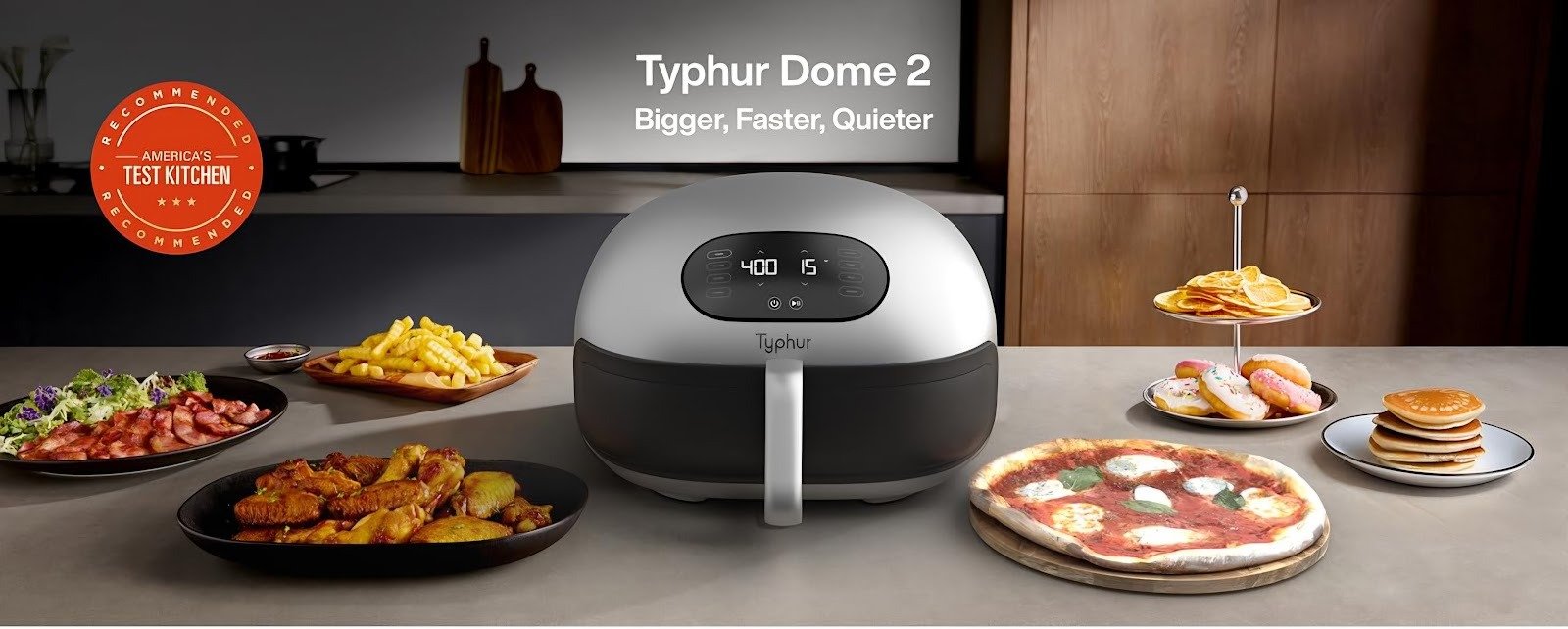
This is the strongest reason to take the Dome 2 seriously. Its basket has unusually large surface area, with a wide enough layout for a 12-inch pizza and a 901 cm² cooking surface. That immediately changes what fits comfortably without piling.
And that is not a small difference. It affects the foods most people actually make: fries, wings, bacon, toast, frozen pizza, garlic bread, cutlets, and other items that benefit from exposure more than depth. In a typical deeper basket, I often feel like I am negotiating with pile height. Here, the whole point is to reduce that negotiation.
This is where the product starts to feel engineered instead of merely styled.
What the Results Suggest in Real Cooking
When I pull the strongest test results together, a clear pattern emerges. The Dome 2 produces very good fried food, with a frying quality score of 7.8, 79.3% crispy fries, and 0% overcooked fries. Those numbers matter because they support the same story the basket design is already telling.
The machine seems especially persuasive when the food benefits from lying flatter and receiving more even exposure. That does not mean it defies physics or becomes the perfect answer for every kitchen. It means the design is aligned with a specific cooking reality, and the results reflect that alignment.
For a premium product, that coherence is important. I do not just want features. I want the features to explain the outcome.
Where It Feels Better Than a Typical Basket Fryer
The Typhur Dome 2 improves the experience in one very practical way: it gives flat and spreadable foods a better environment to finish well.
| Food Type | Why the Dome 2 Helps |
|---|---|
| Fries | more room to spread instead of pile |
| Wings | less reliance on constant flipping |
| cured meat | wide flat layout suits strips well |
| Toast / garlic bread | broad surface is naturally efficient |
| Pizza | 12-inch fit is genuinely useful |
| Steaks / cutlets | bottom heat gives the format more purpose |
That list is the heart of the product. If those foods make up a large part of your real cooking pattern, the Dome 2 starts to look much more rational. If they do not, the premium positioning becomes harder to defend.
The Quietness Changes the Relationship More Than People Expect
A lot of air fryers are useful but vaguely irritating. They work, but they sound like they are staging a mechanical argument on your countertop. The Dome 2 has an advantage here. Claimed operation is about 55 dB, and the quieter behavior seems consistent with the lower effective fan speed.
That matters psychologically as much as practically. Quiet appliances get used more casually. They feel less disruptive. They fit into the room instead of dominating it. For a machine that may stay on the counter full time, that softer daily presence is not a luxury detail. It is part of the ownership experience.
The Hidden Costs Are Not Small
This is where the decision gets honest. The Dome 2 is large. It takes up serious countertop space and is unlikely to fit in most cupboards. The dishwasher-safe parts are physically big. The product is expensive. And despite the wide chamber, it is still only one cooking zone.
That means the machine solves one bottleneck while leaving another intact. It is excellent at giving flat foods more breathing room, but it does not give you dual-zone flexibility. For some households, that is completely fine. For others, it is the exact reason to look elsewhere.
Some functions also lean on the app. That will not bother everyone, but it does create a small compatibility fault line between tech-forward buyers and people who want every important function to live on the appliance itself.
The Drift I Would Still Watch Closely
The Dome 2 clearly reduces crowding drift, but it does not erase time drift. Time to reach 400°F is 4:51, and recovery after the drawer is opened is 6:09. That means the machine rewards a steadier cooking rhythm more than constant checking.
In plain terms, this is not a machine I would want to fuss over. The wide-basket advantage works best when I let it do its job rather than repeatedly interrupting the cycle. That is not a flaw so much as a usage truth. But it matters, because it shapes the kind of cook who will get the most out of it.
Compatibility Split 3.0
Here is the real buying split as I see it:
| Buyer Type | Fit Level | Why |
|---|---|---|
| Frequent air fryer user cooking for 2–4 | High | wide single-layer surface pays off repeatedly |
| Frozen pizza, toast, bacon, wings household | High | shape matches the food pattern unusually well |
| Small kitchen / limited counter space | Low | footprint is hard to justify |
| Budget-first buyer | Low | performance is good, but price is still premium |
| User needing dual-zone flexibility | Medium-Low | only one cooking chamber |
| App-averse buyer | Medium-Low | some functions lean on the app |
| Tech-forward buyer who values quiet operation | High | premium UX matters more here |
That table is the decision. If you fall into the first, second, or seventh row, the Dome 2 becomes much easier to justify. If you fall into the third, fourth, fifth, or sixth, the objections are not minor. They are structural.
My Verdict on the Typhur Dome 2
I would not call the Typhur Dome 2 a universal recommendation. It is too large, too premium, and too specific for that. But I also would not dismiss it as an overdesigned luxury fryer, because the best part of it is rooted in a real cooking problem.
Its wide, shallow layout changes how food sits. That changes how air moves. And that reduces how often I would need to intervene. For the right kitchen, that is not marketing language. That is relief.
If your everyday frustration with normal air fryers is crowding, uneven flat-food performance, and noisy routine use, this is exactly the kind of product that can feel worth the premium. If your kitchen is small, your budget is tight, or dual-zone flexibility matters more than single-layer exposure, it becomes a harder sell.
The emotional bottom line is simple: this machine makes the most sense when you are tired of fighting the basket.
Go to the product page here: [PRODUCT_LINK]
Final Verdict
Final verdict: Buy.
Not because it is perfect. Not because it is for everyone. Buy because it solves a specific, common, annoying problem with unusually clear design logic, and it appears to do that job well enough to matter.
It protects the Single-Layer Crisping Threshold better than most basket designs.
It makes unusual sense for fries, wings, bacon, toast, and pizza.
It earns its case when crowding is your main frustration, not just when you want something premium.
Short Product-Page Summary
The Typhur Dome 2 makes the most sense when I judge it by the right problem. This is not just another premium air fryer with a futuristic shell. Its real job is to reduce crowding. That is why the wide basket matters so much. With 5.6–5.7 quart capacity, a 901 cm² cooking surface, support for a 12-inch pizza, top-and-bottom heating, dual heating elements, dual temperature sensors, 1,750W power, and temperatures up to 450°F, the design is clearly built to keep more food exposed instead of stacked.
The measured results support that direction. Maximum fan speed is 2,060 RPM. Time to reach 400°F is 4:51. Temperature variation at 400°F is 25°F. Frying quality is 7.8, with 79.3% crispy fries and 0% overcooked fries. In real terms, that points to a machine that is less about brute-force speed and more about preserving a stable single-layer cooking zone.
It is not a casual recommendation for everyone. The footprint is large, the price is premium, recovery after opening is 6:09, and it is still only one cooking zone. But if your main frustration with traditional air fryers is crowding, uneven flat-food results, and noisy daily use, the Dome 2 has a strong case.
Final verdict: Buy.
Best for households that cook flat foods often.
Weaker fit for small kitchens and budget-first buyers.
Most persuasive when basket crowding is your real pain point.
Check the product page if crowding is the problem you want to solve: [PRODUCT_LINK]
Transparency Note:
This analysis is not based on quick personal impressions.
It is derived from documented system behavior, verified user patterns, and the physical constraints of storage capacity.
The goal is to translate complex technical behavior into a realistic performance model that helps you make a clear decision