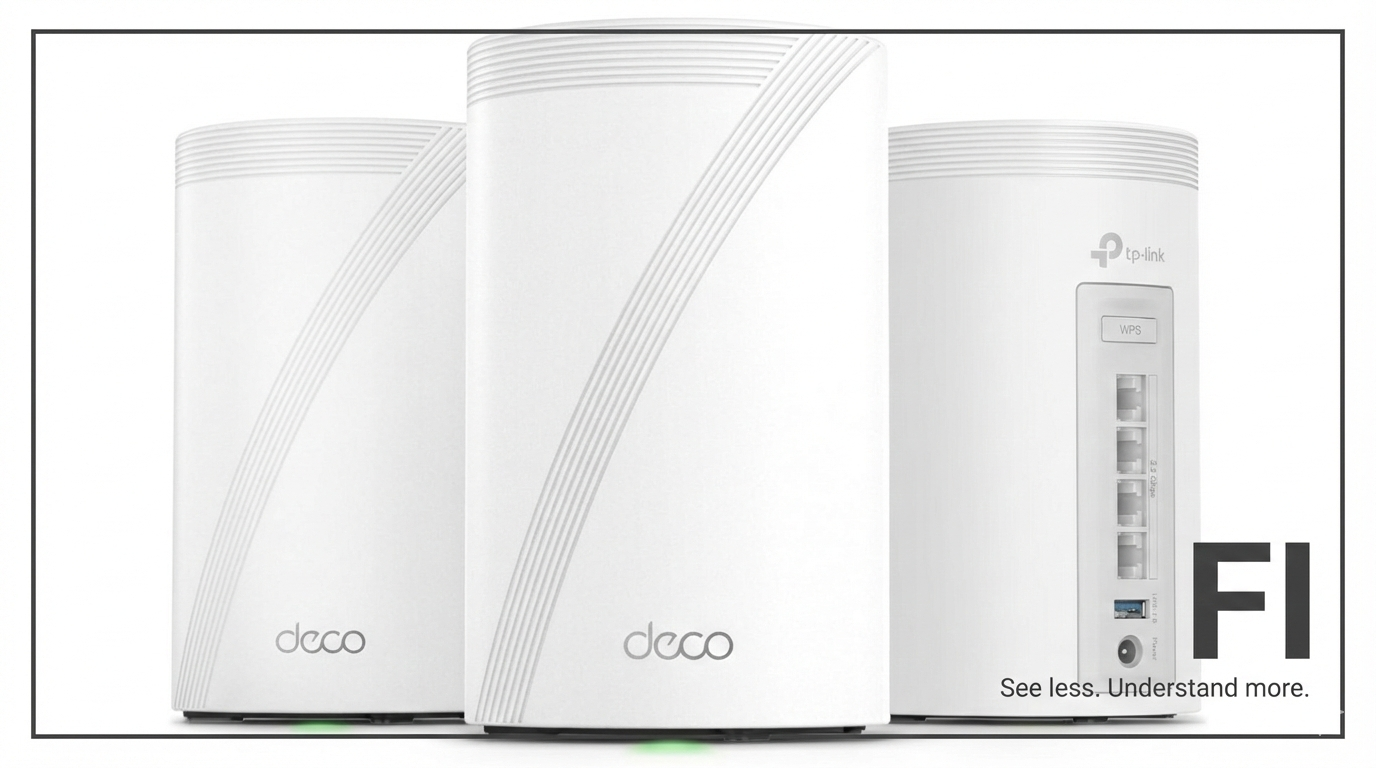
TP-Link Deco BE63 Wi-Fi 7 Mesh: Complete Technical Decision Analysis
DECISION ANALYSIS
TP-Link Deco BE63 mesh nodes placed across multiple rooms in a modern residential environment.
Opening Decision Context — The Real Problem This System Is Designed to Solve
At this stage, the decision is no longer about upgrading speed. It is about eliminating structural instability.
Modern homes no longer behave like simple networks. They are dense digital environments containing:
• smart home ecosystems
• multiple streaming endpoints
• latency-sensitive work and gaming devices
• simultaneous multi-user bandwidth demand
Traditional routers collapse under this load due to spectrum congestion, roaming inefficiency, and gigabit infrastructure limitations.
TP-Link Deco BE63 is engineered specifically to resolve these structural constraints through tri-band Wi-Fi 7 architecture and multi-gig infrastructure.
It delivers up to 10Gbps combined wireless throughput across three independent frequency bands, fundamentally transforming internal network stability.
This is not a speed upgrade. It is an architectural correction.
Technical Analysis Section — Core Structural Architecture and Real Performance Capability
Tri-Band Wi-Fi 7 Spectrum Architecture and Throughput Distribution
Deco BE63 operates across three independent spectrum layers:
• 6GHz band — up to 5188 Mbps
• 5GHz band — up to 4324 Mbps
• 2.4GHz band — up to 574 Mbps
This tri-band isolation prevents internal network self-interference.
Instead of forcing all communication through a shared spectrum bottleneck, Deco BE63 distributes traffic intelligently across independent frequency paths.
This dramatically improves:
• roaming continuity
• latency stability
• signal reliability across rooms
• performance under simultaneous load
This is the structural foundation of Wi-Fi 7 mesh stability.
Multi-Link Operation (MLO) — Continuous Multi-Path Connectivity
This improves:
• packet delivery reliability
• roaming stability
• connection continuity
• latency consistency under interference
Instead of collapsing when signal conditions change, Deco BE63 maintains parallel transmission paths.
This eliminates unpredictable performance drops.
Multi-Gig Ethernet Infrastructure — Removing Internal Physical Bottlenecks
Each Deco BE63 node includes:
• four 2.5GbE WAN/LAN ports
• USB 3.0 connectivity
• wired and wireless multi-gig backhaul support
This removes the gigabit bottleneck that limits traditional mesh systems.
The network can scale beyond gigabit throughput internally, ensuring wireless performance is not restricted by physical infrastructure.
This is critical for:
• multi-gig internet connections
• NAS-based media systems
• workstation environments
• high-throughput internal networks
The infrastructure supports future network scaling.
Density Stability
The 3-unit Deco BE63 system covers up to 7,600 square feet and supports 200+ connected devices simultaneously.
This ensures stable performance across:
• multi-floor homes
• large residential layouts
• dense smart home ecosystems
• multi-user environments
The system maintains stability under extreme device density.
This is a structural advantage, not a marketing feature.
Use Case Fit Analysis — Where Deco BE63 Provides Maximum Structural Value
Deco BE63 is structurally optimized for environments where network instability originates from infrastructure limitations rather than ISP speed.
It performs best in:
• multi-floor residential homes
• large coverage areas exceeding traditional router range
• smart home ecosystems with dozens or hundreds of devices
• latency-sensitive gaming environments
• hybrid work environments requiring stability
• multi-gig internet infrastructure deployments
It resolves the root causes of instability.
Not just the symptoms.
Competitive Positioning Section — Structural Performance Tier and Market Placement
Deco BE63 occupies the upper mid-tier structural class within Wi-Fi 7 mesh systems.
It delivers the core architectural capabilities defining Wi-Fi 7 performance:
• tri-band Wi-Fi 7 architecture
• 320MHz ultra-wide channel support
• Multi-Link Operation capability
• multi-gig Ethernet infrastructure
• AI-driven mesh coordination ([أمازون][1])
Higher-tier systems primarily extend maximum throughput margins.
However, Deco BE63 already resolves the primary structural bottlenecks affecting real-world stability.
Its architectural design addresses the most important performance variables.
Pricing Logic Section — Structural Efficiency Relative to Infrastructure Capability
The value proposition of Deco BE63 is structural efficiency.
You are paying for elimination of infrastructure bottlenecks:
• spectrum congestion
• roaming instability
• gigabit infrastructure limitations
• mesh coordination inefficiency
This delivers architectural performance transformation without requiring flagship-tier investment.
It represents a structural upgrade point rather than incremental improvement.
Verdict Section — Final Structural Decision Resolution
TP-Link Deco BE63 is engineered to resolve the structural limitations that cause modern home network instability.
Its tri-band Wi-Fi 7 architecture, multi-gig Ethernet infrastructure, and distributed mesh coordination model eliminate the core causes of connectivity inconsistency.
It resolves:
• roaming instability
• mesh backhaul congestion
• internal throughput bottlenecks
• device density performance collapse
It delivers structural network stability rather than superficial speed improvement.
This makes it an appropriate decision for environments requiring consistent, scalable, whole-home network performance.
Product Access Section — Decision Execution Point
Access the complete product specifications, technical configuration, and current availability here:

One Comment