When a Microwave-Air Fryer Combo Stops Feeling Clever and Starts Feeling Useful
ANALYSIS FRAMEWORK
I’ve had this reaction more than once: the box promises everything, the feature list sounds brilliant , and for a few days the machine feels like the smartest thing in the kitchen. Then normal life takes over. Leftovers need reheating. Fries need rescuing. Frozen food needs speed. The cavity needs cleaning. And suddenly the real question isn’t whether a microwave-air fryer combo can do a lot. It’s whether it can do enough of the right things, often enough, that I stop reaching for a second appliance.
That’s the line I care about most.
Not novelty. Not presets. Not how impressive the control panel looks on day one.
What I want is a countertop machine that reduces friction instead of quietly relocating it.
The Threshold That Actually Matters
For this category, I don’t judge value by the number of cooking modes. I judge it by what I call the Replacement Threshold: the point where a combo unit becomes dependable enough in daily life that it truly starts replacing appliances, not merely joining them.
To cross that threshold, a machine has to clear four conditions at the same time.
| Requirement | What I mean in practice | Why it matters |
|---|---|---|
| Even microwave performance | Food heats without obvious cold centers and dry edges | This is the task the machine will do most often |
| Crisping that is good enough to trust | Wings, fries, leftovers, and frozen foods finish with believable texture | Otherwise “air fry” is decorative |
| Low-friction daily use | Controls are understandable, presets make sense, no constant babysitting | Complexity kills repeat use |
| Acceptable cleanup cost | The machine cannot punish me every time grease or splatter enters the cavity | Most combo-owner regret starts here |
That table is the whole category in miniature. If a combo appliance can satisfy those four demands together, it becomes a real kitchen tool. If it misses even one badly enough, it starts behaving like a compromise with a polished face.
Where Most Combo Ovens Quietly Lose Their Grip
The failure pattern usually isn’t dramatic. That’s why people miss it when they shop.
At first, the convenience is obvious. One appliance. More functions. Less clutter. That feels like a win. But over time the smaller inconveniences accumulate: the interior gets messier than expected, the air-fry results are decent rather than exciting, accessories interrupt quick microwave use, and switching between functions feels less seamless than the box implied.
The machine still works. It just stops feeling useful in the way you hoped.
That is what real drift looks like in this category. Not breakdown. Behavioral slippage.
The buyer thought they were replacing friction. In practice, they often just redistributed it.
What the Better Products Get Right
The strongest combo units tend to win the microwave side first.
That matters more than most buyers realize, because the microwave side is the side that carries daily volume. Reheating leftovers, defrosting dinner, warming sauces, reviving takeout, heating a drink, softening something frozen — that’s the real workload. The air-fry mode matters, but it usually isn’t the highest-frequency task.
So when I assess a combo appliance seriously, I start with the same question every time: does the microwave behavior feel calm, even, and predictable?
That is where the better machines separate themselves. They don’t just advertise extra cooking functions; they reduce guesswork in the job you’ll ask them to do most often.
Why “Air Fry Included” Is Not the Same as “Air Fry Solved”
This is where expectations need discipline.
A combo appliance does not have to beat a dedicated basket-style air fryer to be worth owning. That’s the wrong standard. But it does have to crisp well enough that I don’t feel cheated every time I use that mode.
That means believable texture on the foods people actually make in real kitchens:
- frozen snacks
- leftover fries
- nuggets
- wings
- roasted vegetables
- fast browning jobs
If the food comes out with real contrast — not just heat, but texture — the air-fry function becomes useful. If it merely dries the surface and calls it crisping, it becomes one more feature that looks better in the listing than it feels in the home.
That distinction matters because many buyers are not looking for the absolute best air fryer on the market. They are looking for one machine that can do enough, often enough, without making daily cooking more irritating.
The Compatibility Split That Makes the Category Easier to Understand
I keep seeing the same three buyer profiles appear again and again.
| User type | What they really need | Does a combo make sense? |
|---|---|---|
| Space-compressed kitchen | Fewer boxes on the counter, broad utility, decent results across tasks | Yes, often the best fit |
| Microwave-first household | Reheat, defrost, beverages, leftovers, occasional crisping | Yes, if microwave performance is strong |
| Air-fry-first household | Maximum crunch, fast browning, easy grease cleanup, frequent crisping | Usually no, dedicated air fryer still wins |
That split clears away a lot of noise.
If you mostly want a better everyday microwave that can also crisp food when needed, a strong combo can make excellent sense. If your kitchen life revolves around aggressive air frying several times a week, the category itself becomes less convincing.
The Product That Makes This Question More Interesting
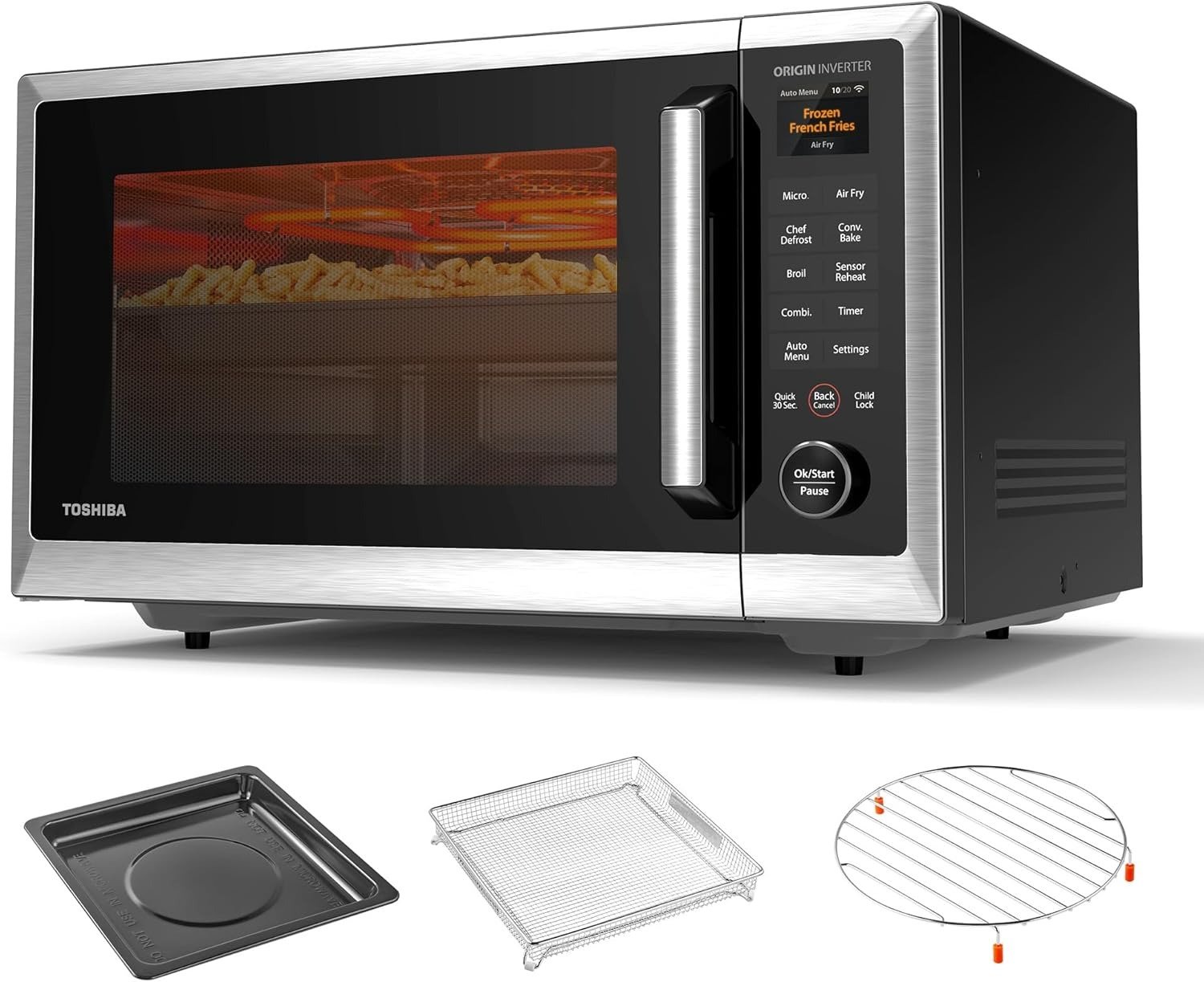
The Toshiba OptiChef ML2-STC13SAIT stands out because, on paper, it looks like it understands the threshold better than many machines in this class.
It combines 1100W output, 1.3 cu. ft. capacity, humidity sensor cooking, Origin Inverter technology, ChefFry Plus air frying, a 2.4-inch color screen, app and Alexa support, and a cavity large enough for a 13-inch pizza or a whole chicken. It weighs 45.6 pounds and measures 21.8 by 19.4 by 12.8 inches, which tells me immediately that this is not trying to be tiny. It is trying to be useful enough to justify replacing more than one appliance.
And that is exactly why it deserves a closer look.
Because the real issue here isn’t whether it sounds impressive. It’s whether those features translate into lower intervention in actual kitchen life.
The Quiet Question Behind the Sale
This is the question I would ask before buying any product in this category:
Does this machine make my most common food faster and easier without making cleanup or texture meaningfully worse?
That is the real decision frame.
Not how many presets it offers.
Not whether it looks smart.
Not whether the listing sounds futuristic.
Just whether it earns trust where repetitive kitchen behavior lives.
The Toshiba OptiChef ML2-STC13SAIT makes a serious promise on that front. The only thing left is to test whether it actually crosses the line between feature density and daily usefulness.
[Link — Decision Article: [DECISION_LINK]]
Does the Toshiba OptiChef ML2-STC13SAIT Actually Cross the Replacement Threshold?
Transparency Note:
This analysis is not based on quick personal impressions.
It is derived from documented system behavior, verified user patterns, and the physical constraints of storage capacity.
The goal is to translate complex technical behavior into a realistic performance model that helps you make a clear decision