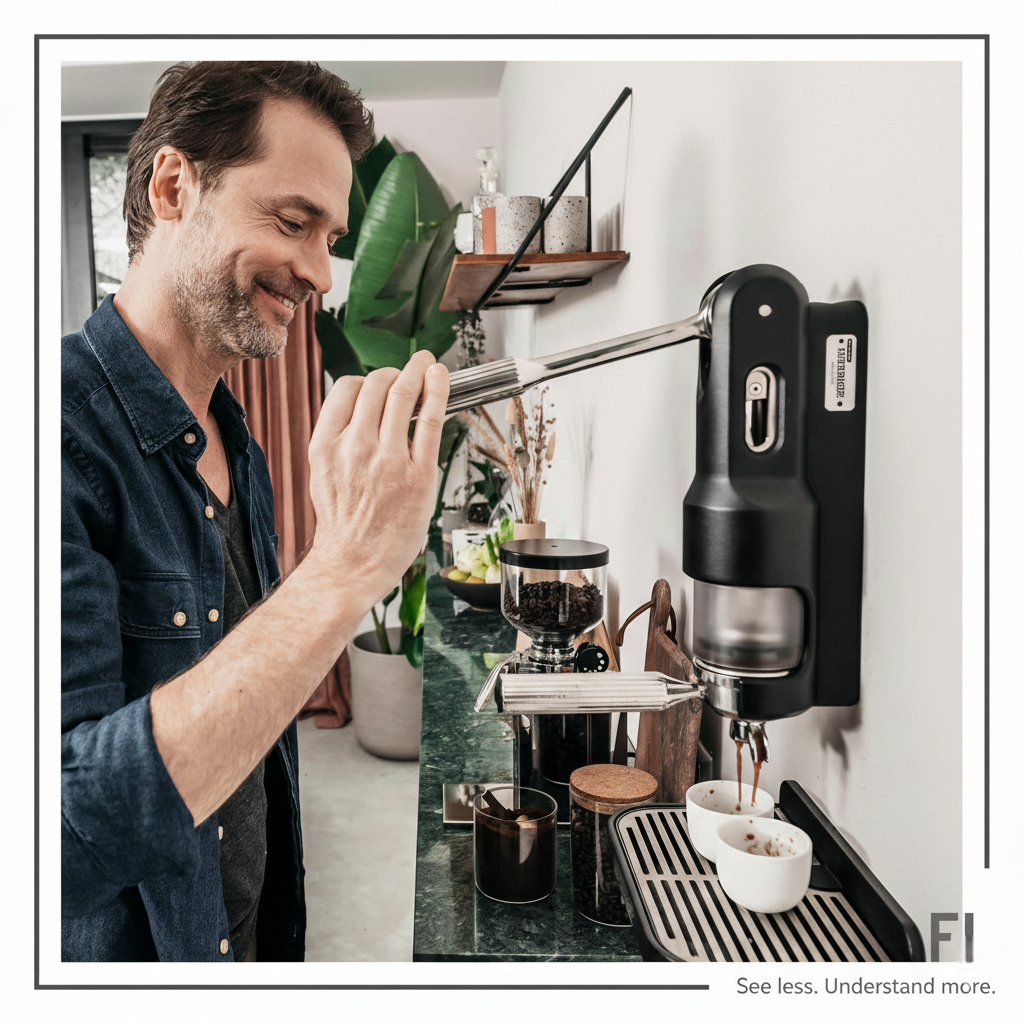
THE REAL PROBLEM WITH PORTABLE ESPRESSO IS NOT TASTE. IT IS VARIANCE.
ANALYSIS FRAMEWORK
We thought we wanted stronger flavor.
What we actually wanted was stability.
One morning the shot flows thick and dark. The next morning it runs thin, sharp, slightly sour. Same beans . Same grinder. Same ritual. So why does it change?
Because espresso is not about taste first. It is about pressure behavior.
And once we started analyzing manual lever systems closely, especially designs like SUPERKOP, we realized something uncomfortable:
Most frustration does not come from bad engineering. It comes from invisible mechanical variance that we never learned to feel.
WHY DOES MANUAL PRESSURE FEEL DIFFERENT FROM ELECTRIC MACHINES?
When we push a button on an electric machine, we outsource pressure.
When we pull a lever, we embody it.
Mechanical Variable
→ Observable Sensory Outcome
→ Behavioral Impact
Manual stepped pressure strokes
→ We feel resistance build gradually instead of exploding instantly
→ We adjust mid-motion instead of reacting after the shot fails
With a multi-stroke displacement mechanism, pressure is not one violent push. It is rhythm. Push. Reset. Push. Reset.
In daily use, that rhythm feels calmer. The lever does not fight back aggressively. It moves with weight, not chaos.
And that matters psychologically.
Because when force feels predictable, our nervous system relaxes. When we relax, we repeat more consistently. When we repeat consistently, extraction stabilizes.
That is not marketing. That is biomechanics.
WHY DOES “NO ELECTRICITY” CHANGE THE WAY WE THINK?
We used to think no electricity meant inconvenience.
Now we see it differently.
No boiler means:
• No heat cycling
• No warm-up anxiety
• No internal temperature mood swings
Instead, we control water temperature externally.
Mechanical Variable
→ Sensory Outcome
→ Impact
Externally heated water at stable temperature
→ The workflow feels immediate and direct
→ We remove warm-up variability from the system
There is something strangely grounding about pouring water yourself. You feel the steam. You feel the weight of the kettle. You are present.
Presence reduces careless repetition.
Careless repetition increases variance.
This is where manual systems quietly outperform automated ones — not in specs, but in attentional discipline.
WHY DOES 58MM MATTER MORE THAN MOST PEOPLE ADMIT?
We noticed something interesting.
When a machine uses a 58mm basket, our behavior changes. We tamp differently. We distribute more carefully. We treat it seriously.
Mechanical Variable
→ Sensory Outcome
→ Behavioral Impact
Standard 58mm puck geometry
→ Tamping pressure feels familiar and stable in the palm
→ We trust our prep process more
Trust reduces second-guessing.
Second-guessing increases inconsistent corrections.
It is subtle. But real.
THE QUIET ISSUE NOBODY TALKS ABOUT: FEEDBACK SPEED
Here is where opinions split.
Some users praise the simplicity. Others complain about lack of pressure gauge.
Why does this matter?
Because feedback speed determines how fast we learn.
No visible pressure reading
→ We must diagnose by taste alone
→ Dialing-in takes more attempts
If we enjoy tactile learning, this feels engaging.
If we prefer numeric confirmation, this feels blind.
Neither is wrong.
But the psychological preference must match the mechanical system.
That alignment is everything.
THE MAINTENANCE MYTH
“Maintenance-free” is often said.
Let us reframe it properly.
No boiler
→ Fewer internal wet chambers
→ Less scale accumulation
Yes, cleanup is straightforward. Remove puck. Rinse. Wipe.
But seals exist. Springs exist. Metal wears.
Low-maintenance is not no-maintenance.
And precision tools deserve respect.
When we treat them as permanent, they degrade.
When we treat them as mechanical instruments, they stabilize.
WHAT WE LEARNED FROM REAL USER PATTERNS
Across reviews and discussion threads, one pattern repeats:
Early shots disappoint.
Later shots improve dramatically.
Why?
Because manual pressure requires calibration of three variables:
• Grind fineness
• Distribution discipline
• Stroke cadence
Once cadence becomes rhythmic instead of forced, the espresso thickens. Crema stabilizes. Sour edges soften.
But here is the truth:
This tool does not hide your skill gaps.
It exposes them.
And for some people, that exposure feels empowering. For others, it feels frustrating.
That emotional reaction determines long-term satisfaction more than the espresso quality itself.
THE SENSORY REALITY OF DAILY USE
Let us step away from specs.
Morning. Quiet kitchen. Kettle humming softly.
We grind. The coffee smells dense and sweet.
We tamp. The metal basket feels solid. Weighty.
We pour water. Steam brushes our fingers.
We begin the strokes.
Push. Resistance builds gradually.
Release. The lever resets with measured return.
Push again. Flow thickens.
No vibration. No pump noise. Just mechanical rhythm.
The cup fills slowly.
That silence is different from button machines.
It feels deliberate.
And that deliberateness changes how we evaluate the result.
THE EQUILIBRIUM GAP
So here is the real question:
Why are we considering a manual lever system in the first place?
Is it for portability?
Counter aesthetics?
Mechanical purity?
Control?
Or are we trying to reduce machine dependency?
Before deciding, we must identify our own constraint map:
• Do we need fast feedback loops?
• Do we tolerate manual rhythm daily?
• Do we prefer tactile correction over digital precision?
• Are we comfortable learning pressure cadence by feel?
Until we answer those, no purchase decision is stable.
This is where the next layer begins.
LINK → Decision Analysis: Is SUPERKOP the Right Stability Tool for Your Workflow?
One Comment