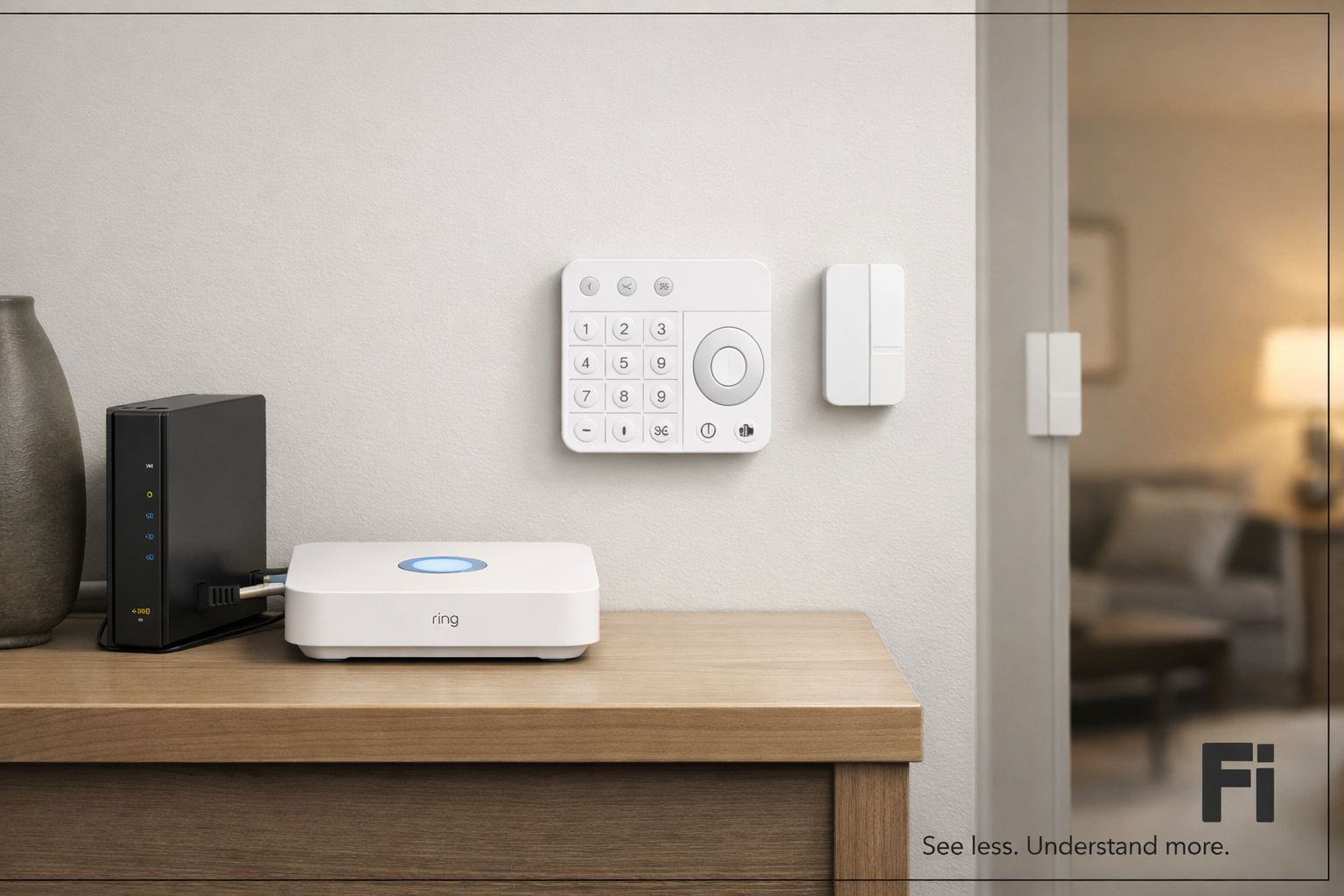
Ring Alarm Pro 8-Piece Kit — The Decision Factors Most People Miss
ANALYSIS FRAMEWORK
Alt text: Ring Alarm Pro 8-piece kit with keypad, contact sensor, and base station router in a modern entryway.
Opening Context — Why This Kit Feels “Bigger” Than a Typical Alarm
When people say a security system “just works,” they usually mean one thing: it reduces mental load. Ring Alarm Pro is designed to reduce mental load in two places at once—home security and home connectivity—because the base station can also act as an eero Wi-Fi 6 router.
That creates a very specific emotional split I see in user reactions:
- Relief: “Finally, one hub and one app that keeps the house stable.”
- Worry: “If this becomes my router, what happens when something goes wrong?”
If you already have a stable network you trust, your brain treats a router change as a high-risk move. If your Wi-Fi has been messy, the router-included idea feels like a rescue.
Primary keyword used naturally: Ring Alarm Pro 8-Piece Kit
Semantic variations included: DIY home security system, eero Wi-Fi 6 router base station, Ring Alarm kit, smart security sensors
Core Structural Explanation — What You’re Actually Buying (System-Level)
Most buyers look at the box and see “sensors and a keypad.” Structurally, you’re buying three layers that behave like one system.
Layer 1 — Intrusion detection (the obvious layer)
This is the familiar part: a base station, keypad, motion detection, contact sensors, and a range extender. In real life, this layer is about preventing two failures: false confidence and false alarms. People who rate systems highly usually felt the sensors were consistent, predictable, and didn’t require daily babysitting.
Layer 2 — Network centrality (the layer that changes everything)
Ring Alarm Pro can be positioned as the network gateway for the home. That single design choice changes the evaluation criteria from “Is the alarm good?” to:
- “Am I comfortable placing my internet traffic and my security brain in the same box?”
This is where satisfaction is won or lost. A buyer who understands this early usually ends up happy. A buyer who discovers it mid-setup often feels trapped or irritated—even if the hardware is fine.
Layer 3 — Capability activation (the layer people underestimate)
Many “smart” conveniences are plan-dependent across the smart security market, and Ring is no exception. When users complain, they’re rarely complaining about a dollar amount; they’re reacting to a feeling of gating—the sense that a product is “less complete” without a plan.
So the real question becomes: are you buying hardware only, or are you buying a service-supported system?
Hidden Technical Factors — Where User Satisfaction Really Comes From
This section is where people’s reviews typically reveal the truth—because it’s where daily friction shows up.
The “primary router” question is not a minor setup detail
If you plan to use Alarm Pro as your main router, you should treat this like a network decision, not a security accessory. The upside is cohesion: one backbone. The downside is the psychological cost: if anything goes wrong, it can feel like “my whole house is down,” not “one sensor is down.”
Alternative network setups exist, but complexity becomes the price
Some users try to keep their existing router and fit Alarm Pro around it. That can work, but the experience becomes “network design.” When people leave mixed reviews, it often traces back to this: they expected a simple install, but they ended up troubleshooting topology.
Coverage expectations must match reality (especially in busy homes)
Wi-Fi performance is not only about speed; it’s about consistency under load—streaming, calls, smart devices, and walls that hate radio signals. The built-in router can be excellent for many households, but people with dense device environments tend to be more sensitive to any weakness. The more devices you have, the more you should evaluate this as “infrastructure,” not a gadget.
Subscription psychology is real: predictability drives trust
Security is a trust category. Users stay loyal when they feel the cost/benefit is stable over time. When buyers talk about “value,” they’re usually talking about predictability—knowing what the system will do, and knowing what it will cost to keep it doing that.
Market Reality — What People Praise vs. What Makes Them Bounce
I’m going to summarize the patterns that show up most consistently in user sentiment:
Why people praise it
- Low mental load: set it up, expand it later, live your life.
- Ecosystem comfort: it feels coherent if you already lean Ring/Alexa.
- All-in-one clarity: security + Wi-Fi story feels clean and modern.
Why some people bounce off it
- Router replacement anxiety: “I don’t want to touch what already works.”
- Configuration friction: “I expected plug-and-play, but I’m troubleshooting.”
- Plan resistance: “I want the system to feel complete without extra layers.”
Here’s the key: none of these reactions are “irrational.” They’re perfectly logical responses to different household realities.
Decision Transition — The One Fit Question That Determines Everything
If I had to reduce the entire evaluation to one sentence, it would be this:
Are you comfortable letting your security base station also serve as a meaningful part of your home network—either as the primary router or as a planned component in your setup?
If “yes,” this product tends to feel unusually unified.
If “no,” even a good kit can feel like ongoing friction.
If you want the criteria applied directly to the kit and its real trade-offs, read the complete technical analysis → 🔗 [complete technical analysis]