Why a Security Camera System Can Look Great on Day One and Still Fail the Real-World Threshold
ANALYSIS FRAMEWORK
The first thing I look for in a security system is not whether the footage looks impressive on a product page. It is whether the system stays above the identification threshold when real life gets messy: a person moving across the frame, a driveway scene at dusk, a delivery at night, or a notification that arrives often enough to become background noise.
That is where the system either becomes trusted or slowly starts to drift out of the center of daily behavior.
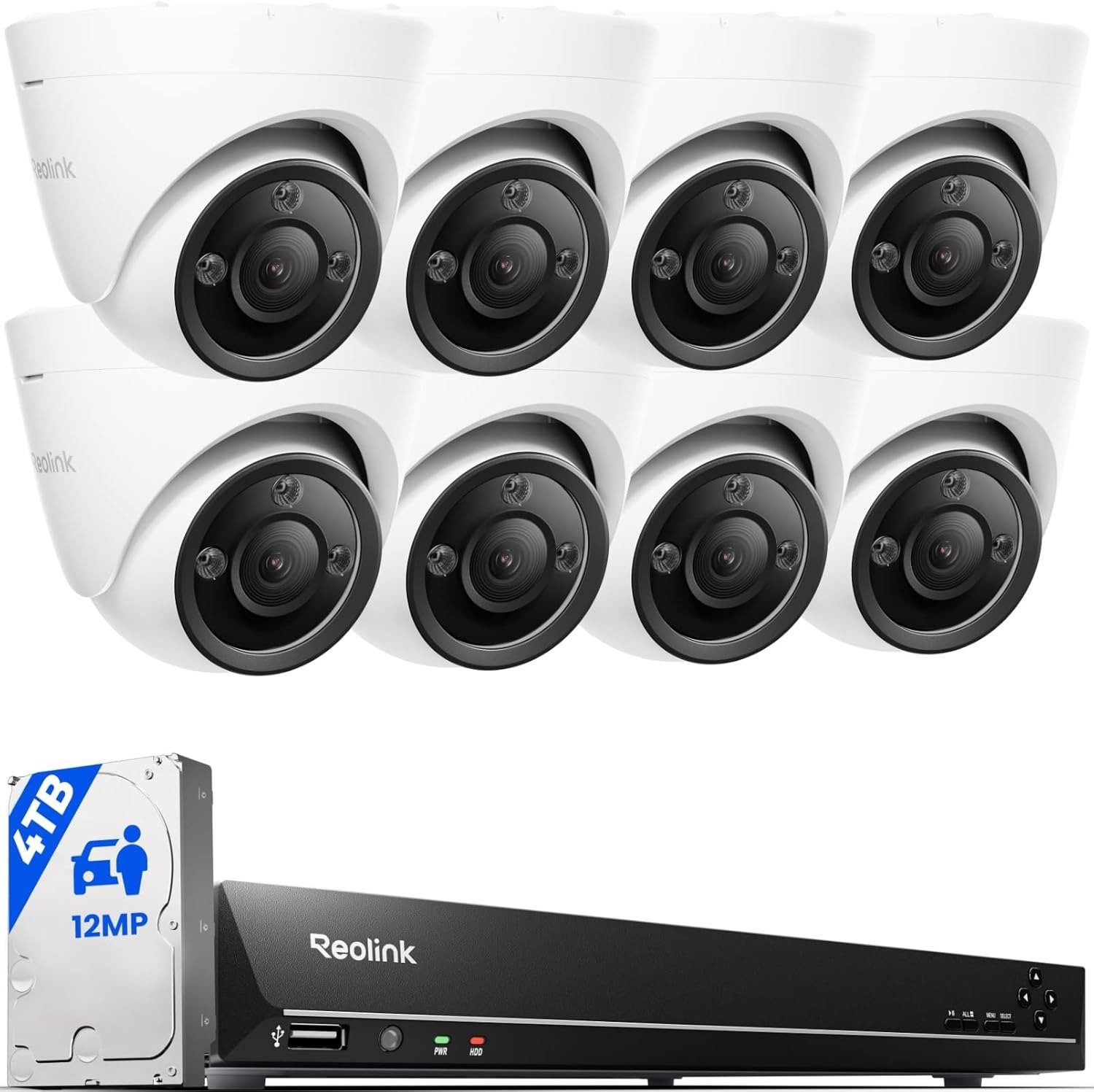
With the Reolink RLK16-1200D8-A, the reason people respond positively is easy to understand. On paper and in user feedback, it gives them several things that immediately reduce anxiety: 12MP capture at 4512×2512, local 24/7 recording, person/vehicle/pet detection, two-way audio, spotlight color night vision, and a 16-channel NVR with a 4TB drive already inside.
That combination does not feel like a toy. It feels like infrastructure.
What makes systems like this emotionally sticky is not hype. It is behavioral relief.
People stop worrying about batteries, subscription fees, and unstable Wi-Fi behavior because a wired PoE system changes the ownership feeling of the whole setup. In the feedback I reviewed, that pattern kept repeating: easy setup once the hardware is in place, better peace of mind from local recording, and a stronger sense that the system belongs to the house rather than to a cloud service.
But this is where the hidden threshold problem begins. A security system does not fail only when it stops recording. It can fail more quietly than that.
It can fail when the image remains sharp in daylight but loses practical separation under motion, when night color depends on the spotlight rather than pure sensor strength, when alerts improve only after tuning, or when storage expectations collide with the reality of eight 12MP streams recording around the clock.
That kind of drift does not look dramatic, but it changes how often the owner checks the system, trusts the alerts, and depends on the footage.
This is why higher resolution by itself is not the answer. I noticed that the strongest argument for this kit is not simply that it is 12MP. It is that the system tries to hold the threshold across several layers at once: detail, local retention, manageable alerts, wired stability, and expansion room.
Reolink says the NVR supports up to 24 cameras in total, with up to 16 wired cameras, and the included system pairs that recorder with eight dome cameras and built-in 4TB storage expandable to 16TB total. That matters because trust in a security system is cumulative.
It grows when the system survives time, not just first impressions.
At the same time, the weaknesses are not imaginary. The included D1200 cameras run at 20 fps by default, and community feedback around Reolink’s 12MP kits shows a recurring perception that the extra daytime clarity is real, but the jump is less dramatic at night and can feel less smooth on movement than strong 8MP/4K alternatives.
That does not make this kit weak. It simply defines the threshold honestly: this system is strongest when the buyer values detail, wired reliability, and local recording more than maximum fluidity under motion or an open, highly customizable ecosystem.
Psychologically, that distinction matters a lot. Most buyers in this class are not really buying “cameras.” They are buying a quieter mental loop.
They want fewer unknowns. They want to know that the side yard was recorded, that the driveway alert was not nonsense, and that footage will still exist when they need to look back days later.
Reviews and community discussions show that people tend to forgive the labor of running cable or the learning curve of alert tuning if the system eventually becomes predictable. They do not forgive unpredictability.
That is the real lens I would use here: not “Is this 12MP kit impressive?” but “At what point does it become operationally trustworthy?”
For me, the answer is simple. It crosses the threshold when the owner needs a wired, local-first, no-monthly-fee system with strong daytime detail, useful AI filtering, and enough recorder headroom to build beyond the starter layout.
It drops below the threshold when the buyer expects dramatic night superiority over good 8MP systems, frictionless installation, or a more open platform approach than this bundle is designed to provide.
When the System Starts to Feel Reliable Instead of Merely Impressive
The shift happens when the system stops being judged as a spec sheet and starts being judged as a habit.
Once alerts are tuned, camera angles are finalized, and the owner understands what 12MP detail actually improves versus what it does not, the product’s strengths become clearer: crisp daytime evidence, stable PoE operation, local archive control, and a straightforward path to broader coverage.
That is why people who want “real security infrastructure” react differently to it than people who are still shopping with consumer-gadget expectations.
If you want the direct buying judgment, this is the point where I would move to the decision article and look at whether the RLK16-1200D8-A stays above the practical security threshold for your property size, lighting conditions, and tolerance for setup work.
Transparency Note:
This analysis is not based on quick personal impressions.
It is derived from documented system behavior, verified user patterns, and the physical constraints of storage capacity.
The goal is to translate complex technical behavior into a realistic performance model that helps you make a clear decision

One Comment