Reolink Argus 4 Pro: The Point Where “Wide Coverage” Stops Being a Spec and Starts Being the Decision
Reolink Argus 4 Pro
You do not feel the problem when a camera misses the obvious.
You feel it when the footage looks good, the app says everything is fine, and you still know there is a blind stretch in the scene that your setup is quietly gambling with.
That is the real opening for the Reolink Argus 4 Pro.
Not because it is merely “4K.”
Not because it is solar.
Not because it says ColorX on the box.
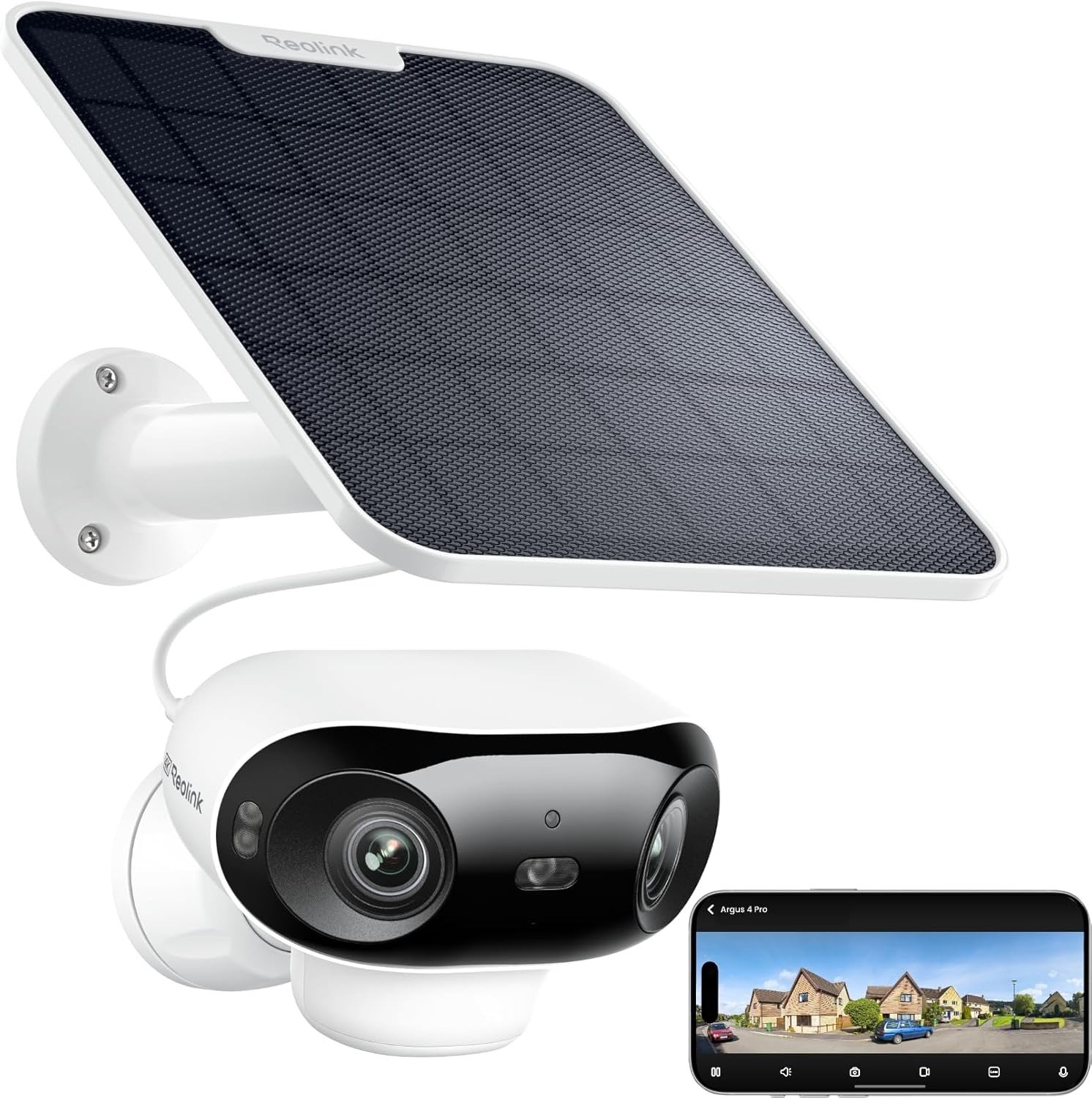
The real reason is narrower and more useful than that: it tries to solve the moment where one ordinary lens stops being enough, but a fully wired system still feels heavier than the problem you are actually dealing with. Reolink positions it as a dual-lens, battery-powered 180° camera with ColorX night vision, Wi-Fi 6, local storage, smart detection, and optional cloud support.
On paper, that is a long feature list. In practice, the whole product lives or dies on one threshold: when lateral scene width matters more than vertical detail, continuous recording, or perfect center-frame stitching.
The Result Looks Fine. The Problem Isn’t.
A lot of outdoor cameras fail in a boring way.
They give you a neat image of the doorway, the gate, or the driveway centerline, and they quietly leave the flanks to chance.
That is why wide-angle marketing works so easily. It flatters the buyer before it protects the property.
What I found, after lining up Reolink’s own spec sheet with field tests and long-form reviews, is that the Argus 4 Pro is not impressive because it is “premium.”
It is impressive because it addresses a specific kind of tension that normal battery cams handle badly: a broad horizontal scene where you want one mounting point instead of two cameras or one powered panoramic unit.
Reolink’s official numbers are clear: dual stitched lenses, 5120×1440 output, 180° horizontal field of view, 50° vertical field of view, battery power, triggered recording, and a maximum 512GB microSD slot.
Reviewers who used it in open yards and street-facing placements consistently praised how much width it covers from a single position, especially when compared with standard single-lens views.
The contradiction is the hook here: the footage can look calmer and more complete precisely because the camera is solving a layout problem, not because it is solving every surveillance problem.
That distinction matters.
| What looks solved at first glance | What actually matters later |
|---|---|
| “It sees more.” | It sees more side to side, not more in every direction. |
| “It’s 4K.” | The output is 5120×1440 at up to 15fps, which is panoramic, not conventional 3840×2160 4K framing. |
| “It’s wireless, so it’s easier.” | It is easier to place, but still bound by battery behavior, Wi-Fi conditions, and motion-trigger logic. |
| “It has AI detection.” | Detection quality still depends on placement, sensitivity, schedules, and whether you enable broad motion alerts. |
What You’re Actually Feeling but Not Naming
Most buyers do not walk around saying, “I need a dual-lens battery camera with a panoramic compression profile.”
They say something looser.
They say the front yard feels half-covered.
They say the side approach never looks as exposed as they thought it would.
They say the driveway is technically visible, but not in a way that settles the mind.
That feeling has a shape.
It is not fear.
It is coverage irritation.
The Argus 4 Pro is strongest when your annoyance is horizontal.
A broad driveway mouth.
A yard spanning fence to fence.
A front elevation where a visitor can enter from either side before landing in the center of frame.
Reolink’s own positioning leans into this exact use case, and multiple reviewers tested it in open exterior scenes with very little lighting, street frontage, or wide garden coverage where one camera replacing two is the real attraction.
The quiet truth is that many people buy a “better” camera when what they really need is a wider one.
That sounds like a small difference.
It is not.
The Hidden Mechanism Behind the Miss
The Argus 4 Pro’s core mechanism is simple enough to say in one line: two lenses, one stitched panoramic image.
Reolink says the camera uses dual-image stitching to produce a 180° field of view with minimal distortion, and the hardware stack around that includes twin 4mm lenses, a 1/1.8″ sensor, an F/1.0 aperture for ColorX low-light work, and H.264/H.265 compression.
That mechanism creates three gains at once:
| Mechanism | Practical gain | Hidden cost |
|---|---|---|
| Dual-lens stitching | One camera can cover a much wider frontage | Center seam can be the weakest visual area |
| F/1.0 + 1/1.8 sensor + ColorX | Full-color low-light footage without relying on IR | There is no infrared black-and-white night mode on the official spec sheet |
| Battery + 6W solar support | Fast, flexible installation with low wiring burden | Recording remains motion-triggered, not true 24/7 continuous capture |
This is where the product becomes more interesting than the usual “pros and cons” list.
The lack of IR is not just an omission.
It tells you what the camera is trying to be.
Reolink is betting that many buyers would rather keep recognizable color in dim scenes than switch to the flatter but often more predictable black-and-white IR style.
The official page says ColorX uses an F/1.0 aperture that captures four times more light, paired with a 1/1.8 sensor for improved low-light sensitivity.
Independent reviewers broadly support the upside: night footage can look unusually usable for a battery camera, especially in dim street-facing or garden scenes.
But there is another side to the mechanism.
A reviewer at Digital Camera World pointed out the stitched center can show a slight mismatch when a person stands directly in the seam, and also noted that the 5120×1440 panoramic feed creates a relatively narrow letterboxed view on phones, with frame rate topping out at 15fps.
That is not a deal-breaker.
It is the tax you pay for this design choice.
The Threshold Where the Outcome Quietly Breaks
Here is the threshold in plain language:
The Reolink Argus 4 Pro starts making unusually strong sense when your scene is wide enough that a standard single-lens battery camera forces either a compromise angle or a second unit.
Below that threshold, the product is overqualified.
Above that threshold, it becomes efficient.
I would define the break point like this:
| Scene condition | Threshold reading |
|---|---|
| Narrow porch, tight doorway, short path | Below threshold |
| Broad driveway entrance | Inside threshold |
| Yard or frontage where visitors can emerge from either edge | Inside threshold |
| Need for reliable vertical coverage over multiple depth layers | Borderline |
| Need for continuous 24/7 recording | Outside threshold |
| Need for the cleanest possible subject rendering dead center | Borderline |
This is not guesswork from branding language alone.
The official spec sheet is what sets the threshold: 180° horizontal, 50° vertical, triggered recording, PIR-based smart alarms up to 10m, battery power, and local/cloud storage choices rather than a wired always-on architecture.
Review coverage then fills in the lived edge cases: strong wide-scene usefulness, easy mounting, better night color than cheaper siblings, but also visible stitching limitations in the center and the constraints of panoramic framing on a phone.
That is the hidden variable most buyers miss.
They shop by resolution first.
This camera should be shopped by scene geometry first.
Why Most Buyers Misread This Too Early
The early mistake is easy to make because the sales page gives you so many shiny handles to grab.
4K.
Wi-Fi 6.
Solar.
Color night vision.
No subscription.
All true.
None of them is the real decision metric.
The real failure in early judgment is feature-led buying.
Buyers compare brand names, bitrate fantasies, app aesthetics, or whether the night shot looks dramatic in a promo image.
Meanwhile, the actual question is simpler: Do you have a one-camera width problem or not?
A second mistake shows up in how people interpret motion reliability.
Reolink’s own support documentation makes a crucial point: if “Any Motion” is enabled, alerts may be triggered by general movement such as lighting changes or tree sway, even when you only think you care about people, vehicles, or pets.
That sounds technical until you live with it.
Then it becomes battery drain, nuisance pings, and quiet mistrust of the whole setup.
Community feedback also points to real-world tuning friction, including one user who solved connection issues by moving the router closer and switching to 2.4GHz.
That gives us a more useful reading of the product:
| Buyer assumption | What the evidence says instead |
|---|---|
| “Wide view means fewer worries.” | Only if detection settings and placement are tuned properly. |
| “Battery + solar means set-and-forget.” | Battery life varies with settings, use, and temperature; solar helps, but workload still matters. |
| “No subscription means no trade-offs.” | Local storage is strong value, but battery cameras remain event-driven rather than continuous. |
| “4K means cleaner identification everywhere in frame.” | Panoramic width is excellent, but the center stitch and 15fps ceiling impose limits. |
The uncomfortable truth is that many bad camera purchases happen before installation.
The buyer uses the wrong ruler.
Who Is Actually Inside This Problem
This product is not for everyone.
That is why it is easier to trust.
It is a strong fit for people whose property problem looks like this:
| Fit profile | Why the Argus 4 Pro fits |
|---|---|
| One-camera coverage across a wide frontage | 180° horizontal field of view is the main point of the device |
| Outdoor placement where wiring is annoying or disproportionate | Battery design, solar support, and flexible mounting reduce installation friction |
| Buyers who want local storage without being forced into a monthly plan | microSD up to 512GB, Home Hub compatibility, and local-first positioning |
| Users who care about seeing color in low light | ColorX stack is explicitly built around low-light color capture |
| People who want quick remote checks rather than nonstop archival surveillance | Triggered recording, app playback, and mobile alerts support that use case |
I would go even narrower.
This is especially logical for the buyer who has been compensating with bad camera angles.
Tilting too high.
Mounting too far back.
Trying to “catch both sides” with one normal lens and ending up with neither side feeling fully owned.
That buyer is inside this problem.
Where Wrong-Fit Begins
This is not for the buyer who wants a camera to be a silent black box that never needs interpretation.
It is also not for the buyer whose top priority is any of the following:
| Wrong-fit priority | Why the fit weakens |
|---|---|
| Continuous 24/7 recording | Official recording mode is triggered recording; this is a battery camera |
| Tall vertical scene coverage | Vertical field of view is 50°, so this is a width-first tool |
| Perfect geometric rendering dead center | Panoramic stitching can show mismatch in the seam area |
| Loud, forceful two-way talk | At least one reviewer found the speaker underwhelming |
| Zero setup sensitivity | Motion schedules, zones, and Wi-Fi placement still matter |
And there is a more subtle wrong-fit that many people only discover after purchase: the evidence-security problem.
One reviewer noted the camera can be unscrewed and removed from its mount, which matters if your entire strategy depends on footage remaining on the device.
Reolink does support local storage and, in selected countries, cloud storage, but this product still rewards buyers who think through retention and placement rather than assuming the box solves the chain of evidence by itself.
That is where regret begins: not in bad image quality, but in a mismatch between what the buyer thought “wire-free” meant and what a battery camera can structurally promise.
The One Situation Where This Product Becomes Logical
Here is the cleanest version of it:
The Reolink Argus 4 Pro becomes logical when you need one wire-free camera to cover a broad outdoor approach, want local storage without subscription pressure, and care more about width and low-light color than about continuous recording or perfect seam-free subject rendering.
That is the sentence the product has been trying to say all along.
The technical case under it is solid.
Officially, you get 5120×1440 output at up to 15fps, dual 4mm lenses, a 1/1.8″ sensor, F/1.0 aperture, H.264/H.265, 180° horizontal coverage, person/vehicle/animal detection, 5000mAh battery, 6W solar panel support, dual-band Wi-Fi 6, IP66 weather resistance, two-way audio, Google Assistant support, microSD up to 512GB, Home Hub compatibility, and triggered recording with time-lapse support.
Third-party reviews broadly confirm the strengths that matter most: unusually wide one-camera coverage, easy installation, respectable low-light color, and strong value when local storage matters.
That is why the product authorization here is quiet rather than dramatic.
It does not earn a yes by being the best at everything.
It earns a yes by being unusually exact at one kind of job.
[Image Placeholder]
What It Solves, What It Reduces, and What It Still Leaves to You
The easiest way to trust a camera is to stop asking it to be something else.
| Category | What the Argus 4 Pro does well | What it still leaves to you |
|---|---|---|
| Coverage | Replaces the narrowness problem with a real panoramic field | You still need thoughtful height and angle placement |
| Night use | Preserves color in dim conditions through ColorX design | You must accept there is no IR fallback mode on the official spec |
| Installation | Removes power-cable friction and supports solar top-up | You still need decent Wi-Fi and sane solar placement |
| Ownership cost | Local storage avoids forced monthly fees | Storage strategy still matters if camera theft is a concern |
| Alerts | AI categories and custom zones improve relevance | Bad schedules or “Any Motion” settings can still create noise |
| Daily use | Easy app access, playback, and remote viewing | You still need to tune sensitivity to your environment |
This is where the product becomes more respectable to me.
It is not pretending to erase maintenance.
It is reducing the right maintenance.
You are trading cable work, blind flanks, and subscription pressure for a different kind of responsibility: placement discipline, alert tuning, and honest expectations about what a panoramic battery camera can and cannot do.
Final Compression
Here is the whole decision reduced to one line:
If your real break point is horizontal coverage from a single wire-free mounting position, the Reolink Argus 4 Pro is one of the clearest logical answers in its class.
If your break point is continuous recording, tall vertical framing, or flawless center-frame stitching, it is the wrong answer no matter how attractive the spec sheet looks.
That is the cleanest way to leave it.
Not with hype.
With the threshold named.
If this is the condition you are actually dealing with, this is the logical next step.
Transparency Note:
This analysis is not based on quick personal impressions.
It is derived from documented system behavior, verified user patterns, and the physical constraints of storage capacity.
The goal is to translate complex technical behavior into a realistic performance model that helps you make a clear decision