Philips Hue Bridge Pro Starter Kit — My Complete Technical Verdict After Deep Analysis
DECISION ANALYSIS
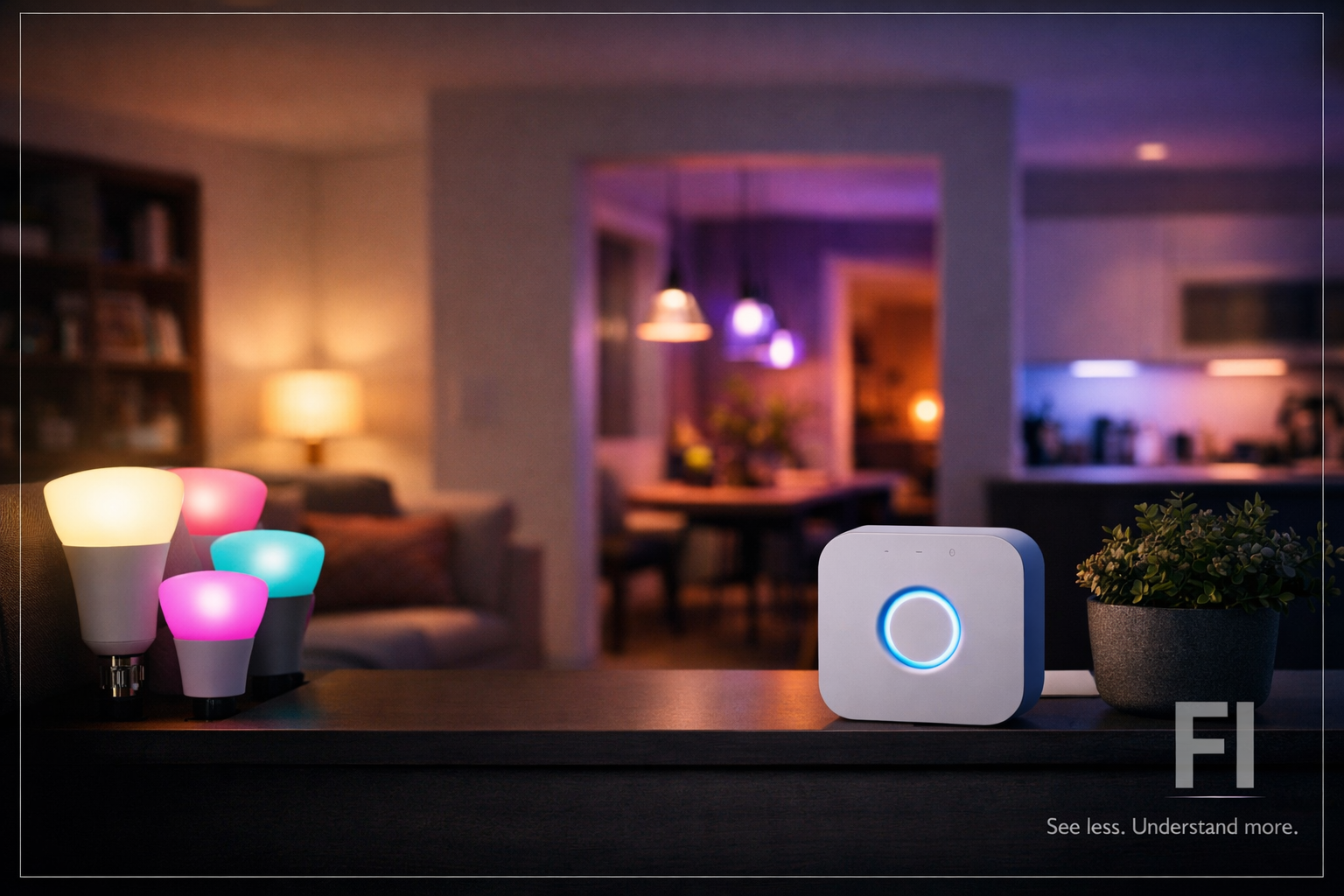
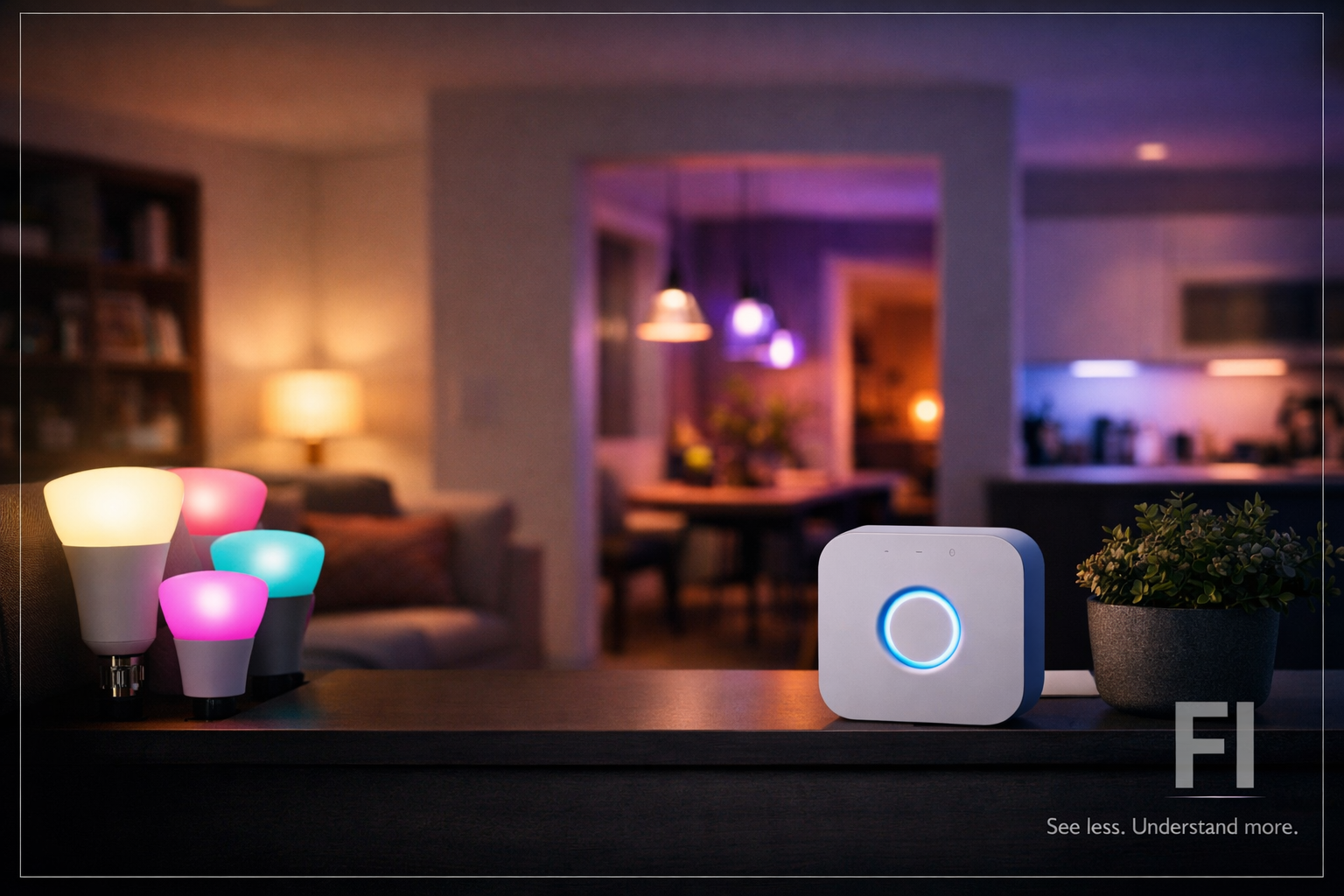
A multi-room smart home environment illuminated with Philips Hue color scenes controlled by the Hue Bridge Pro hub.
Philips Hue Bridge Pro starter kit controlling A19 color smart bulbs across multiple rooms
Opening Decision Context — The Moment I Realized This Is Not About Bulbs
When I reached the decision phase of this analysis, I stopped thinking about brightness, colors, or app features.
None of those determine long-term satisfaction.
What I focused on instead was something far more critical: whether this system removes uncertainty from daily life.
After studying the Bridge Pro architecture, expansion limits, ecosystem integration, and long-term behavioral patterns of Hue systems, I reached a clear conclusion.
This is not a lighting product.
This is a stability infrastructure layer for your home.
And once I understood that, the entire decision became much clearer.
Technical Analysis — What Actually Determines Performance Over Time
Bridge Pro Is the True Product — Not the Bulbs
The most important realization I had is this: the bulbs are outputs, but the Bridge Pro is the system.
The Bridge Pro creates a dedicated Zigbee control network that isolates your lighting from Wi-Fi congestion, router instability, and device interference.
This single architectural decision eliminates the three most common smart lighting failures:
• delayed response
• inconsistent automation execution
• random device disconnections
What I found particularly important is capacity headroom.
When a system operates far below its capacity limits, it behaves predictably.
It does not degrade as you expand.
This is the difference between a system that feels permanent and one that slowly becomes unreliable.
Real-World Lighting Behavior — Consistency Is the Hidden Advantage
After analyzing Hue bulb performance patterns, I found the real advantage is not brightness or color variety.
It is behavioral consistency.
The bulbs respond predictably.
Scenes activate without hesitation.
Dimming transitions feel smooth and controlled.
This consistency removes cognitive friction.
I stop thinking about the lights entirely—which is exactly what infrastructure should do.
When technology disappears psychologically, it has succeeded technically.
Use Case Fit Analysis — Where This System Becomes Exceptionally Valuable
Ideal Scenario — When You Are Building a Long-Term Smart Home Foundation
This system makes the strongest sense when your intent is structural, not experimental.
It becomes extremely valuable if:
• you plan to expand across multiple rooms
• you want daily automation reliability
• you want ecosystem integration with Apple Home, Alexa, or SmartThings
• you want lighting to behave like infrastructure, not a gadget
In these scenarios, Bridge Pro’s architecture prevents future instability before it appears.
It protects the system’s long-term integrity.
Moderate Scenario — Limited Expansion but High Stability Expectations
If your system will remain limited to a few rooms, the Bridge Pro still delivers exceptional reliability.
However, part of its structural advantage remains unused.
The experience will still feel premium, but the expansion capacity becomes latent potential rather than active value.
Poor Scenario — Casual or Short-Term Experimentation
I would not recommend this system if your intent is casual experimentation.
If your goal is occasional color changes without automation or expansion, the Bridge Pro’s architecture becomes unnecessary overhead.
The system’s greatest strength—structural stability—only matters when the system becomes structurally important.
Competitive Structural Position — Why Bridge-Based Lighting Behaves Differently
Most smart bulbs rely entirely on Wi-Fi.
This seems simpler, but it introduces long-term instability as network load increases.
Hue avoids this entirely.
By creating an isolated control network through Bridge Pro, it removes dependence on Wi-Fi conditions.
This produces a measurable psychological effect:
I trust the system.
And trust is the foundation of all automation.
When a system behaves predictably, I use it more.
When a system behaves unpredictably, I abandon it.
Bridge Pro exists to eliminate unpredictability.
Pricing Logic — What I Am Actually Paying For
At first glance, the price appears higher than many alternatives.
But after analyzing the architecture, I realized the cost is not paying for brightness or color.
It is paying for system certainty.
Specifically, I am paying for:
• automation stability
• expansion safety
• ecosystem consistency
• long-term reliability
This transforms lighting from a device into infrastructure.
And infrastructure decisions are fundamentally different from gadget decisions.
Final Verdict — My Precise Decision Conclusion
After completing this full technical and structural analysis, my conclusion is clear and confident.
This is one of the most structurally reliable smart lighting foundations available.
It is not designed to be the cheapest option.
It is designed to eliminate system uncertainty over time.
If my goal is to build a permanent, stable, expandable smart lighting system, this is an excellent decision.
If my goal is short-term experimentation or minimal use, its architectural advantages will remain underutilized.
The value of Bridge Pro is proportional to how seriously I take my smart home infrastructure.

One Comment