THE IMAGE GETS HUGE FAST. THAT DOES NOT MEAN THE DECISION IS EASY.
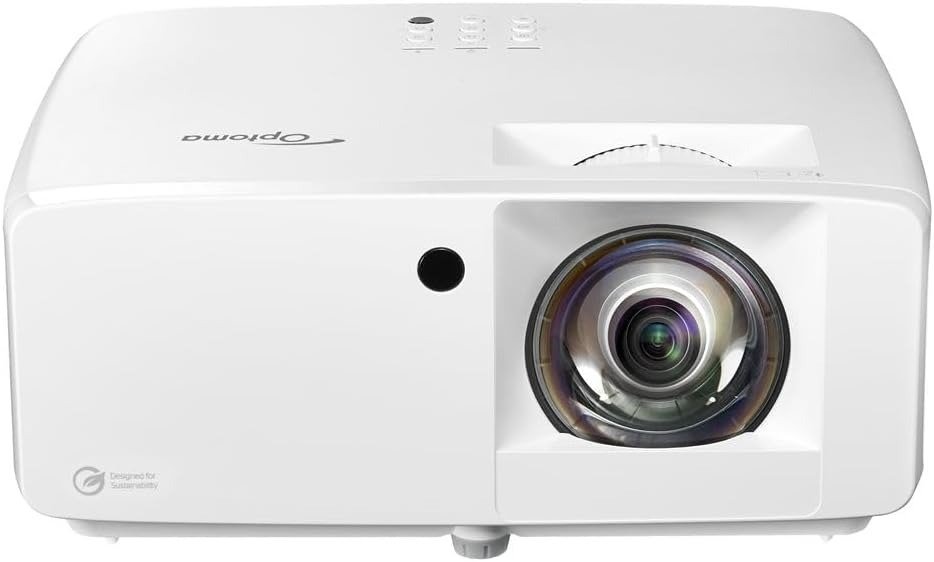
A lot of projector regret starts the same way. You throw a massive picture on the wall, step back, and for ten seconds it feels like you cheated physics. The room is small. The image is enormous. The box is not. Then the second layer arrives. The blacks are not as deep as you imagined. The colors do not bloom the way your memory promised. The built-in speaker sounds like the movie got trapped inside a plastic lunchbox. That is the real split with the Optoma GT2100HDR. It impresses quickly. It also reveals its limits quickly.
This is not a bad projector. It is a narrow one. And narrow products are dangerous when people read them like broad solutions.
THE RESULT LOOKS FINE. THE PROBLEM ISN’T.
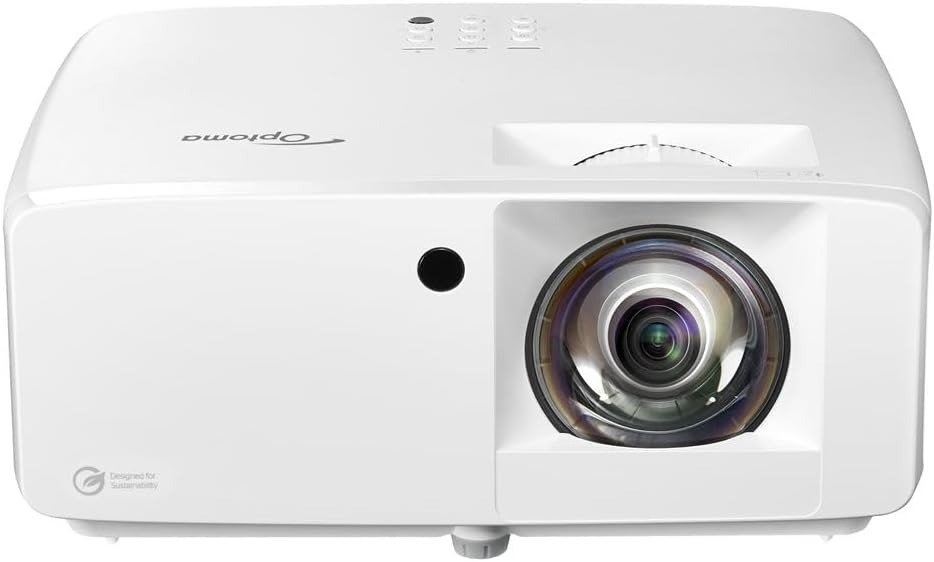
The first thing this projector does well is obvious: it throws a very large image from very little distance. Optoma says it can produce a 120-inch image from 4 feet 4 inches away, and the official spec sheet lists a 0.496:1 throw ratio with a 0.4–3.2 meter projection distance. That is not marketing fluff. That is the core of the machine.
So the early impression is seductive. Small room. Close placement. Big screen. Bright picture. Officially, Optoma rates it at 4,200 lumens, while Tom’s Guide measured 3,012 ANSI lumens in testing—still a genuinely strong result for a home-oriented short-throw unit, even if lower than the headline spec.
That is where many buyers stop thinking. They see “short throw,” “laser,” “HDR,” and “4200 lumens,” and the brain quietly fills in the rest: cinema, immersion, convenience. But the projector does not live in those words. It lives in trade-offs.
WHAT YOU’RE ACTUALLY FEELING BUT NOT NAMING
If you are drawn to the GT2100HDR, you are probably not chasing a projector in the abstract. You are trying to escape one of three practical annoyances.
You do not have room depth.
You do not want bulb anxiety.
You do not want laggy gameplay on a huge image.
That matters, because those are not the same problem.
I see this mistake all the time in projector shopping. Someone thinks they are buying “better movie nights.” What they are really buying is distance relief. Or maintenance relief. Or console responsiveness on a wall-sized screen. When those needs stay unnamed, the wrong projector starts to look right.
The GT2100HDR is strongest when your pain is spatial and operational before it is cinematic. Its compact chassis, laser light source, IP6X-rated optical engine, and 30,000-hour rated life all point in that direction: less placement stress, less lamp churn, less day-to-day fuss.
THE HIDDEN MECHANISM BEHIND THE MISS
The hidden variable here is not brightness. It is brightness under expectation.
Bright projectors often win the room before they win the image. They cut through ambient light, survive imperfect spaces, and keep sports, games, and casual viewing from collapsing the moment a lamp is on. The GT2100HDR clearly does that part well. Optoma positions it for lights-on sports and gaming, and Tom’s Guide’s measured brightness supports the claim that it stays usable where dimmer lifestyle projectors start to look washed out.
But brightness is not the whole picture. Tom’s Guide measured the GT2100HDR at 90% sRGB and 74% DCI-P3, then explicitly criticized its color performance and weak HDR impact. That is the mechanism buyers miss. A bright image can look “impressive” from across the room and still feel a little thin once you sit down and wait for texture, depth, and richer color separation.
That is why this projector can feel excellent for one buyer and overpriced for another without either person being irrational. They are reacting to different layers of the same image.
THE THRESHOLD WHERE THE OUTCOME QUIETLY BREAKS
This article runs on one model only: Threshold.
The threshold is simple:
The GT2100HDR makes sense until your expectation moves from “I need a huge, bright, low-hassle image in a tight room” to “I want rich, cinema-first picture quality with convincing HDR.”
Below that line, the product feels sharp, practical, even liberating.
Above that line, it starts to feel expensive for what it leaves out.
You can see the threshold in the numbers:
| Metric | Optoma GT2100HDR | What It Means |
|---|---|---|
| Native resolution | 1920 x 1080 | Sharp enough for most living-room use, but still not native 4K |
| Measured brightness | 3012 ANSI lumens | Strong for brighter rooms and daytime flexibility |
| Claimed brightness | 4200 lumens | Marketing headline, but real-world measured output is lower |
| Measured contrast | 2370:1 | Better than many casual projectors, decent image depth for mixed use |
| sRGB coverage | 90% | Acceptable, not rich |
| DCI-P3 coverage | 74% | Limited HDR color reach |
| Input lag | 25–26ms in testing | Responsive enough for gaming, especially compared with many projector rivals |
| Supported gaming mode | 1080p 120Hz at 8.6ms; 4K input at 1080p 60Hz around 17ms | The gaming story is real, but it is still a 1080p display at heart |
| Audio output | 15W mono, 3.5mm audio out, no HDMI ARC/eARC | Fine for basic sound, awkward for cleaner home theater audio paths |
That table tells the truth more cleanly than most projector pages do. This machine crosses the threshold beautifully for room difficulty and gaming speed. It does not cross it beautifully for cinematic richness.
WHY MOST BUYERS MISREAD THIS TOO EARLY
Because projector shopping is full of borrowed vocabulary.
People say “HDR” when they mean “more depth.”
They say “laser” when they mean “less maintenance.”
They say “4200 lumens” when they mean “I do not want a washed-out mess at 2 p.m.”
The GT2100HDR is especially easy to misread because the spec sheet stacks reassuring words in a very efficient order: laser, HDR input, short throw, gaming mode, 120Hz, compact, eco-friendly. Each one is true. Together, they can accidentally imply a more rounded premium projector than this really is.
Tom’s Guide cut straight through that illusion. Their verdict praised brightness, contrast, and gaming responsiveness, but criticized weak color, weak audio, the lack of a smart platform, and the overall value proposition at review pricing. That is not a contradiction. It is the product’s shape.
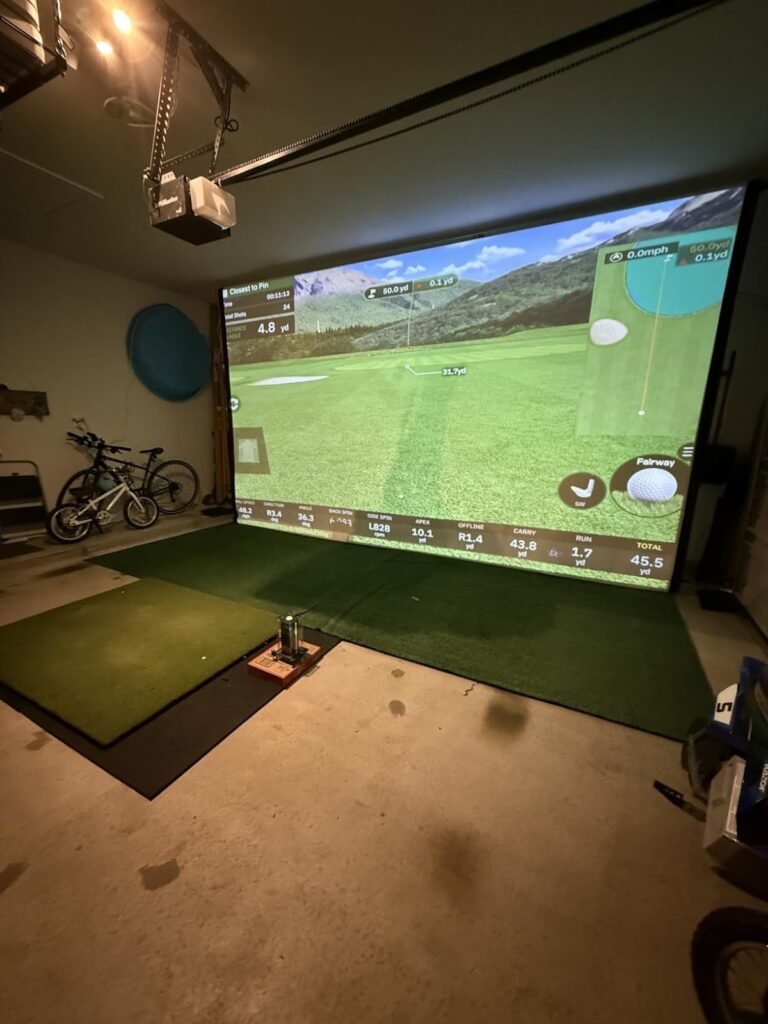
And owner feedback shows the other side of the picture. Best Buy reviewers repeatedly praised picture quality, brightness, and the short-throw convenience, while at least one user specifically called out alignment options as not especially easy and another noted it worked well in a home golf simulator. That combination makes sense: the product solves placement pain very well, but it still asks you to live with installation discipline and some setup friction.
WHO IS ACTUALLY INSIDE THIS PROBLEM
You are inside this problem if your room or routine looks like one of these:
You want a 100–120 inch image without pushing the projector deep into the room.
You watch with some ambient light, not just blackout-theater conditions.
You play on console or PC and care whether controls feel late on a giant screen.
You want laser longevity and less maintenance drama instead of bulb replacement cycles.
You do not need the projector itself to be smart because you are happy to attach an external streamer or receiver.
Psychologically, this buyer is usually tired of compromise in one specific area: room geometry. Not image theory. Not calibration hobbyism. Just the blunt annoyance of trying to make a big picture work in a space that does not want to cooperate.
That is where the GT2100HDR starts to feel less like a gadget and more like an answer.
WHERE WRONG-FIT BEGINS
Wrong-fit begins the moment you quietly expect this projector to be your all-in-one cinema centerpiece.
Not because it is incapable. Because it is selective.
It has no built-in smart TV platform. Focus is manual. Keystone is available, but reviewers describe the adjustment process as more tedious than modern auto-setup lifestyle projectors. Audio handoff is limited, with no HDMI ARC or optical out, only a 3.5mm jack unless your source chain handles sound separately.
That means the GT2100HDR is the wrong fit for buyers who want:
- the clean simplicity of modern smart projectors
- richer out-of-box color as the priority
- built-in audio good enough to stop thinking about speakers
- a movie-first machine where HDR “wow” matters more than brightness margin
And there is one more quiet boundary: expectation inflation from DLP brightness. Some users love the punch. Some buyers, especially those sensitive to DLP artifacts, may want to be cautious. I am not overstating that risk here because I did not find a strong body of model-specific testing on rainbow effect for this projector, but it is a category-level consideration worth keeping in the back of your mind with single-chip DLP designs. The broader lesson is the same: bright is not the same as lush.
THE ONE SITUATION WHERE THIS PRODUCT BECOMES LOGICAL
Here is the one situation where the Optoma GT2100HDR stops being vague and starts being precise:
You need a bright, short-throw, low-latency projector for a smaller room, mixed lighting, and regular gaming, and you are willing to handle streaming and serious audio outside the projector itself.
In that scenario, the product becomes cleanly rational.
Not magical.
Not universal.
Rational.
Because then the strengths line up:
- big image from close range
- real gaming responsiveness
- strong measured brightness for the class
- laser longevity and low-maintenance ownership
And the weaknesses become manageable instead of fatal:
- average-to-weak HDR color becomes less painful in sports and games than in film-first viewing
- bad onboard audio matters less if you already planned for external sound
- no smart OS matters less if you already use Apple TV, Chromecast, a console, or an AVR
That is the entire authorization. No fantasy needed.
WHAT IT SOLVES, WHAT IT REDUCES, AND WHAT IT STILL LEAVES TO YOU
This projector solves three things very well:
| It Solves | How |
|---|---|
| Depth pressure | 0.50:1 short throw makes large images possible without long-room placement |
| Bulb maintenance anxiety | Laser phosphor light source rated up to 30,000 hours |
| Projector gaming sluggishness | Low tested lag and 120Hz support keep controls feeling immediate |
It reduces three common frustrations:
- the feeling that a projector is only usable in full darkness
- the need to mount far back in a room
- the usual “this looks huge but feels slow” problem in gaming
But it still leaves three responsibilities to you:
- audio planning — the built-in 15W mono speaker is not serious home theater sound
- source planning — there is no built-in smart platform
- expectation control — HDR compatibility is not the same thing as rich HDR color impact
That last one is the trapdoor. Ignore it, and this projector feels overpriced. Respect it, and the product becomes much easier to judge fairly.
FINAL COMPRESSION
The Optoma GT2100HDR is not the projector you buy because you want the most beautiful image at any cost. It is the projector you buy when the room itself is part of the problem, and you are tired of pretending that room constraints do not change the decision.
I would summarize it this way:
If your break point is space, brightness, and gaming delay, the GT2100HDR is one of the cleanest answers in its lane. If your break point is color richness, integrated audio, and cinema-first HDR, this is where the fit quietly ends.
That is the threshold.
And once you can name the threshold, the decision stops wandering.
Transparency Note:
This analysis is not based on quick personal impressions.
It is derived from documented system behavior, verified user patterns, and the physical constraints of storage capacity.
The goal is to translate complex technical behavior into a realistic performance model that helps you make a clear decision.
“A quick note: Don’t believe the star ratings, but trust personal experience. This article is a compilation of collected experiences”