NuWave OxyPure Review: When It Actually Fits and When It Does Not
DECISION ANALYSIS
The hook that pulled me into the NuWave OxyPure was not the promise of cleaner air. Every serious purifier promises that. What made me stay with this one longer was a harder question: does it reduce enough real-world friction to justify its size, cost, and maintenance style once the first week is over?
After comparing lab results, retailer data, category recommendations, and owner reactions, I do not think the OxyPure is a universal answer. I think it is a very specific answer to a very specific kind of household problem. And once I looked at it that way, its strengths and limits became much clearer.
My Governing Model — Livability Threshold
I am using one model only here: Threshold.
For me, the NuWave OxyPure becomes a strong buy only when a home crosses a certain practical line:
- the room is big enough that weaker units start feeling symbolic
- the irritation is recurring enough that auto-sensing matters
- the user cares about long-term filter replacement cost
- the user can tolerate some filter-cleaning involvement
- the machine will usually run on low-to-moderate settings, not max blast all day
If that threshold is not met, the OxyPure starts to look oversized, overcomplicated, or simply more machine than the space really needs.
What I Think It Does Exceptionally Well
The strongest case for the OxyPure is not one magic feature. It is the way several useful traits stack together.
| Area | What I found | What it means in daily use |
|---|---|---|
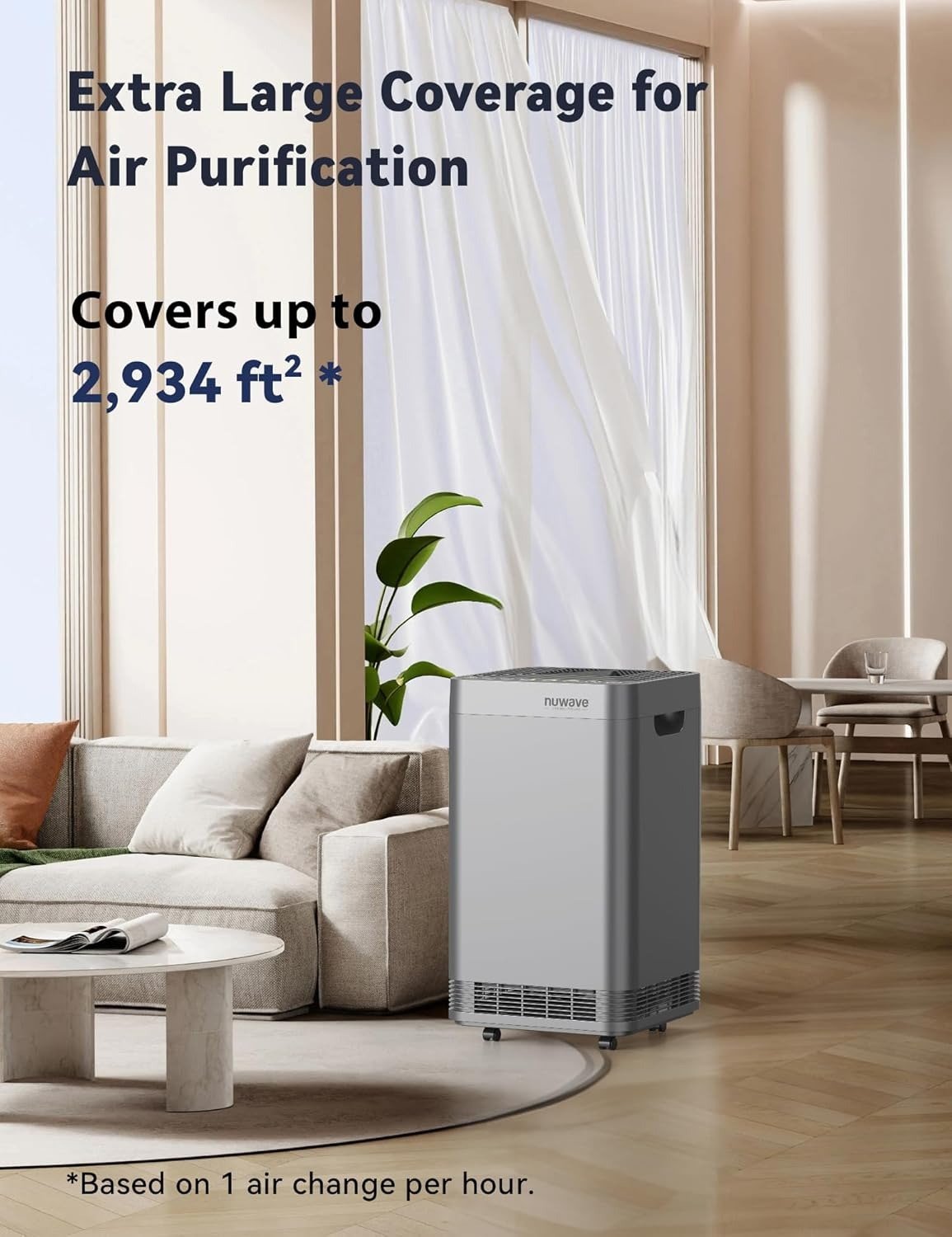
| Real cleaning power | RTINGS measured 323 CFM PM1.0 CADR and recommends it for about 605 sq ft at max speed | It has real open-space credibility, not just small-room comfort |
| Filtration structure | 5-stage system with washable steel pre-filter, Bio-Guard filters, ozone-removal filter, and yearly HEPA/carbon filter | Better ownership story if I dislike frequent replacement buying |
| Automation | Particle sensing, odor sensing, Auto mode, Eco mode, timer, app monitoring, filter-health visibility | Less babysitting once placement and routine are set |
| Low-speed comfort | RTINGS measured 32.3 dBA on the lowest speed | Easy to live with when I am not demanding maximum cleaning |
| Category standing | RTINGS currently ranks it as the best overall air purifier they have tested | It is not an obscure pick without lab credibility |
That package is why this unit keeps getting attention despite its premium positioning. It is trying to solve the whole ownership equation, not just the airflow part. Amazon also flags it as Amazon’s Choice, notes 50+ bought in the past month, and identifies the brand as highly rated with low returns at the brand level, which at minimum suggests it has sustained shopper traction rather than being a dead listing.
Where I Think the Fit Is Strongest
I would put the strongest fit into these buckets:
| Fit Level | Who this suits |
|---|---|
| Excellent Fit | Open-concept living rooms, large family spaces, pet-heavy homes, homes where cooking smells or everyday particulate load keep returning |
| Good Fit | Large bedrooms, studio apartments, main shared spaces where I want app control and less disposable-filter churn |
| Acceptable Fit | Smaller rooms where I deliberately want extra overhead and do not mind paying for it |
| Poor Fit | Minimalist users who want low-effort ownership and do not want to wash filters on a schedule |
| Wrong Fit | People needing whisper-quiet high-output operation all the time, or anyone expecting one machine to “fix the whole house” across many closed rooms |
That split matters because the OxyPure is not a casual appliance. At its best, it feels like infrastructure for a recurring air problem. At its worst, it feels like an expensive tower asking for attention.
The Trade-Off I Would Not Hide
The trade-off is simple:
This machine reduces replacement burden by increasing cleaning involvement.
That is the heart of the product.
RTINGS praises the reusable filtration approach because it keeps ownership costs down, but they also flag the same system as a source of friction because there are many filters to clean. Amazon’s own listing reinforces the idea: washable and reusable components are central to the pitch, but the HEPA/carbon filter still needs replacement roughly every 12 months.
So the real question is not whether washable filters are “better.” The real question is whether that maintenance style matches my habits.
If I would rather rinse and maintain than keep reordering filter sets, the OxyPure becomes more attractive over time. If I know I ignore cleaning tasks until they become annoying, the same design starts working against me.
What I Think People Are Actually Responding To
Psychologically, I think this category splits buyers into two camps.
One camp wants visible control: more stages, more sensors, more modes, more feedback, more confidence that something serious is happening. The OxyPure speaks directly to that mindset. It gives me app access, air-quality readings, filter alerts, six fan speeds, Auto, Eco, Turbo, and a filtration story that sounds engineered rather than generic.
The other camp wants background relief: a machine they barely have to think about, preferably compact, quiet, and simple. That is where the OxyPure can lose emotional momentum. Even when performance is good, a larger premium purifier with several filter elements and louder top-end behavior can feel like “a system” rather than a quiet household object. RTINGS directly notes the high-speed noise, and user commentary shows that reliability anxiety and feature complexity can quickly color perception when the product sits in the premium tier.
That is why I would never sell this as universally reassuring. It reassures a very particular kind of buyer: the one who feels calmer when the machine looks and behaves like serious equipment.
The Comparison That Helped Me Most
The cleanest way I see the OxyPure versus the rest of the market is this:
| Category Option | Strength | Limitation |
|---|---|---|
| NuWave OxyPure | Strong large-room performance, reusable-filter angle, rich automation, highly rated by RTINGS | Higher complexity, more cleaning tasks, loud on high |
| Levoit Core 600S | Simpler three-stage system, still strong airflow, smaller footprint | Fewer specialized filtration elements, more conventional disposable approach |
| Coway / value-oriented mainstream picks | Easier value logic, often simpler ownership | Usually less ambitious in large-space “all-in-one” positioning |
| DIY Corsi-Rosenthal box | Raw performance value can be outstanding | Ugly, bulky, noisy, and missing the lifestyle refinement most people want |
That is also why mainstream review ecosystems do not always crown the same winner. RTINGS likes the OxyPure enough to rank it first overall, while broader review summaries note that many mainstream recommendations still cluster around Coway and Levoit for simpler value. That does not make the OxyPure overrated. It means it wins on a different axis: strong performance plus a particular ownership philosophy.
My Verdict
If I had a large shared room, recurring pet or cooking odor load, noticeable dust or allergy irritation, and I cared about reducing long-term filter replacement churn, I would take the NuWave OxyPure seriously. It clears the Livability Threshold for that environment because it has real airflow, smart control, and a maintenance model that can make financial sense over time.
If I wanted a simpler purifier for a smaller room, or I knew I would resent washing and managing multiple filter elements, I would not force this fit. I would rather buy something more modest and live with less machine.
So my conclusion is narrow, but confident:
The NuWave OxyPure is not compelling because it is premium. It is compelling when the room is large, the air problem keeps returning, and I am willing to trade some maintenance attention for strong performance and lower recurring filter dependence.
Transparency Note:
This analysis is not based on quick personal impressions.
It is derived from documented system behavior, verified user patterns, and the physical constraints of storage capacity.
The goal is to translate complex technical behavior into a realistic performance model that helps you make a clear decision