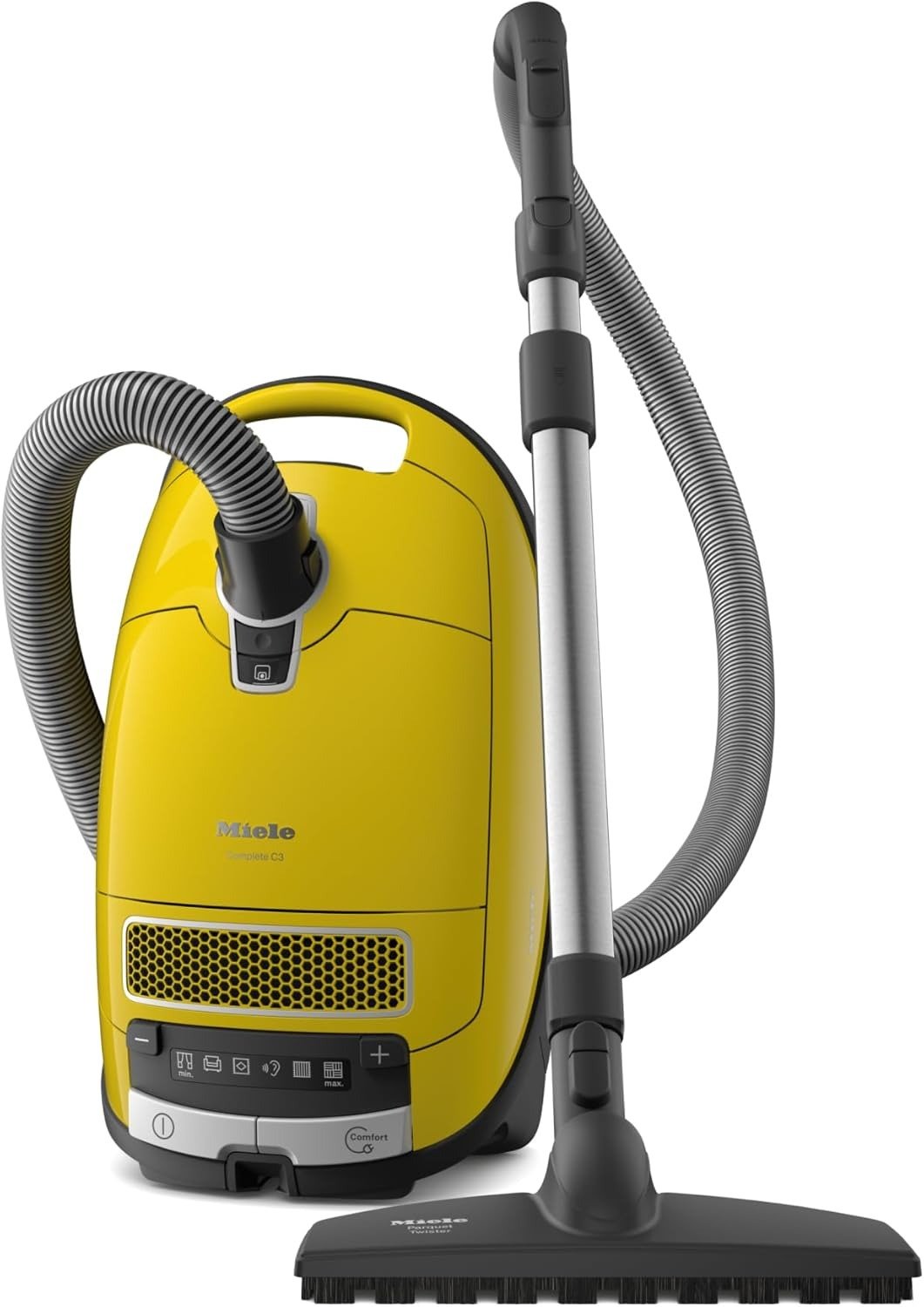
Miele Complete C3 Calima Review: Where It Feels Exceptional, and Where It Starts to Slip
DECISION ANALYSIS
After going deep into the Miele Complete C3 Calima, my conclusion is very clear: this is not a weak vacuum pretending to be premium. It is a genuinely refined vacuum with a very specific operating threshold.
When I look at what it includes — a 1200W C3 platform, HEPA filtration, a Turbo Brush floorhead for low-to-medium pile carpet, a Parquet Twister for hard floors, integrated tools, foot controls, and a 36-foot operating radius — the design intent is obvious.
This machine was built to feel controlled, hygienic, and highly effective in homes dominated by smooth floors and lighter rugs.
What changed my view was not the spec sheet alone. It was the consistency of the pattern in hands-on reviews and lab-style testing.
On hard floors, this machine earns its reputation. On low-pile carpet, it can still perform well. But once the cleaning demand shifts toward thicker carpet, heavy hair load, or the kind of embedded mess people expect a powered carpet nozzle to attack, the Calima starts to feel less like a universal premium vacuum and more like a highly specialized one.
What Felt Genuinely Strong in Real Use
The first thing I would praise is how composed the Calima feels. People repeatedly describe the C3 chassis as quiet, smooth, and easy to pull, and that matched what I expected from the design.
The telescopic wand, foot controls, built-in accessory storage, cord rewind, and long cleaning radius are not glamorous features, but in use they matter more than dramatic headline claims. They reduce friction. They make the machine feel deliberate. And over time that kind of ease leaves a stronger memory than raw suction numbers alone.
On hard flooring, the Calima makes immediate sense. The Parquet Twister is specifically built for sensitive hard floors, and the machine’s filtration system is one of its strongest trust signals.
Miele states dust retention up to 99.999% for the HEPA Lifetime Filter on the Amazon listing, while the operating documents and accessory materials emphasize HEPA and hard-floor suitability across the C3 ecosystem. Independent testing also found excellent filtration and very strong hardwood results. That combination is exactly why this vacuum feels so reassuring in cleaner, dust-conscious homes.
Where the Threshold Starts Showing
The Calima’s main limit is not mysterious once I strip the marketing away. It uses a suction-driven turbo brush, not a true electric carpet powerhead.
Miele’s own accessory guidance makes the intended use pretty clear: the TurboTeQ is for short-pile carpets, while more intensive carpet work in the C3 family is associated with electrobrush-equipped models.
In practice, that distinction turns into the entire story. That is why the mixed feedback does not actually conflict.
One owner with hard floors and area rugs said the suction was so strong the floors looked mopped and rarely needed a second pass. Another buyer in a much larger carpet-and-pet household said the vacuum took multiple passes and still left carpet behind.
Independent testing landed in the middle: very good hardwood cleaning, decent low-pile carpet pickup, major drop-off on high-pile carpet, and weak pet-hair performance for the price.
When I line those reactions up, the machine reads as consistent, not contradictory. The environment changed. The threshold was crossed.
The Drift Most Buyers Misread
The longer I studied the Calima, the more I noticed a behavioral-time drift pattern.
At first, many premium vacuums impress through smoothness, quietness, and immediate hard-floor performance. Over time, the real test becomes repetition: same rugs, same corners, same pet hair, same upstairs carpet, same transitions between surfaces.
That is when the wrong buyer starts feeling friction. More passes. More head cleaning. More tangling. More doubt. The machine has not suddenly become bad. It has simply become misaligned with the household’s ongoing cleaning load.
I also think this explains why some people love the Calima while others feel almost betrayed by it. The vacuum performs beautifully inside its design window, and because everything else about it feels premium, buyers unconsciously assume the window is wider than it is.
That is not a small psychological detail. It is the core of the buying experience.
Compatibility Split 3.0
User Type | Fit Level | Why
Mostly hard floors, wood, tile, delicate surfaces, a few rugs | Strong fit | This is where the Parquet Twister, sealed bagged system, HEPA focus, and refined handling make the most sense.
Mixed home with some low-pile carpet and moderate expectations | Conditional fit | The turbo brush can be effective, but only while carpet depth and hair load remain controlled.
Large carpeted home, frequent pet hair on carpet, expectation of deep carpet agitation | Weak fit | This is where the lack of a true electric powerhead becomes the defining limitation.
That is the split I would trust before I trusted star ratings, brand loyalty, or price positioning.
What People Seem to Love Most
The strongest positive reactions cluster around the same themes: hard-floor cleanliness, strong sealed suction feel, quietness, maneuverability, high-quality tools, and cleaner dust disposal.
That is exactly the kind of satisfaction bagged Miele canisters have built their reputation on. Even broader review coverage of the C3 family points to durable construction, strong suction, and excellent maintenance ergonomics.
What Frustrates People Most
The strongest negative reactions also cluster very tightly: price pressure, carpet expectations, pet-hair frustration, and the realization that this model is not the right base if you later want true powered carpet cleaning.
That last point matters because several experienced vacuum users specifically warn that the Calima is a hard-floor-first machine with only a turbo brush for rugs and lighter carpet use.
My Decision
If I were describing the Miele Complete C3 Calima in one sentence, I would say this: it feels like a premium vacuum for people whose homes are mostly smooth floors, and it starts losing its magic when buyers expect it to behave like a deep-carpet specialist.
That is not a contradiction. It is the whole truth.
In the right home, I can see why people become fiercely loyal to it. The machine is quiet, controlled, hygienic, and satisfying in a way many cheaper vacuums never are.
In the wrong home, I can also see why the reaction turns cold so quickly. The Calima does not fail because it lacks quality.
It fails when the carpet demand crosses the threshold its floorhead was never meant to dominate.
Transparency Note:
This analysis is not based on quick personal impressions.
It is derived from documented system behavior, verified user patterns, and the physical constraints of storage capacity.
The goal is to translate complex technical behavior into a realistic performance model that helps you make a clear decision
One Comment