Is This Crystal LED Chandelier a Good Fit or Just a Beautiful Misfit?
DECISION ANALYSIS
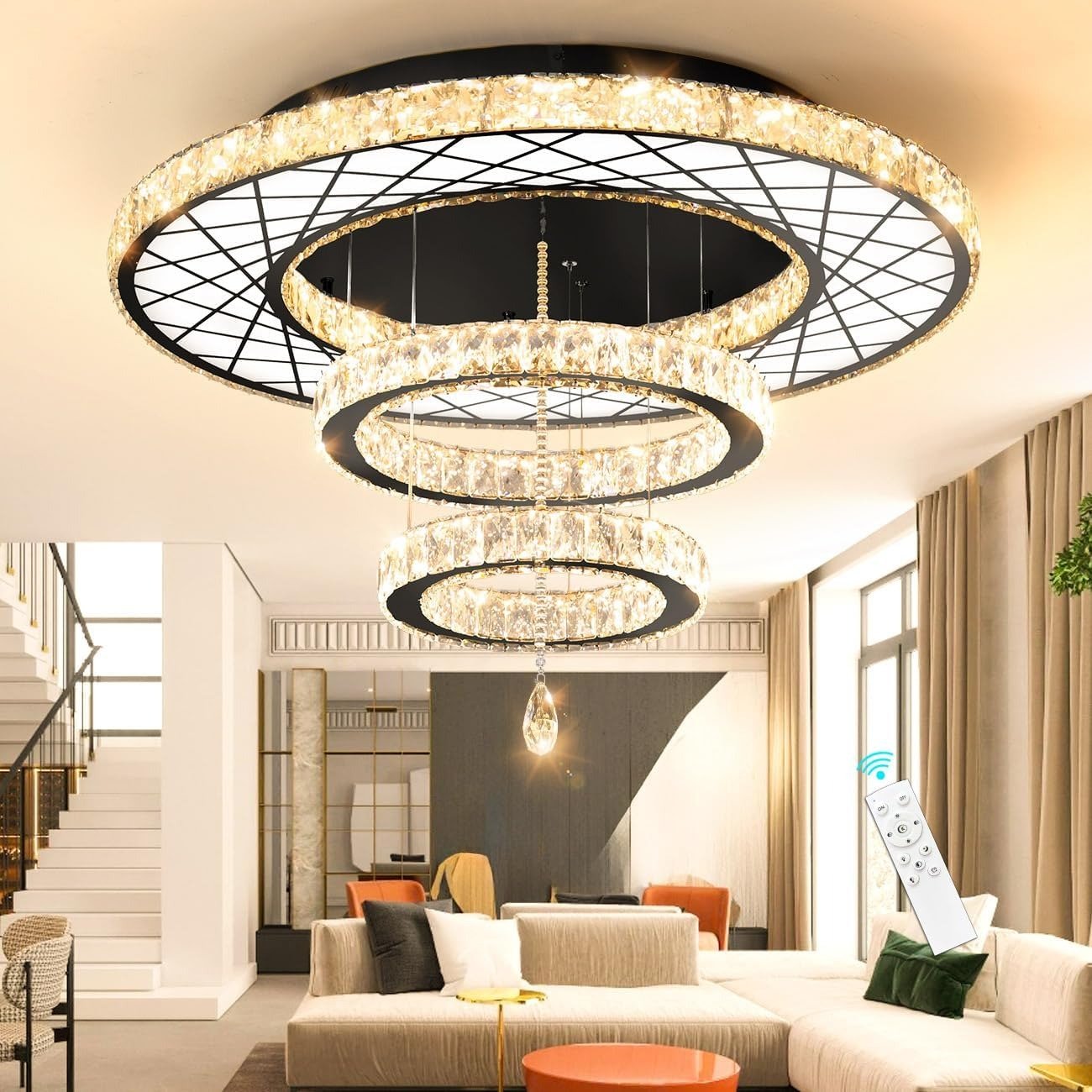
Once I got past the surface appeal, this chandelier stopped looking like a style decision and started looking like a compatibility decision. That is how I think it should be judged. The specs are attractive: 32-inch width, integrated 108W LED lighting, claimed 8,640 lumens, 3000K–6000K color range, stainless-steel body, K9 crystal, and a 35 lb installation load.
But none of that answers the only question that actually protects a buyer from regret: what kind of room and what kind of person does this fixture fit well enough to stay satisfying after the first week?
For me, this is not a broad-market chandelier. It is a selective fit. The compatibility line is sharp enough that I would not call it forgiving. Public guidance on ceiling-light sizing keeps pointing back to proportion and placement, while public feedback on similar glam crystal LED chandeliers keeps circling the same themes: visually striking once installed, better-than-expected finish, flexible dimming, but also a recurring need to confirm size, support, and installation expectations in advance.
That pattern tells me this fixture succeeds when it is chosen by someone who already knows why they want a crystal centerpiece—not someone merely trying to “upgrade the room a bit.”
My Compatibility Split
I’d break the fit into five bands.
| Fit band | Who I think this suits |
|---|---|
| Excellent fit | Medium-to-large formal rooms that need a visual anchor and real ambient light from one fixture |
| Good fit | Dining rooms, foyers, and glam-leaning living rooms with adequate ceiling support and layered décor |
| Acceptable fit | Rooms that can physically support it but may still need extra lamps for balance and softness |
| Borderline fit | Low-ceiling or visually quiet spaces where the chandelier may dominate more than it harmonizes |
| Wrong fit | Buyers wanting a neutral ceiling light, universal wall-dimmer simplicity, or low-commitment installation |
Excellent Fit
I like this chandelier most for rooms that are already asking for a centerpiece. If the space is polished, somewhat formal, and visually able to carry crystal reflection without feeling crowded, this fixture has a real case. The claimed lumen output is high enough to justify treating it as ambient lighting on paper, and the adjustable color temperature helps it move between warmer evening mood and cooler daytime clarity.
In that context, the chandelier stops feeling like a risky indulgence and starts feeling like an integrated part of the room’s identity. Practical room-lighting guidance also supports the underlying logic: in living and dining zones, dimmable ambient light is most useful when it can shift with activity instead of staying fixed.
Psychologically, this is the buyer who wants the room to feel “finished” the moment someone looks up. Not louder. Not trendier. Finished. That matters, because fixtures like this do best when the owner enjoys visible presence rather than merely tolerating it.
Good Fit
I also think it works for buyers who want one large fixture to reduce the need for multiple decorative lighting decisions. The chandelier’s integrated LED engine means there are no routine bulb-style decisions to keep revisiting, and public Q&A around this family of products repeatedly leans into that convenience angle.
The remote dimming also helps if your normal behavior is to tune brightness for dinner, guests, or evening wind-down rather than simply flipping a switch and walking away. Comparable listings and reviews for similar fixtures repeatedly call out that flexibility as part of the appeal.
This is also where the stainless-steel-and-K9-crystal build helps. On less expensive statement fixtures, I often worry that the photos are doing half the work. Here, the repeated emphasis on thicker metal framing and crystal presence suggests a fixture that is at least trying to justify its visual ambition with material heft.
Acceptable Fit
There is a middle category where I can see the chandelier working, but only if the buyer understands the tradeoffs clearly. That is the person with a room that can support the fixture structurally and dimensionally, but not perfectly stylistically.
Maybe the space is a little calmer than true glam. Maybe the room already has enough going on. Maybe the buyer wants the sparkle but not necessarily the full “showpiece” effect. In those cases, I can still see the chandelier working if the rest of the room stays disciplined.
The caution here is brightness interpretation. A claimed 8,640 lumens sounds enormous, but raw lumen claims never tell the whole story of how a room feels once light is diffused, reflected, or visually filtered by crystal and fixture geometry.
Broader testing discussions around brightness marketing make the same conceptual point in other display categories: headline brightness numbers can be directionally useful without being a perfect proxy for lived experience. So I would treat the spec as a good sign, not an absolute guarantee.
Borderline Fit
I get hesitant when the room is small, low, visually soft, or intentionally understated. This chandelier is not shy, and I would not buy it for a room that needs the ceiling fixture to disappear when it is off.
I also think it becomes borderline when the buyer values frictionless wall-switch behavior over feature control. Similar product listings keep repeating the same warning against pairing these fixtures with other dimmer systems, and that is a real compatibility issue, not a footnote.
If your home setup is built around standard dimmer logic, this may feel like a beautiful interruption rather than a smooth addition.
There is also the weight question. Thirty-five pounds is manageable in the right ceiling context, but it is enough to move the product out of the “casual décor” category in my mind. Once a light reaches that weight, I mentally classify it as a fixture that deserves structural respect, not aesthetic optimism.
Wrong Fit
I would reject this quickly for three kinds of buyers.
First, anyone wanting a quiet, neutral ceiling light that simply blends in. This fixture is the opposite of that.
Second, anyone hoping for the easiest possible install-and-forget experience. It is too heavy and too visually dominant for that expectation.
Third, anyone who is already unsure whether they even like glam crystal lighting. Uncertainty and statement fixtures are a bad pairing.
The hidden cost here is not electricity. It is commitment. Once this chandelier is up, it tells the room what kind of room it is.
My Final Read
I think this chandelier is a good decision only if you want one ceiling fixture to do all of the following at once: carry decorative authority, supply substantial ambient light on paper, offer controllable color temperature, and visibly define the room’s style even when switched off. If that is the job description, this product makes sense. If you only need “a nice chandelier,” it is probably more chandelier than you actually need.
The Quiet Recommendation
I would lean toward it for a buyer with a medium-to-large dining room, foyer, or glam-forward living space, a ceiling setup that can handle a 35 lb fixture responsibly, and a genuine preference for remote-controlled brightness and color flexibility over traditional wall-dimmer habits. That is the clean fit.
If your room fits that profile, this is the product page I would use for the final check on finish, size, and current availability: HAIXIANG Crystal Glam Chandelier LED Ceiling Light.
Transparency Note:
This analysis is not based on quick personal impressions.
It is derived from documented system behavior, verified user patterns, and the physical constraints of storage capacity.
The goal is to translate complex technical behavior into a realistic performance model that helps you make a clear decision