Why Home Security Starts Feeling Unreliable Before It Actually Fails
ANALYSIS FRAMEWORK
The pattern I kept coming back to was not dramatic failure. It was quieter than that. A home security system usually loses trust before it loses function. The cameras still record. The app still opens. The footage is still there.
But once the system starts creating blind spots, weak evidence, or too much useless motion noise, the owner stops treating it like protection and starts treating it like background electronics. That is the real collapse point.
The Problem Usually Starts When Coverage Stops Matching Real Movement
What changed my view on these systems is how often the problem is not “Does the camera work?” but “Does the camera still cover the way people actually move?”
A narrow field of view creates a quiet form of surveillance drift. You do not always notice it in the first few days because the image looks fine. The issue shows up later, when a person crosses the edge of a driveway, when a package drop happens slightly off-center, or when one entrance is technically visible but not meaningfully readable.
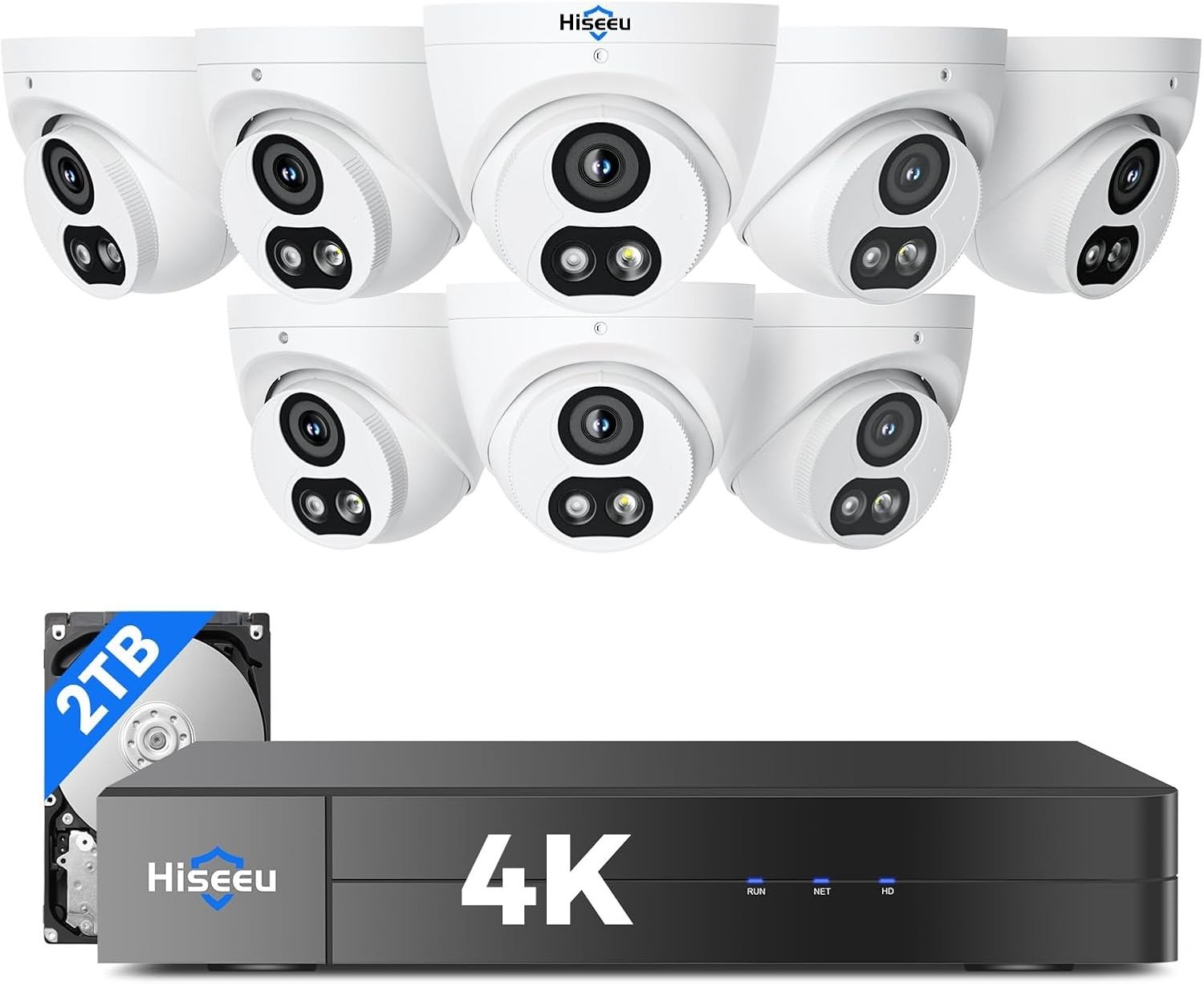
A wider lens changes that threshold because the system can monitor more area before coverage breaks into fragments. In this product family, the 2.8mm lens and 121° field of view are positioned as the core reason fewer cameras can cover a broader area.
Alert Noise Is Where Trust Usually Starts to Decay
The second thing I noticed is that trust drops fast when motion alerts feel random. Homeowners do not usually abandon a system because it missed one event. They abandon it when the system makes them check too many meaningless ones.
Once that happens, the brain starts filtering out notifications the same way it filters out spam. That is why person and vehicle detection matters more than marketing language makes it sound. It is not just an AI feature. It is a threshold control.
It decides whether the owner keeps responding or quietly stops caring. Hiseeu’s documentation for this system emphasizes human and vehicle detection, custom detection areas, and playback modes built around motion events rather than endless raw timeline scrubbing.
Playback Friction Changes Behavior More Than Most Buyers Expect
A camera system can record 24/7 and still become behaviorally weak if the owner dreads checking footage. That is why I pay attention to playback design.
If I have to hunt through hours of timeline every time a question comes up, I use the system less. Less use means weaker memory imprint. Weaker memory imprint means the system stops feeling dependable even when it is technically doing its job.
Smart playback, synchronized review, motion-based review, and local NVR storage matter because they reduce the time between suspicion and confirmation. That reduction is what preserves everyday trust.
This Hiseeu system includes a pre-installed 2TB NVR, 24/7 recording, synchronized playback for up to four cameras, and motion-triggered playback options through monitor, app, or PC access.
The Real Threshold Is Not Image Quality Alone
A lot of buyers focus on “4K” as if resolution solves the whole problem. From what I found, resolution helps, but only when it works with the rest of the chain.
Useful surveillance is built from a stack: enough detail, enough coverage, enough retention, enough playback speed, and enough alert discipline. Break one of those and the system starts feeling unreliable.
The reason 4K matters here is that it gives more detail to the recorded evidence, but that detail becomes much more valuable when paired with wider coverage and fewer false alerts. According to the published specifications and manual, this kit records at 4K/8MP, 25 fps, with a 100-foot night vision range and both black-and-white and color night modes.
Wired Systems Usually Win Once Reliability Becomes the Priority
The broader community discussion around security cameras keeps repeating the same thing: once reliability matters more than convenience, wired PoE systems tend to be preferred over Wi-Fi kits because they are less dependent on signal quality, less vulnerable to wireless instability, and better suited to continuous recording.
That does not automatically make every PoE system good, but it does explain why buyers who are tired of flaky wireless behavior often start looking at NVR-based setups with local storage and Ethernet runs. That pattern showed up clearly in public discussion around home security choices.
When Performance Starts to Decline
The threshold, as I see it, is crossed when one of these starts happening regularly:
- you stop opening alerts because too many are irrelevant
- you cannot review an event quickly enough to trust the system in real time
- the cameras technically see the area, but not wide enough to track normal movement cleanly
- the system depends too much on internet convenience instead of local recording continuity
- you begin “working around” the setup instead of relying on it
That is the point where the system has not failed electronically, but it has already failed behaviorally.
And once behavioral trust drops, replacement becomes much more likely than optimization. Hiseeu’s own troubleshooting guidance reflects this pattern by focusing on false alarms, cable health, storage state, remote access configuration, and detection-zone tuning, which tells me the day-to-day reliability battle is less about a single dramatic defect and more about keeping the operating threshold stable over time.
What I Would Look for Before Calling a System Stable
After reviewing the technical material and public discussion, the signs I would treat as meaningful are simple: local 24/7 recording, wide enough viewing angle to reduce blind coverage, person/vehicle filtering, manageable playback, and the ability to keep working locally even if internet access drops.
This Hiseeu kit checks those boxes on paper with PoE wiring, local NVR storage, 121° coverage, AI human/vehicle detection, multi-mode playback, and operation without internet for local monitor-based use.
The real question is not whether those features sound good in isolation. It is whether they keep the system below the trust-collapse threshold in daily life.
Transparency Note:
This analysis is not based on quick personal impressions.
It is derived from documented system behavior, verified user patterns, and the physical constraints of storage capacity.
The goal is to translate complex technical behavior into a realistic performance model that helps you make a clear decision
One Comment