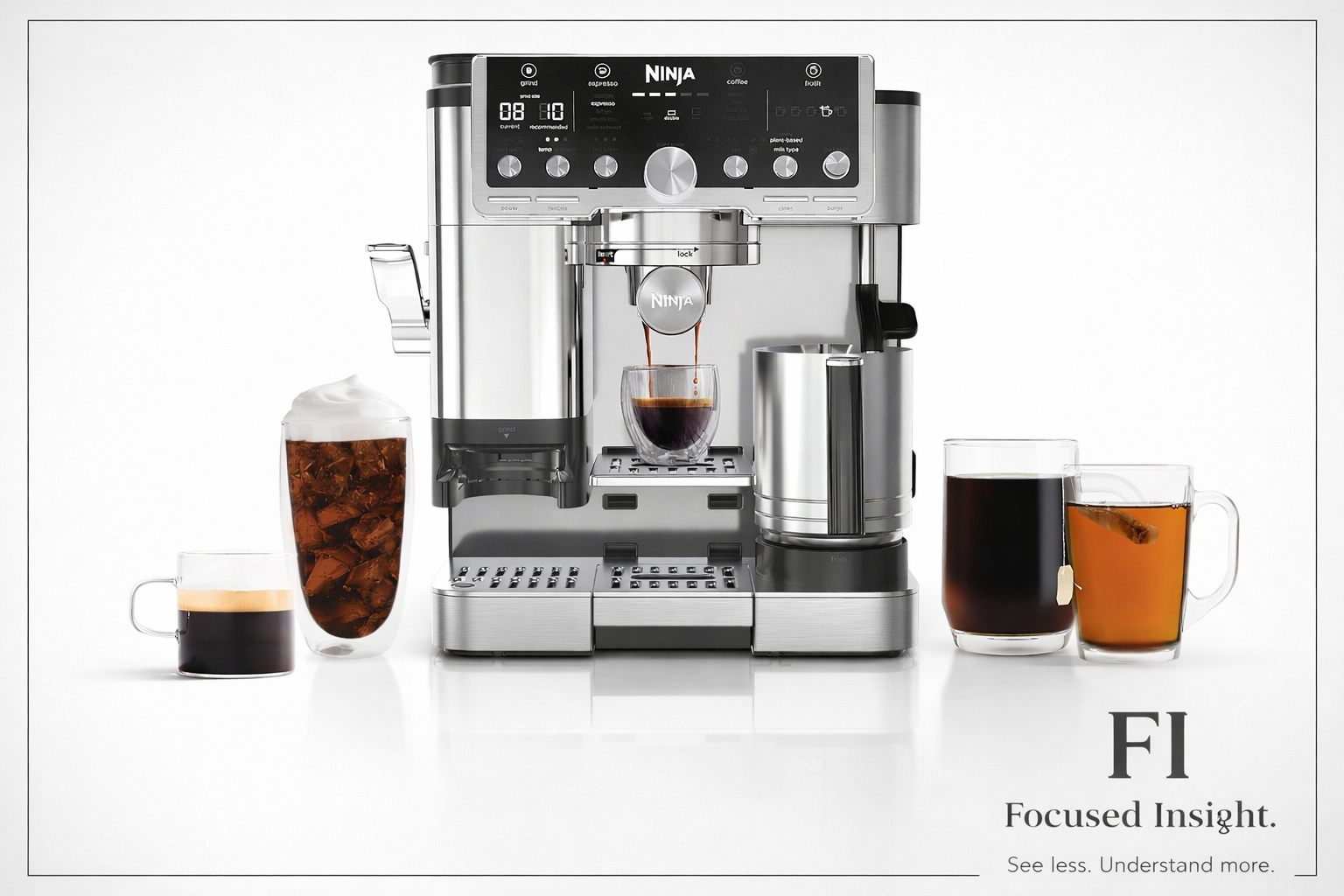
The Hands-Free Espresso Problem: When Convenience Breaks Consistency ([شاركنينجا][1])
ANALYSIS FRAMEWORK
I keep seeing the same quiet conflict in home espresso setups: people don’t mind effort, they mind wasted effort. The frustration isn’t “espresso is hard.” It’s “I did the steps, and the result still moved.”
That’s the equilibrium gap:
Expected Performance: café-style espresso and milk drinks, repeatable morning after morning.
Operational Reality: tiny variations in grind, dose, tamp, temperature, and milk technique compound into shots that drift—sometimes dramatically.
The newest class of machines tries to close that gap by replacing the most error-prone steps with guided automation: grind recommendations, weight-based dosing, integrated tamping, and a “hands-free” milk workflow designed to produce repeatable foam without demanding barista muscle memory. ([شاركنينجا][1])
But there’s a catch: the moment a system automates the workflow, it also locks you into its geometry—its basket size, its dosing logic, its temperature behavior, its purge cycles, its milk path. If those fundamentals are stable, convenience feels like calm. If they aren’t, convenience becomes a faster way to repeat inconsistency.
This article is about recognizing that instability before you choose a machine in this category.
The Equilibrium Gap You Can’t See in Product Photos ([Coffee Bros.][2])
Most people shop this segment with a simple mental model:
- built-in grinder = fewer purchases
- guided dosing = fewer mistakes
- automated milk = better cappuccinos
- more drink modes = more value
In practice, the deciding factors hide in mechanics that rarely make headlines:
- How narrow the “espresso-capable” range is inside a grinder that must also do drip grinding. ([Coffeeness][3])
- Whether the automation is actually stabilizing the puck, or simply standardizing a workflow that can still drift.
- How much the machine purges and self-cleans, because that changes water use, drip tray frequency, noise, and daily friction. ([CoffeeGeek][4])
- Whether the milk system creates the foam texture you expect—or a different foam style that reads “cap-friendly” but not latte-art friendly. ([Coffeeness][3])
If your goal is “press fewer buttons,” you’ll be happy with almost anything for a week.
If your goal is stable espresso, you need measurable criteria.
Criteria Framework — 6 Signals That Predict Stability (Not Hype) ([شاركنينجا][1])
Below are the signals I use to judge whether a “hands-free” espresso system will actually reduce variance, or just hide it.
Signal 1: A Closed, Measurable Dosing Loop (Weight Matters More Than Recipes)
If a machine claims “no guesswork,” the question isn’t the screen—it’s the loop:
- Does it weigh the dose, or just time the grinder?
- Can it adapt when bean density, roast level, and humidity shift?
Weight-based dosing is one of the few automations that directly reduces variance, because it controls the input variable that most strongly affects extraction. ([شاركنينجا][1])
Signal 2: Grind Range Reality (Especially When One Grinder Serves Espresso and Drip)
A built-in conical burr grinder with many settings sounds like freedom. In hybrid machines, the hidden tension is that the grinder must span two worlds:
- espresso: small adjustments, narrow window
- drip: broader range, less sensitive
Independent reviewers frequently point out that the “espresso range” can be more limited than the raw number of settings implies. ([Coffeeness][3])
So I treat this as a stability test:
- If the espresso window is narrow, does the machine compensate elsewhere (dose control, brew monitoring, tamp consistency)?
Signal 3: Tamp Consistency as a Mechanical Event (Not a Skill)
Tamping is where human inconsistency quietly enters:
- uneven force
- tilted puck
- edge channeling
An integrated tamp lever is not just about convenience. It’s about transforming tamping from “a skill” into “a repeatable mechanical event.” That can stabilize extraction—if the rest of the puck prep and basket geometry are coherent. ([شاركنينجا][1])
Signal 4: Thermal Behavior and Shot Timing (Stability Over Brag Numbers)
Pressure numbers sell; temperature stability ranks.
Even without deep boiler diagrams, you can infer stability from behavior:
- Does the system monitor brew output and adjust?
- Does it recover fast enough for back-to-back drinks?
- Does it support consistent ratios across styles?
Lab-style reviewers evaluate this by logging shot volumes, temperatures, recovery times, and repeating hundreds of shots—not by reading the box. ([CoffeeGeek][4])
Signal 5: Milk Workflow — Foam Texture and Cleaning Friction
Hands-free milk is where expectations diverge.
Some systems are engineered for repeatable cappuccino/latte foam, but the texture may not reach “silky microfoam” standards for latte art. Reviewers who’ve used high-performing auto-wands often note that certain hands-free systems do “pretty good foam,” yet still fall short of truly silky results. ([Coffeeness][3])
Then there’s the part people ignore until day five: cleaning.
Milk paths punish neglect. If the system requires frequent purge cycles or specific routines, the user experience shifts from “easy” to “managed.” ([appliancehub.mt][5])
Signal 6: Purge Cycles, Noise, and the Drip Tray Tax
Automation often brings auto-purging (for heat and cleanliness). That has consequences:
- drip tray fills faster
- water tank drains faster
- noise becomes part of the ritual
A high-quality review specifically called out frequent drip-tray filling from auto-purging and loud/high-pitched milk steaming as real-world costs of the “guided” approach. ([CoffeeGeek][4])
This matters because instability isn’t only in taste—it’s also in daily friction. Friction causes inconsistent usage, inconsistent cleaning, and then inconsistent output.
Hidden Technical Factors That Separate “Smart” From “Stable” ([شاركنينجا][1])
Here’s the difference I watch for:
- A smart machine tells you what to do.
- A stable machine reduces the number of ways things can drift.
In this category, stability tends to come from a few converging design decisions:
- integrated grinder + guidance that adapts across beans ([شاركنينجا][1])
- dose control that is weight-informed ([شاركنينجا][1])
- tamp consistency that doesn’t rely on the user ([شاركنينجا][1])
- milk automation that is optional (so skilled users can override) ([Coffeeness][3])
Also, the physical reality matters more than people admit: these systems are often large and heavy (north of ~25 lb class), and footprint pressure affects where the machine lives—which affects how often it gets used. ([أمازون][6])
Market Reality — Why This Category Exists (And Why It’s Crowded) ([Serious Eats][7])
The market pressure is straightforward:
- Enthusiast machines produce great espresso but require workflow discipline.
- Superautomatics are easy but can feel “flat” to people who care about espresso character. ([WIRED][8])
- Hybrid “guided espresso systems” try to give you a portafilter-style drink with fewer failure points.
That’s why mainstream buying guides keep highlighting machines that integrate grind + tamp assistance + milk consistency, because it maps to what most households actually want: repeatable drinks without turning the kitchen into a training lab. ([Serious Eats][7])
The controversy is also consistent: hardcore espresso communities often warn that all-in-one combos can limit grind quality or flexibility. ([Reddit][9]) Meanwhile, practical users prioritize “good enough + repeatable + fast,” especially for milk drinks.
Both sides are describing the same reality from different goals.
What People Tend to Like—and What They Push Back On (Pattern Summary) ([CoffeeGeek][4])
Across independent reviews and broader buyer behavior, I repeatedly see these patterns:
People like:
- guided workflows that make weekday espresso predictable ([شاركنينجا][1])
- integrated features that remove extra purchases (especially grinder) ([شاركنينجا][1])
- hands-free milk that reduces technique dependence for cappuccinos and lattes ([شاركنينجا][1])
- multi-mode flexibility (espresso + coffee + cold brew/hot water) for mixed-household needs ([شاركنينجا][1])
People push back on:
- milk foam quality not always reaching truly silky microfoam, depending on system design ([Coffeeness][3])
- noise and purge behavior becoming part of the daily ritual ([CoffeeGeek][4])
- complexity: a feature-dense interface can overwhelm a true beginner, even if it’s “guided.” ([Coffeeness][3])
Notice what’s missing: very few serious critiques are about “espresso taste” in isolation. They’re about whether the machine keeps taste stable without adding new friction.
Controlled Curiosity — The Decision You’re Actually Making ([Coffee Bros.][2])
If you’re shopping this category, you’re not deciding between brands.
You’re deciding between two philosophies:
- Skill-forward espresso: you control the variables, and you own the variability.
- System-forward espresso: the machine reduces the variable surface area, and you accept its boundaries.
The right choice depends on which form of uncertainty you tolerate:
- uncertainty from your hands (grind/dose/tamp technique)
- or uncertainty from the system (its foam texture, purge logic, internal defaults)
Once you see that clearly, the category stops being confusing.
Natural Transition to a Single-Product Structural Evaluation
At this point, the next step is not “a recommendation.”
It’s a clean application of the criteria above to one machine—strictly: spec → mechanism → behavior → outcome—so you can see whether the system closes the equilibrium gap in practice, and what trade-offs it introduces.
You can open the full application here: complete decision analysis
One Comment