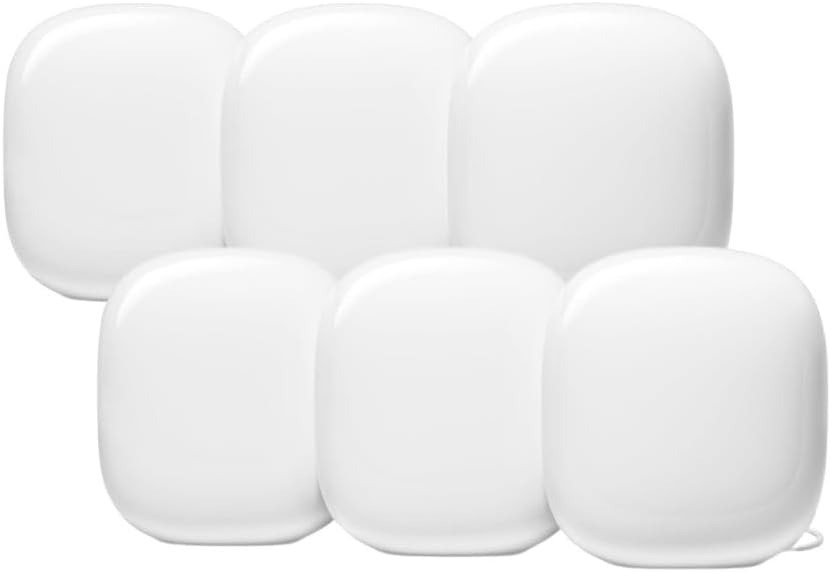
Google Nest WiFi Pro — What You’re Really Paying For
DECISION ANALYSIS
I don’t treat this as a “speed purchase.” I treat it as a predictability purchase: fewer daily Wi-Fi surprises across rooms, with tri-band Wi-Fi 6E and a mesh designed to smooth typical home usage.
The One Ceiling That Decides Everything
The ceiling is backhaul quality through your layout. If your nodes have to fight dense walls or long distances, the stable range narrows and drift becomes structural.
If your layout is friendly (or you can wire key points), the stable range stays wide and the system feels calm.
Drift (Short, Behavioral-Time Coupled)
The drift pattern is most likely after change events—adding devices, rearranging nodes, or after firmware cycles—because the mesh renegotiates routes and bands.
Some owners describe the repeating loop: performance degrades, a full restart restores it briefly, then it fades again.
The 3 Signals I Use to Judge Fit
| Signal | What I Want to See | What Warns Me |
|---|---|---|
| Time | Stable for weeks even after “change week” | Repeatable decline after changes |
| Performance | Similar experience room-to-room | Big swings or regular latency spikes |
| Sensory | Calls stay clean while moving | Brief voice crack between rooms (repeatable) |
Compatibility Split 3.0 (Early, Calm)
Path A — Compatible:
If your usage pattern is “multi-device home, consistent coverage matters,” and your layout keeps nodes connected without heavy obstruction, the limitation stays situational. This is the profile where Nest WiFi Pro earns its keep.
Path B — Misaligned:
If your usage pattern includes dense walls/long hops and frequent changes (devices moving, nodes moving), the limitation becomes structural rather than situational. In that environment, you’re not buying calm—you’re buying a system that may require periodic resets to feel normal again.
The Quiet Verdict (No Drama)
If your home can keep the mesh inside a wide stable range, Nest WiFi Pro is a clean “set it and forget it” style choice.
If your layout repeatedly compresses that range, drift becomes routine—and the decision should be made with that ceiling in mind.
Transparency Note:
This analysis applies a structured performance framework to documented user patterns and technical documentation, focusing on repeatable behavior over time rather than isolated impressions


2 Comments