Your Camera Sees Movement. It Still Misses the Moment
Eufy S350 Review
A lot of indoor cameras look convincing right up until the second you need more than proof that something moved.
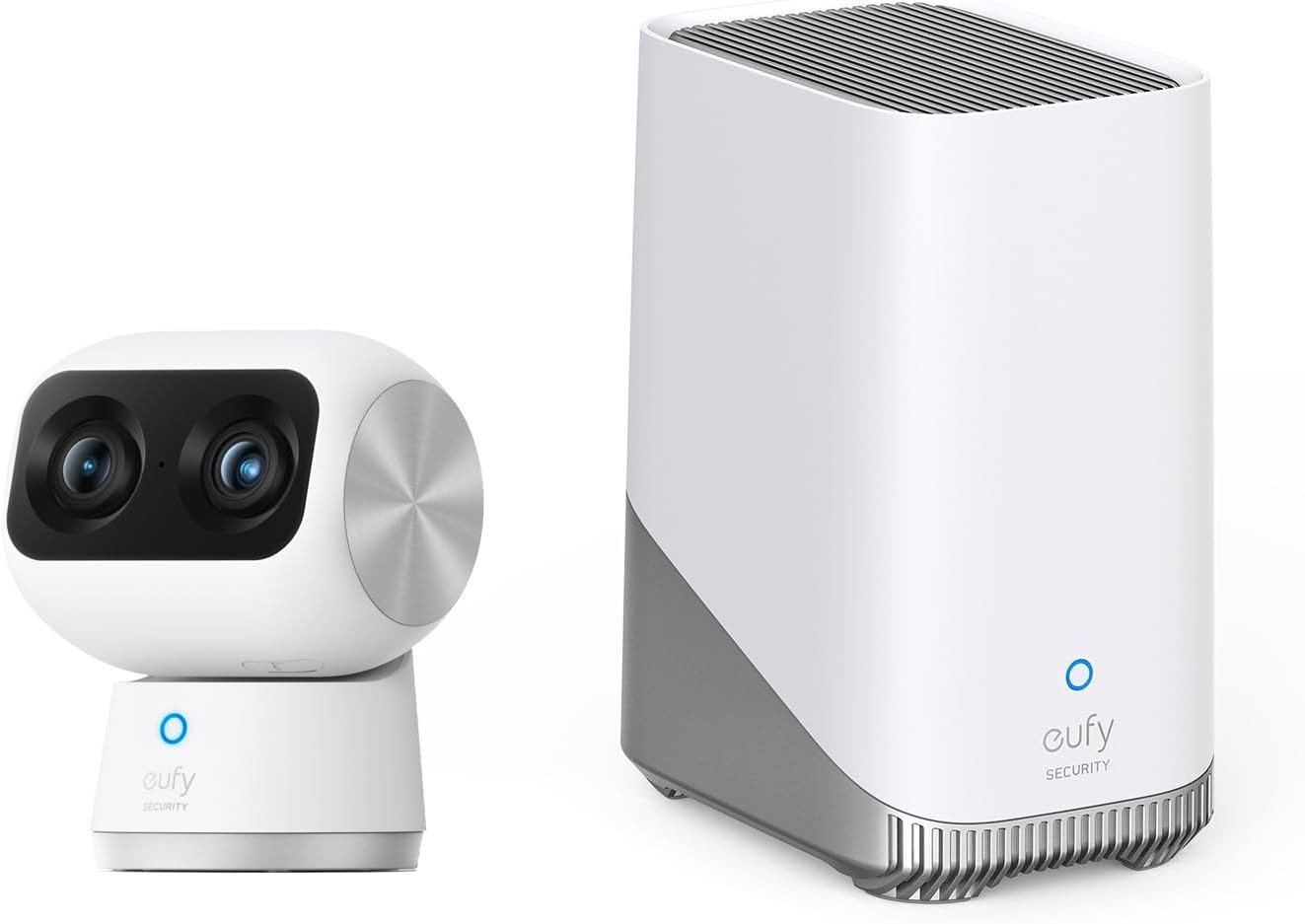
That is the break point I kept coming back to while analyzing the Eufy Indoor Cam S350 with HomeBase 3. On paper, it sounds easy to summarize: dual cameras, 4K wide lens, 2K telephoto lens, 8× hybrid zoom, pan-and-tilt coverage, local storage, no monthly fee. But those specs are not the real story. The real story is narrower than that.
This product starts making sense when a normal indoor camera stops giving you enough decision-grade detail. Not when you want prettier footage. When you need the camera to hold onto context across distance, movement, and room geometry without turning every alert into a vague blur. That is the threshold this device is built for.
The Result Looks Fine. The Problem Isn’t.
I have seen this failure pattern too many times in indoor security: the clip looks acceptable in the app, the room seems covered, the alert arrives on time, and yet the part that mattered is still unresolved.
You can tell that someone entered the room. You cannot tell what they picked up.
You can see the dog jump on the couch. You cannot see what ended up in its mouth.
You can review the hallway. You still cannot read the event cleanly from the far end of the frame.
That gap is where cheap interpretation errors begin. People think they need “better image quality.” Often they do not. They need a camera that survives distance compression inside a real room. The S350’s entire design—dual lenses, tracking, zoom, and rotating coverage—is aimed at that exact problem, not at generic indoor monitoring. Reviewers consistently singled out the sharpness, dual-lens arrangement, and full-room coverage as the product’s defining strengths.
| What looks fine at first | What actually goes wrong later |
|---|---|
| Motion alerts arrive | The subject is too small to interpret |
| The room is “covered” | Blind spots appear once furniture and angles matter |
| Video is sharp near the camera | Distance turns detail into uncertainty |
| Tracking feels impressive in demos | The value depends on how much intervention you were doing before |
What You’re Actually Feeling but Not Naming
Most people do not describe this problem accurately. They say the old camera was “not clear enough,” or “missed stuff,” or “felt annoying to check.”
That is not precise enough.
What they are usually feeling is intervention burden.
You compensate for the camera. You reposition it. You zoom manually. You replay clips twice. You check one alert on the sofa, then another from the kitchen, then a third because the first one did not tell you enough. The device technically works, but it keeps pushing cognitive labor back onto you.
That matters more than spec-sheet bragging. The best indoor camera is not the one with the loudest resolution claim. It is the one that reduces the number of times you have to step in and finish the job yourself. The S350’s pan-and-tilt coverage, AI tracking, patrol modes, and dual-lens zoom exist to reduce that burden, which is why owners and reviewers tend to talk about room coverage and follow behavior almost as much as image quality.
The Hidden Mechanism Behind the Miss
The hidden variable is not “camera quality” in the abstract. It is detail retention at distance.
The S350 uses a 4K wide-angle lens plus a 2K telephoto lens. Officially, eufy says the pair delivers 3× optical zoom and up to 8× digital zoom. That matters because normal indoor cameras usually ask one lens to do everything: cover the room, preserve detail, and track movement. That is where they quietly break. Once you widen the frame enough to monitor the whole space, the subject shrinks. Once the subject shrinks, the alert becomes informationally weak.
The second mechanism is coverage geometry. The S350 pans horizontally through a full circle and tilts vertically, while also supporting privacy mode, AI tracking, and patrol points. In practical terms, that means it is trying to solve two indoor problems at once: room coverage and event follow-through. The Verge’s launch coverage emphasized 4K, 8× zoom, patrol points, privacy shutter, and subject tracking; eufy’s own documentation adds dual-band Wi-Fi 6, WPA3, and local recording options including microSD and HomeBase 3.
| Mechanism | Why it matters in real use |
|---|---|
| Dual-lens design | Helps preserve usable detail when the subject is not close |
| 360° pan / tilt | Reduces static blind spots in open rooms |
| AI tracking | Keeps movement inside frame with less manual checking |
| Privacy mode | Makes an indoor camera less intrusive when you are home |
| Local storage options | Reduces dependence on subscriptions for basic retention |
The Threshold Where the Outcome Quietly Breaks
Here is the rule I would use.
A basic indoor cam stops being enough when you need identity, object detail, or room-end clarity without manual zooming or camera babysitting.
That is the threshold.
Below that line, almost any decent indoor camera can look acceptable. If all you want is broad awareness—did the pet move, did the child wake up, did someone enter the room—you can live with less. Above that line, weak indoor cams start wasting your time. The footage exists, but the answer does not.
This is exactly where the S350 earns its place. Its strongest case is not “best image quality ever.” It is this: it is built for the moment indoor monitoring becomes interpretive, not merely observational. That framing also matches how major reviewers positioned it: strong feature density, no-fee local storage appeal, broad room coverage, useful AI, and unusually capable zoom for an indoor model.
| Threshold test | Basic indoor cam | S350 logic |
|---|---|---|
| Need to see the whole room | Usually fine | Strong |
| Need to identify details across the room | Weak | Strong |
| Need fewer blind spots | Borderline | Strong |
| Need subscription-free local setup | Varies | Strong |
| Need HomeKit-native support | Varies | Weak |
| Need zero motorized movement or noise | Strong | Weak |
Why Most Buyers Misread This Too Early
Most buyers make the same mistake: they compare indoor cameras as if they were all solving one problem.
They are not.
Some indoor cameras are simple presence detectors. Some are baby cams with a security label. Some are app-first convenience devices. The S350 is a threshold product. It is for people who have already discovered that room coverage alone is not enough.
That is why the lazy comparison trap fails here. If you judge it only by price, you miss the labor it is trying to remove. If you judge it only by resolution, you miss the lens architecture. If you judge it only by “does it record indoors,” you flatten the whole category and lose the reason this product exists.
There is another early misread that matters more: privacy trust. eufy’s brand still carries residue from the 2022–2023 security controversy, when reporting showed the company’s claims around end-to-end encryption and cloud behavior were not as clean as advertised at the time. eufy later revised language and now states that video is stored locally, that thumbnails for push notifications may be temporarily hosted, and that transmission/storage protections include encryption. That does not make the past irrelevant. It means an informed buyer should treat privacy as a setup discipline, not as a marketing slogan.
Who Is Actually Inside This Problem
I would put the real-fit buyer into a narrow group.
They have one or more rooms where motion alone is no longer enough.
They are checking on pets, children, caregivers, entries into shared spaces, deliveries inside a foyer, or repeated activity in a room where distance keeps flattening the footage.
They also care about not paying another monthly fee just to make an indoor camera usable. The S350 supports local recording to microSD, can connect to HomeBase 3, and with a 128 GB card can store up to 120 hours of continuous 4K footage at the highest setting. HomeBase S380 also expands the broader eufy system with support for multiple device categories and up to 16 cameras plus 34 sensors.
| Fit profile | Match |
|---|---|
| Wants detailed indoor monitoring across room depth | Strong |
| Wants broad pan-and-tilt coverage in one device | Strong |
| Wants local storage and no mandatory subscription | Strong |
| Wants pet / child / room activity tracking | Strong |
| Wants HomeKit-first indoor setup | Poor |
| Wants a simple cheap fixed-angle cam | Poor |
Where Wrong-Fit Begins
This is not for everyone.
If your only need is a fixed, low-cost glance camera, this is more system than you need.
If your top priority is Apple HomeKit support, stop here. The S350 does not support HomeKit. eufy’s own FAQ is explicit about that. It supports Alexa and Google Assistant smart displays for live view, but not HomeKit, and it is not compatible with HomeBase 2.
If you are highly sensitive to connectivity quirks, firmware friction, or long-term reliability variance, that boundary matters too. Review coverage is generally positive, but owner feedback on retail pages and forums is mixed on exactly these points: some users report smooth setup and stable performance, while others mention reconnection problems, sporadic offline behavior, or motor/pan issues over time. That does not cancel the product’s strengths. It does narrow the buyer profile.
| Wrong-fit condition | Why it matters |
|---|---|
| You only need simple presence awareness | You will overpay for capability you will not use |
| You require HomeKit support | The S350 is the wrong device |
| You want a totally static, silent camera body | Pan/tilt design is part of the value—and the compromise |
| You expect privacy trust to be automatic | You still need to configure, update, and audit your setup |
The One Situation Where This Product Becomes Logical
The S350 becomes logical when the room itself is the problem.
Not the app. Not the subscription. Not the idea of indoor security. The room.
A long living room. A wide kitchen-dining space. A nursery where you do not just want “movement detected,” but need to understand what happened. A pet-monitoring setup where the action starts in one part of the room and ends somewhere else. A front interior corridor where the difference between a usable clip and a useless one is whether the camera can preserve detail across depth.
That is the moment this product stops being a gadget and starts being a correction.
After going through the specs, review footage, and owner patterns, that is the cleanest authorization I can give it: this is a strong solution for indoor scenes where a standard single-lens camera keeps giving you evidence of activity without enough usable context. The dual-camera architecture, 8× hybrid zoom, PTZ coverage, local recording, and AI tracking all point to that same use case.
What It Solves, What It Reduces, and What It Still Leaves to You
It solves the “I saw movement, but I still do not know enough” problem better than a normal indoor cam.
It reduces blind spots, manual checking, and the need to choose between wide coverage and closer detail.
It still leaves a few things on your side of the line.
You still need to decide whether you trust eufy enough for an indoor camera after its past privacy failures. You still need to place it intelligently, keep firmware current, configure alerts correctly, and be honest about whether you need HomeBase 3 or whether local microSD recording is enough for your setup. And if you are buying it expecting flawless ecosystem elegance across every platform, the lack of HomeKit support should be treated as a hard stop, not a footnote.
| Category | What the S350 gives you | What it does not remove |
|---|---|---|
| Detail at distance | Better than typical indoor cams | Not a substitute for perfect room placement |
| Coverage | Full-room pan/tilt flexibility | Still needs sensible mounting |
| Storage cost | Local-first, no required monthly fee | You still manage storage choices |
| Smart features | AI tracking, person/pet/crying detection | Not every alert becomes useful by default |
| Privacy control | Privacy mode and local storage options | Trust still depends on brand history and user setup |
Final Compression
The Eufy Indoor Cam S350 is not the indoor camera I would call universal.
It is narrower than that, which is exactly why it is interesting.
Buyers usually think the upgrade path is from “lower resolution” to “higher resolution.” That is the wrong frame. The real jump here is from basic visibility to usable indoor interpretation. When your current camera can show that something happened but cannot hold enough detail across the room to reduce doubt, this is the point where the category changes.
That is the break point.
If that is the condition you are actually dealing with, the S350 becomes a logical next step.
If it is not, a simpler indoor cam will probably leave you with less cost, less complexity, and less buyer’s remorse.
Transparency Note:
This analysis is not based on quick personal impressions.
It is derived from documented system behavior, verified user patterns, and the physical constraints of storage capacity.
The goal is to translate complex technical behavior into a realistic performance model that helps you make a clear decision